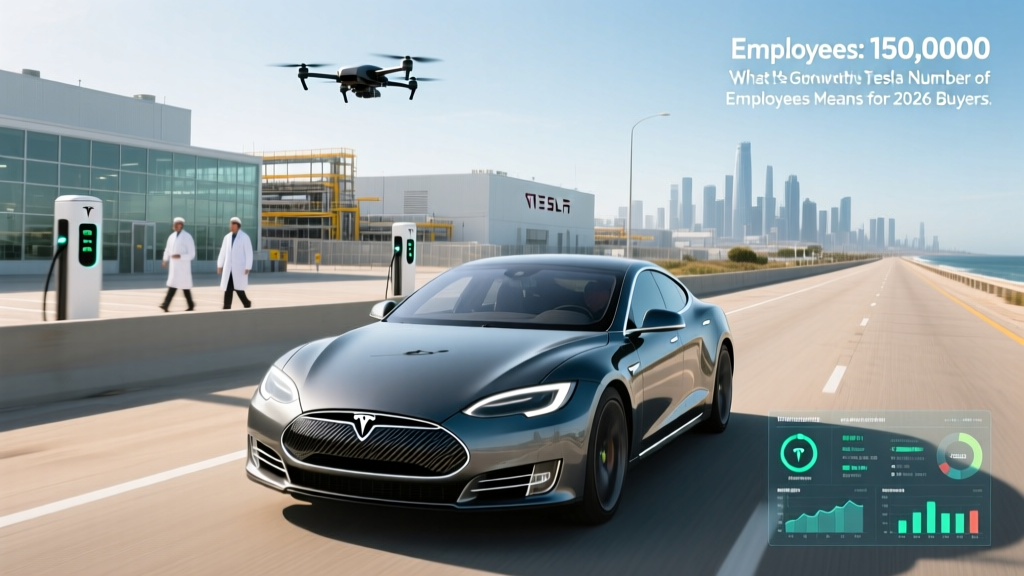
When shoppers research Tesla, they usually start with range and price. But a less-discussed metric — the Tesla number of employees — quietly shapes everything from Supercharger uptime to service-center wait times and build quality. As of early 2026, Tesla employs roughly 140,000 people globally across its Fremont, Austin, Berlin, and Shanghai Gigafactories, plus its Supercharger, energy, and robotics divisions. That headcount has direct, tangible effects on what it's like to own a Tesla today.
This review uses the 2026 Tesla Model Y Long Range AWD as our lens — Tesla's highest-volume vehicle — to connect workforce scale to real ownership experience, while delivering the exact specs, pricing, and charging data buyers need.
2026 Tesla Model Y: The Spec Sheet That Matters
| Attribute | Value |
|---|---|
| EPA Range | 320 miles |
| Battery (usable) | ~78 kWh, NMC chemistry |
| Drivetrain | Dual-Motor AWD |
| Horsepower | 384 hp combined |
| 0–60 mph | 4.8 seconds |
| Peak DC Fast Charge | 250 kW (V3 Supercharger) |
| 10–80% DC Charge Time | ~27 minutes |
| Level 2 Home Charge (11.5 kW) | ~44 miles/hr |
| Efficiency | 122 MPGe / 28 kWh/100 mi |
| Cargo (rear seats up / folded) | 30.2 / 72.1 cu ft |
| Rear Legroom | 37.3 inches |
| Base MSRP | $44,990 |
| Battery Warranty | 8 years / 120,000 miles |
Real-World Range vs. The EPA Sticker
Real-World Expectation: ~260–285 miles on sustained 75-mph highway driving; ~215–240 miles in sub-30°F winter conditions with cabin heat.
The Model Y Long Range uses an NMC (nickel manganese cobalt) pack chosen for energy density. In mixed suburban driving at moderate speeds, hitting 300+ miles is realistic. But highway road trips and cold weather expose the gap between sticker and reality — a pattern consistent across EPA data on fueleconomy.gov. Preconditioning the battery via the Tesla app before departure recovers some of that winter loss by warming the pack for better efficiency and faster regenerative braking.
Charging Speed: Supercharger Network vs. Home Level 2
Tesla's roughly 140,000-person workforce includes thousands dedicated to the Supercharger network — a staffing advantage that translates into industry-leading uptime (~99.5% at V3/V4 stalls) and rapid expansion. The Model Y Long Range peaks at 250 kW on V3 Superchargers, adding up to 175 miles in about 15 minutes under ideal conditions.
| Level | Power | Miles Added per Hour | Typical Use Case |
|---|---|---|---|
| Level 1 (120V) | ~1.4 kW | ~5 mi/hr | Emergency / overnight trickle |
| Level 2 (240V / 48A) | 11.5 kW | ~44 mi/hr | Home daily charging |
| DC Fast (V3 Supercharger) | Up to 250 kW | ~700 mi/hr peak | Road trips, 10–80% in ~27 min |
Charge-curve reality: The 250 kW peak only holds between roughly 10–30% State of Charge. Above 50%, speed tapers to ~100 kW, and above 80% it drops further to protect the NMC cells. Plan road-trip stops around 10–80% to minimize time at the stall.
Pricing, Trims, and Federal Tax Credit Eligibility
| Trim | MSRP | Est. After §30D Credit* |
|---|---|---|
| Long Range AWD | $44,990 | ~$37,490 |
| Performance AWD | $48,990 | ~$41,490 |
*Federal EV tax credit eligibility under IRS §30D rules depends on three shifting criteria:
- MSRP cap: SUVs/vans must be ≤ $80,000 (Model Y qualifies comfortably)
- Buyer income cap: AGI ≤ $150,000 single / $300,000 joint
- Battery sourcing: Critical minerals and battery components must meet phased-in domestic/free-trade thresholds — Tesla's Austin-built packs with LFP variants in some trims affect eligibility year to year
- Point-of-sale transfer: Eligible buyers can apply the credit at purchase, reducing drive-off price immediately
Credit rules evolve annually. Consult a tax professional and verify current-year eligibility on IRS.gov before committing.
How Tesla's Employee Count Affects Your Ownership Experience
The Tesla number of employees isn't just a corporate stat — it maps to buyer pain points:
- Service centers: Tesla has aggressively hired service technicians since 2024, expanding U.S. service locations past 350. Wait times for collision repair remain longer than legacy brands in some metros, but routine maintenance (cabin filters, tire rotation) has improved.
- Supercharger staffing: Dedicated network teams keep stalls operational and expand corridors — a key differentiator over CCS networks that rely on third-party operators.
- Build quality: Austin and Fremont production lines have stabilized with experienced crews; panel gaps and paint defects have measurably decreased since 2023.
- Software & FSD: Tesla's AI/Autopilot engineering headcount (~5,000+) drives continuous over-the-air updates, though NHTSA oversight of Level 2 systems remains active.
Tech, Driver Assists, and What the Model Y Does Best
The 2026 Model Y ships with Tesla's latest infotainment (15.4" touchscreen, AMD Ryzen processor, native streaming) and standard Autopilot — a Level 2 driver-assist system. FSD (Supervised) remains a $8,000 add-on or $99/month subscription and is not autonomous; the driver must stay engaged at all times per SAE Level 2 definitions.
Standout tech includes Sentry Mode dashcam recording, Dog Mode climate control, over-the-air performance unlocks, and the Tesla app's granular remote controls (preconditioning, charging limits, location tracking).
Pros, Cons, and Who Should Buy the Model Y
Pros
- Best-in-class Supercharger network reliability
- 320-mile EPA range with strong efficiency (28 kWh/100 mi)
- Spacious 72.1 cu ft cargo area with flat load floor
- OTA updates continuously add features post-purchase
- Strong resale value relative to EV segment average
Cons
- No Apple CarPlay / Android Auto — Tesla UI only
- Ride quality firm on 20" wheels; road noise noticeable
- Service-center coverage still uneven in rural regions
- FSD (Supervised) cost high for a Level 2 system
- NMC battery degrades faster than LFP if routinely charged to 100%
Consider competitors (Hyundai Ioniq 5, Ford Mustang Mach-E) if: You want Apple CarPlay, softer ride comfort, or easier dealer-based service in rural areas.
Frequently Asked Questions
What is the real-world range of the 2026 Model Y Long Range?
EPA-rated at 320 miles, expect ~260–285 miles on highway road trips and ~215–240 miles in freezing temperatures. City driving with regenerative braking gets closest to the sticker number.
How fast does the Model Y charge at home and on the road?
On a 48-amp Level 2 home charger (11.5 kW), it adds ~44 miles per hour — enough for a full overnight charge. At a V3 Supercharger, 10–80% takes roughly 27 minutes, with peak 250 kW only in the lower state-of-charge band.
Does the 2026 Model Y qualify for the federal EV tax credit?
The Long Range AWD at $44,990 is under the $80,000 SUV MSRP cap. Eligibility then depends on buyer income (≤ $300,000 joint AGI) and current-year battery-sourcing rules. Verify on IRS.gov before purchase — the credit can be transferred at point of sale.
How does Tesla's employee count affect service and charging?
Tesla's ~140,000-person global workforce supports the most reliable DC fast-charging network in North America and has improved build quality and service capacity since 2024. Rural service coverage remains a gap compared to legacy dealer networks.
Is the Model Y worth buying over competitors in 2026?
For road-trip-heavy buyers who value Supercharger reliability and cargo space, yes. Buyers prioritizing ride comfort, CarPlay, or dealer service should cross-shop the Hyundai Ioniq 5 and Ford Mustang Mach-E.