The VW Microbus Electric in 60 Seconds
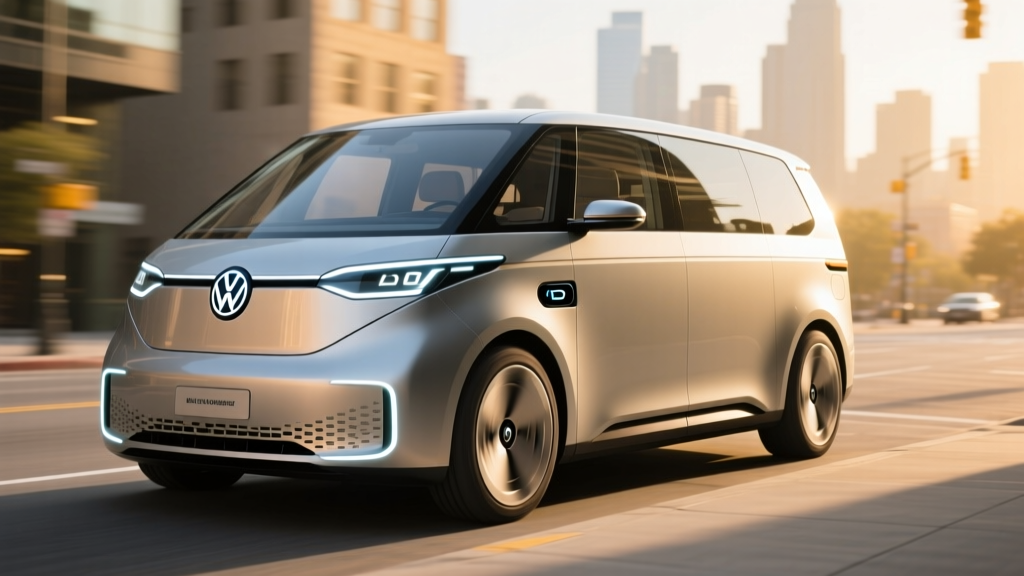
The VW Microbus electric — officially sold in the U.S. as the Volkswagen ID. Buzz — is a retro-styled three-row electric van built on VW's MEB platform. For the 2025/2026 model year, the long-wheelbase (LWB) version sold in North America carries a 91 kWh (usable) NMC battery, an EPA-estimated range of up to 234 miles, a peak DC fast-charge rate of 200 kW, and dual-motor AWD producing 335 horsepower. The starting MSRP for the Pro S trim sits around $61,545 before destination. Expect real-world highway range closer to 190–210 miles, and cold-weather range of roughly 160–180 miles. Federal §30D tax-credit eligibility is uncertain due to battery-sourcing rules — verify current-year status on irs.gov before counting on $7,500.
Range, Battery, and the Real-World Reality Check
The ID. Buzz's 91 kWh usable battery (NMC chemistry) is competitive for a three-row electric vehicle, but the van's boxy aerodynamics — a drag coefficient around 0.29, poor by modern EV sedan standards — exact a toll at highway speeds. Here's what the numbers actually look like in practice:
| Scenario | Estimated Range | Efficiency (kWh/100mi) |
|---|---|---|
| EPA Combined (sticker) | 234 miles | ~39 kWh/100mi |
| Highway (70–75 mph, 70°F) | ~195–210 miles | ~43–46 kWh/100mi |
| City / Suburban (mixed, 70°F) | ~220–235 miles | ~39–41 kWh/100mi |
| Cold Weather (25°F, highway) | ~155–180 miles | ~50–58 kWh/100mi |
| Towing (max 3,500 lbs) | ~120–150 miles | ~60–75 kWh/100mi |
The ID. Buzz lacks a heat pump in the U.S. market, relying on resistive PTC heating. This means cold-weather range loss is more pronounced than in vehicles like the Hyundai Ioniq 5 or Tesla Model Y, which use heat pumps to scavenge ambient and waste heat. If you live above the 38th parallel and plan winter road trips, budget for 25–35% range reduction versus the EPA sticker.
The regenerative braking system offers multiple levels, but VW does not provide true one-pedal driving to a full stop — you'll still need the friction brakes at very low speeds. This is a deliberate calibration choice, not a flaw, but it surprises first-time EV drivers expecting Tesla-style regen behavior.
Charging Speed: 200 kW Peak, But Watch the Curve
Charging is where the ID. Buzz's MEB platform shows its age compared to 800-volt architectures (Hyundai Ioniq 5, Kia EV6, Porsche Taycan). The ID. Buzz runs on a 400-volt system, which caps its DC fast-charging performance:
| Charging Level | Power / Rate | Time or Miles Added |
|---|---|---|
| Level 1 (120V, 12A) | ~1.4 kW | ~3–4 miles/hour |
| Level 2 (240V, 48A) | ~11 kW | ~26–28 miles/hour; 0–100% in ~9 hrs |
| DC Fast Charge (peak) | 200 kW | 10–80% in ~26 minutes |
| DC Fast Charge (sustained avg.) | ~120–140 kW | Average over 10–80% session |
The 200 kW peak is only sustained briefly — typically between 10% and 30% State of Charge (SoC). Above 50%, the charge curve tapers significantly, dropping below 100 kW. Above 80%, it slows to under 40 kW. This is standard behavior for NMC batteries on 400V systems, but it means your actual charging-stop time on a road trip is closer to 30–35 minutes for a 10–80% session, not the 26-minute best-case figure VW publishes.
The ID. Buzz uses a CCS1 connector in North America. With the industry-wide shift to NACS (Tesla's connector), VW has committed to adopting NACS on future models, but the current ID. Buzz requires a CCS-to-NACS adapter for Tesla Supercharger access. VW has indicated adapter compatibility — confirm with your dealer before relying on Superchargers in a pinch.
Home charging reality: A full Level 2 home charge (0–100%) takes roughly 9 hours. For daily driving of 40–60 miles, you'll only need to replenish 15–25 kWh overnight, which a standard 240V/48A home charger handles in 2–3 hours. Installation of a hardwired Level 2 charger typically costs $800–$2,000 depending on your electrical panel's proximity to the garage and whether a panel upgrade (to 200A service) is needed.
Price, Trims, and the Tax-Credit Question
The U.S.-spec ID. Buzz launched in late 2024 as a long-wheelbase, three-row vehicle — notably larger than the short-wheelbase version sold in Europe. Here's the approximate 2025/2026 pricing structure:
| Trim | Drivetrain | Approx. MSRP |
|---|---|---|
| Pro S | RWD (282 hp) | ~$59,995 |
| Pro S Plus | RWD or AWD | ~$63,545 – $67,545 |
| 1st Edition (launch) | AWD (335 hp) | ~$69,995 |
Destination charges add approximately $1,395. Fully loaded, you're looking at $68,000–$72,000 out the door before any incentives.
Tax Credit: Myth vs. Fact
| Claim | Reality |
|---|---|
| "The ID. Buzz gets the full $7,500 federal credit." | Uncertain. §30D eligibility depends on battery-component and critical-mineral sourcing requirements that tighten yearly. VW's MEB battery supply chain has not consistently met all thresholds. Always verify on fueleconomy.gov before purchasing. |
| "I can transfer the credit to the dealer for a price reduction." | True if eligible. The point-of-sale transfer option under §30D(g) lets qualified buyers apply the credit as an immediate discount. But eligibility still hinges on MSRP caps ($80,000 for vans/SUVs), buyer income limits ($300K MFJ / $150K single), and sourcing rules. |
| "State incentives stack on top." | Often yes. States like Colorado, California, and others offer additional rebates. Check your state energy office — these vary widely and have their own income/price caps. |
EV vs. Gas Minivan: The Ownership Cost Breakdown
The ID. Buzz doesn't have a direct electric rival in the three-row van segment — it's essentially alone. The real comparison is against gas minivans like the Toyota Sienna (hybrid, ~36 MPG combined) or the Chrysler Pacifica (PHEV option available). Here's a 5-year, 75,000-mile ownership comparison:
| Cost Category | VW ID. Buzz (AWD) | Toyota Sienna Hybrid (AWD) |
|---|---|---|
| Purchase Price (MSRP avg.) | $65,545 | $45,000 |
| Federal Tax Credit (if eligible) | –$7,500 (uncertain) | $0 |
| Fuel / Electricity (75K mi) | $2,600 (home charging at $0.14/kWh) | $8,300 (gas at $3.50/gal, 33 MPG avg.) |
| Maintenance (5 yrs) | $1,200 (no oil, fewer brake pads) | $3,500 (oil changes, filters, brakes) |
| Insurance (avg. annual) | $2,400/yr ($12,000 total) | $1,800/yr ($9,000 total) |
| Estimated Depreciation (5 yr) | ~$28,000 (43%) | ~$18,000 (40%) |
| 5-Year Total Cost of Ownership | ~$65,845 | ~$47,800 |
The honest takeaway: Even with maximum tax credit eligibility and home-charging savings, the ID. Buzz costs roughly $18,000 more over five years than a Sienna Hybrid. The fuel savings are real — about $5,700 over 75,000 miles — but they don't bridge the $20,000+ purchase-price gap. You buy the ID. Buzz for the driving experience, the silent powertrain, the design, and the emissions benefit — not because it's cheaper than a gas minivan.
Where the math shifts: if you have access to free or subsidized workplace charging, solar-offset home electricity, and qualify for the full federal credit plus a state rebate (e.g., Colorado's $5,000 EV credit), the gap narrows to $8,000–$10,000. That's a premium some families will happily pay for a vehicle that costs $2/day to "fuel" and never needs an oil change.
Performance, Interior, and Daily Livability
The AWD ID. Buzz produces 335 horsepower and hits 0–60 mph in approximately 5.9 seconds — brisk for a 5,800-pound van. The RWD version (282 hp) clocks in around 7.0 seconds. Both versions feel quicker than their numbers suggest thanks to instant electric torque and the absence of transmission shift lag.
The interior is where the ID. Buzz earns its keep as a family vehicle:
- Three rows with genuine adult-sized third-row seating — not a penalty bench
- Cargo volume: ~18 cu ft behind the third row, expanding to ~75 cu ft with both rear rows folded
- Sliding second-row seats with significant fore/aft travel for legroom flexibility
- Infotainment: 12.9-inch touchscreen with wireless CarPlay/Android Auto (VW's ID. Software 4.0 is a meaningful improvement over the buggy launch software)
- Driver assist: Travel Assist (SAE Level 2 adaptive cruise + lane centering) — not autonomous driving; hands must remain on the wheel
Notable limitations: the ID. Buzz has no front trunk (frunk) — the MEB platform's motor placement and HVAC components fill that space. Towing capacity is rated at 3,500 lbs (braked), adequate for a small trailer but not a boat or camper. And the panoramic glass roof (available on higher trims) adds weight and reduces headroom slightly.
Who Should Buy the VW Microbus Electric — And Who Shouldn't
Decision Framework
Choose the ID. Buzz if:
- You need three rows and want the only fully electric option in the minivan/van segment
- You have reliable home Level 2 charging (garage or driveway with 240V access)
- Your daily driving is under 150 miles round-trip, with occasional 200-mile road trips
- You value the design, heritage styling, and silent, smooth EV powertrain
- You qualify for federal and/or state incentives that meaningfully reduce the price gap vs. gas minivans
Look elsewhere if:
- You regularly drive more than 200 highway miles between charging stops (the tapering charge curve and 234-mile EPA range make this stressful)
- You live in a cold climate and need reliable 200+ mile winter range without a heat pump
- You need to tow more than 3,500 lbs
- Budget is the primary driver — the Sienna Hybrid or Pacifica PHEV will cost significantly less over 5 years
- You rely exclusively on public fast charging with no home option — the ID. Buzz's ~26-minute 10–80% time is adequate but not class-leading
Common Misconceptions About the VW Electric Microbus
| Myth | Fact |
|---|---|
| "It's a retro camper van." | The U.S. ID. Buzz is a three-row passenger van, not a camper. No pop-top, no kitchen, no camper conversion from VW. Aftermarket camper conversions exist but are third-party. |
| "234 miles of range isn't enough." | For 90% of daily driving (avg. U.S. commute is ~35 miles), it's more than sufficient. Range anxiety is real on road trips — plan charging stops and precondition the battery. |
| "EV batteries need replacing after 5 years." | VW warranties the ID. Buzz battery for 8 years / 100,000 miles with a minimum 70% capacity retention. Real-world NMC degradation data from MEB-platform vehicles suggests ~8–12% loss over 5 years with normal use. |
| "I can charge it at any Tesla Supercharger." | Not natively. The ID. Buzz uses CCS1. You'll need a VW-approved CCS-to-NACS adapter for Supercharger access, and not all Supercharger stalls may support non-Tesla vehicles. Check the Tesla app for compatibility. |
| "Electricity is always cheaper than gas." | At home on a standard rate ($0.12–$0.18/kWh), yes — dramatically cheaper. On DC fast chargers ($0.35–$0.55/kWh), the cost per mile can approach or exceed a 36-MPG hybrid. Always prioritize home charging for savings. |
Frequently Asked Questions
Is the VW ID. Buzz eligible for the $7,500 federal EV tax credit?
Eligibility under §30D depends on battery-component and critical-mineral sourcing requirements, which tighten annually. The ID. Buzz's MSRP ($59,995–$69,995) falls under the $80,000 van/SUV cap, and buyer income limits apply ($300K married filing jointly, $150K single). However, battery sourcing compliance has been inconsistent across VW's lineup. Check the latest status at fueleconomy.gov and consult a tax professional before relying on the credit.
How long does it take to charge the ID. Buzz at home?
On a 240V Level 2 home charger (48A / ~11 kW), a full 0–100% charge takes about 9 hours. For typical daily use (replenishing 20–30 kWh), expect 2–3 hours overnight. A standard 120V outlet (Level 1) adds only 3–4 miles per hour — useful for emergencies or very low-mileage days, but not practical as a primary charging strategy for a 91 kWh battery.
What's the real highway range at 75 mph?
Expect approximately 195–210 miles at sustained highway speeds in moderate temperatures (65–80°F). The boxy shape and 0.29 drag coefficient hurt efficiency above 65 mph. In winter conditions (below 35°F) at highway speed, plan for 155–180 miles due to battery heating demands and the absence of a heat pump.
Can I tow with the electric VW Microbus?
Yes, the ID. Buzz is rated to tow up to 3,500 lbs (braked trailer). However, towing cuts range dramatically — expect 120–150 miles on a full charge with a max-load trailer. For anything beyond a light utility trailer, plan charging stops carefully.
How does the ID. Buzz compare to the Chrysler Pacifica PHEV?
The Pacifica PHEV offers 32 miles of electric-only range before the gas engine kicks in, making it a bridge option for families without reliable home charging. Total range exceeds 500 miles (electric + gas). The trade-off: you still pay for gas on longer trips, maintain a gas engine, and miss out on the EV driving experience. If you can charge at home and your daily driving fits within 200 miles, the ID. Buzz is the more future-proof choice. If you need 400+ mile road-trip range without planning charging stops, the Pacifica PHEV (or Sienna Hybrid) is more practical today.
What is the battery warranty?
Volkswagen covers the ID. Buzz high-voltage battery for 8 years or 100,000 miles (whichever comes first), guaranteeing a minimum of 70% original capacity retention. The powertrain (motors, reduction gear) carries the same 8-year/100,000-mile coverage. The basic vehicle warranty is 4 years / 50,000 miles.