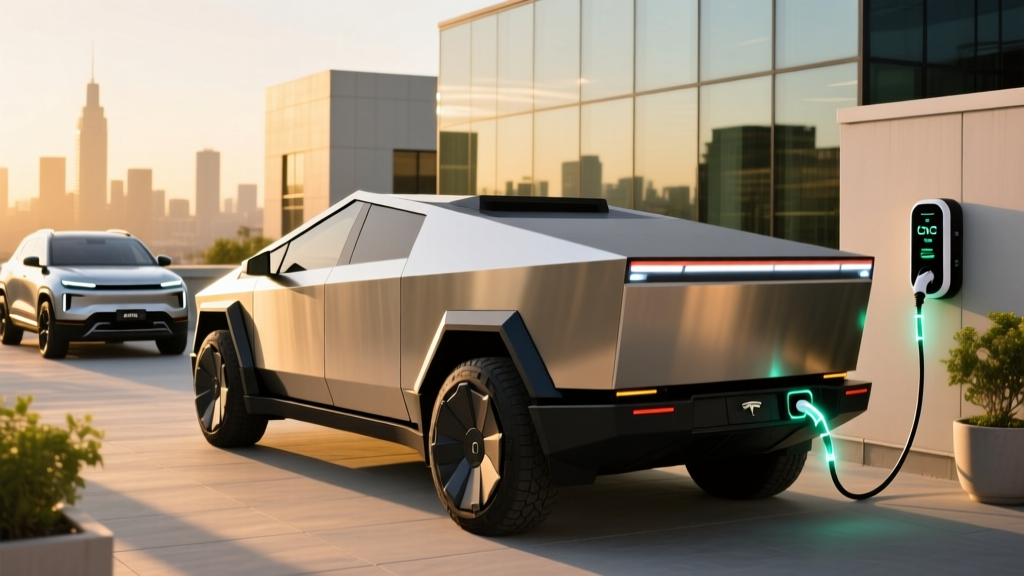
Since deliveries began in late 2023, no EV has polarized the market quite like the Tesla Cybertruck. By early 2026, enough data exists to move past the hype cycle and answer the question buyers are actually asking: is the Cybertruck a flop, or has it found its niche? The answer depends entirely on what you measure — unit volume, owner satisfaction, capability, or total cost of ownership.
This review examines the Cybertruck lineup as it stands for the 2026 model year, covering the AWD dual-motor and the tri-motor Cyberbeast. (The long-promised rear-wheel-drive base model has been repeatedly delayed and is not addressed as a current purchase option.) We'll run through EPA range versus real-world results, charging behavior on Tesla's 400-volt architecture, tax credit eligibility under current IRS §30D rules, and whether the truck's polarizing design and stainless-steel exoskeleton translate into daily-driver practicality.
Quick Verdict: Sales Context and Market Position
Tesla does not break out Cybertruck sales separately in its quarterly delivery reports, but registration data and third-party estimates from Kelley Blue Book and Cox Automotive placed cumulative US deliveries above 130,000 units by the end of 2025. For a $80,000+ vehicle in a niche segment, that is not a flop by volume — it roughly matches the Ford F-150 Lightning's first two years on sale. However, it falls far short of the 250,000+ reservations Tesla claimed pre-launch, and the Cybertruck has not come close to threatening the F-Series' overall sales dominance.
Where the Cybertruck has succeeded: it is the best-selling vehicle in the US at an MSRP above $80,000, according to Tesla's Q4 2025 earnings call. It has also forced legacy automakers to rethink their electric truck strategies. Where it struggles: panel-gap quality issues, a recall for the accelerator pedal cover (NHTSA campaign 24V-123), limited towing range, and a polarizing design that limits its buyer pool.
Cybertruck Spec Table: 2026 Model Year Lineup
| Spec | Cybertruck AWD | Cyberbeast (Tri-Motor) |
|---|---|---|
| EPA Range | 340 miles | 320 miles |
| Battery (usable est.) | ~123 kWh (NMC) | ~123 kWh (NMC) |
| Drivetrain | Dual-motor AWD | Tri-motor AWD |
| Horsepower | 600 hp | 845 hp |
| 0-60 mph | 4.1 seconds | 2.6 seconds |
| Top Speed | 112 mph | 130 mph |
| Max DC Charge Rate | 250 kW | 250 kW |
| 10-80% DC Time | ~28 minutes | ~28 minutes |
| Level 2 Charge Rate | 11.5 kW (~37 mi/hr) | 11.5 kW (~37 mi/hr) |
| Towing Capacity | 11,000 lbs | 11,000 lbs |
| Payload | 2,500 lbs | 2,500 lbs |
| MPGe (combined) | 72 MPGe | 68 MPGe |
| Efficiency (kWh/100 mi) | 47 kWh/100 mi | 50 kWh/100 mi |
| Base MSRP | $79,990 | $99,990 |
| Battery/Drive Unit Warranty | 8 yr / 120,000 mi | 8 yr / 120,000 mi |
Sources: Tesla Cybertruck specs, fueleconomy.gov
Real-World Range: What the EPA Number Doesn't Tell You
EPA Sticker: 340 miles (AWD) / 320 miles (Cyberbeast)
Real-World Highway (70 mph, mild weather): ~270-290 miles
Cold-Weather Highway (30°F or below): ~220-250 miles
While Towing (5,000-lb trailer): ~150-175 miles
The Cybertruck's angular stainless-steel body gives it a drag coefficient around 0.38 Cd — poor by EV sedan standards, and the reason its real-world highway range drops significantly from the EPA combined figure. In independent testing by outlets including Car and Driver and Edmunds, the AWD model delivered roughly 270-290 miles at sustained highway speeds in 65-75°F conditions.
Cold weather compounds the problem. The Cybertruck uses a heat pump for cabin and battery thermal management, which helps, but the large frontal area and high mass (~6,700 lbs curb weight) mean cold-weather range loss hits harder than in lighter EVs. Expect 25-35% range reduction in sub-freezing highway driving.
Towing is the Cybertruck's Achilles' heel for range. With a mid-weight trailer (5,000-7,000 lbs), range effectively halves. Tesla's built-in range estimator and trailer-lighting integration are helpful, but physics is physics: a brick-shaped truck pushing a box trailer at 65 mph is a range-destroying proposition. If regular towing is your use case, the F-150 Lightning with its extended-range battery offers comparable towing range and a more conventional service network.
Charging Speed and Infrastructure Reality
| Charging Method | Power | Miles Added per Hour | Notes |
|---|---|---|---|
| Level 1 (120V outlet) | ~1.4 kW | ~3 mi/hr | Emergency/trickle only |
| Level 2 (240V, 48A) | 11.5 kW | ~37 mi/hr | Full charge in ~11 hours |
| DC Fast Charge (Tesla Supercharger V3/V4) | Up to 250 kW peak | Up to ~200 mi in 15 min | 10-80% in ~28 min |
| DC Fast Charge (CCS via adapter) | Up to 250 kW peak | Similar to Supercharger | Tesla CCS adapter included |
The Cybertruck charges on Tesla's 400-volt architecture, meaning it peaks around 250 kW at DC fast chargers but cannot match the 350 kW peak of 800-volt platforms like the Hyundai Ioniq 5 or Porsche Taycan. The charge curve is respectable: Tesla's V3 and V4 Superchargers sustain high power through the 20-60% SoC window before tapering. Expect a 10-80% session in roughly 28 minutes under ideal thermal conditions.
One practical note for new owners: the Cybertruck's ~123 kWh battery is enormous. On a standard Level 2 home charger at 11.5 kW, a full 0-100% charge takes approximately 11 hours. If your daily driving is under 50 miles, overnight charging easily covers it. But if you arrive home at 10% and need a full battery for a road trip the next morning, plan your charging window accordingly.
For non-Tesla DC fast charging, the Cybertruck uses the NACS connector natively. Tesla ships a CCS adapter, allowing access to Electrify America, EVgo, and other CCS networks. As of 2026, Tesla's Supercharger network remains the most reliable DC fast-charging infrastructure in North America, which is a meaningful ownership advantage.
Pricing, Tax Credits, and Total Cost of Ownership
| Item | Cybertruck AWD | Cyberbeast |
|---|---|---|
| Base MSRP (2026) | $79,990 | $99,990 |
| As-Tested (w/ Foundation Series pkg, FSD) | ~$93,000 | ~$113,000 |
| Federal §30D Tax Credit | $7,500 (if eligible) | $7,500 (if eligible) |
| Effective Price After Credit | ~$72,490 | ~$92,490 |
| Est. Annual Insurance | $3,200-$4,500 | $3,800-$5,200 |
| Est. Annual Electricity (12,000 mi/yr, $0.16/kWh) | ~$900 | ~$960 |
Tax credit eligibility is not guaranteed. Under current IRS §30D rules, the Cybertruck qualifies as a light truck under the $80,000 MSRP cap — but only at the base AWD trim's starting MSRP. Any options or packages that push the manufacturer's suggested retail price above $80,000 disqualify the vehicle. The Cyberbeast, at $99,990 base, does not qualify for the federal credit.
Buyer income caps also apply: $300,000 joint filers, $225,000 head of household, $150,000 single. Additionally, critical-mineral and battery-component sourcing requirements phase in annually, and Tesla's supply chain compliance should be verified at the point of sale via the dealer's or Tesla's IRS-reporting documentation. The credit can now be transferred to the point of sale as an instant discount under the 2024-onward rules, which helps offset the Cybertruck's high entry price.
Insurance is a significant ownership cost. The Cybertruck's stainless-steel body panels, specialized structural components, and high repair complexity push premiums well above comparable trucks. Multiple owners report annual quotes between $3,200 and $5,200 depending on location, driving record, and coverage level. Factor this into your five-year cost projection.
Performance, Capability, and Daily Driving
The Cybertruck AWD's 4.1-second 0-60 time is quick for a 6,700-lb truck, but the Cyberbeast's 2.6-second run is genuinely supercar territory. Tesla's tri-motor torque vectoring provides remarkable launch traction, and the steer-by-wire system — a first for a production vehicle sold in the US — offers a variable steering ratio that eliminates the need for hand-over-hand turning. The 180-degree lock-to-lock at low speeds makes parking maneuvers surprisingly easy for a vehicle this size.
Ride quality benefits from the adaptive air suspension, which offers up to 16 inches of ground clearance in Extract Mode and automatically lowers at highway speeds for efficiency. The vault-like stainless-steel bed (6 ft x 4 ft, ~67 cu ft of volume) includes a powered tonneau cover rated to support 300 lbs, integrated 120V and 240V outlets (up to 9.6 kW of PowerShare output), and a front trunk (frunk) with roughly 7 cu ft of lockable storage.
Interior space is adequate but not generous for the truck's exterior footprint. Rear legroom measures approximately 38 inches — competitive with mid-size trucks but less than a full-size F-150 crew cab. The minimalist interior centers on an 18.5-inch front touchscreen and a 9.4-inch rear screen. There are no physical buttons; even the glovebox opens via the touchscreen. This will delight Tesla loyalists and frustrate traditionalists.
Driver Assistance: Autopilot and FSD Supervised
SAE Automation Level: Level 2 (driver-assist, NOT autonomous).
The driver must remain attentive, keep hands on the yoke, and be prepared to take over at any time. Tesla's Full Self-Driving (Supervised) is not self-driving despite its name.
The Cybertruck ships with Tesla's HW4 (Hardware 4) Autopilot computer, featuring higher-resolution cameras and improved neural-net processing over HW3. Basic Autopilot (lane centering, adaptive cruise) is standard. Full Self-Driving (Supervised) remains a $8,000 option (or $99/month subscription as of early 2026) and adds automated lane changes, city-street navigation, and traffic-light recognition.
In our experience, FSD Supervised on the Cybertruck performs comparably to other Tesla vehicles running the v12.x neural-network-based stack — impressive in many scenarios but prone to cautious hesitation in complex intersections and construction zones. It is a useful driver aid that reduces fatigue on long trips, not a replacement for an attentive driver. NHTSA continues to monitor Tesla's Autopilot/FSD system under an ongoing investigation into crash patterns involving stationary emergency vehicles.
Biggest Pros and Cons
Pros
- Best-in-class Supercharger network access (most reliable DC fast charging in North America)
- 845 hp Cyberbeast offers supercar acceleration in a truck body
- Stainless-steel exoskeleton is dent-resistant; powered tonneau is genuinely useful
- 9.6 kW PowerShare vehicle-to-load capability (run tools, appliances, or a campsite)
- Steer-by-wire makes the large truck maneuverable at low speeds
- OTA updates continue to add features post-purchase
Cons
- Real-world highway range (270-290 mi) well below 340-mi EPA sticker
- Towing range is severely limited (~150-175 mi with mid-weight trailer)
- Insurance premiums are among the highest in the EV truck segment
- Cyberbeast does not qualify for the $7,500 federal tax credit (MSRP exceeds $80K cap)
- Build quality inconsistencies (panel gaps, trim alignment) reported by early owners
- Steer-by-wire and buttonless interior have a steep learning curve
- No Apple CarPlay or Android Auto — Tesla ecosystem only
Who Should Buy the Cybertruck — and Who Shouldn't
Choose the Cybertruck if:
- You want a fast, tech-forward electric truck primarily for daily driving and light cargo
- You already live in the Tesla/Supercharger ecosystem and value seamless road-trip charging
- You need vehicle-to-load power for job-site tools or off-grid camping
- You want a conversation piece that also happens to be legitimately quick
Look elsewhere if:
- You regularly tow more than 3,000 lbs — range will be a constant frustration
- You need maximum rear-seat space for car seats or adult passengers (consider the F-150 Lightning or Rivian R1T)
- You want a conventional steering wheel, physical controls, and Apple CarPlay
- You need a commercial fleet truck with established dealer service infrastructure nationwide
Competitive Comparison: Cybertruck vs. F-150 Lightning vs. Rivian R1T
| Attribute | Tesla Cybertruck AWD | Ford F-150 Lightning (Ext. Range) | Rivian R1T (Dual-Motor Max) |
|---|---|---|---|
| EPA Range | 340 mi | 320 mi | 410 mi |
| Real-World Highway | ~270-290 mi | ~260-280 mi | ~340-360 mi |
| 0-60 mph | 4.1 sec | 3.8 sec | 3.5 sec |
| Towing Capacity | 11,000 lbs | 10,000 lbs | 11,000 lbs |
| DC Fast Charge Peak | 250 kW | 150 kW | 220 kW |
| Starting MSRP | $79,990 | ~$69,995 | ~$79,900 |
| Charging Network | Tesla Supercharger (NACS) | NACS (via adapter + Supercharger access) | NACS (via adapter + Supercharger access) |
| Federal §30D Credit | AWD base only ($79,990 MSRP) | Eligible trims qualify | US-built; check sourcing rules |
The Rivian R1T with the Max Pack battery offers the best real-world range and the most refined interior, but at a significantly higher price point. The F-150 Lightning remains the pragmatic choice for buyers who want a conventional truck experience with electric powertrain benefits and Ford's nationwide dealer service. The Cybertruck wins on Supercharger-native convenience, tech features, and sheer acceleration spectacle.
Frequently Asked Questions
Is the Cybertruck a flop in 2026?
By volume, no — over 130,000 units delivered in roughly two years is strong for an $80,000+ niche vehicle. By Tesla's own pre-launch hype and reservation numbers, it has not met expectations. It is a profitable, polarizing, niche product rather than the mass-market truck Tesla once implied it would be.
What is the real-world range of the Cybertruck?
Expect 270-290 miles on the highway in mild weather for the AWD model, dropping to 220-250 miles in cold conditions. Towing cuts range roughly in half. The EPA combined rating of 340 miles is achievable only with mixed city/highway driving in ideal temperatures.
Does the Cybertruck qualify for the $7,500 federal EV tax credit?
The base AWD model at $79,990 MSRP qualifies under the §30D light-truck MSRP cap, provided the buyer meets income limits ($150K single / $300K joint) and the specific vehicle's battery sourcing meets IRS critical-mineral and component requirements for the current tax year. The Cyberbeast at $99,990 does not qualify. Always verify eligibility with a tax professional and Tesla's point-of-sale documentation before relying on the credit. See IRS §30D guidelines.
How fast does the Cybertruck charge?
At a Tesla V3/V4 Supercharger, the Cybertruck peaks at 250 kW and charges from 10-80% in approximately 28 minutes. At home on a Level 2 charger (240V, 48A), it adds roughly 37 miles of range per hour, with a full charge taking about 11 hours due to the large ~123 kWh battery.
Is the Cybertruck good for towing?
It has an 11,000-lb tow rating and integrated trailer brake control, but towing range is poor — roughly 150-175 miles with a 5,000-lb trailer. If you tow frequently over long distances, a diesel truck or the F-150 Lightning with its broader service network may be more practical.
What is the Cybertruck's warranty coverage?
Tesla covers the battery and drive units for 8 years or 120,000 miles (whichever comes first) with a minimum 70% capacity retention threshold. The limited vehicle warranty is 4 years / 50,000 miles. This is competitive with the segment but not class-leading — Hyundai and Rivian offer longer bumper-to-bumper terms.
Editorial note: Specifications and pricing reflect the 2026 model year as of early 2026. Tax credit rules, MSRPs, and features are subject to change. Always confirm current details with Tesla and your tax advisor before purchasing.