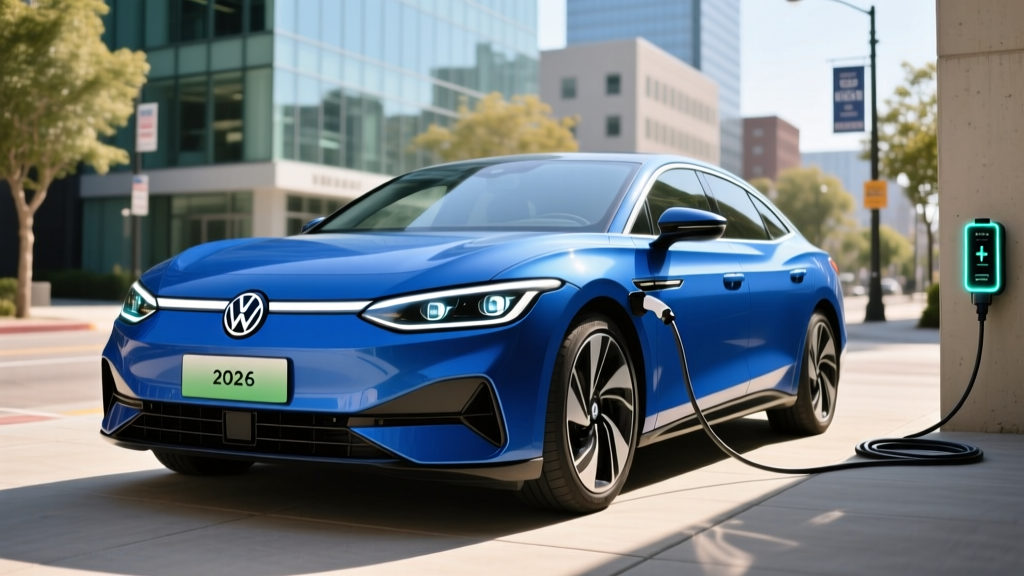
Volkswagen's all-electric flagship sedan has been a long time coming for American buyers. The VW ID.7 USA launch, originally teased in 2023 and delayed repeatedly, finally materializes for the 2026 model year as a direct competitor to the Tesla Model 3, Hyundai Ioniq 6, and BMW i4. Built on Volkswagen's MEB platform at the Emden plant in Germany, the ID.7 brings a 340-mile EPA-estimated range, a spacious fastback interior, and VW's latest driver-assist suite to a segment that has been hungry for a credible electric sedan alternative.
But specs on paper only tell part of the story. After spending time with the ID.7's European counterpart and analyzing the confirmed US-spec details, here is what real buyers need to know about range in actual driving conditions, charging behavior at public DC stations, tax credit eligibility under current IRS rules, and whether this sedan earns a spot on your shortlist.
2026 VW ID.7 Full Specification Overview
| Attribute | Specification |
|---|---|
| EPA-Estimated Range | 340 miles (Pro S RWD) |
| Battery (Usable / Gross) | 86 kWh usable / 91 kWh gross |
| Battery Chemistry | NMC (Nickel Manganese Cobalt) |
| Drivetrain | Rear-Wheel Drive (single motor) / AWD available (GTX) |
| Horsepower | 282 hp (Pro S RWD) / 335 hp (GTX AWD) |
| 0–60 mph | 6.5 sec (Pro S) / 5.4 sec (GTX) |
| Max DC Fast Charge Rate | 175 kW peak |
| 10–80% DC Charge Time | ~30 minutes (preconditioned) |
| Level 2 Home Charging | 11 kW onboard charger (~37 miles/hr) |
| Efficiency | 115 MPGe combined / 29 kWh/100 mi |
| Cargo Volume | 19.8 cu ft (rear seats up) / 56.2 cu ft (folded) |
| Rear Legroom | 39.1 inches |
| Base MSRP (Pro S) | $52,990 |
| As-Tested (GTX w/ Pkg) | ~$63,500 |
| Battery/Powertrain Warranty | 8 years / 100,000 miles |
| Vehicle Warranty | 4 years / 50,000 miles bumper-to-bumper |
Real-World Range: What to Expect Beyond the EPA Sticker
EPA Estimate: 340 miles
Real-World Highway (70–75 mph, moderate climate): ~285–305 miles
Real-World City / Suburban Mixed: ~310–330 miles
Cold Weather (below 32°F, highway): ~240–270 miles (20–30% reduction)
Note: EVs lose range at sustained highway speeds and in cold temperatures due to increased aerodynamic drag and battery thermal demands. The ID.7's standard heat pump helps mitigate cold-weather loss compared to EVs without one.
The ID.7 Pro S uses an 86 kWh usable NMC lithium-ion pack — one of the larger batteries in the midsize electric sedan class. Volkswagen's 340-mile EPA figure positions it ahead of the Tesla Model 3 Long Range (341 miles, essentially tied) and significantly ahead of the Hyundai Ioniq 6 SE Long Range (361 miles EPA, though in a lighter, more aerodynamic package). The BMW i4 eDrive40, for comparison, achieves 307 miles EPA with a similarly sized battery.
In mixed suburban and city driving, the ID.7's efficiency hovers around 2.8–3.1 miles per kWh, which translates to the upper end of its real-world range estimate. Highway driving at 70–75 mph pushes consumption to roughly 3.3–3.5 miles per kWh, dropping effective range to the 285–305 mile band. This is consistent with most large-battery sedans and is not a weakness unique to the ID.7.
The standard heat pump is a meaningful advantage for buyers in northern US climates. Cold-weather testing of MEB-platform vehicles (including the ID.4) has shown that heat-pump-equipped models retain roughly 75–80% of rated range in freezing conditions, compared to 65–70% for resistive-heating EVs. Expect the ID.7 to perform similarly.
Charging Speed: DC Fast Charging and Home Level 2
| Charging Level | Power | Speed / Time |
|---|---|---|
| Level 1 (120V household) | ~1.4 kW | ~4 miles per hour |
| Level 2 (240V, 48A home charger) | 11 kW (onboard limit) | ~37 miles per hour; full charge in ~9 hours |
| DC Fast Charge (peak) | 175 kW | 10–80% in ~30 min (preconditioned) |
| DC Fast Charge (sustained avg) | ~130 kW avg | Adds ~180 miles in 20 min |
The ID.7's 175 kW peak DC fast-charge rate is competitive but not class-leading. The Hyundai Ioniq 6, with its 800-volt E-GMP architecture, peaks at 239 kW and completes a 10–80% charge in roughly 18 minutes. The Tesla Model 3 Long Range peaks around 250 kW on V3 Superchargers. Volkswagen's MEB platform operates on a 400-volt architecture, which physically limits peak charge rate compared to 800V competitors.
What matters more for road trips is the sustained charging curve. The ID.7 holds close to its 175 kW peak from roughly 10–30% State of Charge (SoC), then tapers progressively through the 50–80% range, averaging around 130 kW across the full 10–80% session. Battery preconditioning — activated automatically when you navigate to a DC fast charger in the infotainment system — warms the pack to optimal temperature and is essential for achieving these times. Skip preconditioning on a cold day and you may see peak rates closer to 90–110 kW initially, extending your 10–80% session to 40+ minutes.
For home charging, the 11 kW onboard charger is a strong point. On a 48-amp Level 2 circuit (the most common home installation), you'll add roughly 37 miles of range per hour, meaning a depleted battery reaches full overnight in about 9 hours. This is faster than some competitors limited to 7.2 kW or 9.6 kW onboard charging.
The US-spec ID.7 comes equipped with the NACS (North American Charging Standard) port, aligning with Volkswagen's commitment to adopt Tesla's connector for all 2025+ models. This grants access to the Tesla Supercharger network — currently the most reliable and extensive DC fast-charging network in the country — using the native port without an adapter.
Performance and Driving Dynamics
The ID.7 Pro S sends 282 horsepower to the rear wheels through a single permanent-magnet synchronous motor. The 0–60 mph time of 6.5 seconds is respectable for a 4,800-pound sedan but won't challenge the Tesla Model 3 Long Range (4.2 seconds) or the dual-motor Ioniq 6 (5.1 seconds). Torque delivery is immediate and linear, as with all EVs, making the ID.7 feel quicker in city driving than the stopwatch suggests.
The GTX trim adds a front motor for all-wheel drive and a combined 335 hp, dropping the 0–60 time to 5.4 seconds. The AWD system also improves traction in wet and snowy conditions — a practical upgrade for buyers in the upper Midwest and Northeast.
Ride quality is where the ID.7 differentiates itself. Volkswagen has tuned the suspension for comfort over sportiness, with a compliant ride that absorbs highway imperfections well. The low center of gravity (battery pack under the floor) keeps body roll controlled through corners, though the steering is weighted for relaxed cruising rather than precision feedback. This is a grand-touring electric sedan, not a sports sedan, and it's better for it in daily use.
Regenerative braking offers multiple modes: a coasting mode (D), progressive regen (B), and an adaptive mode that uses radar and navigation data to automatically adjust deceleration based on traffic and upcoming intersections. The adaptive mode is well-executed and reduces brake pedal use substantially in mixed driving.
Interior Space, Technology, and Driver Assistance
The ID.7's fastback silhouette yields an impressive 19.8 cubic feet of cargo space behind the rear seats — more than a Toyota Camry trunk — and 56.2 cubic feet with the 60/40 split rear seats folded. Rear legroom measures 39.1 inches, enough for six-foot passengers to sit comfortably behind a similarly sized driver. The long wheelbase (116.9 inches) is the enabler here, and it gives the ID.7 a rear-seat advantage over the Model 3 and Ioniq 6.
The 15-inch center touchscreen runs VW's ID.Software 4.0, a significant improvement over the sluggish, buggy ID.Software 2.x that plagued early ID.4 models. Response times are quick, the interface is logically structured, and wireless Apple CarPlay and Android Auto are standard. A new head-up display with augmented-reality navigation overlays projects turn directions and speed onto the windshield in the driver's line of sight.
The driver-assistance suite, branded IQ.DRIVE, includes:
- Adaptive cruise control with stop-and-go
- Lane-keeping assist with active centering
- Travel Assist (combined lane-centering + ACC for highway use)
- Automatic emergency braking with pedestrian detection
- Blind-spot monitoring with rear cross-traffic alert
- Park Assist Plus with semi-autonomous parking
Travel Assist is a Level 2 driver-assist system per SAE International classification. The driver must keep hands on the wheel (or demonstrate attentiveness via capacitive sensing) and remain fully engaged at all times. This is not self-driving. It is comparable to Tesla Autopilot, Ford BlueCruise, and GM Super Cruise in capability — not to Level 4 robotaxi services like Waymo.
One notable drawback: the ID.7 uses capacitive-touch steering wheel controls rather than physical buttons. Many reviewers and owners of previous ID models have found these frustrating to use while driving, as accidental inputs are common. Volkswagen has added haptic feedback to the 2026 version to partially address this, but physical buttons remain preferable for most drivers.
Pricing, Trim Levels, and Federal Tax Credit Eligibility
| Trim | Drivetrain | Base MSRP | Est. After §30D Credit* |
|---|---|---|---|
| Pro S | RWD | $52,990 | $45,490 |
| Pro S Plus | RWD | $56,490 | $48,990 |
| GTX | AWD | $59,990 | $52,490 |
| GTX w/ Gradient Pkg | AWD | $63,490 | $55,990 |
*Tax credit figures assume full $7,500 eligibility under IRS §30D. Eligibility depends on buyer income, battery component sourcing, and critical mineral requirements. The ID.7's MSRP falls under the $55,000 sedan cap for most trims, but the GTX with Gradient Package may exceed it. Always verify with a tax professional.
The federal EV tax credit under §30D remains complex. Here is the eligibility checklist for the ID.7:
- MSRP Cap: Sedans must have an MSRP at or below $55,000. The Pro S and Pro S Plus qualify; the GTX trims may exceed this threshold depending on options.
- Buyer Income Cap: Modified adjusted gross income must not exceed $150,000 (single), $225,000 (head of household), or $300,000 (joint filing).
- Battery Sourcing: The battery must meet critical mineral and battery component requirements that phase in annually. Volkswagen sources NMC cells from SK On and LG Energy Solution; final assembly of the ID.7 occurs in Emden, Germany, which affects component-sourcing compliance. VW has stated that the US-spec ID.7 Pro S qualifies for the full $7,500 credit at launch, but buyers should confirm at point of sale, as sourcing rules tighten yearly.
- Point-of-Sale Transfer: As of 2024, buyers can transfer the credit to the dealer at purchase, reducing the out-of-pocket price immediately rather than waiting for a tax refund.
Destination charges add approximately $1,295. Dealer-installed accessories and market adjustments may push the GTX above the MSRP cap. Buyers targeting the tax credit should negotiate based on the Pro S or Pro S Plus trims for the most straightforward eligibility.
How the VW ID.7 Compares to Key Competitors
| Spec | VW ID.7 Pro S | Tesla Model 3 LR | Hyundai Ioniq 6 SEL | BMW i4 eDrive40 |
|---|---|---|---|---|
| EPA Range | 340 mi | 341 mi | 305 mi | 307 mi |
| Battery | 86 kWh NMC | ~75 kWh NMC | 77.4 kWh NMC | 81.5 kWh NMC |
| Peak DC Charge | 175 kW | 250 kW | 239 kW | 205 kW |
| 10–80% Time | ~30 min | ~25 min | ~18 min | ~28 min |
| 0–60 mph | 6.5 sec | 4.2 sec | 5.1 sec (AWD) | 5.5 sec |
| Cargo (rear seats up) | 19.8 cu ft | 23 cu ft | 12.3 cu ft | 16.6 cu ft |
| Rear Legroom | 39.1 in | 35.3 in | 35.7 in | 34.7 in |
| Base MSRP | $52,990 | $47,740 | $46,700 | $57,900 |
The ID.7's strongest advantage is interior space. Its 39.1 inches of rear legroom and 19.8 cubic feet of cargo volume substantially beat the Model 3, Ioniq 6, and i4. If you regularly carry rear-seat passengers or need sedan-class cargo capacity, the ID.7 is the clear pick in this segment.
Where it falls behind is charging speed. The 400V MEB architecture limits the ID.7 to 175 kW peak, while the 800V Ioniq 6 and Tesla's V3 Supercharger network offer meaningfully faster stops on road trips. For a buyer who road-trips 3+ times per year and relies on DC fast charging, this 10–12 minute gap per session adds up.
The Model 3 remains the performance and value benchmark — faster, cheaper, with access to the Supercharger network (though the ID.7 now has native NACS access too). The Ioniq 6 is the efficiency and charging-speed leader. The ID.7 carves out its niche as the comfort, space, and refinement choice.
Who Should Buy the VW ID.7?
- Prioritize rear-seat comfort and cargo space over outright performance
- Want a quiet, comfortable highway cruiser with strong range
- Value VW's build quality and dealer service network over Tesla's direct-to-consumer model
- Commute 40–80 miles daily and can charge at home on Level 2
- Live in a region with cold winters where the standard heat pump matters
- Want the fastest possible DC charging for frequent road trips (consider Ioniq 6)
- Need the lowest possible purchase price (Model 3 is ~$5,000 less)
- Prefer sporty handling dynamics (consider BMW i4 or Model 3 Performance)
- Want a frunk — the ID.7's MEB platform does not include front trunk storage
Pros and Cons at a Glance
- Class-leading rear legroom (39.1 in) and cargo space (19.8 cu ft)
- 340-mile EPA range with large 86 kWh NMC battery
- Standard heat pump for cold-weather efficiency
- NACS port for native Tesla Supercharger access
- 11 kW Level 2 onboard charger (faster home charging than many rivals)
- Comfortable, quiet ride quality tuned for long-distance driving
- 8-year / 100,000-mile battery warranty
- 175 kW peak DC charging is slower than 800V competitors
- Capacitive-touch steering wheel controls remain frustrating
- No front trunk (frunk) due to MEB platform layout
- Higher base price than Model 3 and Ioniq 6
- GTX trims may exceed $55,000 MSRP cap for federal tax credit
- Single-motor RWD performance is adequate but not exciting
- Built in Germany — potential for longer delivery times and parts sourcing
Frequently Asked Questions
What is the real-world range of the VW ID.7?
The EPA rates the ID.7 Pro S at 340 miles. In real-world highway driving at 70–75 mph, expect 285–305 miles. City and suburban driving yields closer to 310–330 miles. In freezing temperatures with highway driving, range drops to approximately 240–270 miles, mitigated somewhat by the standard heat pump.
How fast does the VW ID.7 charge at home and on the road?
On a 48-amp Level 2 home charger, the ID.7 adds about 37 miles of range per hour and charges fully in roughly 9 hours. On DC fast chargers, it peaks at 175 kW and completes a 10–80% session in about 30 minutes with battery preconditioning enabled. Without preconditioning in cold weather, expect 40+ minutes.
Does the VW ID.7 qualify for the $7,500 federal EV tax credit?
The ID.7 Pro S ($52,990) and Pro S Plus ($56,490) fall under the $55,000 MSRP cap for sedans and are expected to qualify, pending final battery-sourcing verification under IRS §30D rules. The GTX trims may exceed the cap. Buyer income limits ($150K single / $300K joint) also apply. Confirm eligibility with your dealer and a tax professional at time of purchase.
Is the VW ID.7 worth buying over the Tesla Model 3 or Hyundai Ioniq 6?
If interior space, ride comfort, and build quality are your top priorities, the ID.7 is the strongest choice in this segment. If you prioritize the lowest price and fastest charging, the Model 3 and Ioniq 6 respectively are better fits. The ID.7's native NACS access narrows the charging-network gap that previously favored Tesla exclusively.
What is the VW ID.7 battery warranty?
Volkswagen covers the ID.7's high-voltage battery for 8 years or 100,000 miles, whichever comes first, against defects and capacity loss below 70% of original capacity. This is consistent with industry standards (Tesla, Hyundai, and BMW offer similar terms). The bumper-to-bumper warranty is 4 years / 50,000 miles.
Does the VW ID.7 have a frunk (front trunk)?
No. The MEB platform places power electronics and the HVAC system under the hood, leaving no room for a front trunk. All cargo space (19.8 cu ft standard, 56.2 cu ft with seats folded) is in the rear hatch area. If frunk storage is important to you, the Tesla Model 3 and Hyundai Ioniq 6 both offer front trunk compartments.
Sources: EPA Fuel Economy, IRS Clean Vehicle Credits, Volkswagen USA