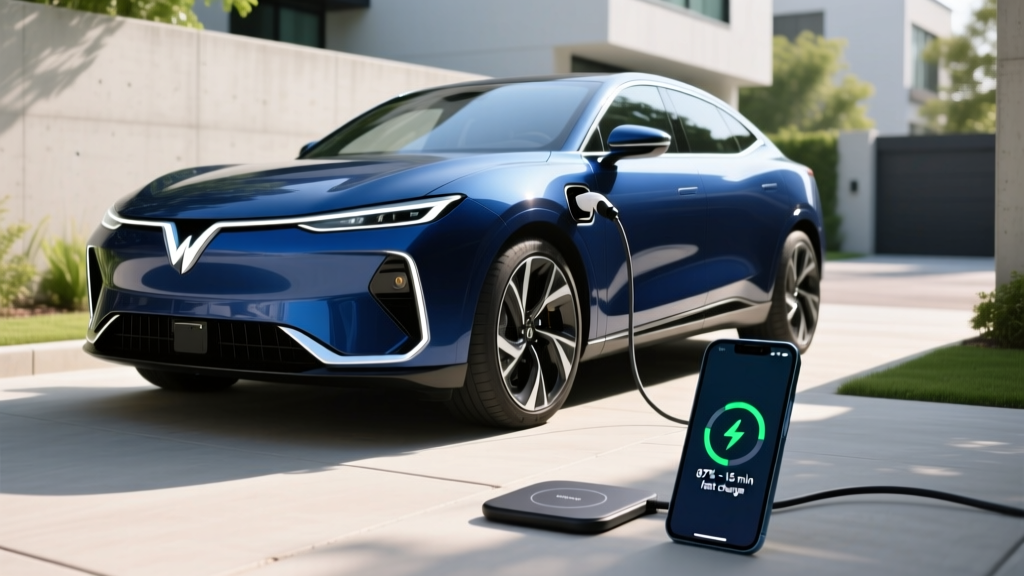
The VinFast VF 8 occupies a strange space in the American EV market. The Vietnamese automaker's midsize electric SUV undercuts rivals on sticker price, wraps them in a striking Pininfarina-penned design, and offers one of the longest battery warranties in the business. But early model-year reviews highlighted software quirks, suspension tuning issues, and range that fell short of expectations. For 2026, VinFast has rolled out over-the-air updates addressing several launch complaints, refined its ADAS suite, and adjusted pricing to remain competitive against the Tesla Model Y, Hyundai IONIQ 5, and Ford Mustang Mach-E.
This review puts the 2026 VF 8 through our triad evaluation — the three pillars that matter most to EV buyers: real-world range and efficiency, charging speed and infrastructure compatibility, and technology plus ownership value. We'll give you the exact numbers, the caveats the brochure leaves out, and a clear verdict on who should — and shouldn't — put the VF 8 on their shortlist.
Quick Verdict: The 2026 VF 8 at a Glance
The VF 8 is a competent but imperfect midsize EV SUV. It delivers adequate range for daily commuting and moderate road trips, charges at a respectable (if not class-leading) rate on DC fast chargers, and offers generous interior space. Its standout advantage is a 10-year/125,000-mile battery warranty and aggressive MSRP. Its weaknesses remain ride refinement at highway speeds and a brand-new dealer network that's still thin in many states. If you can charge at home, live near a VinFast service center, and prioritize warranty peace of mind over best-in-class efficiency, the VF 8 earns consideration.
| Spec | VF 8 Eco (RWD) | VF 8 Plus (AWD) |
|---|---|---|
| EPA Range | 264 miles | 243 miles |
| Battery (usable) | 82.7 kWh (NMC) | 82.7 kWh (NMC) |
| Horsepower | 349 hp | 402 hp |
| 0–60 mph | ~5.8 sec | ~5.1 sec |
| Drivetrain | Rear-wheel drive | Dual-motor AWD |
| Max DC Charge Rate | 190 kW | 190 kW |
| 10–80% DC Time | ~31 min | ~31 min |
| Level 2 Charge Rate | 11 kW (~34 mi/hr) | 11 kW (~34 mi/hr) |
| MPGe (combined) | 89 MPGe | 82 MPGe |
| Base MSRP | $42,200 | $48,200 |
| Battery Warranty | 10 yr / 125,000 mi | 10 yr / 125,000 mi |
Triad Pillar 1 — Real-World Range & Efficiency
The 2026 VF 8 Eco carries an EPA-estimated 264 miles of range, while the dual-motor Plus drops to 243 miles due to the added weight and friction of the front motor. The 82.7 kWh usable battery uses NMC (nickel manganese cobalt) chemistry — the energy-dense choice common in performance-oriented EVs, though it requires more careful thermal management than LFP packs.
EPA Sticker: 264 mi (Eco) / 243 mi (Plus)
Mixed driving (city + suburban): ~240–255 mi (Eco)
Sustained highway (70–75 mph): ~210–230 mi (Eco), ~195–215 mi (Plus)
Cold weather (below 32°F): Expect 15–25% reduction, yielding ~195–220 mi (Eco)
Why the gap? The VF 8's boxy SUV profile and ~5,100 lb curb weight create significant aero drag at highway speeds. NMC chemistry also loses more capacity in extreme cold than LFP, though the VF 8's heat pump and battery preconditioning help mitigate this.
Efficiency lands at 89 MPGe combined for the Eco (38 kWh/100 mi) and 82 MPGe for the Plus (41 kWh/100 mi). That trails the Tesla Model Y Long Range (~117 MPGe) and Hyundai IONIQ 5 (~114 MPGe), meaning the VF 8 uses more electricity per mile. Over 12,000 annual miles, that efficiency gap translates to roughly $80–$120 more in electricity costs per year versus the most efficient rivals, depending on your local utility rate.
Regenerative braking offers three levels plus a one-pedal driving mode. In city driving, the strongest regen setting recovers meaningful energy and reduces brake wear, but the transition between regen and friction braking still feels slightly inconsistent compared to the seamless blending in the IONIQ 5 or Model Y.
Triad Pillar 2 — Charging Speed & Infrastructure
Charging is where many midsize EVs separate themselves, and the VF 8 delivers adequate but not exceptional performance. The peak DC fast-charge rate is 190 kW on a CCS1 connector (via the standard J1772-compliant inlet with CCS combo pins). That's competitive with the Ford Mustang Mach-E (~150 kW) but well below the Hyundai IONIQ 5's 240 kW peak on 800-volt architecture or the Tesla Model Y's ~250 kW on Superchargers.
| Charge Level | Power (kW) | Speed (mi/hr added) | Notes |
|---|---|---|---|
| Level 1 (120V household) | ~1.4 kW | ~4 mi/hr | Emergency/trickle only; full charge in ~60 hrs |
| Level 2 (240V home, 48A) | 11 kW | ~34 mi/hr | Full charge overnight (~8 hrs 0–100%) |
| DC Fast (peak) | 190 kW | ~500 mi/hr (at peak) | Peak sustained only between ~15–45% SoC |
| DC Fast (10–80%) | Avg ~120 kW | ~31 minutes | Curve tapers sharply above 80% |
The charging curve matters more than peak kW. The VF 8 hits 190 kW briefly in the 15–45% state-of-charge window, then steps down progressively: roughly 140 kW by 55%, 90 kW by 70%, and 50 kW by 85%. This is typical NMC behavior, but it means your average charge rate over a 10–80% session is closer to 120 kW. On a road trip, plan for ~30-minute stops at 150+ kW chargers (Electrify America, EVgo, ChargePoint) for meaningful range additions.
For home charging, the onboard 11 kW AC charger is competitive. On a 48-amp Level 2 circuit (the most common home installation), you'll add about 34 miles of range per hour — enough to fully replenish the battery overnight from near-empty. We recommend a hardwired Level 2 station (ChargePoint Home Flex, Emporia Vue, or Wallbox Pulsar Plus) on a 60-amp breaker for optimal speed. A licensed electrician will typically quote $800–$2,500 for a Level 2 installation depending on panel capacity and conduit run length.
The VF 8 uses the CCS1 connector natively. As of 2026, VinFast has not announced a NACS (Tesla-style) native port, though a CCS-to-NACS adapter is included for access to Tesla Supercharger stalls that support non-Tesla vehicles. Confirm adapter compatibility with your local Superchargers via the VinFast app before relying on this for road trips.
Triad Pillar 3 — Performance, Tech & Interior
Powertrain & Driving Dynamics
The Eco's single rear motor produces 349 hp and a 5.8-second 0–60 time — brisk for a family SUV and more than adequate for highway merging. The Plus adds a front motor for dual-motor AWD, bumping output to 402 hp and dropping the sprint to ~5.1 seconds. Neither will embarrass you at a stoplight, but neither matches the Model Y Long Range's ~4.8 seconds or the IONIQ 5's dual-motor ~4.5 seconds.
Ride quality drew heavy criticism at the VF 8's US launch. For 2026, VinFast has retuned the adaptive dampers (standard on Plus, optional on Eco) with revised software that firms up the compression stroke and softens rebound. The result is noticeably improved highway composure, though the VF 8 still transmits more road imperfections through the seat than the softer-riding Mach-E or the planted IONIQ 5. Steering is precise but artificially weighted — fine for commuting, less engaging on canyon roads.
Interior Space & Cargo
The VF 8's dimensions work in its favor for passenger comfort:
- Front legroom: 41.3 inches
- Rear legroom: 38.6 inches
- Cargo (behind 2nd row): 28.8 cu ft
- Cargo (seats folded): 62.3 cu ft
- Frunk: 2.5 cu ft (small — fits a charging cable bag, not much else)
Rear seat space is generous enough for two adults on long trips or three children in boosters. The cargo area is slightly smaller than the Model Y's 30.2 cu ft but competitive with the segment. The tiny frunk is a missed opportunity — competitors like the F-150 Lightning and Rivian R1S offer far more front-trunk utility.
Infotainment & Driver Assistance
The centerpiece is a 15.6-inch touchscreen running VinFast's proprietary OS. The 2026 software update (v4.2) has improved responsiveness and added wireless Apple CarPlay and Android Auto — a much-requested fix. The interface is logically organized but still lacks the polish of Tesla's or Hyundai's systems. Voice commands via the "Hey VinFast" wake word handle navigation, climate, and media requests with reasonable accuracy.
The ADAS suite (branded VinFast ADAS) includes adaptive cruise control with stop-and-go, lane-centering assist, automatic emergency braking, blind-spot monitoring, and rear cross-traffic alert. The Plus trim adds a surround-view camera and automated parking assist.
The VF 8's ADAS is a Level 2 driver-assistance system. It can control steering, acceleration, and braking simultaneously, but the driver must remain fully engaged — hands on the wheel, eyes on the road. This is not self-driving. VinFast does not currently offer a Level 3 or Level 4 autonomous system.
Pricing, Tax Credits & Ownership Value
The 2026 VF 8 is offered in two trims:
| Trim | Base MSRP | As-Tested (typical) | §30D Credit Eligibility |
|---|---|---|---|
| VF 8 Eco (RWD) | $42,200 | $44,500 (w/ ADAS pkg, metallic paint) | Up to $3,750 (partial — battery sourcing) |
| VF 8 Plus (AWD) | $48,200 | $52,800 (w/ adaptive dampers, premium audio) | Up to $3,750 (partial — battery sourcing) |
Federal tax credit reality check: Under IRS §30D rules for 2026, the VF 8 qualifies for up to $3,750 of the potential $7,500 credit. It earns the $3,750 critical-minerals half but does not currently meet the battery-component sourcing requirement for the second $3,750 half. VinFast's battery cells are sourced from partners in Vietnam and China, and final assembly occurs in Hai Phong, Vietnam — which satisfies the North American assembly exemption for leases but complicates the purchase credit.
Key §30D eligibility caveats for buyers:
- MSRP cap: SUVs must be under $80,000 — the VF 8 clears this easily.
- Income cap: Modified AGI must not exceed $150,000 (single), $225,000 (head of household), or $300,000 (joint).
- Point-of-sale transfer: The credit can be applied at purchase to reduce your out-of-pocket cost, but you must confirm eligibility with your tax professional.
- Lease loophole: If leased through VinFast Financial, the vehicle may qualify for the full $7,500 commercial credit (§45W) passed through as a lease incentive — a common strategy for import-brand EVs.
The battery and powertrain warranty is the VF 8's trump card: 10 years or 125,000 miles with a capacity-retention threshold of 70%. That exceeds the industry-standard 8-year/100,000-mile coverage and provides meaningful long-term protection against degradation. VinFast also includes 3 years/36,000 miles of bumper-to-bumper coverage and complimentary roadside assistance.
How It Stacks Up: VF 8 vs. Key Competitors
The VF 8 doesn't exist in a vacuum. Here's how it measures against the three midsize EV SUVs most buyers cross-shop:
| Attribute | VinFast VF 8 Eco | Tesla Model Y LR | Hyundai IONIQ 5 LR | Ford Mach-E ER AWD |
|---|---|---|---|---|
| EPA Range | 264 mi | 330 mi | 303 mi | 290 mi |
| Battery | 82.7 kWh NMC | ~78 kWh NMC | 77.4 kWh NMC | 91 kWh NMC |
| Peak DC kW | 190 kW | ~250 kW | 240 kW (800V) | 150 kW |
| 10–80% Time | ~31 min | ~25 min | ~18 min | ~38 min |
| 0–60 mph | 5.8 sec | 4.8 sec | 5.1 sec | 5.1 sec |
| Base MSRP | $42,200 | $44,990 | $45,500 | $48,995 |
| Battery Warranty | 10 yr/125k mi | 8 yr/120k mi | 10 yr/100k mi | 8 yr/100k mi |
The VF 8's advantage is price and warranty. Its disadvantages are range (60+ miles less than the Model Y), charging speed (the IONIQ 5's 800V architecture is dramatically faster), and brand maturity. If road-trip charging speed is your top priority, the IONIQ 5 wins. If range-per-dollar matters most, the Model Y is hard to beat. If you want the longest safety net on your battery investment, the VF 8's 10-year/125k-mile warranty is the strongest in this group.
Pros, Cons & Who Should Buy
- Class-leading 10-year/125,000-mile battery warranty
- Competitive MSRP undercuts most AWD rivals by $3,000–$7,000
- Spacious rear seat and cargo area for the segment
- Striking Pininfarina design stands out in parking lots
- Improved 2026 ADAS and infotainment software
- Heat pump standard (better cold-weather range retention)
- EPA range trails rivals by 40–70 miles
- 190 kW peak DC charging is midpack; 10–80% in 31 min is slow vs. IONIQ 5
- Efficiency (89 MPGe) lags — higher electricity cost per mile
- Ride quality improved but still not class-competitive
- Small frunk (2.5 cu ft) limits front-storage utility
- Thin dealer/service network in many US regions
- Only partial ($3,750) federal tax credit on purchase
Choose the VF 8 if: You prioritize warranty security, want a distinctive design, can charge at home nightly, mostly drive under 200 miles per day, and live near a VinFast service center. The Eco trim is the value pick — it's the most efficient, cheapest, and still quick.
Look elsewhere if: You take frequent 300+ mile road trips (the IONIQ 5 or Model Y charge much faster), need maximum range, live in a region without VinFast service coverage, or want best-in-class efficiency to minimize electricity costs.
Frequently Asked Questions
What is the real-world range of the 2026 VinFast VF 8?
The EPA rates the VF 8 Eco at 264 miles and the Plus at 243 miles. In real-world mixed driving, expect ~240–255 miles from the Eco. Sustained highway driving at 70–75 mph drops that to ~210–230 miles, and cold weather (below 32°F) can reduce range by 15–25%. Plan road trips around ~200 miles of usable range to maintain a comfortable buffer.
How fast does the VF 8 charge at home and on DC fast chargers?
On a DC fast charger, the VF 8 peaks at 190 kW and charges from 10–80% in approximately 31 minutes. At home on a 240V Level 2 charger (11 kW), it adds ~34 miles of range per hour and fully charges in about 8 hours. Level 1 (120V) trickle charging adds only ~4 miles per hour and is suitable only for emergencies or very low-mileage drivers.
How much does the VF 8 cost after federal tax credits?
The VF 8 Eco starts at $42,200 MSRP. With the partial $3,750 federal tax credit (available on purchase if you meet IRS income caps), the effective price drops to ~$38,450 before state incentives. Leasing may unlock a larger incentive via the §45W commercial credit. Always confirm eligibility with a tax professional, as rules change annually.
Does the VF 8 qualify for the full $7,500 federal EV tax credit?
No. As of 2026, the VF 8 qualifies for only $3,750 under IRS §30D — the critical-minerals half. It does not currently meet the battery-component sourcing requirement for the second $3,750. Leasing through VinFast Financial may allow access to the full $7,500 equivalent via the commercial clean vehicle credit (§45W), which has different sourcing rules. Consult IRS guidance and your tax advisor.
Is the VinFast VF 8 worth buying versus the Tesla Model Y or Hyundai IONIQ 5?
It depends on your priorities. The VF 8 wins on base price and battery warranty length. The Model Y wins on range (330 mi EPA), Supercharger network access, and efficiency. The IONIQ 5 wins on charging speed (18-minute 10–80%) and driving refinement. If you value warranty protection and a lower entry price over maximum range and charging speed, the VF 8 is a rational choice — but test-drive all three before committing.
What are the biggest drawbacks of the VF 8?
The three most significant compromises are: (1) below-average EPA range versus key rivals, (2) middling DC fast-charge speed that adds time on road trips, and (3) a still-developing US service and dealer network that may complicate maintenance in some regions. Secondary concerns include lower efficiency (higher electricity cost per mile) and a small frunk.
What battery chemistry does the VF 8 use, and how long will it last?
The VF 8 uses an NMC (nickel manganese cobalt) lithium-ion battery with 82.7 kWh of usable capacity. NMC offers high energy density but degrades slightly faster than LFP chemistry if routinely charged to 100% or exposed to extreme heat. VinFast recommends daily charging to 80–90% and using 100% only for long trips. The 10-year/125,000-mile warranty guarantees at least 70% capacity retention — one of the strongest protections in the industry.
Sources: EPA fuel economy data via fueleconomy.gov; IRS clean vehicle credit rules via irs.gov; VinFast US specifications via vinfast.com.