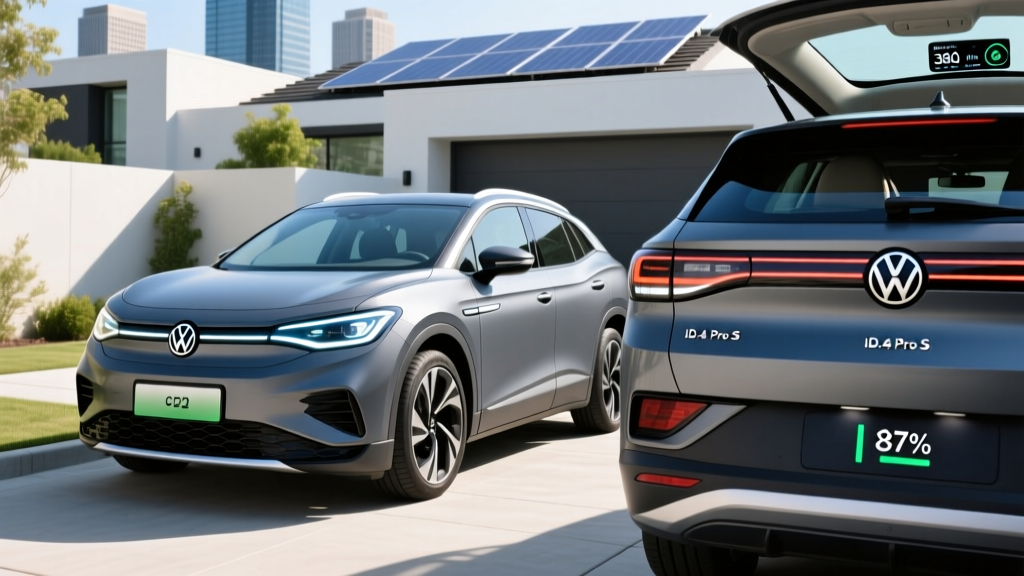
The 2026 Volkswagen ID.4 Pro S sits at the top of the single-motor ID.4 lineup, packing the larger 82 kWh battery, premium interior upgrades, and a suite of driver-assistance features that VW bundles into a practical, family-oriented electric crossover. With a starting MSRP of $46,115 (before destination), it undercuts several competitors on price while offering competitive range and one of the most generous battery warranties in the segment. But spec sheets don't tell the whole story. After extensive analysis of EPA data, real-world efficiency patterns, and current IRS §30D tax credit rules, here's what you actually need to know before signing paperwork.
2026 VW ID.4 Pro S: Quick Spec Reference
| Spec | Value |
|---|---|
| EPA Range | 275 miles |
| Battery (Usable) | 82 kWh (NMC chemistry) |
| Drivetrain | Rear-wheel drive, single motor |
| Horsepower / Torque | 282 hp / 339 lb-ft |
| 0–60 mph | 7.7 seconds |
| Max DC Fast Charge | 170 kW peak |
| 10–80% DC Charge Time | ~30 minutes |
| Level 2 Home Charging | 11.0 kW (48A) — ~37 mi/hr |
| EPA Efficiency | 104 MPGe combined (32 kWh/100 mi) |
| Cargo Volume (rear seats up / down) | 30.3 / 64.2 cu ft |
| Base MSRP (before destination) | $46,115 |
| Battery / Powertrain Warranty | 8 years / 100,000 miles |
Range and Efficiency: EPA vs. the Real World
The EPA rates the 2026 ID.4 Pro S at 275 miles of combined range. That figure is achievable in mixed city/suburban driving at moderate temperatures, where regenerative braking recovers energy and speeds stay below 65 mph. However, real-world conditions rarely mirror the EPA test cycle perfectly.
EPA Sticker: 275 miles
Highway (70–75 mph, moderate climate): ~235–250 miles
Cold Weather (below 30°F, highway): ~185–210 miles
City/Suburban (regenerative-heavy): ~265–280 miles
Range estimates based on observed efficiency patterns for the MEB platform with NMC chemistry. Actual results vary with driving style, terrain, HVAC load, and tire condition.
The ID.4 Pro S uses an 82 kWh (gross) NMC (nickel manganese cobalt) lithium-ion battery, with approximately 77 kWh usable. VW reserves a buffer at the top and bottom of the state-of-charge window to protect long-term battery health — a standard practice that reduces degradation but means you'll never see a true "zero to full" cycle on the dashboard.
Efficiency is rated at 104 MPGe combined, which translates to roughly 32 kWh per 100 miles. That's respectable for a 4,700-pound crossover but trails the Hyundai Ioniq 5 (114 MPGe RWD) and Tesla Model Y (122 MPGe RWD). The ID.4's less aggressive aerodynamics and heavier curb weight explain most of the gap. On the plus side, VW's thermal management system includes a heat pump (standard on Pro S trims), which mitigates cold-weather range loss compared to resistive heater setups.
According to fueleconomy.gov, the ID.4 Pro S achieves 107 MPGe city and 99 MPGe highway. The city-highway split reflects how regenerative braking benefits stop-and-go driving — a pattern every EV owner should understand when planning routes.
Charging Speed: DC Fast Charging and Home Level 2
Charging speed is where the ID.4 Pro S reveals both strengths and compromises. VW rates the single-motor Pro S at a peak of 170 kW on DC fast chargers. Under ideal conditions — battery preconditioned to optimal temperature, state of charge below 20%, and a charger capable of delivering full power — you can expect a 10–80% charge in approximately 30 minutes.
| Charging Level | Max Power | Approx. Miles Added per Hour | Typical Use Case |
|---|---|---|---|
| Level 1 (120V household) | 1.2 kW | ~4 mi/hr | Emergency / trickle |
| Level 2 (240V, 48A) | 11.0 kW | ~37 mi/hr | Home / workplace overnight |
| DC Fast Charge | 170 kW peak | ~220 mi/hr (peak) | Road trips, quick top-ups |
The charge curve matters more than the peak number. The ID.4 holds close to peak power from roughly 10% to 35% state of charge, then tapers progressively. From 50% to 80%, expect sustained rates closer to 70–90 kW. This is typical for the MEB platform and means the last 30% of a DC session takes nearly as long as the first 50%. If you're road-tripping, plan your stops to charge from 10–60% rather than trying to fill to 80% every time — you'll spend less total time plugged in.
For home charging, the onboard 11.0 kW AC charger is competitive. On a properly installed 240V/48A Level 2 circuit (NEMA 14-50 or hardwired), a full charge from near-empty takes roughly 7.5 hours — easily achievable overnight. VW includes three years of complimentary 30-minute DC fast-charging sessions at Electrify America stations, which partially offsets the public-charging cost burden during the early ownership period.
The ID.4 Pro S uses the CCS1 connector for DC fast charging. As of the 2026 model year, VW has not adopted the NACS (Tesla-style) connector on the ID.4, though CCS-to-NACS adapters are available for accessing Tesla Supercharger V2/V3 stalls. This is a practical workaround, but the native CCS ecosystem at Electrify America and other networks remains the primary fast-charging path.
Performance and Driving Dynamics
The single-motor ID.4 Pro S sends 282 horsepower and 339 lb-ft of torque to the rear wheels. VW claims a 0–60 mph time of 7.7 seconds, which is adequate for highway merging and daily commuting but won't win any drag races against the dual-motor AWD variants (which cut that to roughly 5.4 seconds) or the Tesla Model Y Long Range (5.0 seconds).
What the RWD Pro S does offer is a composed, planted ride. The MEB platform's low center of gravity (battery pack under the floor) and rear-biased weight distribution give the ID.4 handling that feels more car-like than many crossover competitors. Steering is light and precise, if slightly numb at highway speeds. The turning circle is impressively tight at 31.5 feet — a genuine advantage in urban parking situations.
Regenerative braking in the ID.4 operates through steering-wheel paddles that cycle through three levels (B1, B2, B3) plus a "coast" mode. Unlike some competitors, VW does not offer a true one-pedal driving mode that brings the car to a complete stop — you'll still need the brake pedal at very low speeds. This is a deliberate engineering choice that some drivers appreciate for its natural feel and others find frustrating.
Interior, Cargo, and Technology
The Pro S trim elevates the ID.4 interior with synthetic leather (V-Tex) upholstery, heated front seats, a heated steering wheel, a panoramic fixed glass roof, and a 12.9-inch infotainment touchscreen running VW's latest software. The Pro S also includes a 10.25-inch digital instrument cluster, wireless Apple CarPlay and Android Auto, and a wireless phone charging pad.
Passenger space is generous for the segment:
- Front headroom: 41.1 inches
- Front legroom: 41.1 inches
- Rear headroom: 38.8 inches
- Rear legroom: 37.6 inches
Cargo capacity measures 30.3 cubic feet behind the second row and 64.2 cubic feet with the rear seats folded — competitive with the Hyundai Ioniq 5 (27.2 / 59.3 cu ft) and only slightly behind the Tesla Model Y (30.2 / 76.2 cu ft). There is no front trunk (frunk) on the ID.4; the space under the hood houses electronics and the HVAC system.
On the technology front, the ID.4 Pro S includes VW's IQ.DRIVE suite: adaptive cruise control with stop-and-go, lane-keeping assist, blind-spot monitoring, rear cross-traffic alert, and front assist with automatic emergency braking. This is an SAE Level 2 driver-assistance system — it does not drive the car autonomously. You must keep your hands on the wheel and eyes on the road at all times. Travel Assist, VW's combined lane-centering and adaptive cruise feature, works well on highways but requires consistent driver engagement.
IQ.DRIVE and Travel Assist are SAE Level 2 systems. They do not make the ID.4 self-driving. The driver remains fully responsible for vehicle control, and the system will disengage if hands are not detected on the steering wheel. Performance degrades in heavy rain, faded lane markings, and construction zones.
A notable drawback: earlier ID.4 model years drew criticism for sluggish infotainment response times and capacitive touch sliders (for volume and climate) that were difficult to use while driving. VW has improved the software responsiveness for the 2026 model year, but the touch-sensitive sliders remain — a polarizing design choice that some owners find frustrating compared to physical buttons.
Pricing, Trims, and Federal Tax Credit Eligibility
The 2026 ID.4 Pro S (RWD) starts at $46,115 before the $1,395 destination charge, bringing the total to $47,510. The AWD Pro S variant adds approximately $3,800, starting at $49,915 before destination.
| Item | Amount |
|---|---|
| Base MSRP (Pro S RWD) | $46,115 |
| Destination Charge | $1,395 |
| Total MSRP | $47,510 |
| Est. Federal Tax Credit (§30D, if eligible) | Up to $7,500 |
| Effective Price After Max Credit | ~$40,010 |
The ID.4 qualifies for the IRS §30D federal tax credit, but eligibility is not automatic. Several conditions must be met:
- MSRP cap: The vehicle MSRP must not exceed $80,000 for SUVs (the ID.4 clears this easily at ~$47,510).
- Buyer income cap: Modified adjusted gross income must not exceed $150,000 (single), $225,000 (head of household), or $300,000 (married filing jointly).
- Battery sourcing: The critical minerals and battery component requirements phase in progressively. As of 2026, a significant percentage of battery components must be manufactured or assembled in North America, and critical minerals must be sourced from the U.S. or free-trade-agreement partners. The ID.4 is assembled in Chattanooga, Tennessee, and VW has been progressively localizing its battery supply chain — but the exact credit amount ($3,750, $7,500, or $0) depends on the specific battery pack's sourcing at time of delivery.
- Point-of-sale transfer: Eligible buyers can transfer the credit to the dealer at purchase, reducing the purchase price directly rather than waiting for a tax refund.
Always verify current credit eligibility with your dealer and a tax professional before purchase. IRS sourcing rules are updated periodically, and the credit amount can change between when you configure your vehicle and when you take delivery.
Ownership Costs and Warranty
VW provides a comprehensive warranty package for the ID.4 Pro S:
- Battery warranty: 8 years / 100,000 miles (whichever comes first), guaranteeing at least 70% capacity retention.
- Powertrain warranty: 8 years / 100,000 miles
- Bumper-to-bumper: 4 years / 50,000 miles
- Roadside assistance: 4 years / 50,000 miles
The 70% capacity retention threshold is industry-standard (matching Tesla, Hyundai, and Ford), but the 8-year/100,000-mile term is reassuring given that battery replacement costs for an 82 kWh pack currently range from $12,000 to $18,000 out of warranty.
Charging costs for the ID.4 Pro S depend heavily on your electricity rate. At the U.S. residential average of approximately $0.16/kWh, a full 77 kWh usable charge costs roughly $12.32 — equating to about 4.5 cents per mile at the EPA efficiency rating. Compare that to a comparable gasoline crossover at 25 MPG and $3.30/gallon: roughly 13.2 cents per mile. Over 15,000 annual miles, that's an estimated $1,305 in fuel savings per year with home charging.
Insurance costs tend to run 10–20% higher for EVs compared to equivalent gas vehicles, driven by higher repair costs and parts pricing. Expect annual premiums in the $1,600–$2,200 range depending on your location, driving record, and coverage levels.
Pros and Cons: The Honest Summary
- 275-mile EPA range covers most daily and weekend needs
- Comfortable ride quality with a tight turning circle
- Generous passenger and cargo space for the segment
- Heat pump standard on Pro S (better cold-weather range)
- Strong 8-yr/100,000-mi battery warranty
- 3 years of free Electrify America DC charging
- Qualifies for up to $7,500 federal tax credit (if sourcing/income eligible)
- Built in Tennessee — strong domestic assembly story
- 170 kW peak DC charging trails competitors (Ioniq 5: 240 kW, Model Y: 250 kW)
- CCS1 connector requires adapter for Tesla Supercharger access
- No front trunk (frunk)
- Capacitive touch sliders for climate/volume are frustrating while driving
- No true one-pedal driving mode
- 104 MPGe trails Ioniq 5 and Model Y in efficiency
- 7.7-second 0–60 is adequate, not quick
- Infotainment, while improved, still lags rivals in responsiveness
Who Should Buy the ID.4 Pro S?
Choose the ID.4 Pro S if:
- You want a comfortable, practical family EV with strong interior space and a smooth ride
- Most of your driving is suburban/city with occasional highway trips under 200 miles
- You have home Level 2 charging and can charge overnight (making the slower DC speed less relevant)
- You value a strong battery warranty and domestic assembly
- You want a mainstream brand with a wide dealer network for service
- You take frequent road trips and need the fastest possible DC charging (consider the Ioniq 5 or Model Y)
- You want NACS native compatibility for seamless Tesla Supercharger access
- You prioritize sporty acceleration or one-pedal driving
- You need a frunk for additional cargo flexibility
Frequently Asked Questions
What is the real-world range of the ID.4 Pro S?
The EPA rates it at 275 miles combined. In real-world highway driving at 70–75 mph, expect approximately 235–250 miles. In cold weather (below 30°F) with highway speeds and cabin heating, range can drop to 185–210 miles. City driving with regenerative braking can match or slightly exceed the EPA figure.
How fast does the ID.4 Pro S charge?
On DC fast chargers, it peaks at 170 kW with a 10–80% time of roughly 30 minutes under ideal conditions. The charge curve tapers significantly above 50%, so plan road-trip stops around 10–60% charges for efficiency. At home on Level 2 (240V/48A), the 11.0 kW onboard charger adds approximately 37 miles per hour, filling the battery overnight in about 7.5 hours.
Does the ID.4 Pro S qualify for the $7,500 federal tax credit?
It can, but eligibility depends on your income (must be under IRS caps), the vehicle's battery sourcing compliance at time of delivery, and the MSRP (which clears the $80,000 SUV cap). The credit can be transferred at point of sale to reduce your purchase price directly. Always verify with your dealer and review the latest IRS §30D guidance before committing.
How does the ID.4 Pro S compare to the Hyundai Ioniq 5 and Tesla Model Y?
The ID.4 Pro S offers more passenger space than the Ioniq 5 and a lower starting price than the Model Y Long Range. However, the Ioniq 5 charges significantly faster (240 kW peak, 10–80% in ~18 minutes), and the Model Y delivers better efficiency (122 MPGe), faster acceleration, and native NACS Supercharger access. The ID.4 wins on ride comfort, turning circle, and included Electrify America charging.
Is the ID.4 Pro S good for road trips?
It's capable, but not class-leading. The 275-mile range means you'll stop every 200–220 miles on the highway (accounting for a safety buffer), and the 170 kW peak charge rate means 30-minute stops rather than 18–20 minute stops. The included Electrify America sessions help with cost, and the comfortable ride reduces fatigue. If road trips are your primary use case, the Ioniq 5 or Model Y are more efficient choices for DC charging time.
What is the battery warranty coverage?
VW covers the ID.4 battery for 8 years or 100,000 miles, whichever comes first. The warranty guarantees at least 70% capacity retention. If the battery degrades below that threshold within the warranty period, VW will repair or replace it. Out-of-warranty battery replacement for the 82 kWh pack is estimated at $12,000–$18,000 depending on labor and parts availability.