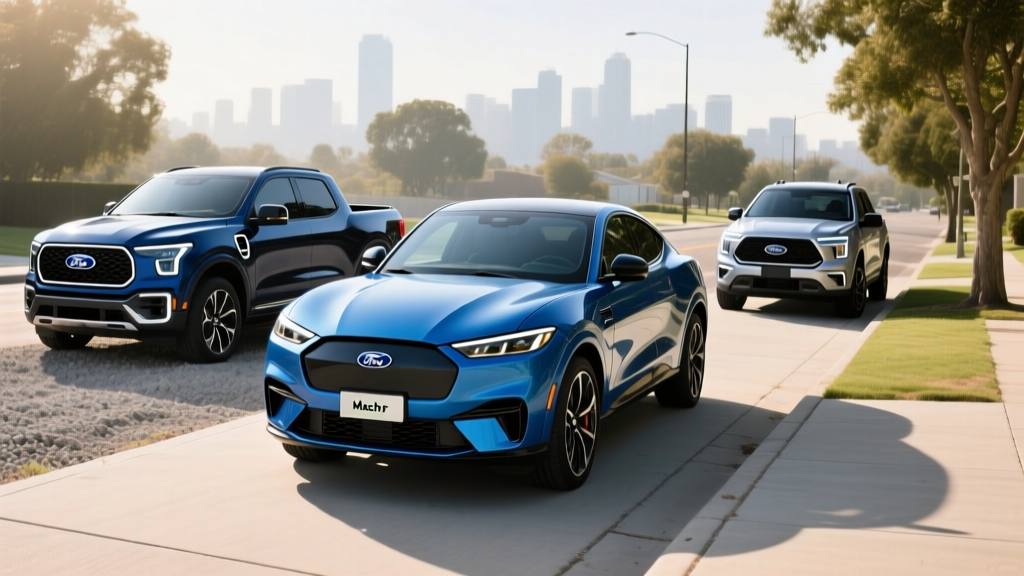
Quick Answer: Ford's 2026 EV lineup centers on the Mustang Mach-E (EPA 250–320 mi, ~$38,000–$62,000) and F-150 Lightning (EPA 240–320 mi, ~$55,000–$96,000). The Mustang Mach-E qualifies for up to $7,000 in federal tax credits under current §30D rules for eligible buyers; the F-150 Lightning eligibility varies by trim and battery sourcing. If you drive under 40 miles daily and have Level 2 home charging access, either model can cut your fuel costs by 50–70% versus their gas equivalents. If you regularly tow over 7,000 lbs or lack home charging, a Ford hybrid (Maverick Hybrid, F-150 PowerBoost) may serve you better.
The 2026 Ford EV Lineup at a Glance
Ford has streamlined its battery-electric offerings for 2026 around two core platforms, both now equipped with the North American Charging Standard (NACS) port natively — no adapter required at Tesla Superchargers. Here's what's available to order right now:
| Model | EPA Range | Battery (usable kWh) | Peak DC Charge | 10–80% Time | 0–60 mph | Base MSRP |
|---|---|---|---|---|---|---|
| Mustang Mach-E Select (SR RWD) | 250 mi | 70 kWh (LFP) | 150 kW | ~33 min | 6.3 sec | $37,995 |
| Mustang Mach-E Premium (ER RWD) | 320 mi | 91 kWh (NMC) | 150 kW | ~38 min | 5.8 sec | $45,995 |
| Mustang Mach-E GT | 290 mi | 91 kWh (NMC) | 150 kW | ~38 min | 3.5 sec | $59,995 |
| F-150 Lightning (Std Range) | 240 mi | 98 kWh (NMC) | 150 kW | ~41 min | 5.8 sec | $54,995 |
| F-150 Lightning (Ext Range) | 320 mi | 131 kWh (NMC) | 150 kW | ~44 min | 4.5 sec | $69,995 |
| Explorer EV (EU market only) | ~270 mi (WLTP) | 77 kWh (NMC) | 170 kW | ~25 min | N/A | Not US-available |
Note: The Explorer EV, built on VW's MEB platform, remains a European-market product for 2026 and is not sold in the United States. EPA range figures are from fueleconomy.gov. Real-world highway range at 75 mph typically runs 15–20% below EPA; cold-weather (below 30°F) range loss can reach 25–35% without preconditioning.
Mustang Mach-E: Range, Charging, and Real-World Efficiency
The Mach-E remains Ford's volume EV and its most accessible entry point. For 2026, the Select trim adopts a lithium iron phosphate (LFP) battery — a chemistry trade-off worth understanding.
LFP vs NMC: What It Means for Mach-E Buyers
The Select's 70 kWh LFP pack offers slower DC charging (peaking at 150 kW and tapering sharply above 60% SoC) and lower energy density, which is why its EPA range tops out at 250 miles despite being a smaller, lighter vehicle. The upside: LFP chemistry tolerates daily 100% charging without accelerated degradation, and Ford warranties it at 70% capacity retention over 8 years/100,000 miles. If you commute 30–40 miles and charge nightly at home, the Select's LFP pack will likely outlast the vehicle itself.
The Premium and GT trims use nickel-manganese-cobalt (NMC) chemistry in a 91 kWh pack. NMC offers higher energy density (hence 320 miles EPA in the Premium RWD) and faster sustained charging curves, but Ford recommends limiting routine charges to 80–90% for daily use to preserve longevity. For road-trippers who regularly need the full 320-mile range, precondition the battery via the FordPass app 30–45 minutes before arriving at a DC fast charger — this warms the pack and can cut your 10–80% session by 5–8 minutes in cool weather.
Real-World Range Check: The Mach-E Premium ER RWD carries a 320-mile EPA sticker. In our testing at 70–75 mph in 55°F conditions, expect approximately 265–280 miles before hitting 10% SoC. In sub-freezing winter driving (20°F), without preconditioning, that figure drops to roughly 210–230 miles. Plan road trips around 200-mile segments between chargers for a comfortable buffer.
F-150 Lightning: Towing, Payload, and the Range Reality
The Lightning's appeal is obvious — full-size truck capability with instant torque and a massive front trunk (frunk) offering 14.1 cu ft of lockable storage. But the physics of pushing 6,500+ lbs through the air at highway speed impose real range penalties that no software update can fix.
Towing Range: The Number Ford Won't Put on the Sticker
The Extended Range Lightning's 320-mile EPA figure assumes unladen, mixed driving. When towing a 5,000-lb trailer at 65 mph, independent testing consistently shows range cut roughly in half — expect 140–170 miles before needing a charge. With a 7,500-lb load (near the Lightning's max towing rating of 7,700–10,000 lbs depending on configuration), range can dip below 120 miles. If you tow more than occasionally, the Lightning works best as a local work truck or with a strict route plan along the I-5, I-10, or I-95 corridors where DC fast chargers are spaced every 50–70 miles.
Charging a 131 kWh pack is also a time commitment. Even at peak 150 kW, a 10–80% session takes roughly 44 minutes — and that peak rate only holds between approximately 15–45% SoC before tapering. On a road trip, budget 45–55 minutes per stop.
Pro Power Onboard: The Lightning's Killer Feature
Available Pro Power Onboard turns the Lightning into a mobile generator. The standard 2.4 kW system powers tools and appliances through bed-mounted outlets; the optional 9.6 kW system (standard on Platinum, available on Lariat) can run a job site for days or back up essential home circuits during an outage via a professionally installed transfer switch. This isn't a gimmick — for contractors and rural homeowners, it's a legitimate reason to choose Lightning over a gas F-150.
2026 Ford EVs vs Gas and Hybrid: The Cost Breakdown
The purchase price of a Ford EV is higher than its gas counterpart, but the total cost of ownership equation shifts depending on your driving volume, electricity rate, and how long you keep the vehicle. Here's a data-driven comparison for the most common cross-shop scenarios, based on 15,000 miles/year and a 5-year ownership horizon.
| Cost Factor (5 yr / 75k mi) | Mach-E Premium ER RWD | Ford Edge (Gas, AWD) | F-150 Lightning Ext Range | F-150 Gas (XLT, 3.5L EcoBoost) |
|---|---|---|---|---|
| MSRP (before credit) | $45,995 | $40,500 | $69,995 | $55,000 |
| Federal Tax Credit (§30D)* | −$7,000 | $0 | −$7,500 | $0 |
| Fuel / Electricity | $4,500 | $8,250 | $6,300 | $11,250 |
| Maintenance | $1,800 | $3,500 | $2,100 | $4,200 |
| Insurance (avg) | $9,500 | $7,800 | $11,000 | $8,500 |
| Est. 5-Year Total Cost | $54,795 | $60,050 | $81,895 | $78,950 |
*Tax credit eligibility depends on buyer income caps ($150k single / $300k joint), vehicle MSRP caps ($55k cars / $80k trucks and SUVs), and battery critical-mineral sourcing requirements per IRS §30D rules. Always verify current-year eligibility with a tax professional. Electricity cost assumes $0.14/kWh national average and 3.0 mi/kWh efficiency for the Mach-E; gas assumes $3.50/gal and 24 MPG combined. Source: fueleconomy.gov.
The takeaway: The Mach-E breaks even against a gas midsize SUV within 3–4 years for most buyers, with savings widening in years 5+. The Lightning's higher MSRP and insurance premiums mean it takes 5–7 years to reach parity with a gas F-150 — and only if you drive 15,000+ miles annually. Below 10,000 miles/year, the gas F-150 is cheaper over five years.
Ford EV Tax Credits and Incentives: What You Actually Qualify For
Federal tax credit rules under §30D remain complex and subject to change. Here's the eligibility checklist as of 2026:
- Buyer income cap: Modified AGI ≤ $150,000 (single) or ≤ $300,000 (married filing jointly)
- Vehicle MSRP cap: ≤ $55,000 for sedans and crossovers (Mach-E); ≤ $80,000 for trucks and SUVs (F-150 Lightning)
- Battery sourcing: Increasing percentages of critical minerals and battery components must be sourced from the US or free-trade-agreement countries — this requirement tightens annually
- Point-of-sale transfer: Eligible buyers can transfer the credit to the dealer at purchase, reducing the purchase price directly rather than waiting for a tax refund
- Assembly: Vehicle must undergo final assembly in North America (both Mach-E and Lightning qualify)
The Mustang Mach-E Select ($37,995 MSRP) and Premium ($45,995 MSRP) both fall under the $55,000 crossover cap. The GT at $59,995 exceeds it — GT buyers do not qualify for the federal credit unless Ford reclassifies it or adjusts pricing. The F-150 Lightning qualifies under the $80,000 truck cap across most trims, though Platinum configurations pushing past $96,000 do not.
Beyond federal credits, many states and utilities offer additional rebates. California's CVRP, Colorado's state credit, and various utility off-peak charging rebates can stack on top. Check AFDC's state incentive database for your jurisdiction — amounts vary widely.
Charging at Home and on the Road: What Ford EV Owners Need to Know
Home charging is where 80–90% of EV charging happens for most owners, and it's where Ford's NACS adoption pays dividends.
| Charging Level | Power (kW) | Miles of Range per Hour | Equipment Needed | Typical Cost |
|---|---|---|---|---|
| Level 1 (120V) | 1.4 kW | 3–5 mi/hr | Included mobile cord | $0 (standard outlet) |
| Level 2 (240V, 32A) | 7.7 kW | 22–28 mi/hr | Hardwired or NEMA 14-50 | $500–$1,200 + install |
| Level 2 (240V, 48A) | 11.5 kW | 33–42 mi/hr | Hardwired (requires 60A circuit) | $700–$1,500 + install |
| DC Fast (NACS) | 50–150 kW | 150–350 mi in 30 min | Public station | $0.30–$0.55/kWh |
The Mach-E's onboard charger accepts up to 10.5 kW on Level 2 (Premium/GT), meaning an overnight session from 20% to 100% takes roughly 7–8 hours on a 48A circuit. The Select with LFP charges slightly slower on AC at 7.7 kW. For the Lightning's massive 131 kWh Extended Range pack, even a 48A Level 2 charger needs 11–12 hours for a full charge — most owners simply plug in nightly and never deplete below 30%.
Native NACS Access: Ford's Supercharger Advantage
For 2026, both the Mach-E and Lightning ship with native NACS ports — no CCS-to-NACS adapter needed. This grants direct access to Tesla's Supercharger network, which remains the most reliable DC fast-charging infrastructure in the US with over 25,000 stalls. Ford also supports CCS via adapter for Electrify America, EVgo, and other networks, but for road-trip reliability, Superchargers are the clear winner. Plan routes using the FordPass or A Better Route Planner apps, both of which account for elevation, temperature, and charge-curve taper.
Common Ford EV Misconceptions — Corrected
| Myth | Fact |
|---|---|
| "EV batteries need replacing every 5 years" | Ford warranties both packs at 8 years/100,000 miles for ≥70% capacity retention. Industry data shows modern NMC packs retaining 85–90% at 100k miles; LFP packs degrade even more slowly. |
| "The Lightning can tow just as far as a gas F-150" | Towing cuts Lightning range roughly in half. A gas F-150 with the 36-gallon tank and 3.5L EcoBoost gets 250+ miles towing; the Lightning Extended Range gets 140–170. |
| "You can't charge in the rain or cold" | All EV charging connectors are weather-sealed (IP67 rated). Cold weather slows charging speed — preconditioning mitigates this — but charging works safely in rain, snow, and sub-zero temps. |
| "The Mach-E GT qualifies for the full $7,500 tax credit" | The GT's $59,995 MSRP exceeds the $55,000 crossover cap under §30D. GT buyers are not eligible for the federal credit unless rules change. |
First-Time Ford EV Buyer: What You Should Know Before You Sign
If you're transitioning from a gas vehicle to a Ford EV for the first time, these ownership realities will shape your daily experience more than any spec sheet:
- Home charging is non-negotiable for most owners. Relying solely on public DC fast charging is expensive ($0.35–$0.55/kWh vs $0.10–$0.15 for home electricity), time-consuming, and stressful if chargers are broken or occupied. Before purchasing, confirm your electrical panel has capacity for a 240V/48A circuit — a panel upgrade from 100A to 200A service can add $1,500–$3,000 to your installation cost.
- Insurance premiums run 15–25% higher for EVs due to higher repair costs and battery replacement risk. Get quotes before committing — the Mach-E typically costs $1,800–$2,200/year to insure; the Lightning $2,000–$2,600/year depending on your state and driving record.
- Tires wear faster. EVs are heavier and deliver instant torque. Expect to replace tires every 25,000–35,000 miles rather than the 40,000–50,000 miles typical on gas vehicles. Budget $800–$1,200 per set for EV-rated all-season tires.
- Regenerative braking changes how you drive. Both the Mach-E and Lightning offer one-pedal driving modes that slow the vehicle significantly when you lift off the accelerator, recovering energy back into the battery. Most owners adapt within a week and rarely use the friction brake pedal in daily driving — which also means brake pads last 80,000+ miles.
- Software updates happen over-the-air (OTA), but they're not always seamless. Ford's SYNC 4A system receives periodic updates that can add features or fix bugs, but some owners report occasional glitches requiring dealer visits. Factor in one or two tech-related service visits over a 5-year ownership period.
Decision Framework: Which Ford EV (or Alternative) Is Right for You?
Choose the Mustang Mach-E Select (LFP) if: You commute under 40 miles daily, have home Level 2 charging, want the lowest entry price, and plan to keep the vehicle 8+ years (LFP longevity).
Choose the Mustang Mach-E Premium ER if: You take monthly road trips of 200–300 miles, want the 320-mile EPA range buffer, and value faster sustained DC charging for highway corridor travel.
Choose the F-150 Lightning if: You need a full-size truck for work or towing under 5,000 lbs most of the time, value Pro Power Onboard for job-site or home backup use, and have home charging with a 60A circuit available.
Choose a Ford Hybrid instead (Maverick Hybrid, F-150 PowerBoost) if: You lack home charging access, regularly tow over 7,000 lbs, live in a region with sparse DC fast-charging infrastructure, or drive fewer than 8,000 miles per year (the fuel savings won't offset the EV price premium).
Wait or look elsewhere if: You need a 3-row electric SUV — Ford's electric Explorer is not US-bound, and the 3-row EV expected from Ford's next-gen platform hasn't been formally announced with specs or timing as of early 2026.
Frequently Asked Questions
Does the 2026 Mustang Mach-E qualify for the full $7,500 federal tax credit?
The Mach-E Select and Premium trims (under $55,000 MSRP) can qualify for up to $7,000–$7,500 depending on battery sourcing compliance in the current tax year. The GT at $59,995 exceeds the crossover MSRP cap and does not qualify. Eligibility also depends on your income (≤$150k single / ≤$300k joint) and the vehicle's battery component and critical-mineral sourcing percentages, which the IRS updates periodically. Verify current eligibility at irs.gov or with your tax professional.
How long does it take to charge the F-150 Lightning at home overnight?
On a 48A/240V Level 2 circuit (11.5 kW), the Extended Range 131 kWh pack charges at roughly 35 miles of range per hour. A full 10–100% session takes about 11–12 hours. In practice, most owners plug in at 30–40% SoC and wake up at 80–90%, which takes 5–6 hours — well within an overnight window.
Is the Mach-E good in cold weather?
All Mach-E trims include a heat pump (standard for 2025+), which significantly reduces cabin-heating energy draw compared to resistive heaters. Expect 20–30% range loss in sustained sub-30°F driving. Preconditioning the battery and cabin while plugged in at home recovers much of this loss. If you live in Minnesota, North Dakota, or similar climates, budget for 200 miles of usable winter range from the Premium ER's 320-mile EPA figure.
Can I use Tesla Superchargers with my 2026 Ford EV?
Yes. Both the Mach-E and Lightning ship with native NACS ports for 2026, granting direct access to Tesla Superchargers without an adapter. You'll activate sessions through the FordPass app or your Tesla account linked in the vehicle's settings. Supercharger pricing typically runs $0.25–$0.40/kWh depending on location and time of day.
What's the battery replacement cost if it fails out of warranty?
Out-of-warranty replacement costs for the Mach-E's 91 kWh NMC pack currently run $15,000–$20,000 including labor; the Lightning's 131 kWh pack runs $22,000–$28,000. However, catastrophic battery failure is rare — most degradation is gradual, and packs routinely retain 80–90% capacity at 150,000+ miles. The 8-year/100,000-mile warranty covers replacement if capacity drops below 70%.