Quick Verdict: The Cybertruck in 2026 — Substance Beyond the Spectacle
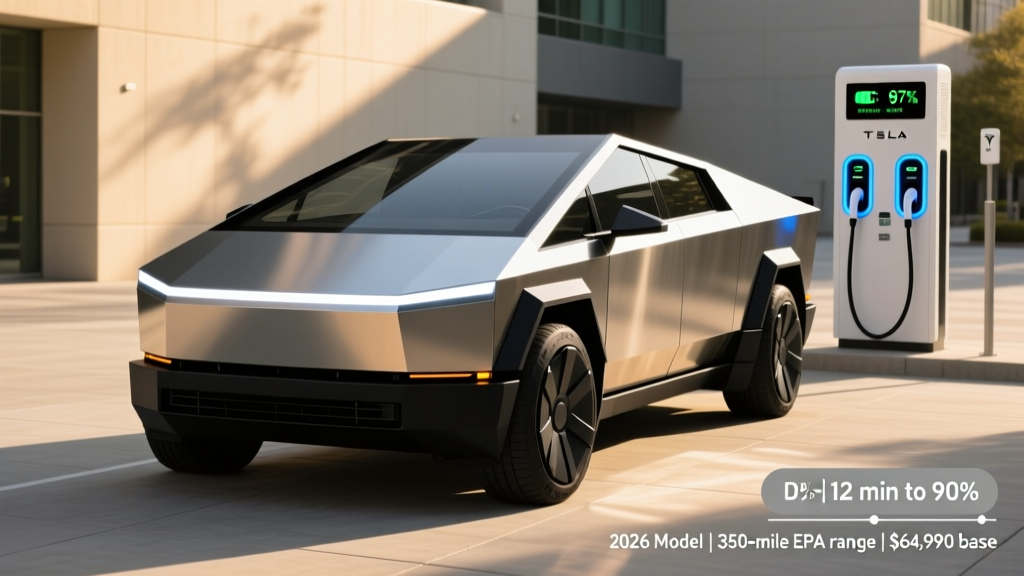
Love it or hate the polarizing angular design, the Tesla Cybertruck has settled into a defined role in the electric pickup segment two years after deliveries began. The viral launch events and every Cybertruck ad campaign promised a paradigm shift — a stainless-steel exoskeleton truck that would out-tow a Ford F-150 and outrun a Porsche 911. The reality, now that the dust has settled and thousands of examples are on the road, is more nuanced but still genuinely impressive in specific metrics.
For 2026, Tesla continues to offer the Cybertruck in three trims: the dual-motor All-Wheel Drive (AWD), the tri-motor Cyberbeast, and the base Rear-Wheel Drive (RWD) variant that finally began reaching customers in late 2025. Each delivers a dramatically different value proposition, and the gap between marketing claims and real-world results deserves a hard look before you put down a deposit.
| Spec | RWD (Base) | AWD | Cyberbeast (Tri-Motor) |
|---|---|---|---|
| EPA Range | ~250 mi (est.) | 340 mi | 320 mi |
| Battery (usable, kWh) | ~100 kWh (est.) | ~123 kWh | ~123 kWh |
| Chemistry | NMC | NMC (4680 cells) | NMC (4680 cells) |
| 0-60 mph | ~6.5 sec (est.) | 4.1 sec | 2.6 sec |
| Horsepower | ~315 hp (est.) | 600 hp | 845 hp |
| Drivetrain | RWD (single motor) | AWD (dual motor) | AWD (tri-motor) |
| Max Tow Capacity | 7,500 lb (est.) | 11,000 lb | 11,000 lb |
| Base MSRP | $60,990 | $79,990 | $99,990 |
| MPGe (combined) | TBD | 66 MPGe | 64 MPGe |
| Efficiency (kWh/100 mi) | TBD | 51 kWh/100 mi | 53 kWh/100 mi |
Real-World Range vs. the EPA Sticker
EPA Sticker: 340 miles (AWD) / 320 miles (Cyberbeast)
Real-World Expectation: ~270–290 miles highway at 70 mph in mild weather; ~220–250 miles in sub-32°F cold; ~200–220 miles when towing 8,000+ lb trailer.
The Cybertruck AWD's 340-mile EPA rating is a legitimate achievement for a vehicle with the aerodynamic profile of a stainless-steel wedge. But the EPA combined cycle blends city and highway driving, and the Cybertruck's sheer mass (nearly 6,800 lb curb weight for the AWD) and 48-volt architecture still can't fully overcome physics at sustained highway speeds.
In real-world highway testing at 70–75 mph on flat terrain in 65–80°F conditions, expect to use roughly 380–420 Wh/mi, translating to approximately 270–290 miles of usable range before you'd want to find a charger. Drop the ambient temperature below freezing and the EPA-rated range can shrink by 20–30%, primarily due to cabin heating demands and increased battery internal resistance. The heat pump helps, but it can't eliminate cold-weather losses entirely.
Towing is where the Cybertruck — like every EV pickup — shows its cards most dramatically. Pulling an 8,000-pound enclosed trailer at highway speeds pushes consumption above 700 Wh/mi, cutting effective range to roughly 170–200 miles. If your use case involves frequent heavy towing on long corridors without reliable DC fast-charging, plan your routes carefully or consider a range-extender solution.
Charging Speed: DC Fast, Level 2, and the 4680 Reality
Tesla's 4680 structural battery pack was supposed to unlock unprecedented charge rates. The reality in 2026 is solid but not class-leading. The Cybertruck AWD and Cyberbeast peak at approximately 250 kW on a V3 Supercharger (or compatible NACS-equipped DC fast charger), though that peak is sustained for only a narrow state-of-charge (SoC) window.
| Charging Level | Power (kW) | Speed (miles of range/hr) | Notes |
|---|---|---|---|
| Level 1 (120V, 12A) | ~1.4 kW | ~3 mi/hr | Emergency/trickle only; 100+ hr for full charge |
| Level 2 (240V, 48A) | 11.5 kW | ~28 mi/hr | Full charge in ~11 hr; standard home install |
| Level 2 (240V, 80A) | 19.2 kW | ~46 mi/hr | Requires Tesla Wall Connector + 100A circuit |
| DC Fast (NACS, peak) | ~250 kW | ~130 mi in 15 min | Peak only; tapers significantly above 60% SoC |
| DC Fast 10–80% | Avg ~150 kW | ~30–35 minutes | With battery preconditioning active |
The 10–80% DC fast-charge time of roughly 30–35 minutes is competitive with the Rivian R1T but trails the 800-volt architectures in vehicles like the Hyundai Ioniq 5 or Porsche Macan Electric. The charge curve is the critical detail: the Cybertruck pulls close to its 250 kW peak between roughly 10–35% SoC, then progressively tapers. By 60% SoC, you're looking at roughly 120 kW, and above 80% the rate drops below 50 kW to protect the cells. This is normal lithium-ion behavior, but it means the "15 minutes of charging" marketing claim only applies to that initial burst.
Preconditioning matters. Navigate to a Supercharger using the built-in navigation and the Cybertruck will pre-warm the battery pack en route, which can shave 5–10 minutes off your 10–80% time — especially in cold weather. Arriving at a charger with a cold-soaked pack can halve your peak charge rate.
Performance: The Numbers Behind Every Cybertruck Ad
If there's one area where the Cybertruck delivers precisely what every Cybertruck ad promised, it's straight-line acceleration. The tri-motor Cyberbeast's 2.6-second 0–60 mph time (with rollout subtracted) places it firmly in supercar territory, and the instant torque delivery from three electric motors makes it feel even more violent than the number suggests. This is an 845-horsepower, nearly 7,000-pound stainless-steel triangle that will gap most sports cars off the line.
The dual-motor AWD's 4.1-second 0–60 is still deeply impressive for a pickup and makes highway merging and passing effortless. The single-motor RWD variant, at an estimated 6.5 seconds, trades urgency for a lower entry price and slightly better efficiency — a pragmatic choice for buyers who don't need supercar acceleration in their daily driver.
Handling is where mass tells its story. The Cybertruck's steer-by-wire system (a first for a production vehicle sold in the U.S.) removes the mechanical connection between the steering wheel and the wheels, using electronic actuators instead. The result is a yoke-style steering wheel that requires only about 340 degrees of lock from stop to stop — no hand-over-hand maneuvering. It takes genuine adaptation, and opinions among owners remain split. Some find it intuitive after a week; others never fully trust the lack of mechanical feedback. The turning circle, at roughly 40 feet, is tighter than you'd expect for a vehicle this size, which is a direct benefit of the rear-wheel steering integrated into the steer-by-wire system.
Pricing, Trims, and the Federal Tax Credit Question
The Cybertruck's pricing has been a moving target since its 2019 unveiling, when Tesla famously promised a sub-$40,000 starting price. The 2026 reality is considerably higher, though the late-2025 introduction of the RWD base model brought the entry point down meaningfully.
| Trim | Base MSRP | As-Tested (typical) | §30D Credit Eligible? | Effective Price (if eligible) |
|---|---|---|---|---|
| RWD (Base) | $60,990 | $62,500 | Yes — under $80K truck cap | ~$53,490 |
| AWD | $79,990 | $84,000–$87,000 | Yes — under $80K truck cap* | ~$72,490 (base) |
| Cyberbeast | $99,990 | $105,000+ | No — exceeds $80K truck MSRP cap | $99,990+ |
* The IRS §30D credit classifies the Cybertruck as a light truck, subject to the $80,000 MSRP cap (not the $55,000 sedan cap). The AWD at base MSRP qualifies, but options packages that push the sticker above $80,000 eliminate eligibility. Always verify current rules at irs.gov.
Federal tax credit eligibility (IRS §30D) depends on several factors beyond the vehicle:
- Buyer income caps: Modified AGI must not exceed $150,000 (single), $225,000 (head of household), or $300,000 (married filing jointly).
- MSRP cap: $80,000 for trucks and SUVs, $55,000 for sedans. The Cybertruck is classified as a truck.
- Battery sourcing requirements: The critical minerals and battery component rules tighten annually. As of 2026, a growing percentage of battery components must be manufactured or assembled in North America, and critical minerals must be sourced from the U.S. or FTA partners. Tesla's increasing domestic sourcing of 4680 cell materials has helped maintain eligibility, but always confirm the specific VIN's status on fueleconomy.gov before purchasing.
- Point-of-sale transfer: As of 2024, the credit can be transferred to the dealer at purchase, reducing your out-of-pocket cost immediately rather than waiting for a tax refund. This effectively lowers the drive-off price.
The Cyberbeast, at $99,990 base, exceeds the $80,000 MSRP cap and does not qualify for the federal credit regardless of your income. If the $7,500 credit matters to your budget, the RWD and base AWD are your options.
Cargo, Passenger Space, and Daily Practicality
The Cybertruck is classified as a full-size pickup, but its footprint is closer to a midsize truck — think Toyota Tacoma rather than Ford F-150 SuperCrew. Here's what that means in real measurements:
- Bed length: 6 feet (72 inches) — shorter than the standard 6.5-foot beds on most midsize pickups
- Bed width: Approximately 43 inches between wheel wells (narrow due to the structural battery pack)
- Cargo bed volume: ~67 cu ft (with tonneau cover closed)
- Frunk (front trunk): ~7 cu ft — enough for a charging cable and a small bag
- Rear-seat legroom: ~38 inches — adequate for adults on shorter trips, tight for tall passengers on long drives
- Seating capacity: 5 passengers (3-across rear bench, though the middle seat is narrow)
The powered tonneau cover is a standout feature — it's lockable, supports up to 300 pounds of distributed weight on top, and integrates with the bed's built-in ramp for loading ATVs, motorcycles, or wheeled equipment. The "vault" bed design with no traditional tailgate hinges (it deploys downward as a ramp) is genuinely useful for slide-in cargo.
The trade-off is interior space. Compared to a Rivian R1T's crew-cab proportions or a Ford F-150 Lightning's generous rear seat, the Cybertruck feels snug inside. The rear seats are more upright than competitors, and the angular roofline cuts into rear headroom. For a family of four on a road trip, it works. For six-foot-plus passengers in the back regularly, it doesn't.
Technology, Driver Assistance, and the Steer-by-Wire Learning Curve
The Cybertruck runs Tesla's latest infotainment stack on an 18.5-inch center touchscreen, with a secondary 9.4-inch rear touchscreen for passengers. The interface is fast, responsive, and integrates navigation, media, climate, and vehicle settings into a single pane. There are no physical buttons for climate or volume — everything routes through the screen or voice commands, which continues to polarize.
On the driver-assistance front, the Cybertruck ships with Tesla's Enhanced Autopilot hardware suite, including the HW4.0 computer and a camera-only vision system (Tesla removed ultrasonic sensors and radar). Autopilot is a Level 2 driver-assistance system per SAE classification — it handles lane centering and adaptive cruise control on highways, but the driver must remain fully engaged with hands on the yoke and eyes on the road at all times.
⚠ Driver Supervision Required: Tesla Autopilot and Full Self-Driving (Supervised) are SAE Level 2 systems. They do NOT make the Cybertruck self-driving. The driver is legally and operationally responsible for the vehicle at all times. FSD (Supervised) adds city-street navigation and traffic-light recognition but still requires active monitoring and intervention readiness.
Full Self-Driving (Supervised) is available as a $8,000 one-time purchase or $99/month subscription. In 2026, FSD has improved substantially in urban environments, handling most intersections and lane changes competently, but it still makes occasional errors that require swift driver takeover — particularly in construction zones, unusual lane configurations, and adverse weather. Treat it as an advanced cruise control, not a chauffeur.
The 48-volt electrical architecture is a behind-the-scenes innovation that reduces wiring harness weight by roughly 70% compared to traditional 12-volt systems and enables higher-power accessories. It also means the Cybertruck can power tools, appliances, or a campsite via its bed-mounted 240V NEMA 14-50 outlet (up to 11.5 kW output) — a legitimate V2L (vehicle-to-load) capability that turns the truck into a mobile generator.
Warranty, Battery Longevity, and Ownership Costs
Tesla provides the following warranty coverage on the 2026 Cybertruck:
- Basic vehicle: 4 years / 50,000 miles
- Battery & drive unit: 8 years / 120,000 miles (whichever comes first), with a minimum 70% capacity retention guarantee over the warranty period
- Restraint system: 5 years / 60,000 miles
The 8-year/120,000-mile battery warranty is slightly better than the 100,000-mile coverage on the Model 3 and Model Y, reflecting the higher expected mileage on a pickup. The 70% retention threshold is industry-standard — it means Tesla will replace or repair the battery if it degrades below 70% of original capacity within the warranty window.
Based on data from Tesla's fleet and independent analysis of 4680 cells, early degradation curves suggest most Cybertruck owners will see roughly 8–12% capacity loss over the first 100,000 miles, with the curve flattening significantly after that. A full battery pack replacement out of warranty would likely cost $18,000–$25,000 based on current parts pricing — a number worth factoring into very long-term ownership plans, though most owners will sell or trade before reaching that point.
Insurance remains a cost factor. The Cybertruck's stainless-steel body panels, steer-by-wire system, and high repair complexity push premiums above segment averages. Expect annual insurance costs of $2,800–$4,200 depending on your location, driving record, and coverage level — roughly 30–50% higher than a comparably priced F-150 Lightning.
Pros
- Class-leading acceleration (Cyberbeast: 2.6s 0–60)
- Stainless-steel body is dent- and corrosion-resistant
- 48V architecture with 11.5 kW V2L capability
- Tight turning circle via rear-wheel steering
- 340-mile EPA range (AWD) is strong for a pickup
- Access to Tesla Supercharger network (35,000+ stalls globally)
- Powered tonneau cover with integrated ramp
Cons
- Cyberbeast ineligible for federal tax credit (MSRP cap)
- Steer-by-wire yoke requires significant adaptation
- Rear seat is tighter than F-150 Lightning or Rivian R1T
- Bed is narrower and shorter than most midsize trucks
- Insurance premiums are above segment average
- DC fast-charge speed trails 800V competitors
- Camera-only vision system struggles in heavy rain/fog
- Polarizing design limits resale appeal to a narrower buyer pool
Who Should Buy the 2026 Cybertruck?
Choose the Cybertruck RWD ($60,990) if: You want an electric daily-driver pickup with adequate range, tax-credit eligibility, and don't need AWD or heavy towing. Best for commuters with home charging who occasionally haul light cargo.
Choose the Cybertruck AWD ($79,990) if: You need all-weather capability, 11,000-lb towing capacity, and 340 miles of EPA range for road trips. This is the best all-around configuration and still qualifies for the §30D credit at base MSRP. Ideal for active-lifestyle owners who tow boats or trailers on weekends.
Choose the Cyberbeast ($99,990) if: Acceleration and exclusivity are your priorities, the tax credit doesn't matter to your financial picture, and you want the fastest production pickup ever built. This is a performance statement, not a value proposition.
Look elsewhere if: You need maximum rear-seat space for a family (consider the F-150 Lightning), prefer a conventional steering wheel (Rivian R1T), or need 400+ miles of range without towing (wait for the promised range-extender battery pack, which Tesla has referenced but not yet delivered as of early 2026).
Frequently Asked Questions
What is the real-world range of the Tesla Cybertruck?
The AWD's EPA-estimated 340 miles translates to roughly 270–290 miles at sustained highway speeds in mild weather, and 220–250 miles in freezing temperatures. The Cyberbeast's 320-mile EPA rating yields approximately 250–275 miles highway. Towing a heavy trailer can cut range to 170–200 miles.
How fast does the Cybertruck charge at home and on the road?
On a DC fast charger, the Cybertruck peaks at ~250 kW and charges from 10–80% in approximately 30–35 minutes with battery preconditioning. At home on a 240V/48A Level 2 charger, it adds about 28 miles of range per hour, requiring roughly 11 hours for a full charge. An 80A circuit with the Tesla Wall Connector increases that to ~46 miles per hour.
Does the Cybertruck qualify for the $7,500 federal EV tax credit?
The RWD ($60,990) and base AWD ($79,990) qualify for the full $7,500 credit under IRS §30D, provided your income falls within the caps ($150K single / $300K joint) and the vehicle's battery sourcing meets 2026 critical-mineral and component requirements. The Cyberbeast ($99,990) exceeds the $80,000 truck MSRP cap and is not eligible. Verify your specific vehicle on fueleconomy.gov and consult a tax professional.
Is the Cybertruck worth buying over the F-150 Lightning or Rivian R1T?
It depends on your priorities. The Cybertruck wins on acceleration, corrosion resistance, and Supercharger network access. The F-150 Lightning offers a larger bed, more rear-seat room, and a more traditional truck experience. The Rivian R1T provides a more refined interior, a conventional steering wheel, and better off-road capability with its quad-motor setup. Test-drive all three before deciding.
What are the biggest Cybertruck drawbacks owners report?
The most common complaints center on the yoke steering adaptation period, the narrow bed width limiting cargo flexibility, higher-than-expected insurance costs, and the camera-only vision system's limitations in heavy rain or fog. Some owners also note that the stainless-steel exterior shows fingerprints and water spots readily, requiring frequent cleaning to maintain its appearance.
Can the Cybertruck power my home during an outage?
The Cybertruck supports vehicle-to-load (V2L) at up to 11.5 kW via its bed-mounted 240V outlet, which can power tools, appliances, or a campsite. Full vehicle-to-home (V2H) integration — where the truck automatically backs up your home's electrical panel during an outage — requires additional hardware (such as Tesla's Powerwall or a compatible bidirectional charger) that Tesla has announced but not fully deployed for the Cybertruck as of early 2026.