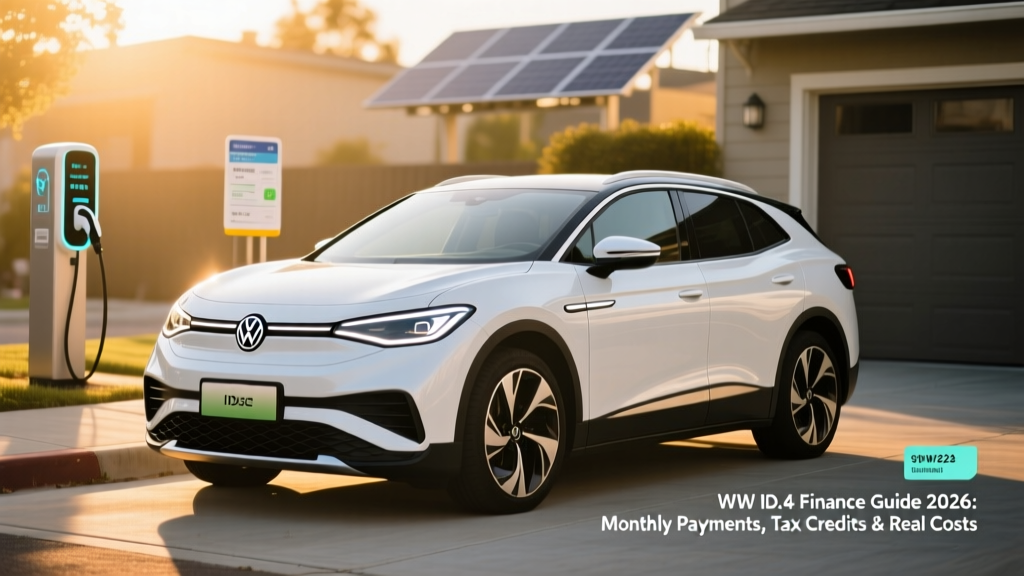
2026 VW ID.4: The Finance-First EV Crossover
The Volkswagen ID.4 occupies a specific niche in the electric-vehicle market: a practical, midsize crossover that undercuts the Tesla Model Y and Hyundai Ioniq 5 on price while delivering competitive range and a mature ride. For 2026, VW has streamlined the ID.4 lineup, updated its software stack, and kept pricing aggressive enough to make financing calculations genuinely attractive — especially when federal incentives enter the equation.
This review examines the 2026 ID.4 through a finance-first lens: what you'll actually pay monthly, which trims deliver the best value, how the federal §30D tax credit reshapes the math, and what real-world range and charging look like once you leave the dealership. We'll pair every EPA sticker figure with the ownership reality you should budget for.
Spec Snapshot: 2026 VW ID.4 at a Glance
| Attribute | Value |
|---|---|
| EPA Estimated Range | 291 miles (Pro RWD, 82 kWh) |
| Battery Capacity (Usable) | 82 kWh (gross ~91 kWh), NMC chemistry |
| Max DC Fast Charge Rate | 175 kW peak |
| 10–80% DC Charge Time | ~28 minutes (preconditioned) |
| Level 2 Home Charge Rate | 11 kW onboard charger (~37 mi/hr) |
| 0–60 mph | 7.7 seconds (RWD) / 5.4 seconds (AWD Pro S) |
| Horsepower / Torque | 282 hp / 339 lb-ft (RWD); 335 hp / 402 lb-ft (AWD) |
| EPA Efficiency | 104 MPGe combined (RWD) / 98 MPGe (AWD) |
| kWh per 100 Miles | 32 kWh/100 mi (RWD) |
| Cargo Volume (rear seats up/down) | 30.3 cu ft / 64.2 cu ft |
| Rear Legroom | 37.6 inches |
| Battery/Powertrain Warranty | 8 years / 100,000 miles |
| Base MSRP (Pro RWD) | $40,290 (before incentives) |
Real-World Range: What the 291-Mile EPA Figure Actually Means
Real-World Expectation:
• Highway cruising (70–75 mph, mild weather): ~245–260 miles
• City/suburban mixed driving: ~270–285 miles
• Cold weather (below 32°F, highway): ~200–225 miles
• Cold weather + cabin heat + short trips: ~185–210 miles
The ID.4 Pro RWD's 291-mile EPA estimate is achievable in ideal conditions — moderate temperatures, city-heavy driving, and conservative speeds. On a 75-mph highway run at 70°F, expect to see roughly 245–260 miles before the battery indicator hits zero. This aligns with independent testing by fueleconomy.gov, where the ID.4 RWD returns 104 MPGe combined.
Cold weather is the ID.4's Achilles' heel. The NMC battery loses efficiency in freezing temperatures, and VW's thermal management system, while adequate, doesn't match the heat-pump sophistication of Hyundai's E-GMP platform. In sustained sub-30°F highway driving, plan for 200–225 miles of usable range — a roughly 25–30% reduction. If your commute involves extreme cold and highway speeds, the AWD Pro S (275-mile EPA) compounds the penalty with its lower baseline efficiency.
For most owners charging nightly at home, the real-world range is more than sufficient for daily needs. The constraint appears on road trips, where you'll want to plan stops every 180–200 miles to keep state of charge above 15% and avoid the steep portion of the charge-curve taper.
Charging Speed: DC Fast Charging and Home Setup
| Charging Level | Max Power | Speed (Miles Added) | Typical Use Case |
|---|---|---|---|
| Level 1 (120V household) | ~1.4 kW | ~4–5 miles/hour | Emergency/top-up only |
| Level 2 (240V home, 48A) | 11 kW (onboard max) | ~37 miles/hour | Daily overnight charging |
| DC Fast Charge (CCS) | 175 kW peak | 10–80% in ~28 min | Road trips, Electrify America network |
The ID.4's 175 kW peak DC fast-charge rate is respectable but not class-leading. The Hyundai Ioniq 5 peaks at 240 kW on 800V architecture, and the Tesla Model Y can sustain higher rates on V3 Superchargers. In practice, the ID.4 holds near-peak power from roughly 10–40% state of charge, then tapers progressively. The full 10–80% session takes about 28 minutes when the battery is preconditioned — add 5–8 minutes if you arrive cold.
Preconditioning matters. If you navigate to a DC fast charger using the ID.4's built-in navigation, the vehicle will begin warming the battery en route. Without preconditioning, peak power may be limited to 120–140 kW for the first several minutes, extending your stop. VW includes three years of complimentary 30-minute charging sessions on the Electrify America network with every new ID.4 — a meaningful perk given VW's corporate relationship with EA.
At home, the 11 kW onboard charger fills the 82 kWh usable battery from empty in roughly 8 hours on a 48-amp Level 2 circuit. Most owners will plug in overnight and wake to a full charge. A quality Level 2 home charger (ChargePoint Home Flex, Emporia V2) costs $400–$700, with professional installation ranging from $500–$1,500 depending on your panel capacity and run length. Budget $1,000–$2,200 total for a reliable home charging setup.
Pricing, Trims, and VW ID.4 Finance Breakdown
The 2026 ID.4 lineup has been simplified into four core trims, with the Pro RWD serving as the value anchor and the Pro S Plus AWD topping the range. Here's the MSRP structure before any incentives:
| Trim | MSRP | §30D Credit (Est.) | Effective Price |
|---|---|---|---|
| Pro RWD | $40,290 | Up to $7,500 | ~$32,790 |
| Pro S RWD | $45,290 | Up to $7,500 | ~$37,790 |
| Pro S AWD | $48,790 | Up to $7,500 | ~$41,290 |
| Pro S Plus AWD | $53,290 | Up to $7,500 | ~$45,790 |
- Maximum credit: $7,500 (split: $3,750 for battery components + $3,750 for critical minerals sourcing)
- MSRP cap: $80,000 for SUVs/crossovers — all ID.4 trims qualify
- Buyer income cap: $150,000 single / $225,000 head of household / $300,000 joint (modified AGI)
- Battery sourcing: Partial credit ($3,750) if only one of two sourcing requirements is met; full $7,500 requires both battery-component and critical-mineral thresholds
- Point-of-sale transfer: Available — apply the credit as a down-payment reduction at the dealer rather than waiting for tax filing
Verify current eligibility on IRS.gov's qualified vehicle list before signing, as sourcing compliance can shift model year to model year.
Monthly Finance Estimates
Assuming a $32,790 effective price (Pro RWD after $7,500 credit), a 72-month loan at 5.9% APR, and $0 down beyond the credit:
- Monthly payment: ~$540/month
- Total interest paid: ~$6,100 over 72 months
- Total cost: ~$38,890
Leasing through Volkswagen Credit often yields more attractive monthly figures — recent ID.4 leases have appeared in the $299–$379/month range with $2,500–$3,500 due at signing. Leasing also sidesteps the §30D income cap: the lessor claims the credit and can pass savings through as a capitalized-cost reduction. Always compare the lease's total cost against a purchase with the credit applied.
Performance, Efficiency, and Daily Drivability
The ID.4 Pro RWD's 282-horsepower rear-mounted motor delivers a 7.7-second 0–60 mph time — adequate for highway merging but hardly thrilling. The AWD variant adds a front motor for 335 combined horsepower and a 5.4-second sprint, which feels meaningfully quicker in real-world driving.
Where the ID.4 earns its keep is ride quality. VW's MEB platform delivers a composed, European-tuned suspension that absorbs rough pavement better than the firmer Model Y or the lighter-steering Ioniq 5. At 4,682 pounds (RWD), the ID.4 feels substantial and planted, with minimal body roll through corners. Regenerative braking offers a B-mode for stronger regen, but the ID.4 does not support true one-pedal driving to a full stop — you'll still use the brake pedal at intersections.
Efficiency lands at 104 MPGe combined (32 kWh/100 mi) for the RWD, which is midpack. The Ioniq 5 RWD achieves 114 MPGe, and the Model Y Long Range hits 122 MPGe. Over 15,000 annual miles at $0.14/kWh (national average residential rate), the ID.4 RWD will cost roughly $672/year in electricity — compared to $1,875/year for a 25-MPG gas crossover at $3.13/gallon. That's a $1,200 annual fuel savings.
Interior Space, Tech, and Standout Features
The ID.4's cabin prioritizes function over flash. Rear legroom measures 37.6 inches — generous for a compact crossover and competitive with the RAV4 Hybrid. Cargo space behind the second row is 30.3 cubic feet, expanding to 64.2 cu ft with seats folded. There's no front trunk (frunk); VW uses that space for power electronics.
The 12.9-inch infotainment touchscreen runs VW's ID. Software 4.0, which is a significant improvement over the sluggish, bug-prone 3.x releases. Wireless Apple CarPlay and Android Auto are standard. The system responds quickly, though the haptic-touch climate controls below the screen remain frustrating — slider-based temperature and fan adjustments lack the precision of physical knobs.
Driver assistance comes via VW's IQ.DRIVE suite, which includes adaptive cruise control with stop-and-go, lane-centering assist, and blind-spot monitoring. This is a competent SAE Level 2 system — not self-driving — and requires active driver supervision. It lacks the hands-free capability of GM's Super Cruise or Ford's BlueCruise on mapped highways. Travel Assist performs well on interstates but can hunt within the lane on faded markings.
Standout features include the ID. Light bar (a thin LED strip across the dash that pulses for navigation prompts and incoming calls), a panoramic fixed-glass roof with an electrochromic shade (Pro S and above), and a heat pump (standard on AWD trims, optional on RWD). The heat pump is worth specifying if you live in a cold climate — it reduces winter range loss by roughly 5–8%.
Pros, Cons, and the Verdict
Pros
- Strong value at ~$32,790 effective price after tax credit (Pro RWD)
- Comfortable, compliant ride quality — best in class for daily comfort
- 3 years of free Electrify America DC fast charging included
- Competent 291-mile EPA range covers most commutes and day trips
- Spacious rear seat and cargo area for the segment
- 8-year/100,000-mile battery and powertrain warranty
- Improved ID. Software 4.0 with responsive touchscreen
Cons
- 175 kW peak DC charge rate lags Hyundai/Kia's 800V architecture
- No one-pedal driving to a full stop
- Cold-weather range loss is significant without the optional heat pump
- Haptic-touch climate controls are imprecise and distracting
- IQ.DRIVE is competent but less advanced than BlueCruise or Super Cruise
- No front trunk (frunk) for additional storage
- Efficiency (104 MPGe) trails the Model Y and Ioniq 5
Who Should Finance the VW ID.4?
Best for: Suburban families and commuters who prioritize ride comfort, cabin space, and value over cutting-edge charging speed or performance. If your daily driving is under 80 miles round-trip and you can charge at home, the ID.4's real-world range and monthly finance costs make it one of the most accessible electric crossovers available.
Consider alternatives if: You regularly road-trip in cold weather (the Ioniq 5's 800V charging and heat pump outperform here), you want hands-free highway driving (Ford Mustang Mach-E with BlueCruise), or you need maximum efficiency (Tesla Model Y Long Range delivers 330 miles EPA and 122 MPGe).
Frequently Asked Questions
What is the real-world range of the 2026 VW ID.4?
The EPA estimates 291 miles for the Pro RWD. In real-world highway driving at 70–75 mph, expect 245–260 miles. In freezing temperatures with highway speeds, plan for 200–225 miles. City driving in mild weather can match or slightly exceed the EPA figure.
How fast does the ID.4 charge at home and on DC fast chargers?
On a Level 2 home charger (240V, 48A), the ID.4 charges at up to 11 kW, adding roughly 37 miles of range per hour — a full charge takes about 8 hours. On DC fast chargers, it peaks at 175 kW and reaches 10–80% in approximately 28 minutes when preconditioned.
How much does the VW ID.4 cost after federal tax credits?
The Pro RWD starts at $40,290 MSRP. If you qualify for the full $7,500 §30D federal tax credit (subject to income limits and battery-sourcing compliance), the effective price drops to approximately $32,790. The credit can be applied at the point of sale as a down-payment reduction. Verify current eligibility at IRS.gov before purchasing.
Does the 2026 VW ID.4 qualify for the federal EV tax credit?
The ID.4 qualifies for up to $7,500 under §30D, provided the buyer meets income thresholds ($150K single / $300K joint modified AGI) and the vehicle's battery meets component and critical-mineral sourcing requirements. All trims fall under the $80,000 MSRP cap for SUVs. Check the IRS qualified vehicle list for the specific model year and trim, as sourcing compliance can change.
Is the VW ID.4 worth buying vs. the Tesla Model Y or Hyundai Ioniq 5?
The ID.4 wins on ride comfort and effective pricing after incentives. The Model Y Long Range offers 330 miles of EPA range, superior Supercharger network access, and 122 MPGe efficiency. The Ioniq 5 charges faster (240 kW peak, 10–80% in ~18 min) and has a more distinctive design. Choose the ID.4 if comfort, value, and free Electrify America charging top your priorities; choose the Model Y for range and charging infrastructure, or the Ioniq 5 for fast-charging speed.
What is the battery warranty on the VW ID.4?
Volkswagen covers the ID.4's high-voltage battery and electric powertrain for 8 years or 100,000 miles, whichever comes first. The warranty guarantees the battery will retain at least 70% of its original capacity during that period. VW's NMC battery chemistry has shown moderate degradation in real-world use — most owners report 5–8% capacity loss over the first 60,000 miles.