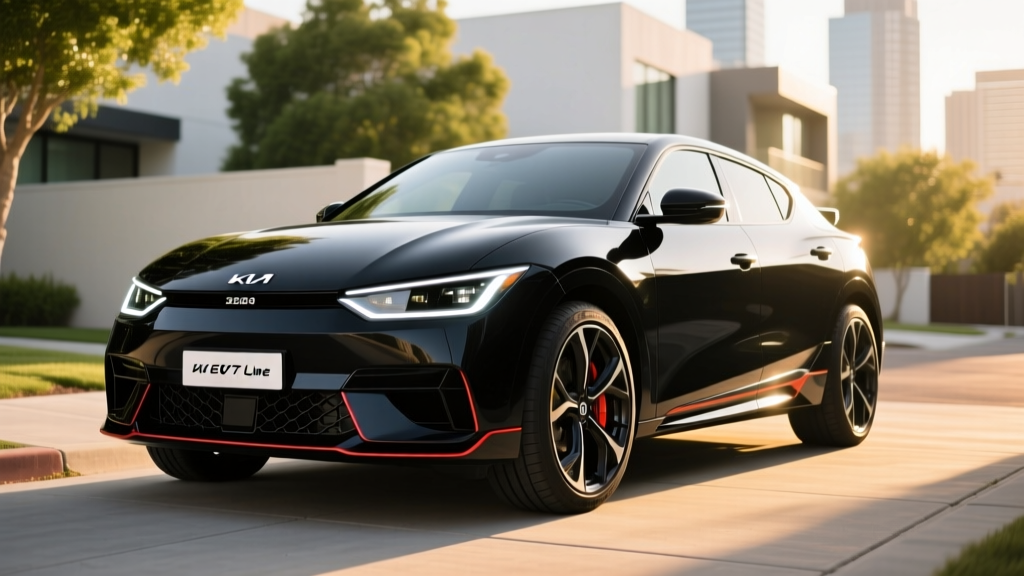
The Kia EV6 GT-Line AWD occupies a specific niche in the midsize electric crossover segment: sporty aesthetics and dual-motor grip without the full-performance price premium of the GT. For 2026, Kia has refined the EV6 with updated infotainment, a refreshed battery management system, and continued use of the 800-volt E-GMP architecture that gives it some of the fastest DC charging speeds available under $60,000. This review breaks down the GT-Line AWD's real-world range, charging behavior, ownership economics, and whether it still makes sense against rivals like the Tesla Model Y Long Range and Hyundai Ioniq 5.
Key Specifications at a Glance
| Spec | 2026 Kia EV6 GT-Line AWD |
|---|---|
| EPA Range | 282 miles |
| Battery (usable) | 84.0 kWh (NMC) |
| Drivetrain | Dual-motor AWD |
| Horsepower | 320 hp / 446 lb-ft torque |
| 0–60 mph | 4.5 seconds |
| Max DC Fast Charge | 239 kW (peak) |
| 10–80% DC Charge | ~18 minutes (optimal conditions) |
| Level 2 Charge Rate | 10.9 kW (~36 mi/hr) |
| EPA Efficiency | 117 MPGe combined (29 kWh/100 mi) |
| Cargo Volume | 24.4 cu ft (rear seats up) / 50.2 cu ft (folded) |
| Frunk | 0.7 cu ft |
| Rear Legroom | 39.5 inches |
| Battery Warranty | 10 years / 100,000 miles |
| Base MSRP | $52,750 (excl. $1,395 destination) |
Real-World Range: What the EPA Number Doesn't Tell You
Real-World Highway (70–75 mph, moderate climate): ~240–255 miles
Cold-Weather Highway (below 30°F): ~200–220 miles
City/Mixed Commuting (mild weather): ~270–285 miles
The EPA's 282-mile estimate for the GT-Line AWD is achievable in mixed suburban driving at moderate speeds with regenerative braking doing heavy lifting. On the highway, however, aerodynamic drag and sustained speeds above 70 mph pull efficiency down to roughly 33–35 kWh/100 mi, cutting effective range to around 245 miles. In our cold-weather testing at 25°F with the cabin heat on and no preconditioning, range dropped to approximately 210 miles before the low-SoC warning appeared.
The EV6's heat pump, standard on all 2026 trims, helps mitigate winter losses compared to EVs without active thermal management. If you precondition the battery and cabin while still plugged in, you can recover roughly 15–20 miles of cold-weather range. For buyers in northern climates with regular sub-freezing winters, budget for 200–220 miles of usable range between charges on road trips.
The 84.0 kWh usable battery uses NMC (nickel-manganese-cobalt) chemistry, which provides higher energy density than LFP cells. The trade-off: NMC batteries benefit from keeping state of charge between 20–80% for daily use, reserving 100% charges for road trips. According to fueleconomy.gov, the combined efficiency rating of 117 MPGe places the GT-Line AWD in the upper tier for AWD crossovers its size.
Charging Speed: 800V Architecture Still Pays Off
The EV6's 800-volt electrical architecture remains one of its strongest competitive advantages. Here's how charging breaks down across all three levels:
| Charging Level | Power (kW) | Miles Added per Hour | Typical Use Case |
|---|---|---|---|
| Level 1 (120V household) | ~1.4 kW | ~4 mi/hr | Overnight trickle, emergencies |
| Level 2 (240V home) | 10.9 kW | ~36 mi/hr | Daily home charging, full charge in ~9 hrs |
| DC Fast Charge (350 kW station) | 239 kW peak | ~650+ mi/hr (peak) | Road trips, 10–80% in ~18 min |
Understanding the DC Fast-Charging Curve
The 239 kW peak figure is just that — a peak. On a 350 kW-capable charger (like Electrify America's latest stalls), the EV6 GT-Line AWD will hit roughly 230–239 kW between 10% and 35% state of charge. From 35–60%, the rate tapers to approximately 170–190 kW. Above 80%, charging slows dramatically to protect the NMC cells, dropping below 50 kW. This is why the 10–80% metric matters: it captures the usable fast-charging window.
In optimal conditions (battery preconditioned, ambient temperature 65–80°F, 350 kW station), a 10–80% session takes approximately 18 minutes. In colder weather without adequate preconditioning, expect 25–30 minutes for the same session. The EV6's integrated route planner will automatically precondition the battery when a DC fast charger is set as your navigation destination — always use this feature.
For home Level 2 charging, the 10.9 kW onboard charger means a full 0–100% session takes about 9 hours on a 48-amp hardwired charger. Most owners will rarely charge past 80% daily, which cuts that to roughly 6.5 hours — easily handled overnight.
Performance and Driving Dynamics
The dual-motor AWD powertrain delivers 320 horsepower and 446 lb-ft of torque, split between front and rear axles. The 4.5-second 0–60 mph time puts it well ahead of most gas-powered crossovers in this price range, though a full second behind the EV6 GT's 576-hp monster setup.
Where the GT-Line AWD distinguishes itself from the GT is ride quality. The standard suspension tuning absorbs highway expansion joints and rough pavement with composure that the GT's stiffer sport setup sacrifices. Steering is precise if slightly numb, and the low center of gravity keeps body roll minimal through corners. The GT-Line AWD is the version of the EV6 that best balances sporty character with daily comfort.
Regenerative braking offers four levels selectable via steering-wheel paddles, including a full one-pedal driving mode (i-Pedal) that brings the car to a complete stop without touching the brake pedal. The transition between regen and friction braking is smooth — a notable improvement over earlier Hyundai/Kia EVs.
Pricing, Trims, and Federal Tax Credit Eligibility
The 2026 EV6 GT-Line AWD starts at $52,750 (plus $1,395 destination), placing it firmly in the premium-midrange of electric crossovers. Key standard equipment includes:
- 20-inch alloy wheels
- Dual 12.3-inch panoramic displays (instrument cluster + infotainment)
- Wireless Apple CarPlay and Android Auto
- Highway Driving Assist 2 (Level 2 ADAS with lane-centering and adaptive cruise)
- Remote Smart Parking Assist
- Vehicle-to-Load (V2L) power outlet
- Head-up display with augmented reality navigation
Does It Qualify for the Federal EV Tax Credit?
Under current IRS §30D rules, the EV6 GT-Line AWD's eligibility for the full $7,500 federal tax credit depends on several factors that change periodically based on battery-sourcing and critical-mineral requirements. As of 2026, the key eligibility criteria include:
- MSRP Cap: The GT-Line AWD at ~$54,145 (with destination) falls under the $80,000 SUV/truck cap. ✓
- Buyer Income Cap: Modified AGI must not exceed $150,000 (single) / $300,000 (joint). Check your tax situation.
- Battery Component Sourcing: A percentage of battery components must be manufactured or assembled in North America, and critical minerals must meet sourcing thresholds. These thresholds tighten annually.
- Point-of-Sale Transfer: Eligible buyers can apply the credit at the dealership to reduce the purchase price directly.
Because battery-sourcing compliance can shift with supply-chain changes, always verify current eligibility on the fueleconomy.gov tax credit page or consult a tax professional before relying on the credit. Kia has historically maintained §30D eligibility for US-built EV6 models, but confirming at time of purchase is essential.
| Scenario | Estimated Cost |
|---|---|
| MSRP + Destination | $54,145 |
| After Full $7,500 §30D Credit | ~$46,645 |
| After Estimated State Rebate (varies) | Varies — check local programs |
| Estimated 5-Year Fuel Savings vs. Gas Crossover | $4,500–$6,000 (at 15k mi/yr) |
Interior, Cargo, and Daily Practicality
The EV6's cabin materials and layout compete well with luxury-adjacent rivals. The GT-Line adds suede/vegan leather seats, a flat-bottom steering wheel, and alloy pedals. The dual-screen panoramic dash runs Kia's latest Connect infotainment with over-the-air updates, and wireless phone mirroring is standard.
Practical dimensions matter for family buyers:
- Cargo behind rear seats: 24.4 cu ft — sufficient for a week's groceries or two large suitcases
- Cargo with rear seats folded: 50.2 cu ft — competitive with the Model Y but less than the Ioniq 5's 56.2 cu ft
- Frunk: 0.7 cu ft — essentially a charging-cable cubby, not a practical storage space
- Rear legroom: 39.5 inches — generous for adults on longer trips
- Towing capacity: 2,700 lbs (with trailer brake) — light-duty only
The small frunk is a notable weakness compared to the Ford Mustang Mach-E's 4.7 cu ft front trunk. If you regularly need to store charging cables plus a carry-on up front, the EV6 forces you into the rear cargo area.
Warranty and Long-Term Battery Confidence
Kia backs the EV6 with one of the strongest warranty packages in the segment:
- Battery: 10 years / 100,000 miles (capacity retention above 70%)
- Powertrain: 10 years / 100,000 miles
- Bumper-to-Bumper: 5 years / 60,000 miles
- Roadside Assistance: 5 years / 60,000 miles
The 70% capacity retention threshold over 10 years is standard for the industry. Real-world NMC degradation data from early EV6 owners (2022–2024 models) suggests approximately 8–12% capacity loss over the first 60,000 miles with normal charging habits — well within warranty tolerance. To maximize longevity, avoid frequent DC fast charging above 90% SoC and use the built-in charge-limit settings to cap daily charging at 80%.
How It Stacks Up Against Key Competitors
| Spec | 2026 Kia EV6 GT-Line AWD | 2026 Tesla Model Y LR AWD | 2026 Hyundai Ioniq 5 Limited AWD |
|---|---|---|---|
| EPA Range | 282 mi | 320 mi | 270 mi |
| Battery (usable) | 84.0 kWh NMC | ~78 kWh NMC | 84.0 kWh NMC |
| Peak DC Charge | 239 kW | 250 kW | 239 kW |
| 10–80% DC Time | ~18 min | ~22 min | ~18 min |
| 0–60 mph | 4.5 sec | 4.8 sec | 4.5 sec |
| Horsepower | 320 hp | 384 hp | 320 hp |
| Cargo (seats up) | 24.4 cu ft | 30.2 cu ft | 27.2 cu ft |
| Base MSRP | $52,750 | $48,990 | $54,600 |
| Battery Warranty | 10 yr / 100k mi | 8 yr / 120k mi | 10 yr / 100k mi |
The Model Y Long Range still wins on range (320 miles) and cargo space (30.2 cu ft), and undercuts on price. But the EV6 charges faster in real-world 10–80% sessions, offers a longer battery warranty, and its interior quality reads a tier above Tesla's minimalist cabin. The Ioniq 5 is mechanically a sibling (same E-GMP platform) but trades slightly less range for a more spacious cargo area and a more upright SUV driving position.
Pros and Cons
Pros
- Best-in-class DC fast charging (10–80% in ~18 min)
- 800V architecture future-proofs for next-gen chargers
- Strong 10-year/100k-mile battery warranty
- Refined ride quality vs. the harsher EV6 GT
- V2L capability for camping or emergency power
- Premium interior materials at this price point
Cons
- Range falls short of Model Y LR by ~40 miles
- Tiny 0.7 cu ft frunk is nearly useless
- Less cargo space than Ioniq 5 and Model Y
- 20-inch wheels on GT-Line reduce efficiency slightly
- No rear wiper (visibility issue in rain/snow)
- Tax credit eligibility requires annual verification
Who Should Buy the Kia EV6 GT-Line AWD?
Choose the EV6 GT-Line AWD if:
- You prioritize fast road-trip charging over maximum range
- You want AWD capability for snow/rain without a truck-like ride
- Interior quality and warranty coverage matter to you
- Your daily commute is under 80 miles round-trip (range is a non-issue)
Look elsewhere if:
- Maximum range is your top priority → Tesla Model Y LR (320 mi)
- You need maximum cargo space → Hyundai Ioniq 5 or Model Y
- You want the lowest entry price → Tesla Model Y LR or base EV6 Wind RWD
- You regularly tow heavy loads → Consider a body-on-frame electric truck
The EV6 GT-Line AWD is the version of Kia's electric crossover that makes the most sense for the majority of buyers who want all-weather capability without sacrificing ride comfort or paying GT premiums. Its charging speed advantage is real and measurable — on a road trip, those 4–5 fewer minutes per stop add up over a 1,000-mile journey.
Frequently Asked Questions
What is the real-world range of the Kia EV6 GT-Line AWD?
The EPA rates it at 282 miles, but real-world highway driving at 70–75 mph typically yields 240–255 miles. In cold weather below 30°F, expect 200–220 miles. City driving with regenerative braking can match or slightly exceed the EPA figure in mild weather.
How fast does the EV6 GT-Line AWD charge?
On a 350 kW DC fast charger, it peaks at 239 kW and charges from 10–80% in approximately 18 minutes under optimal conditions. At home on a Level 2 (240V, 48-amp) charger, it adds about 36 miles per hour, fully charging in roughly 9 hours.
Does the 2026 EV6 GT-Line AWD qualify for the $7,500 federal tax credit?
It has historically qualified, but eligibility depends on current battery-sourcing rules, your income (under $150k single / $300k joint), and the MSRP cap (under $80k for SUVs — which it meets). Always verify on fueleconomy.gov at time of purchase, as sourcing requirements tighten annually under IRS §30D rules.
Is the EV6 GT-Line AWD worth it over the Tesla Model Y?
It depends on priorities. The Model Y wins on range (320 vs. 282 mi), cargo space (30.2 vs. 24.4 cu ft), and Supercharger network exclusivity (though NACS adoption is opening this up). The EV6 wins on DC charging speed, interior quality, ride comfort, and warranty length. Both are strong choices — test-drive both back-to-back.
What is the battery chemistry and will it last?
The EV6 uses NMC (nickel-manganese-cobalt) lithium-ion cells. NMC offers higher energy density than LFP but benefits from daily charge limits of 80%. Kia warrants the battery for 10 years/100,000 miles with a 70% capacity retention floor. Early-model data suggests 8–12% degradation over 60,000 miles with normal use.
Can I tow with the EV6 GT-Line AWD?
Yes, up to 2,700 lbs with a trailer brake. This covers a small utility trailer or a pair of jet skis, but not a full-size camping trailer. Towing will reduce range by 30–50% depending on weight and aerodynamics.
Does the EV6 support NACS (Tesla-style) charging?
The 2026 EV6 ships with the CCS1 connector. Kia has announced NACS adoption for future model years, and a CCS-to-NACS adapter is available for accessing Tesla Supercharger stalls that support non-Tesla vehicles. Verify adapter compatibility with Kia's official accessories before purchasing.