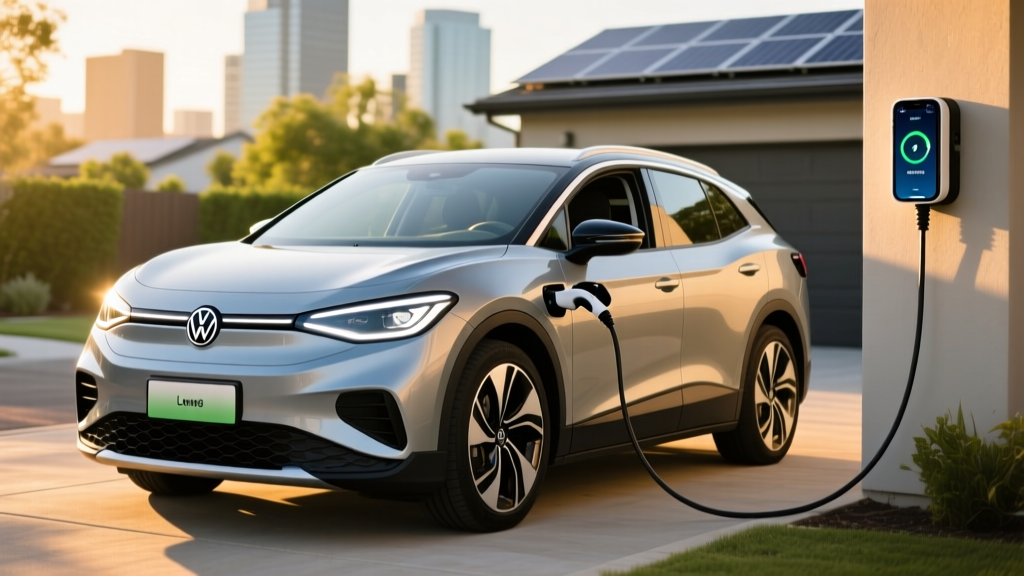
The Volkswagen ID.4 remains one of the most approachable electric SUVs on the market in 2026. It doesn't chase headline-grabbing performance numbers or futuristic styling — instead, it targets the practical family buyer who wants a comfortable, spacious crossover with enough range to handle daily commuting and occasional road trips without drama. After spending time with the current-generation ID.4, we've compiled everything you need to know about range, charging, pricing, and whether it earns a spot in your driveway over rivals like the Hyundai Ioniq 5, Ford Mustang Mach-E, or Tesla Model Y.
2026 VW ID.4 Key Specifications
| Spec | Pro S (RWD) | AWD Pro S |
|---|---|---|
| EPA Range | 291 miles | 263 miles |
| Battery (usable) | 82 kWh (NMC) | 82 kWh (NMC) |
| Horsepower | 282 hp | 335 hp |
| 0–60 mph | 7.7 sec | 5.4 sec |
| Max DC Fast Charge | 175 kW | 175 kW |
| 10–80% DCFC Time | ~28 min | ~28 min |
| Level 2 Home Charge | 11 kW (~37 mi/hr) | 11 kW (~37 mi/hr) |
| MPGe (combined) | 107 MPGe | 98 MPGe |
| Efficiency | 31 kWh/100 mi | 34 kWh/100 mi |
| Cargo (behind rear seats) | 30.3 cu ft | 30.3 cu ft |
| Cargo (rear seats folded) | 64.2 cu ft | 64.2 cu ft |
| Rear Legroom | 37.6 in | 37.6 in |
| Base MSRP | $42,195 | $46,295 |
| Battery/Powertrain Warranty | 8 years / 100,000 miles | |
Real-World Range: What the EPA Number Doesn't Tell You
The rear-wheel-drive ID.4 Pro S carries an EPA-estimated 291 miles of range, while the dual-motor AWD variant drops to 263 miles. Those numbers come from the EPA's fueleconomy.gov database and reflect a combined city/highway driving cycle.
Real-World Range Expectations
EPA sticker: 291 miles (RWD) / 263 miles (AWD)
Highway-heavy driving (70–80 mph): Expect roughly 245–265 miles (RWD) — the ID.4's boxy crossover shape creates more aerodynamic drag at speed than a sedan like the Hyundai Ioniq 6.
Cold weather (below 30°F): Range drops 15–25% depending on cabin heating use. Plan for 215–245 miles in winter conditions (RWD). The ID.4 does offer a heat pump on higher trims, which helps mitigate this loss.
Best-case city driving (mild weather, regen-heavy): You can approach or slightly exceed the EPA number, hitting 295–310 miles.
The 82 kWh usable battery pack uses NMC (nickel manganese cobalt) chemistry. Unlike LFP packs found in some competitors (like the Tesla Model Y Standard Range), NMC offers higher energy density but requires more careful charging habits — Volkswagen recommends keeping daily state of charge at 80% and only charging to 100% for longer trips. This is standard advice for NMC packs and helps preserve long-term battery health.
Charging Speed: DC Fast Charging and Home Level 2
Charging is where the ID.4 delivers competent but not class-leading performance. The 175 kW peak DC fast-charging rate means you'll add range quickly on a road trip, but rivals like the Hyundai Ioniq 5 (which peaks at 240 kW on its 800V architecture) will get you back on the road faster.
ID.4 Charging Speeds at a Glance
| Charging Level | Power | Speed (approx.) | Notes |
|---|---|---|---|
| Level 1 (120V household) | ~1.4 kW | ~4–5 mi/hr | Emergency/top-up only; full charge takes 60+ hours |
| Level 2 (240V home) | 11 kW (48A) | ~37 mi/hr | Full 0–100% in ~8.5 hours; ideal overnight charge |
| DC Fast Charge | 175 kW peak | ~70 mi in 10 min | 10–80% in ~28 min; tapers significantly above 80% |
A critical detail for road-trippers: the ID.4's charging curve holds near its 175 kW peak only between roughly 10% and 35% state of charge. From 35% to 60%, it sustains around 130–140 kW, and from 60% to 80% it drops to approximately 80–100 kW. Above 80%, charging slows dramatically — as it does with nearly all EVs — to protect the battery. If you're planning a multi-stop road trip, plan to charge from 10% to 80% rather than topping off to 100% at each stop; that 80–100% segment can take as long as the 10–80% portion.
The ID.4 uses the CCS1 connector standard for DC fast charging in North America. As of 2026, Volkswagen has not yet transitioned to the NACS (Tesla-style) port on the ID.4, though adapters are available for accessing Tesla Supercharger V2 stations. Electrify America — VW's affiliated charging network — remains the most seamless pairing, with reliable plug-and-charge functionality and complimentary charging credits included with new ID.4 purchases.
Performance and Driving Dynamics
The single-motor RWD ID.4 produces 282 horsepower and reaches 60 mph in 7.7 seconds — adequate for merging and passing but not thrilling. The dual-motor AWD version bumps output to 335 hp and cuts the 0–60 time to 5.4 seconds, which feels genuinely quick in daily driving.
Ride quality is where the ID.4 earns its keep. The suspension tuning favors comfort over sportiness, absorbing bumps and rough pavement with a composed, planted feel that's distinctly German in character. Steering is light and precise if not especially communicative. Regenerative braking offers multiple levels adjustable via steering-wheel paddles, though the ID.4 does not offer true one-pedal driving at its strongest regen setting — you'll still need the brake pedal for a complete stop. This is a common complaint among EV enthusiasts accustomed to the Chevy Bolt or Nissan Leaf's aggressive regen.
The AWD model adds genuine all-weather capability with torque distributed across both axles, making it a strong pick for buyers in snow-belt states. Towing capacity reaches 2,700 pounds on AWD trims (2,200 on RWD), enough for a small utility trailer or a pair of dirt bikes but not a full-size camper.
Pricing, Trims, and Federal Tax Credit Eligibility
The 2026 ID.4 lineup starts at $39,735 for the base Standard Range model (with a smaller 62 kWh battery and 206-mile EPA range) and climbs to approximately $53,000 for a fully loaded AWD Pro S Plus. The volume seller is the Pro S RWD at $42,195, which includes the full 82 kWh battery, panoramic sunroof, heated seats, and a 12.9-inch infotainment display.
2026 ID.4 Pricing by Trim (Before Incentives)
| Trim | Drivetrain | MSRP | Est. After §30D Credit* |
|---|---|---|---|
| Standard Range | RWD | $39,735 | Varies — see eligibility below |
| Pro | RWD | $40,735 | Varies |
| Pro S | RWD | $42,195 | Varies |
| AWD Pro | AWD | $44,795 | Varies |
| AWD Pro S | AWD | $46,295 | Varies |
| AWD Pro S Plus | AWD | $52,595 | Varies |
*Federal tax credit availability depends on battery sourcing, buyer income, and MSRP caps under IRS §30D. See eligibility details below.
Does the ID.4 Qualify for the $7,500 Federal EV Tax Credit?
The answer is: it depends on your specific situation and the current sourcing status of the ID.4's battery components. Under the IRS §30D clean vehicle credit rules, eligibility requires meeting several criteria simultaneously:
- MSRP cap: The ID.4 (as an SUV) must have an MSRP at or below $80,000 — all trims qualify.
- Buyer income cap: Adjusted gross income must not exceed $150,000 (single), $225,000 (head of household), or $300,000 (joint filing).
- Battery component sourcing: A percentage of battery components must be manufactured or assembled in North America, and critical minerals must be sourced from the U.S. or free-trade-agreement partners. These thresholds tighten annually.
- Point-of-sale transfer: As of 2024, buyers can transfer the credit to the dealer for an immediate price reduction at purchase, rather than waiting to claim it on their tax return.
Volkswagen builds the ID.4 for the North American market at its Chattanooga, Tennessee plant, which helps with the assembly requirement. However, battery cell sourcing remains the variable that determines whether the full $7,500, a partial $3,750, or no credit applies. We recommend checking the fueleconomy.gov tax credit database and consulting a tax professional before relying on the credit in your purchase budget. State and local incentives may also apply — check your state's energy office for details.
Interior, Cargo, and Technology
The ID.4's cabin is spacious and practical, if not luxurious. Rear-seat legroom of 37.6 inches is generous for the compact SUV segment, and the flat floor (no transmission tunnel) makes the middle seat usable for a third passenger on short trips. Cargo volume of 30.3 cubic feet behind the rear seats expands to 64.2 cubic feet with the 60/40 split rear seats folded — competitive with the Toyota RAV4 and slightly behind the Hyundai Ioniq 5's 59.3 cu ft (though the Ioniq 5 has a lower roofline).
The 12.9-inch infotainment touchscreen (on Pro S and above) runs VW's latest ID. Software 4.0, which is a significant improvement over the laggy, frustrating interface in early 2021–2023 ID.4 models. Wireless Apple CarPlay and Android Auto are standard. However, Volkswagen's decision to use capacitive touch sliders for volume and climate control remains a usability pain point — physical buttons would be far easier to use while driving.
Driver assistance comes via Volkswagen's IQ.DRIVE suite, which includes adaptive cruise control with stop-and-go, lane centering, automatic emergency braking, and blind-spot monitoring. This is a Level 2 SAE driver-assist system — it does not drive the car for you and requires continuous hands-on-wheel supervision. It's competent for highway cruising but falls short of the hands-free capabilities offered by GM's Super Cruise or Ford's BlueCruise on mapped highways.
Pros
- Comfortable, compliant ride quality ideal for daily commuting and long drives
- Spacious rear seat and competitive cargo volume for the segment
- Strong DC fast-charging reliability on Electrify America network
- Tennessee-built, supporting domestic manufacturing
- Heat pump available for improved cold-weather efficiency
- Competitive starting price for a long-range electric SUV
Cons
- Infotainment touch sliders are distracting while driving
- No true one-pedal driving mode
- DC charging speed (175 kW) trails Ioniq 5 and Ioniq 6 (240 kW)
- RWD 0–60 time of 7.7 sec feels leisurely for the price
- CCS1 port requires an adapter for Tesla Supercharger access
- Frunk (front trunk) is very small — barely fits a charging cable
How the ID.4 Stacks Up Against Key Competitors
The compact electric SUV segment is crowded. Here's how the ID.4 compares to the three rivals most buyers cross-shop:
| Attribute | VW ID.4 Pro S (RWD) | Hyundai Ioniq 5 SEL (RWD) | Ford Mustang Mach-E Extended Range (RWD) | Tesla Model Y Long Range (AWD) |
|---|---|---|---|---|
| EPA Range | 291 mi | 303 mi | 320 mi | 308 mi |
| Battery (usable) | 82 kWh NMC | 77.4 kWh NMC | 91 kWh NMC | ~75 kWh NMC |
| Peak DC Charge | 175 kW | 240 kW | 150 kW | 250 kW |
| 10–80% DCFC | ~28 min | ~18 min | ~36 min | ~22 min |
| 0–60 mph | 7.7 sec | 7.2 sec | 6.1 sec | 4.8 sec |
| Starting MSRP | $42,195 | $43,500 | $44,995 | $46,630 |
| NACS Port | No (CCS1) | No (CCS1) | No (CCS1) | Yes (native) |
The Ioniq 5 wins on charging speed thanks to its 800V architecture. The Mach-E offers more range and a sportier drive. The Model Y leads in performance, Supercharger network access, and software sophistication. The ID.4's advantage is ride comfort, interior space, and a less polarizing design that appeals to EV newcomers.
Who Should Buy the VW ID.4?
The ID.4 Is the Right Pick If:
- You prioritize ride comfort and cabin quietness over sporty handling
- You need generous rear-seat space for car seats or tall passengers
- You want a mainstream EV backed by a traditional dealer network for service
- You commute 30–80 miles daily and want to charge at home overnight without range stress
- You live in a region with reliable Electrify America or CCS-compatible DC fast chargers
Look Elsewhere If:
- Fastest possible DC charging is a priority (choose the Ioniq 5 or Model Y)
- You want hands-free highway driving (look at Ford BlueCruise or GM Super Cruise vehicles)
- You regularly drive in extreme cold and need maximum range retention (consider a larger battery or a PHEV)
- You want native Tesla Supercharger access without an adapter (Model Y)
Battery Warranty and Long-Term Ownership
Volkswagen backs the ID.4's battery pack and electric powertrain with an 8-year / 100,000-mile warranty, which covers defects and excessive capacity loss (below 70% of original capacity). This matches the industry standard set by federal emissions warranty requirements and is on par with Hyundai, Ford, and Tesla's battery coverage.
Based on data from early 2021–2023 ID.4 owners and Volkswagen's NMC cell supplier (LG Energy Solution / SK On), battery degradation for the ID.4 appears to follow a typical curve: approximately 5–8% capacity loss in the first two years, followed by a slower linear decline of roughly 1–2% per year. Most owners should expect to retain 85–90% of original capacity at the 100,000-mile mark. Volkswagen's battery management system includes a buffer (the 82 kWh "usable" figure is already net of a top/bottom buffer) that helps protect the cells from extreme states of charge.
For long-term ownership cost context, the ID.4's efficiency of 31 kWh/100 miles (RWD) translates to roughly $0.045–$0.055 per mile when charging at home on a national average electricity rate of $0.16/kWh. Compare that to a similarly sized gas SUV getting 26 MPG at $3.40/gallon — about $0.13 per mile. Over 15,000 annual miles, the ID.4 saves approximately $1,200–$1,350 per year in fuel costs with home charging. Public DC fast charging at $0.40–$0.50/kWh narrows that gap significantly, which is why home charging access remains the single biggest factor in EV ownership satisfaction.
Frequently Asked Questions
What is the real-world range of the VW ID.4?
The EPA rates the RWD ID.4 at 291 miles and the AWD at 263 miles. In real-world highway driving at 70–80 mph, expect 245–265 miles from the RWD model. Cold weather (below 30°F) can reduce range by 15–25%, so plan for 215–245 miles in winter. City driving with regenerative braking in mild weather can match or slightly exceed the EPA estimate.
How fast does the ID.4 charge at home and on the road?
At home on a 240V Level 2 charger (11 kW), the ID.4 adds roughly 37 miles of range per hour and charges from empty to full in about 8.5 hours — ideal for overnight charging. On a DC fast charger, it peaks at 175 kW and charges from 10% to 80% in approximately 28 minutes. The charging rate tapers significantly above 80%, so avoid topping off on road trips unless necessary.
Does the VW ID.4 qualify for the $7,500 federal EV tax credit?
Eligibility depends on several factors under IRS §30D: your income (capped at $150K single / $300K joint), the vehicle's MSRP (must be ≤$80K for SUVs — all ID.4 trims qualify), and battery component/critical mineral sourcing requirements that tighten each year. The ID.4 is assembled in Tennessee, but battery sourcing determines whether you receive the full $7,500, a partial $3,750, or no credit. Check fueleconomy.gov and consult a tax professional before budgeting around the credit. Point-of-sale transfer to the dealer is available if you qualify.
Is the VW ID.4 worth buying over the Tesla Model Y or Hyundai Ioniq 5?
It depends on your priorities. The ID.4 offers the best ride comfort and the most approachable ownership experience for EV newcomers backed by a traditional dealer service network. The Ioniq 5 charges significantly faster (18 min vs. 28 min, 10–80%). The Model Y delivers superior performance, native Supercharger access, and over-the-air software updates. If comfort and practicality top your list, the ID.4 is a strong pick. If charging speed or performance matter more, look at the Ioniq 5 or Model Y.
What are the biggest drawbacks of the ID.4?
The most common complaints are the capacitive-touch climate and volume sliders (distracting while driving), the lack of true one-pedal driving, a small front trunk, and DC charging speeds that trail 800V competitors. The infotainment software, while improved in the latest version, still lags behind Tesla and Hyundai/Kia in responsiveness and feature depth.
Does the ID.4 have a heat pump for cold weather?
Yes, a heat pump is available on the ID.4 (standard on Pro S and above trims). A heat pump significantly improves cabin heating efficiency in cold weather compared to resistive heating, reducing winter range loss by roughly 5–10 percentage points. If you live in a cold climate, prioritize a trim that includes it.