The question of who created the first electric car doesn't have a single neat answer — it has several, depending on how you define "car." But here's the practical version every modern EV shopper should know before spending $40,000+ on a battery-electric vehicle in 2026.
Quick Answer: Who Invented the First Electric Car?
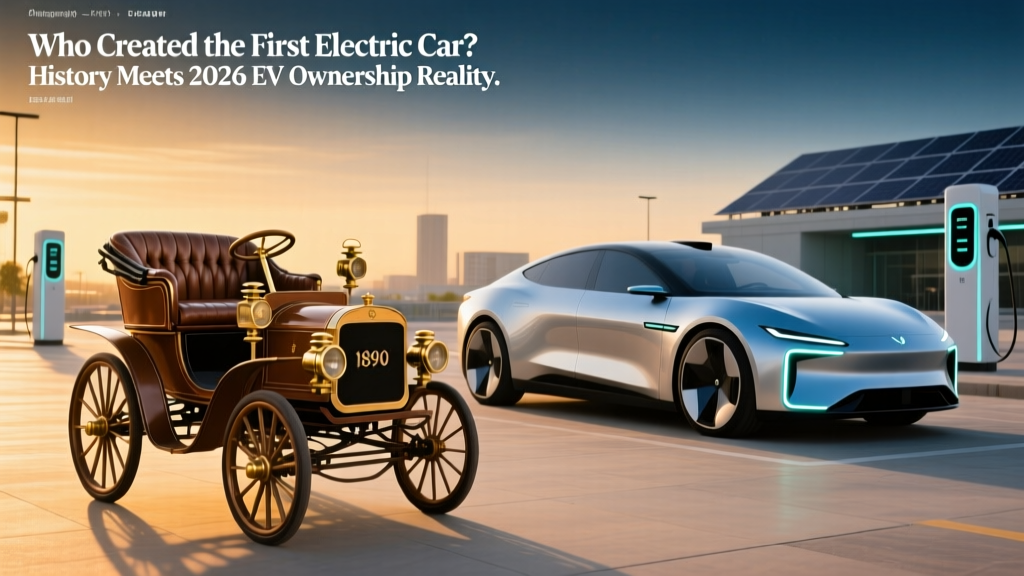
The earliest crude electric carriage is credited to Robert Anderson of Scotland, who built a non-rechargeable electric vehicle sometime between 1832 and 1839. The first practical, rechargeable electric car emerged in the 1880s–1890s, with key contributions from Thomas Parker (London, 1884), Andreas Flocken (Germany, 1888 — often called the first true four-wheel electric car), and William Morrison (Des Moines, Iowa, 1890–1891 — the first successful US electric vehicle). By 1900, electric cars outsold gasoline vehicles in the United States. The internal combustion engine eventually won on range and refueling infrastructure — the same factors EV buyers still weigh today.
More than a century later, those original advantages of electric propulsion — instant torque, quiet operation, zero tailpipe emissions — are back. But so are the original limitations, just in modern form: range, charging infrastructure, and upfront cost. This guide bridges the history with the hard numbers you need to decide whether a 2026 EV actually fits your life and budget.
From Robert Anderson to 2026: The EV Timeline That Matters for Buyers
Understanding EV history isn't trivia — it explains why today's market looks the way it does. Here's the arc that shapes what you'll find on dealer lots right now:
- 1832–1839: Robert Anderson builds a non-rechargeable electric carriage in Scotland. No batteries you could plug in — just a proof of concept.
- 1884: Thomas Parker builds a rechargeable electric car in London using improved battery cells.
- 1888: Andreas Flocken's Flocken Elektrowagen in Germany is widely considered the first real four-wheel electric car.
- 1890–1891: William Morrison's six-passenger electric wagon in Iowa becomes the first commercially viable US electric vehicle, reaching roughly 14 mph with a ~100-mile range on a single charge — a number that wouldn't be matched by modern production EVs until the 2010s.
- 1900: Electric vehicles outsell gasoline cars in America. They're quiet, clean, and don't require hand-cranking.
- 1908–1920s: The Ford Model T, cheap gasoline, and rural electrification gaps kill the first EV era. Range and refueling convenience win.
- 1996–2003: GM's EV1 becomes the first modern production electric car, leased to ~1,100 drivers before the program's controversial cancellation.
- 2008–2012: Tesla Roadster and Nissan Leaf reignite the market with lithium-ion batteries.
- 2026: Over 40 EV models are available in the US, with EPA ranges spanning 200–516 miles, DC fast charging up to 350 kW, and federal tax credits up to $7,500 under IRS §30D rules.
The pattern across 190 years: EVs succeed when battery energy density (kWh per pound) and charging infrastructure keep pace with what drivers actually need. That tension still defines every purchase decision.
What Does a 2026 EV Actually Cost to Own vs. a Gas Car?
History aside, most readers landing on "who created the first electric car" are actually researching whether to buy one. The economics have shifted dramatically. Here's a realistic five-year ownership comparison using a mainstream 2026 EV (e.g., Hyundai Ioniq 5 or Tesla Model Y) versus a comparable gas-powered compact SUV averaging 28 MPG combined.
| Category | 2026 EV (Mid-Range) | Gas Compact SUV (28 MPG) |
|---|---|---|
| Base MSRP (before incentives) | $42,000–$48,000 | $32,000–$38,000 |
| Federal tax credit (§30D) | −$3,750 to −$7,500* | $0 |
| Effective purchase price | $34,500–$44,250 | $32,000–$38,000 |
| Fuel/energy (5 yrs, 75k mi) | $3,800–$5,600** | $9,400–$11,200*** |
| Maintenance (5 yrs) | $1,200–$2,000 | $3,500–$5,000 |
| Insurance (5 yrs avg) | $9,500–$12,500 | $7,500–$10,000 |
| Depreciation (est. 5-yr) | 45–55% | 35–45% |
| 5-yr total cost of ownership | $52,000–$68,000 | $54,000–$66,000 |
*§30D credit eligibility depends on MSRP caps ($55,000 sedans / $80,000 SUVs/trucks), buyer AGI limits ($150K single / $300K joint), battery critical-mineral and component sourcing rules, and point-of-sale transfer. Always verify at IRS.gov and with a tax professional.
**Based on $0.14–$0.20/kWh home charging and 3.5 mi/kWh efficiency. Public DC fast charging at $0.35–$0.55/kWh raises costs significantly.
***Based on $3.40–$4.00/gal and 28 MPG combined per fueleconomy.gov.
The takeaway: EVs close the upfront gap primarily through the tax credit and lower operating costs, but they don't automatically win on total cost. Insurance premiums run 15–25% higher on average due to repair costs for battery packs and aluminum structures, and depreciation has been steeper for EVs since 2023's used-EV price correction. The math only works if you can charge at home at residential rates.
Range, Charging, and the Same Problem Robert Anderson Couldn't Solve
Robert Anderson's 1830s carriage died when its non-rechargeable cells were spent. Modern EVs have solved the rechargeable part — but range and charging speed remain the decisive purchase factors. Here's what 2026 actually delivers, stripped of marketing:
| Metric | Typical 2026 EV | Gas Vehicle |
|---|---|---|
| EPA range / tank | 250–350 mi (up to 516 mi max) | 380–500 mi |
| Real-world highway range | EPA minus 10–20% | EPA minus 5–10% |
| Cold-weather loss (20°F) | 20–35% without heat pump; 10–20% with | 5–10% |
| Refuel/recharge time | 10–80% DC fast: 18–35 min (150–250 kW peak) | 3–5 minutes |
| Home "refuel" (Level 2, 11.5 kW) | ~8–10 hours 0–100% (overnight) | N/A |
| Cost per mile (energy) | $0.04–$0.06 (home) / $0.10–$0.16 (public DC) | $0.12–$0.14 |
A few specifics matter for buyers cross-shopping right now:
- Peak kW is not sustained kW. A vehicle advertising "240 kW peak" may hold that rate from 10–40% State of Charge, then taper sharply. The 10–80% time is the number that matters — expect 18–25 minutes on a properly preconditioned 800V architecture (Hyundai Ioniq 5, Kia EV6, Porsche Taycan) and 30–40 minutes on 400V systems.
- Cold weather is the original EV killer. Below freezing, battery chemistry slows and cabin heating draws 2–5 kW continuously. A 300-mile EPA EV can realistically deliver 200–230 highway miles at 20°F even with a heat pump. If you live above the 40th parallel, plan for this.
- kWh is energy (tank size); kW is power (flow rate). A 77 kWh battery at a 250 kW charger is like a 15-gallon tank at a 25-gallon-per-minute pump. Confusing these is the single most common EV literacy gap.
Home Charging Access: The Make-or-Break Ownership Factor
In 1890, William Morrison's EV worked because he operated in a city with emerging electrical infrastructure. In 2026, the equivalent is home Level 2 charging. Without it, EV ownership shifts from convenient to burdensome for most drivers.
Here's what a realistic 2026 home charging installation costs:
- Level 2 charger (240V, 40–48A): $400–$750 for the unit (ChargePoint Home Flex, Emporia Vue, Tesla Universal Wall Connector)
- Electrician labor (50–60A circuit, 20–50 ft run): $800–$2,500
- Permit and inspection: $100–$350 depending on jurisdiction
- Electrical panel upgrade (if needed, 100A → 200A): $1,500–$3,500
- Total typical range: $1,300–$3,500 without panel upgrade; $3,000–$6,500 with one
The federal Alternative Fuel Vehicle Refueling Property Credit (§30C) may cover up to 30% of equipment and installation costs (max $1,000 for residential), subject to income and census-tract eligibility. Check current-year IRS guidance before committing.
If you cannot install home charging — apartment dwellers, street parkers, condo owners without HOA cooperation — the ownership calculus changes substantially. You'll rely on public Level 2 and DC fast charging, which costs 2–4x more per kWh and adds 30–60 minutes of weekly errand time. A plug-in hybrid (PHEV) with 30–40 miles of electric range and a gas engine for longer trips may be the more practical electrified choice in that scenario.
Common EV Misconceptions — Fact-Checked with 2026 Data
| Myth | Fact (2026 Data) |
|---|---|
| "EV batteries need replacing every 5–8 years." | Federal law mandates 8-year/100,000-mile battery warranty (10 yrs/150k in CARB states). Average degradation is 10–15% over 100k miles for NMC chemistry, 8–12% for LFP. Most packs outlast the vehicle. (NHTSA) |
| "EVs are worse in winter." | Range drops 20–35% in sub-freezing temps — real and significant. But EVs start instantly in cold (no cranking), and preconditioning while plugged in mitigates much of the loss. AWD EVs with heat pumps (e.g., Hyundai/Kia E-GMP, Tesla) perform well on snow. |
| "The grid can't handle mass EV adoption." | Most EV charging occurs overnight during off-peak hours. A single EV adds roughly the load of a central AC unit. Utilities manage this with time-of-use rates. Simultaneous unmanaged daytime charging at scale would strain local transformers — which is why smart charging and V2G matter. |
| "EVs produce more lifetime emissions than gas cars." | Manufacturing an EV creates 30–50% more emissions initially (battery production). But over a 150,000-mile lifespan, even on coal-heavy grids, EVs break even by ~20,000–35,000 miles and produce 50–70% fewer lifetime emissions on the current US average grid mix (Argonne National Laboratory data). |
| "All EVs qualify for the $7,500 tax credit." | As of 2026, many popular EVs qualify for only $3,750 or $0 due to battery critical-mineral sourcing rules, MSRP caps, and buyer income limits. Always check the fueleconomy.gov tax credit database for the specific model and trim. |
Decision Framework: Should You Buy an EV, a Hybrid, or Stick with Gas?
The honest answer depends on your specific situation, not ideology. Use this framework:
Choose a Battery-Electric Vehicle (BEV) If:
- You can install Level 2 home charging (garage, driveway, or cooperative HOA)
- Your daily driving is under 80 miles round-trip (covers 90%+ of US commutes)
- You take road trips ≤2 times per month and can plan 20–30 minute DC fast-charge stops
- You qualify for at least $3,750 in federal/state incentives
- You want the lowest per-mile energy cost and minimal maintenance (no oil changes, fewer brake replacements due to regen)
Choose a Plug-In Hybrid (PHEV) If:
- You lack reliable home charging but want some electric-only driving
- Your daily commute is under 30–40 miles (most PHEVs' electric range)
- You take frequent long road trips and don't want to plan around charging
- You want electrification without range anxiety in extreme cold
Choose a Conventional Hybrid (HEV) or Gas Vehicle If:
- You have zero home charging access and limited public charging nearby
- You regularly tow heavy loads (trailers, boats) — EV range drops 40–60% under tow
- Your annual mileage is under 8,000 miles — the fuel savings won't offset EV premium pricing
- You're buying used on a tight budget (sub-$18,000) and can't absorb potential battery risk
What First-Time EV Buyers Should Know Before Signing
If the history of electric cars teaches anything, it's that technology alone doesn't determine ownership satisfaction — infrastructure and expectations do. Before you buy in 2026, verify these six items:
- Confirm tax credit eligibility for the exact VIN. The dealer's point-of-sale transfer requires the vehicle to meet §30D sourcing rules. Use the IRS portal and the fueleconomy.gov credit lookup — don't rely on salesperson assurances.
- Get an electrician quote before purchase. A $300 pre-purchase consultation prevents a $4,000 surprise panel upgrade. Confirm your home's available amperage on a 240V circuit.
- Test-charge on a public DC fast charger during the test drive. Verify the vehicle's actual charge curve and that your local networks (Electrify America, EVgo, ChargePoint, Tesla Supercharger via NACS adapter) work reliably.
- Check insurance quotes for the exact trim. EV insurance varies wildly — a Tesla Model Y can cost 20–35% more to insure than a Toyota RAV4 in the same ZIP code.
- Understand the battery chemistry. LFP (lithium iron phosphate) batteries tolerate daily 100% charging and degrade slower but are heavier and less cold-tolerant. NMC/NCA batteries offer more range per pound but prefer 20–80% daily State of Charge for longevity.
- Drive it in conditions matching your real life. A 70°F spring test drive tells you nothing about January highway range in Minnesota. If possible, test in cold, at highway speeds, and with climate control running.
Frequently Asked Questions
Who is officially credited with creating the first electric car?
Robert Anderson of Scotland built the earliest known electric carriage between 1832 and 1839, though it used non-rechargeable primary cells. The first practical rechargeable electric cars came from Thomas Parker (1884, London), Andreas Flocken (1888, Germany), and William Morrison (1890, Iowa). There is no single inventor — it was an incremental evolution across decades.
Why did electric cars disappear after 1900 if they were popular?
Three factors: (1) cheap Texas oil made gasoline affordable, (2) the electric starter (1912) eliminated hand-cranking gas engines, and (3) rural America lacked electricity while gasoline distribution expanded rapidly. EVs couldn't match the range and refueling convenience for long-distance travel. These same infrastructure dynamics — charging availability and range — remain the core purchase considerations in 2026.
How much does it cost to charge an EV at home per month?
For a driver covering 1,000 miles per month in an EV averaging 3.5 miles per kWh, that's roughly 286 kWh monthly. At the US residential average of $0.16/kWh (2025–2026 EIA data), that's about $46/month — compared to $120–$140/month in gasoline for a 28 MPG vehicle covering the same distance. Your actual cost depends on local utility rates and whether you use time-of-use pricing to charge during off-peak hours.
Do EV batteries need to be replaced, and how much does it cost?
Most modern EV batteries are designed to last the life of the vehicle. Federal warranty mandates require 8 years/100,000 miles of coverage (with a capacity-retention threshold, typically 60–70% of original). Out-of-warranty replacement costs range from $5,000–$9,000 for smaller packs (Chevrolet Bolt, Nissan Leaf) to $12,000–$22,000 for large packs (Tesla Model S/X, Rivian, GMC Hummer EV). However, real-world failure rates before 150,000 miles remain low — well under 5% based on manufacturer and fleet data.
Is a hybrid a better choice than a full EV in 2026?
It depends entirely on your charging access and driving patterns. If you can charge at home and drive under 80 miles daily, a BEV offers lower operating costs and less maintenance. If you lack home charging, frequently drive over 300 miles in a day, regularly tow, or live in extreme cold, a PHEV or HEV may be more practical. There is no universally correct answer — only the right answer for your specific miles, climate, and housing situation.