The VW Electric Bus Interior at a Glance
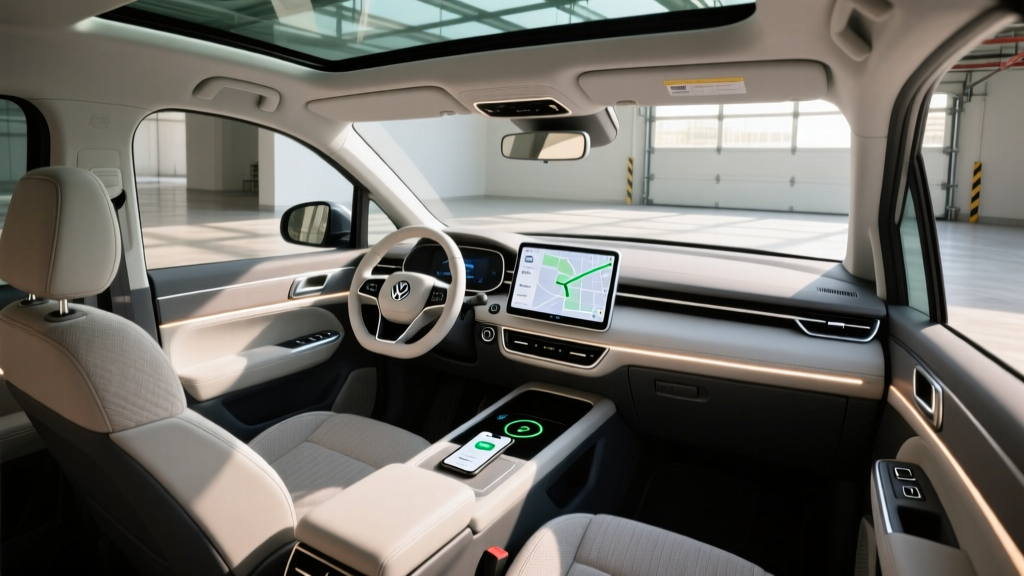
The 2026 Volkswagen ID. Buzz delivers a genuinely spacious, retro-modern cabin that seats up to seven across three rows. The VW electric bus interior features a 12.9-inch infotainment display, a 5.3-inch digital instrument cluster, and a flexible seating layout with sliding second-row captain's chairs. Behind the third row, you get approximately 18.6 cubic feet of cargo space; fold everything flat and capacity expands to roughly 137.5 cu ft. Build quality is solid, though some hard plastics appear on lower door panels and the rear cargo area. The ID. Buzz starts at an MSRP of $59,995 (Pro S trim), and as a 3-row SUV/van classified vehicle, it may qualify for the $7,500 federal §30D tax credit if you meet income and battery-sourcing requirements.
Seating, Space, and the Three-Row Reality
The ID. Buzz rides on VW's MEB platform with a 117.7-inch wheelbase, and that length pays dividends inside. The front row offers generous headroom and a commanding, bus-like driving position that feels airy thanks to the tall greenhouse and large windshield. Heated and ventilated front seats are standard on the Pro S, with a heated steering wheel and synthetic leather (SofTex-style) upholstery across all trims.
The second row is where the VW electric bus interior earns its family-hauler credentials. Two captain's chairs slide fore and aft on tracks, recline, and feature outboard seat heaters. With the second row pushed all the way back, legroom is limousine-like — adults over six feet will have no complaints. A center walk-through allows access to the third row without folding the second-row seats forward, a practical advantage over many SUV competitors.
The third row is a legitimate differentiator. Unlike the token third rows in compact SUVs, the ID. Buzz's rear bench can accommodate adults for shorter trips, though headroom tapers slightly due to the sloping rear roofline. For children and teenagers, it's a comfortable full-time seat. All three rows offer USB-C ports, and tri-zone automatic climate control is standard.
Tech, Infotainment, and the Digital Cockpit
VW has moved past the frustrating software launch of early ID.4 models. The ID. Buzz runs the latest VW ID.Software 4.0 with a 12.9-inch central touchscreen that's responsive, logically organized, and supports wireless Apple CarPlay and Android Auto. The capacitive touch slider for volume and temperature remains — functional, though some buyers will miss physical knobs.
The 5.3-inch digital instrument cluster is compact but clear, showing speed, range, and navigation prompts without clutter. An available head-up display projects turn-by-turn directions and speed onto the windshield. The ID. Buzz also includes VW's IQ.DRIVE suite (a Level 2 driver-assistance system per SAE classification), featuring adaptive cruise control, lane-keeping assist, and Travel Assist for highway cruising. This is not autonomous driving — the driver must remain attentive and keep hands on the wheel at all times.
Range, Charging, and Efficiency: The Numbers
The interior experience only matters if the drivetrain gets you where you need to go. Here's what the 2026 ID. Buzz delivers:
| Specification | 2026 VW ID. Buzz (Pro S RWD) | 2026 VW ID. Buzz (4Motion AWD) |
|---|---|---|
| Battery (usable) | 86 kWh (NMC chemistry) | 86 kWh (NMC chemistry) |
| EPA Range | ~234 miles | ~231 miles |
| Real-World Highway Range | ~195–210 miles | ~190–205 miles |
| Motor Output | 282 hp / 406 lb-ft | 335 hp (combined) |
| 0–60 mph | ~7.9 seconds | ~6.5 seconds |
| Peak DC Fast Charge | 175 kW | 175 kW |
| 10–80% DC Charge Time | ~26 minutes | ~26 minutes |
| Level 2 (AC) Charge Rate | 11 kW | 11 kW |
| MPGe (combined) | ~87 MPGe | ~84 MPGe |
Sources: fueleconomy.gov, Volkswagen of America official specifications.
Real-World Range Reality: The EPA sticker says 234 miles for the RWD model, but expect roughly 195–210 miles on sustained highway driving at 70+ mph. In cold weather (below 30°F), plan for an additional 15–25% reduction, bringing effective range to approximately 155–175 miles in winter conditions. The 86 kWh NMC battery includes a thermal management system with preconditioning — use it when navigating to a DC fast charger to maximize charge speed.
Cost of Ownership: ID. Buzz vs. Gas Minivan
How does the VW electric bus interior and ownership experience compare to a gasoline rival like the Honda Odyssey or Toyota Sienna hybrid? Let's break down the numbers over five years and 75,000 miles.
| Cost Factor | 2026 VW ID. Buzz (RWD) | 2026 Honda Odyssey (Elite) | 2026 Toyota Sienna (XLE AWD) |
|---|---|---|---|
| Base MSRP | $59,995 | $49,100 | $47,000 |
| Federal Tax Credit (§30D) | Up to $7,500* | $0 | $0 (HEV) |
| Effective Purchase Price | ~$52,495 | $49,100 | $47,000 |
| Fuel/Energy (5 yr / 75k mi) | ~$4,200 (home charging)** | ~$10,500 (gas @ $3.50/gal, 22 mpg) | ~$6,400 (gas @ $3.50/gal, 36 mpg) |
| Maintenance (5 yr) | ~$1,200 | ~$3,800 | ~$3,200 |
| Insurance (5 yr est.) | ~$12,500 | ~$9,800 | ~$9,500 |
| Estimated 5-Year Total Cost | ~$70,395 | ~$73,200 | ~$66,100 |
* §30D eligibility depends on buyer AGI, vehicle MSRP classification, and battery critical-mineral sourcing. Verify current rules at irs.gov. ** Based on national average electricity rate of ~$0.17/kWh and 2.5 kWh/mile efficiency.
The ID. Buzz carries a higher upfront cost, but the fuel and maintenance savings close the gap substantially over five years — especially if you charge primarily at home on off-peak rates. The Toyota Sienna hybrid remains the cost champion due to its lower sticker price and exceptional 36 mpg combined, but it cannot match the ID. Buzz's instant torque, near-silent operation, or the ability to "refuel" in your garage overnight.
Common Misconceptions About the ID. Buzz
| Myth | Fact |
|---|---|
| "It's basically a converted gas van." | The ID. Buzz is built on VW's dedicated MEB electric platform with a flat floor, rear-mounted motor, and no engine bay compromises. |
| "234 miles of range isn't enough for a family vehicle." | For daily driving and school commutes, 234 miles is more than sufficient. For road trips, the 175 kW DC fast-charge capability adds ~140 miles in 20 minutes. Plan charging stops around meals and rest breaks. |
| "You can't take it on road trips." | The ID. Buzz has completed multiple documented 1,000+ mile road trips. The CCS/NACS charging network (via adapters on newer models) covers major interstate corridors. |
| "The battery will need replacing in a few years." | VW warranties the high-voltage battery for 8 years / 100,000 miles with a minimum 70% capacity retention guarantee. NMC batteries in thermally managed systems typically degrade 1–2% per year under normal use. |
| "It qualifies for the full $7,500 credit automatically." | Eligibility depends on your adjusted gross income (≤$300k joint / ≤$150k single), MSRP caps, and battery component sourcing rules. Consult a tax professional. |
Charging at Home: What You Actually Need
The ID. Buzz's 11 kW onboard charger means a Level 2 home station at 48 amps (on a 60-amp circuit) will fully replenish the 86 kWh battery in approximately 8.5–9 hours. This is ideal for overnight charging.
Home installation costs vary significantly by your electrical panel's capacity:
| Component | Estimated Cost |
|---|---|
| Level 2 Charger (e.g., ChargePoint Home Flex, Emporia) | $400–$700 |
| Electrician Labor (standard install, panel adjacent) | $500–$1,500 |
| Electrical Panel Upgrade (if 200A panel is full or older) | $1,500–$3,500 |
| Permits & Inspection | $100–$400 |
| Total Estimated Range | $1,000–$6,100 |
If you live in a condo or apartment without dedicated parking, public charging infrastructure becomes critical. Research your local DC fast-charging network (Electrify America, EVgo, Tesla Superchargers with NACS adapter) before purchasing. The ID. Buzz's 175 kW peak charge rate is respectable but not class-leading — expect charge sessions to taper significantly above 80% state of charge, which is why the 10–80% metric matters more than peak kW alone.
Decision Framework: Is the ID. Buzz Right for You?
Choose the VW ID. Buzz if:
- You need genuine 7-passenger seating with adult-usable third-row space
- You have home charging access (garage or driveway with a 240V outlet)
- You value a quiet, refined ride with instant electric torque for city and suburban driving
- You want a distinctive, retro-styled vehicle that stands out from crossover SUVs
- Your typical daily driving is under 150 miles, and road trips are occasional
Consider an alternative if:
- You regularly drive 300+ miles between charging stops (consider a longer-range EV or a hybrid like the Sienna)
- You lack any home or workplace charging access
- Your budget is strictly under $45,000 (the Sienna or Odyssey offers lower entry pricing)
- You need maximum cargo volume behind the third row — the ID. Buzz's 18.6 cu ft is modest compared to a full-size minivan's ~35 cu ft
- You frequently tow — the ID. Buzz is rated for only 2,500 lbs (braked)
Frequently Asked Questions
Does the VW ID. Buzz have a frunk (front trunk)?
No. The ID. Buzz does not include a front trunk. All cargo space is concentrated in the rear. VW uses the front area for HVAC components and the 12V auxiliary battery.
Is the ID. Buzz available with all-wheel drive?
Yes. The 4Motion AWD variant adds a front motor for a combined 335 hp and improved traction in rain and snow. AWD reduces EPA range by approximately 3 miles (231 vs. 234).
What's the real cost per mile to drive the ID. Buzz?
At the U.S. average electricity rate of ~$0.17/kWh and an efficiency of roughly 2.5 kWh/mile (≈400 Wh/mi), you're looking at approximately $0.04–$0.05 per mile on home charging. Public DC fast charging at $0.35–$0.48/kWh pushes that to $0.09–$0.12 per mile — still cheaper than gasoline at current prices.
How does the ID. Buzz perform in cold weather?
The ID. Buzz includes a heat pump (standard on most trims), which significantly reduces the energy penalty of cabin heating compared to resistive heaters. Still, expect 15–25% range loss in sustained sub-freezing temperatures. Preconditioning the battery while plugged in helps preserve range and improves regenerative braking performance in cold conditions.
Is the ID. Buzz eligible for state EV incentives beyond the federal credit?
Many states offer additional rebates or tax credits (e.g., California's CVRP, Colorado's state credit, New York's Charge Drive). These vary by jurisdiction and change frequently. Check your state's energy office or afdc.energy.gov for current programs.