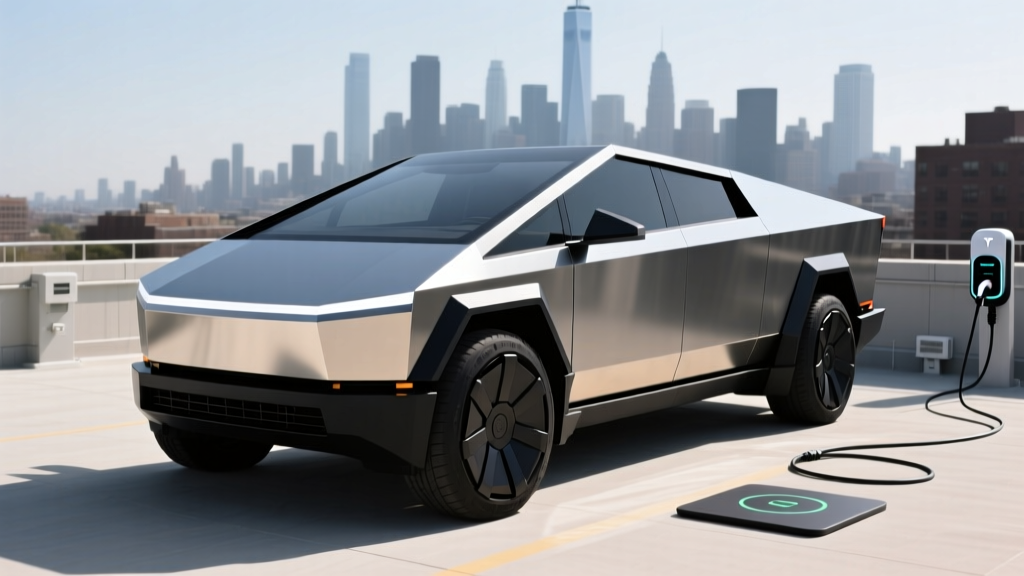
Cybertruck 0-60: Quick Verdict
If you searched "Cybertruck 0-60" you're likely trying to parse a confusing spread of numbers. Tesla publishes three different acceleration figures depending on trim and whether the optional "Acceleration Boost" software is enabled. Here are the manufacturer-claimed 0–60 mph times for the 2025–2026 model year lineup, measured with 1-foot rollout subtracted (the SAE standard Tesla uses):
- Cyberbeast (tri-motor AWD): 2.6 seconds
- AWD (dual-motor) with Acceleration Boost: 3.9 seconds
- AWD (dual-motor) stock: 4.1 seconds
- Rear-Wheel Drive (single-motor): 6.5 seconds (announced, deliveries expected 2026)
For context, a 2.6-second Cyberbeast puts the 6,800-lb stainless-steel truck in hypercar territory — roughly matching a Bugatti Chiron to 60 mph despite weighing four times as much. Independent tests by outlets like MotorTrend and Car and Driver have validated the Cyberbeast's 2.6-second claim on prepped surfaces, though real-world street launches on unprepped pavement typically yield 2.8–3.1 seconds due to the truck's 35-inch all-terrain tires prioritizing off-road grip over drag-strip adhesion.
Full Powertrain & Performance Specs
| Spec | RWD (announced) | AWD | Cyberbeast |
|---|---|---|---|
| Drivetrain | Single-motor RWD | Dual-motor AWD | Tri-motor AWD |
| Horsepower | ~315 hp (est.) | 600 hp | 845 hp |
| 0–60 mph | 6.5 sec | 4.1 sec (3.9 w/ Boost) | 2.6 sec |
| Top Speed | 112 mph | 130 mph | 130 mph |
| Max Towing | 7,500 lb (est.) | 11,000 lb | 11,000 lb |
| Payload | ~1,800 lb | 2,500 lb | 2,500 lb |
| EPA Range | ~250 mi (est.) | 340 mi | 320 mi |
| Base MSRP | ~$60,990 | $79,990 | $99,990 |
Real-World Range: What the EPA Sticker Doesn't Tell You
- Highway (75 mph sustained): ~265–285 miles usable
- City / stop-and-go: ~320–340 miles (regen recovers energy)
- Cold weather (30°F and below): ~230–260 miles (20–25% loss, mitigated partially by the standard heat pump)
- While towing (5,000 lb trailer): ~150–180 miles — range roughly halves under load
The Cybertruck's angular stainless-steel exoskeleton looks futuristic but carries a real aerodynamic penalty compared to the more rounded Rivian R1T. Its drag coefficient is estimated around 0.38–0.39 — poor for an EV — which is why highway efficiency degrades noticeably above 70 mph.
Battery Chemistry, Capacity & Charging Speed
Tesla has not officially published the Cybertruck's exact pack capacity, but teardowns and EPA-filing analysis point to a ~123 kWh usable NMC (nickel-manganese-cobalt) lithium-ion pack sourced from Tesla's 4680 cell production lines in Texas and California. NMC chemistry was chosen over LFP here because the truck's weight (~6,800 lb curb) demands the higher energy density that NMC provides — LFP cells would add too much mass for the required range.
| Charging Level | Rate | Time / Miles Added |
|---|---|---|
| DC Fast Charge (peak) | 250 kW (V3 Supercharger) | 10–80% in ~28 minutes |
| DC sustained (20–60% SoC) | ~200–220 kW avg | ~150 miles in 15 min |
| Level 2 home (48A / 11.5 kW) | 11.5 kW | ~37 miles per hour of charging |
| Level 2 home (80A Wall Connector) | 19.2 kW (truck limited to ~17 kW onboard) | ~55 miles per hour |
| Level 1 (120V / 12A) | 1.4 kW | ~4–5 miles per hour (emergency use only) |
Charging-curve reality: The Cybertruck peaks at 250 kW only between roughly 15–35% state of charge. By 60% SoC the rate tapers to ~120 kW, and above 80% it drops below 50 kW. For road trips, plan stops from 10–80% rather than topping to 100% — the final 20% can add 25+ minutes with minimal range gained.
The truck uses the NACS (Tesla) connector natively, giving it first-party access to the 6,000+ V3 and V4 Supercharger stalls across North America — still the most reliable DC network by uptime, per J.D. Power and PlugShare data.
Efficiency: MPGe and kWh/100mi
According to fueleconomy.gov, the dual-motor AWD Cybertruck achieves:
- Combined MPGe: 67 MPGe
- Energy consumption: ~50 kWh/100 miles combined
- Highway: ~59 MPGe (~57 kWh/100mi)
- City: ~76 MPGe (~44 kWh/100mi)
That's thirsty by EV standards — a Model Y Long Range sips roughly 28 kWh/100mi. The Cybertruck's mass, boxy aero, and all-terrain tires all contribute. At the U.S. average electricity price of ~$0.17/kWh (EIA, 2025), filling the pack costs roughly $21 and yields a "fuel" cost of ~8.5 cents per mile — still cheaper than a comparable gas F-150 at ~18–22 cents per mile, but not the bargain smaller EVs deliver.
Pricing, Trims & Federal Tax Credit Eligibility
| Trim | Base MSRP | As-tested typical | §30D Credit Eligible? |
|---|---|---|---|
| RWD (announced) | ~$60,990 | ~$62,000 | Likely — under truck MSRP cap |
| AWD | $79,990 | $85,000–$92,000 | Yes — qualifies under §30D truck cap ($80k) |
| Cyberbeast | $99,990 | $105,000–$115,000 | No — exceeds $80k MSRP cap for trucks |
Federal tax credit rules (IRS §30D, current-year guidance at irs.gov):
- The MSRP cap is $80,000 for trucks, $80k for SUVs, $55k for sedans. The AWD trim lands exactly at the truck cap, so option-heavy AWD builds can exceed it and lose eligibility.
- Buyer adjusted gross income must not exceed $300,000 (MFJ), $225,000 (HoH), or $150,000 (single).
- The vehicle must meet critical-mineral and battery-component sourcing requirements — Tesla's U.S. production and 4680 cell sourcing currently qualifies most AWD builds for the full $7,500, but verify via the IRS VIN-lookup tool before purchase.
- Since 2024, the credit can be transferred at point-of-sale, reducing your purchase price directly rather than waiting for a tax refund.
- The Cyberbeast at $99,990 does not qualify — the MSRP cap is a hard cutoff regardless of income.
Cargo, Passenger Space & Daily Usability
The Cybertruck seats five across two rows. Interior dimensions are generous up front but the rear seat is compromised by the vault-style bed wall behind it:
- Front legroom: ~41.5 in
- Rear legroom: ~38.4 in (adequate but less than F-150 Lightning's ~42 in)
- Bed (vault) length: 6 ft with tailgate up; ~7 ft with tailgate down
- Bed volume: ~67 cu ft
- Frunk (front trunk): ~7.1 cu ft — useful for charging cables and groceries
- Max towing: 11,000 lb (AWD/Cyberbeast)
The powered tonneau-style bed cover ("vault") is lockable and weather-sealed — a real advantage over open-bed trucks for secure storage. However, the stainless-steel bed is prone to scratching, and the sharp angular bed sides have drawn safety criticism from European regulators (the vehicle is not sold in the EU partly due to pedestrian-protection rules).
Standout Tech, Driver Assists & Drawbacks
Tech highlights:
- 18.5-inch central touchscreen running Tesla's latest infotainment (fast, responsive, but nearly all vehicle controls are menu-driven — no physical buttons for climate, mirrors, or glovebox)
- 48-volt electrical architecture — an industry-first for a production pickup, enabling thinner wiring, lighter weight, and the steer-by-wire system
- Steer-by-wire with variable ratio: just 340° lock-to-lock (less than one full turn), eliminating the need for hand-over-hand maneuvers
- Standard Autopilot (SAE Level 2 — driver must remain engaged); optional FSD (Supervised) for $8,000 or $99/mo subscription
- Bioweapon Defense Mode (HEPA filtration), power-folding tonneau, integrated bed outlets (120V/240V up to 11.5 kW output for job-site or camping use)
Notable drawbacks:
- Steer-by-wire and rear-wheel steering require a learning curve — low-speed maneuvering feels oddly direct, and parking-lot feedback is muted
- Stainless-steel panels show fingerprints constantly and cannot be repaired conventionally — dents require panel replacement
- No Apple CarPlay or Android Auto — Tesla's ecosystem is walled
- Insurance premiums are steep: average ~$3,800–$4,500/year per 2025 industry data, driven by repair cost and parts scarcity
- Build quality variance: early 2024–2025 units had panel-gap and tonneau-motor issues; 2026 builds are more consistent but still worth inspecting at delivery
Who the Cybertruck Suits (And Who Should Skip It)
- You want a 2.6-second 0–60 truck that doubles as a status object
- You need 11,000-lb towing and 2,500-lb payload with 340-mile range
- You're committed to the Tesla/Supercharger ecosystem and want native NACS
- You value the secure, lockable vault bed for gear and tools
- You need family-friendly rear-seat comfort — Rivian R1T and F-150 Lightning offer more rear room and CarPlay
- You want the lowest cost-per-mile EV — Model Y or Ioniq 5 deliver half the kWh/100mi
- You drive in areas with narrow streets or tight garages — the Cybertruck is 80 inches wide without mirrors
- You want a truck for serious off-road work — approach/departure angles are decent but ground clearance (up to 17.4 in in Extract Mode) is air-suspension dependent
Warranty Coverage
- Basic vehicle: 4 years / 50,000 miles
- Battery & drive units: 8 years / 120,000 miles (whichever comes first), with minimum 70% capacity retention guaranteed over that term per Tesla's warranty documentation
- Rust-through (body): 4 years / 50,000 miles — notably, the stainless exoskeleton itself is corrosion-resistant, but underlying chassis components are covered conventionally
Long-term 4680 cell degradation data is still accumulating (the pack architecture is newer than the Model 3/Y 2170 cells), but Tesla's published warranty aligns with industry norms set by Hyundai/Kia at 8/100k and falls slightly short of Rivian's 8/175k battery coverage.
Pros & Cons
- Cyberbeast's 2.6s 0–60 is supercar-tier in a pickup
- Native NACS/Supercharger access — best DC network
- 11,000-lb towing + 340-mile range is a rare combo
- 48V architecture and steer-by-wire are genuinely new engineering
- Secure lockable vault bed with 240V outlet
- 67 MPGe is poor efficiency; expensive per mile
- Cyberbeast doesn't qualify for §30D credit (over $80k cap)
- Stainless panels show fingerprints and can't be traditional-repaired
- No CarPlay/Android Auto
- High insurance cost (~$4k/yr)
- Rear seat less spacious than F-150 Lightning or R1T
Cybertruck 0-60 FAQ
What is the real-world range of the Cybertruck?
EPA-rated at 340 miles (AWD) and 320 miles (Cyberbeast), but expect 265–285 miles highway, and 230–260 miles in sub-freezing cold. Towing cuts range roughly in half.
How fast does the Cybertruck charge?
Peak 250 kW on V3 Superchargers with a 10–80% time of ~28 minutes. At home on a 48A Level 2 wall connector, expect ~37 miles of range added per hour; the 80A Wall Connector pushes that to ~55 miles per hour.
How much does the Cybertruck cost after the federal tax credit?
The AWD at $79,990 MSRP can qualify for the full $7,500 §30D credit (if buyer income and battery-sourcing rules are met), bringing effective price to ~$72,490 before options. The Cyberbeast at $99,990 exceeds the $80k truck MSRP cap and does not qualify. Always verify on the IRS VIN tool before purchase.
Is the Cybertruck worth it versus the Rivian R1T or F-150 Lightning?
For outright acceleration and Supercharger convenience, yes. For family usability, rear-seat comfort, Apple CarPlay, and a more conventional truck feel, the R1T (tri-motor, 3.0s 0–60) and Lightning (cheaper, roomier, Pro Power Onboard) are strong alternatives.
Does the Cybertruck 0-60 time hold up in real life?
The Cyberbeast's 2.6-second claim is validated on prepped surfaces by independent testers. On typical street pavement, expect 2.8–3.1 seconds due to tire grip limits. Repeated hard launches also trigger thermal management, so the truck won't deliver the same time back-to-back without cooldown.
What's the biggest regret owners report?
Insurance premiums, fingerprint magnetism on stainless panels, and the lack of physical controls (opening the glovebox requires a screen tap) are the most-cited daily annoyances in owner forums and TeslaFi community surveys.
Sources consulted: fueleconomy.gov (EPA efficiency data), IRS §30D clean vehicle credit guidance, Tesla official specifications and owner's manual. Prices and credit eligibility reflect 2025–2026 model-year data and current IRS rules; always confirm at point of purchase.