Quick Answer: Which VW EV Car Is Right for You?
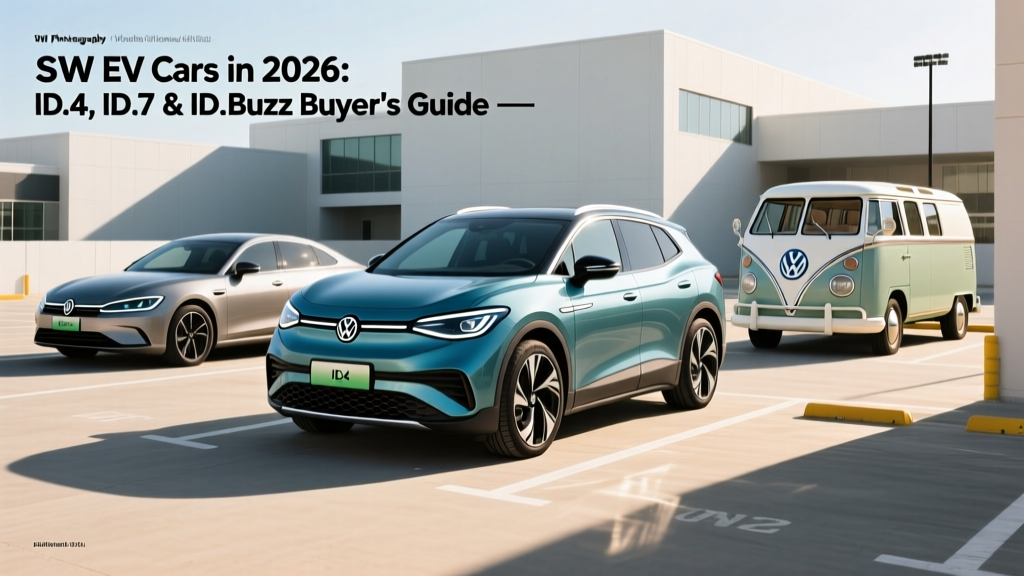
Volkswagen currently sells three battery-electric vehicles in the U.S.: the ID.4 compact SUV (EPA range up to 291 miles, starting ~$39,735), the ID.7 sedan (EPA range up to 342 miles, starting ~$49,990), and the ID.Buzz three-row minivan (EPA range up to 234 miles, starting ~$59,995). All three use VW's MEB platform with NMC battery chemistry, support DC fast charging at up to 175–200 kW, and come with a 8-year/100,000-mile battery warranty. The ID.4 is the volume seller and most likely to qualify for the federal §30D tax credit, while the ID.7 targets range-focused commuters and the ID.Buzz serves families needing three rows and cargo space.
VW's 2026 EV Lineup: Specs at a Glance
Volkswagen's U.S. electric strategy centers on practical, mainstream vehicles rather than luxury performance. Here's how the three current models stack up on paper and in real-world conditions.
| Spec | 2026 ID.4 (Pro S AWD) | 2026 ID.7 (Pro S) | 2026 ID.Buzz (AWD) |
|---|---|---|---|
| Base MSRP | $43,735 | $49,990 | $64,995 |
| Entry Trim MSRP | $39,735 (Standard Range) | $49,990 | $59,995 (RWD) |
| Battery (usable) | 82 kWh (NMC) | 86 kWh (NMC) | 91 kWh (NMC) |
| EPA Range | 263 mi (AWD) / 291 mi (RWD) | 342 mi | 234 mi (AWD) / 231 mi (RWD) |
| Real-World Highway | ~220–240 mi | ~280–300 mi | ~190–210 mi |
| Peak DC Charge Rate | 175 kW | 200 kW | 175 kW |
| 10–80% DC Fast Charge | ~28 min | ~26 min | ~30 min |
| Level 2 Charge Rate | 11 kW (~7.2 hrs 0–100%) | 11 kW (~7.8 hrs 0–100%) | 11 kW (~8.3 hrs 0–100%) |
| Horsepower | 335 hp (AWD) | 282 hp (RWD) | 330 hp (AWD) |
| 0–60 mph | 5.4 sec | 6.5 sec | 6.5 sec |
| Efficiency (MPGe) | 104 MPGe combined | 115 MPGe combined | 87 MPGe combined |
| Cargo (behind 2nd row) | 30.3 cu ft | 18.6 cu ft (trunk) | 75.5 cu ft (2-row mode) |
| Battery Warranty | 8 yr / 100,000 mi | 8 yr / 100,000 mi | 8 yr / 100,000 mi |
Sources: EPA / fueleconomy.gov, Volkswagen USA. Real-world highway estimates assume 70 mph sustained, moderate climate. Cold-weather (below 30°F) range can drop 20–30% across all three models.
Real-World Range vs. EPA Stickers: What to Actually Expect
EPA range figures are tested under controlled conditions that don't fully replicate highway driving, cold weather, or mountain terrain. Here's what VW EV car owners should realistically budget for:
ID.4 (291-mile RWD EPA)
Expect 240–260 miles in mixed driving at moderate temperatures. Sustained 75+ mph highway driving drops this to ~220 miles. Below 30°F, plan for 200–210 miles. The ID.4's heat pump (standard on Pro S trims) helps mitigate winter losses compared to resistive heating.
ID.7 (342-mile EPA)
The ID.7's longer wheelbase and aerodynamic sedan profile give it VW's best real-world efficiency. Expect 290–310 miles mixed, ~280 highway, and roughly 250 in cold weather. On a 400-mile road trip, you'll need one DC fast-charge stop.
ID.Buzz (234-mile AWD EPA)
The boxy minivan shape carries an aero penalty. Expect 195–210 miles mixed and as low as 175 highway in winter. The ID.Buzz is best suited for suburban family duty with reliable home charging — road-tripping requires more frequent stops.
Charging VW EV Cars: Home, Public, and Network Access
Home Level 2 Charging
All three VW EVs accept up to 11 kW on Level 2 AC (48 amps). A full 0–100% charge takes 7–8.5 hours depending on battery size — easily overnight. A quality Level 2 home charger (ChargePoint Home Flex, Emporia Level 2, or Volkswagen's own ID. Charger) costs $400–$700 for the unit, plus $500–$2,000 for professional installation depending on panel proximity and whether you need a 200-amp service upgrade.
DC Fast Charging
VW uses the CCS1 connector on 2026 models (the ID.4 began transitioning to NACS for 2025+ models; check your specific vehicle). Peak DC rates reach 175–200 kW, but sustained rates taper significantly above 80% State of Charge. A 10–80% session takes 26–30 minutes at a capable 350 kW Electrify America station — VW's included Electrify America partnership offers complimentary charging credits on new purchases.
Common VW EV Charging Misconceptions
| Myth | Fact |
|---|---|
| "VW EVs charge slower than Tesla" | VW peaks at 175–200 kW vs. Tesla's ~250 kW. The gap is ~5–8 minutes on a 10–80% session — meaningful but not a dealbreaker with route planning. |
| "You can't road-trip a VW EV" | Electrify America has 4,500+ U.S. stations. The ID.7's 342-mile range covers most interstate segments between chargers. NACS adapter access opens Tesla Superchargers for CCS-equipped models. |
| "The battery will need expensive replacement" | VW warranties the battery for 8 years/100,000 miles with a 70% capacity retention threshold. Real-world MEB platform degradation data from European fleets shows ~8–12% loss over 100,000 miles. |
VW EV vs. Gas and Hybrid: The Real Cost Comparison
Let's compare the 2026 ID.4 Pro S AWD against a comparably equipped gas compact SUV (2026 Toyota RAV4 AWD, ~$35,000 MSRP, 30 MPG combined) and a hybrid (2026 RAV4 Hybrid AWD, ~$37,500, 39 MPG combined) over 5 years and 75,000 miles.
| Cost Category | ID.4 Pro S AWD | RAV4 AWD (Gas) | RAV4 Hybrid AWD |
|---|---|---|---|
| Purchase Price | $43,735 | $35,000 | $37,500 |
| Est. Federal Tax Credit (§30D) | Up to $7,500* | $0 | $0 |
| Effective Purchase | ~$36,235 | $35,000 | $37,500 |
| Fuel/Energy (75k mi) | $3,750 (home L2) / $6,000 (public DC) | $8,750 | $6,730 |
| Maintenance (75k mi) | ~$600 | ~$2,800 | ~$2,400 |
| Insurance (5-yr avg) | ~$9,500 | ~$7,500 | ~$7,800 |
| 5-Year Total Cost | $50,085–$52,335 | $54,050 | $54,430 |
*§30D credit eligibility depends on MSRP cap (SUVs: $80,000), buyer income limits ($150K single / $300K joint), and battery critical-mineral sourcing requirements. The ID.4 assembled in Chattanooga, TN has historically qualified — verify current-year rules at IRS.gov. Point-of-sale transfer is available through participating dealers.
Key takeaway: With the tax credit and home charging, the ID.4 undercuts both gas alternatives over 5 years. Without the credit or relying solely on public DC fast charging, the savings narrow significantly. Insurance premiums run 15–25% higher on EVs — get quotes before committing.
Federal Tax Credit & Incentives for VW EV Cars
The §30D clean vehicle credit can reduce your effective purchase price by up to $7,500, but eligibility is not automatic. Here's the checklist for 2026:
- MSRP cap: Vans/minivans (ID.Buzz) ≤ $80,000; SUVs (ID.4) ≤ $80,000; sedans (ID.7) ≤ $55,000
- Buyer income cap: Modified AGI ≤ $150,000 (single) / $225,000 (head of household) / $300,000 (joint)
- Battery sourcing: Critical minerals and battery components must meet escalating domestic/free-trade-partner thresholds — VW's Chattanooga-built ID.4 has historically met these, but imported models may not
- Point-of-sale transfer: You can transfer the credit to the dealer at purchase for an immediate price reduction, regardless of tax liability
- Final assembly: Must occur in North America — ID.4 (Chattanooga, TN) qualifies; ID.7 and ID.Buzz assembly locations vary by model year
Always verify eligibility at the time of purchase. Rules shift annually, and VW's sourcing and assembly details can change between model years.
First-Time VW EV Buyer: What You Need to Know
Home Charging Is Non-Negotiable for Most Owners
If you can install a Level 2 charger at home, a VW EV will likely be a satisfying daily driver — you'll start each morning with a full battery and rarely visit public chargers except on road trips. If you cannot charge at home (apartment, street parking, HOA restrictions), public DC charging at $0.35–$0.50/kWh erases most fuel savings and adds significant time to your week.
Cold Weather Demands Planning
VW's MEB platform uses liquid thermal management and available heat pumps, but all lithium-ion batteries lose efficiency below freezing. Budget 20–30% range loss in sustained sub-30°F conditions. Preconditioning the battery while plugged in (via the VW Car-Net app) recovers some of this loss and optimizes DC fast-charge speeds on cold mornings.
Software and Infotainment
VW's ID. Software 4.x (current on 2026 models) is substantially improved over the laggy early ID.4 releases, with faster response times, better voice control, and wireless Apple CarPlay/Android Auto. However, touch-capacitive sliders for volume and climate remain a common complaint — test the interface during your demo drive.
Maintenance Is Minimal
No oil changes, no transmission fluid, no spark plugs. VW EVs require cabin air filter replacement (~$50–80), brake fluid checks, tire rotations, and windshield washer fluid. Brake pads last well past 100,000 miles thanks to regenerative braking. Budget roughly $100–150/year in routine maintenance.
Decision Framework: Which VW EV Car Fits Your Life?
Choose the ID.4 if:
- You want the most affordable entry point into VW's EV lineup
- You need SUV cargo flexibility (30.3 cu ft) for gear, pets, or kids
- You qualify for the §30D credit and want the strongest value case
- Your daily commute is under 80 miles round-trip
Choose the ID.7 if:
- Range is your top priority (342 miles EPA covers most road trips with one stop)
- You prefer a sedan's driving dynamics and efficiency over SUV ride height
- You commute long distances and want to minimize charging stops
Choose the ID.Buzz if:
- You need three rows and serious cargo volume (75.5 cu ft behind the second row)
- You want a distinctive, practical family hauler with V2L (vehicle-to-load) capability
- Your driving is mostly local/suburban with home charging
- You accept the range trade-off (~234 miles) for the space and utility
Look beyond VW if:
- You need 350+ miles of range (consider Hyundai Ioniq 6 or Tesla Model 3 Long Range)
- You want the fastest public charging (Hyundai/Kia E-GMP at 800V charges 10–80% in ~18 min)
- You cannot charge at home and public infrastructure in your area is sparse
Frequently Asked Questions
Are VW EV cars reliable?
VW's MEB platform has matured significantly since the ID.4's 2021 U.S. launch. Early software glitches and 12V battery drain issues have been largely resolved through OTA updates and hardware revisions. The battery and drive motors have proven durable in European fleet data. J.D. Power and Consumer Reports reliability scores for the ID.4 have trended upward with each model year. The 8-year/100,000-mile battery warranty provides additional protection.
Can I charge a VW EV at a Tesla Supercharger?
Newer VW models with the NACS charge port can access Tesla Superchargers natively. CCS1-equipped VWs can use Superchargers with a Tesla-approved CCS adapter (~$250) at V3/V4 Supercharger stations that support non-Tesla vehicles. Always confirm your specific model year's connector type before purchasing.
What happens if the VW EV battery degrades?
VW warranties the high-voltage battery against capacity loss below 70% for 8 years or 100,000 miles. If your battery falls below that threshold, VW will repair or replace it at no cost. Out-of-warranty replacement costs are estimated at $12,000–$18,000 depending on the model, though real-world degradation data suggests most MEB batteries retain 85–92% capacity at 100,000 miles.
Is the VW ID.4 eligible for the $7,500 tax credit in 2026?
The ID.4 assembled in Chattanooga, TN has historically met §30D requirements including North American final assembly, MSRP caps, and battery sourcing thresholds. However, critical-mineral and battery-component rules tighten annually. Verify current eligibility on fueleconomy.gov and confirm with your dealer before signing a purchase agreement.
How does VW's EV warranty compare to competitors?
VW offers 4-year/50,000-mile bumper-to-bumper and 8-year/100,000-mile battery coverage — matching Hyundai/Kia's battery warranty but falling short on bumper-to-bumper (Hyundai offers 5-year/60,000-mile). Tesla provides 4-year/50,000-mile basic and 8-year/100,000–120,000-mile battery depending on model. VW's coverage is competitive but not class-leading.