Quick Answer: Does a VW Beetle EV Exist Yet?
As of early 2026, Volkswagen has not officially launched a production Beetle EV. VW CEO Thomas Schäfer confirmed in 2023 that a Beetle revival on the MEB platform is "under consideration," and subsequent reports have indicated active development — but no confirmed on-sale date, finalized specs, or pricing have been published. What follows is a synthesis of confirmed platform data (from the ID. family), credible reporting on VW's plans, and practical guidance for buyers waiting on or considering alternatives to a potential electric Beetle.
What Volkswagen Has Actually Said About an Electric Beetle
The original Beetle ended US sales after the 2019 model year. Since then, VW has funneled its electrification investment into the ID. lineup — the ID.4 crossover, the ID.7 sedan, and the ID. Buzz microbus. But the Beetle nameplate carries enormous brand equity, and VW executives have repeatedly floated an electric successor.
The most concrete signal came from CEO Thomas Schäfer, who told Autocar in mid-2023 that heritage models like the Beetle and Scout are being evaluated for EV revival on Volkswagen's MEB (Modularer E-Antriebs-Baukasten) platform. By late 2024, multiple European automotive outlets reported that a compact, retro-styled EV wearing the Beetle name was in active design phases, potentially sharing underpinnings with the ID.2all concept — VW's upcoming entry-level electric hatchback targeted at a €25,000 (~$27,000) price point in Europe.
However, "in development" is not "on sale." For 2026 model-year shopping, no Beetle EV appears on VW's US configurator, and the EPA's fueleconomy.gov database contains no listing. Buyers interested in this vehicle are, for now, watching and waiting.
Projected Specs: What the MEB Platform Tells Us
While final Beetle EV specs remain unannounced, VW's MEB architecture gives us reliable baselines. The ID.2all concept and the production ID.3 (sold in Europe) use similar battery and motor configurations to what a Beetle EV would likely adopt. Here's a projected spec table grounded in current MEB hardware:
| Spec | Beetle EV (Projected) | ID.3 (Europe, 2025) | ID.4 (US, 2026) |
|---|---|---|---|
| Battery (usable) | ~58 kWh (NMC) | 58 kWh (NMC) | 77 kWh (NMC) |
| EPA Range (est.) | ~220–260 mi | ~263 mi (WLTP → ~220 EPA) | 275 mi (EPA) |
| Motor Output | ~201 hp (rear) | 201 hp | 282 hp (RWD) / 335 hp (AWD) |
| 0–60 mph (est.) | ~7.0 sec | 7.3 sec | 5.7 sec (RWD) |
| Peak DC Charge Rate | ~130–170 kW | 135 kW | 175 kW |
| 10–80% DC Charge | ~28–33 min | ~30 min | ~28 min |
| Level 2 AC Rate | 11 kW | 11 kW | 11 kW |
| Est. US MSRP | $30,000–$38,000 | N/A (not sold in US) | $40,995–$55,995 |
Key distinction — kW vs. kWh: The battery capacity is measured in kilowatt-hours (kWh) — that's the "fuel tank" size. The charge rate is measured in kilowatts (kW) — that's how fast energy flows in. A 130 kW peak charge rate on a 58 kWh battery means a theoretically fast fill, but real-world charging curves taper significantly above 80% state of charge (SoC) to protect cell longevity.
Real-World Range Expectation
If the Beetle EV lands near 240 miles EPA, expect roughly 190–210 miles on the highway at 75 mph, and potentially 150–170 miles in sub-freezing winter conditions. Cold weather increases battery internal resistance and demands cabin heating, which can reduce range by 25–35%. A heat pump (standard on newer MEB vehicles) partially mitigates this but doesn't eliminate the loss.
Beetle EV vs. Current Compact EVs: The 2026 Competition
If VW does launch a Beetle EV in the $30,000–$38,000 window, it enters a crowded compact EV segment. Here's how it would stack up against vehicles you can actually buy today:
| Vehicle | EPA Range | Battery | Peak DC kW | 0–60 | Base MSRP |
|---|---|---|---|---|---|
| VW Beetle EV (projected) | ~220–260 mi | ~58 kWh | ~130–170 kW | ~7.0s | $30K–$38K (est.) |
| Chevrolet Equinox EV | 319 mi | 85 kWh (NMC) | 150 kW | 7.7s | $33,600 |
| Hyundai Kona Electric | 261 mi | 65 kWh (NMC) | 100 kW | 7.6s | $32,975 |
| Volvo EX30 | 261 mi | 69 kWh (NMC) | 153 kW | 3.4s (Twin Motor) | $36,550 |
| Tesla Model 3 RWD | 272 mi | 60 kWh (LFP) | 170 kW | 5.8s | $38,990 |
The Equinox EV currently leads this segment on range and value. The Beetle EV's differentiation would be design — retro styling in a segment dominated by futuristic-crossover aesthetics. But nostalgia doesn't add highway miles, and buyers cross-shopping on spec sheets will weigh range and charging speed heavily.
Ownership Costs: EV vs. Gas Compact — What the Numbers Say
Even without final Beetle EV pricing, we can model ownership costs using MEB-platform averages and a gas-car baseline. Here's a 5-year, 60,000-mile comparison against a similarly priced compact gas car getting 30 MPG combined:
| Category | Beetle EV (est.) | Gas Compact (30 MPG) |
|---|---|---|
| Purchase Price | $34,000 (mid-trim est.) | $28,000 |
| Federal Tax Credit (§30D) | Up to $7,500* | $0 |
| Effective Purchase | ~$26,500 | $28,000 |
| Fuel/Energy (60K mi) | $3,600 (home L2, $0.15/kWh avg) | $7,000 ($3.50/gal avg) |
| Maintenance (5 yr) | $1,500 | $3,500 |
| Insurance (5 yr est.) | $9,000 | $7,500 |
| 5-Year Total | ~$40,600 | ~$46,000 |
*The IRS §30D credit requires meeting battery component and critical mineral sourcing thresholds, MSRP caps ($55,000 for cars), and buyer income limits ($150K single / $300K joint). Eligibility for a future Beetle EV depends on VW's supply chain at time of sale. Always verify current rules on irs.gov or consult a tax professional.
The EV wins on total cost over five years primarily through energy savings (~$3,400) and lower maintenance (~$2,000 — no oil changes, fewer brake replacements thanks to regenerative braking). Insurance runs higher for EVs, typically 15–25% more, due to higher repair costs after collisions. Home charging access is the single biggest variable: if you're relying on DC fast charging at $0.35–$0.50/kWh, your energy cost climbs to roughly $5,500–$8,000 over 60,000 miles — narrowing or eliminating the savings gap.
Common Misconceptions About the VW Beetle EV
| Myth | Fact |
|---|---|
| "The Beetle EV is available to order now." | It is not. VW has not opened reservations or published a US model page. Any site claiming otherwise is speculative or misleading. |
| "It will definitely qualify for the $7,500 tax credit." | Credit eligibility depends on battery sourcing at time of manufacture. VW's current US-built ID.4 qualifies partially, but a Beetle EV — likely built in Europe — may face sourcing hurdles. Check fueleconomy.gov when it's listed. |
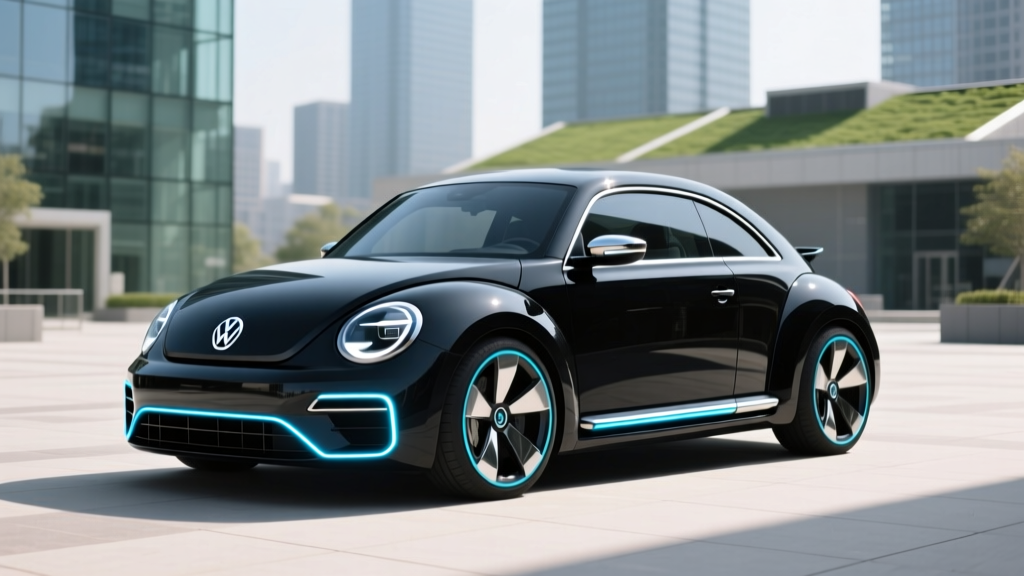
| "It'll look exactly like the classic Beetle." | VW's ID. Buzz shows the brand's approach: retro design cues (round headlights, two-tone paint, curved roofline) on a modern skateboard platform. Expect a compact hatchback with nostalgic styling, not a replica. |
| "250 miles of range isn't enough." | The average American drives ~37 miles per day (FHWA data). A 240-mile EV covers 95%+ of daily needs with home charging. Road trips require planning around DC fast charging, which is a legitimate tradeoff — not a dealbreaker for most. |
| "EV batteries need replacing every few years." | VW's MEB battery warranty covers 8 years/100,000 miles with a minimum 70% capacity retention. Real-world degradation data from ID.3 and ID.4 owners shows roughly 5–8% loss over the first 60,000 miles — well within warranty thresholds. |
Should You Wait or Buy Now? A Decision Framework
Choose to wait for the Beetle EV if:
- Design and brand heritage are top-3 purchase criteria for you
- You don't need a new vehicle within the next 12–18 months
- You want a compact EV in the $30K–$38K range and aren't satisfied with current options
- You have reliable home Level 2 charging and a daily commute under 60 miles round-trip
Choose to buy now if:
- You need a vehicle in the next 6 months — the Beetle EV is not confirmed for any near-term release
- Range above 300 miles is non-negotiable (look at the Equinox EV at 319 mi or Tesla Model 3 Long Range at 341 mi)
- You want guaranteed §30D tax credit eligibility with today's verified sourcing lists
- You frequently drive in extreme cold or remote areas with limited DC fast-charging infrastructure
What First-Time EV Buyers Should Know Before Committing
Whether you're waiting for a Beetle EV or buying a different compact electric car, these ownership realities apply universally:
Home charging is the foundation. A Level 2 home charger (240V, 32–48 amps, delivering 7.7–11.5 kW) adds roughly 25–40 miles of range per hour of charging. Installation typically costs $800–$2,500 depending on panel capacity and wiring distance. If your home has a 200-amp electrical panel, you're likely fine; a 100-amp panel may require a $1,500–$3,000 upgrade. Always get a quote from a licensed electrician before purchasing equipment.
Public charging reliability varies. Networks like Electrify America and EVgo have expanded, but uptime and connector availability remain inconsistent in rural areas. Tesla's Supercharger network — now open to NACS-equipped non-Tesla vehicles via adapter — leads in reliability. The industry is transitioning from CCS to NACS connectors through 2025–2026; a future Beetle EV may ship with either standard depending on market timing.
Cold weather is real, not theoretical. If you live where winter temperatures regularly drop below 30°F, budget 25–35% range loss. Preconditioning the battery while plugged in (a feature on all MEB vehicles) mitigates charging-speed loss but doesn't fully recover range.
The used EV market offers alternatives. If the Beetle EV timeline stretches into 2027 or 2028, consider a certified pre-owned ID.4 or a used Chevrolet Bolt EV (259 mi range, often available under $20,000 with the $4,000 used-EV credit under §25E). These bridge the gap while the retro-EV segment matures.
Frequently Asked Questions
When will the VW Beetle EV be available in the US?
No official US launch date has been announced. Industry reporting suggests a potential 2026–2027 European reveal with US availability following 6–12 months later, but this is speculative. VW's US press site has not published any Beetle EV information.
Will the Beetle EV use NACS or CCS for charging?
This is unconfirmed. VW Group has signaled adoption of NACS (Tesla's connector standard) for North American models, but the timeline and whether it applies to future MEB vehicles like a potential Beetle EV remains unclear. Current 2026 VW EVs in the US still use CCS1, with NACS adapters available for Supercharger access.
How does a Beetle EV compare to the ID. Buzz?
The ID. Buzz is a three-row microbus starting at $59,995 with 234 miles of range and a 170 kW peak charge rate. A Beetle EV would be smaller, lighter, cheaper, and likely more efficient — think compact hatchback vs. family hauler. They share the MEB platform but serve very different use cases.
What battery chemistry will the Beetle EV use?
Most likely NMC (nickel manganese cobalt), consistent with VW's current MEB vehicles. LFP (lithium iron phosphate) is possible for a base trim — VW has discussed LFP adoption for cost reduction — but NMC offers higher energy density, which matters in a compact package where battery space is limited.
Is it worth waiting, or should I buy a Hyundai Kona Electric now?
If you need a vehicle soon and want a compact EV around $33,000 with 261 miles of EPA range, the Kona Electric is a strong, available option with a confirmed 10-year/100,000-mile battery warranty. The Beetle EV is a design-driven gamble on an unconfirmed timeline. Waiting makes sense only if retro styling is a priority and your current vehicle can serve another 12–24 months.