The Lucid Air Pure has been the luxury EV sedan bargain since its introduction, offering flagship-class range and space at a price that undercuts the Mercedes EQS and BMW i7 by tens of thousands. For 2026, Lucid continues the Pure trim as the entry point into the Air lineup — and it remains one of the most efficient large sedans ever engineered. This review covers everything from the 419-mile EPA range to real-world charging curves, cargo practicality, and whether the federal tax credit actually applies.
2026 Lucid Air Pure at a Glance
| Spec | 2026 Lucid Air Pure (RWD) | Air Pure (AWD) |
|---|---|---|
| EPA Range | 419 miles | 410 miles |
| Battery (usable) | 88 kWh (NMC) | 88 kWh (NMC) |
| Drivetrain | Rear-Wheel Drive | Dual-Motor AWD |
| Horsepower | 430 hp | 620 hp |
| 0–60 mph | 5.0 sec | 3.8 sec |
| Peak DC Charge Rate | 300 kW | 300 kW |
| 10–80% DC Time | ~20 minutes | ~20 minutes |
| Level 2 Home Charge | 19.2 kW (~76 mi/hr) | 19.2 kW (~76 mi/hr) |
| EPA Efficiency | 146 MPGe / 24 kWh/100mi | 140 MPGe / 25 kWh/100mi |
| Cargo Volume | 32 cu ft (trunk + frunk combined) | |
| Base MSRP | $69,900 | $77,900 |
| Warranty (Battery/Powertrain) | 8 years / 100,000 miles | |
The RWD Pure is the efficiency champion here. The AWD variant trades a small amount of range for all-weather traction and a meaningful 190-hp bump. Both use Lucid's proprietary miniaturized drive units, which are among the smallest and most power-dense in the industry.
Range and Real-World Efficiency
Real-World Expectation: 340–380 miles highway at 70–75 mph; expect 20–30% range reduction in sub-freezing temperatures without preconditioning.
Lucid's EPA numbers are not marketing fantasy — the Air Pure's efficiency is genuinely exceptional for a 4,500+ lb sedan. The 146 MPGe combined figure translates to roughly 4.2 miles per kWh, which beats the Tesla Model S Long Range and the BMW i7 eDrive50 in EPA testing.
In real-world driving, the RWD Pure consistently delivers 360–385 miles on mixed highway/city loops in mild weather (65–80°F). At sustained 75 mph highway speeds, expect closer to 340–360 miles. Cold weather (below 32°F) without cabin/battery preconditioning can drop range to 290–320 miles. Lucid's heat pump and thermal management system help mitigate this — preconditioning while plugged in recovers a significant portion of that loss.
The Air's aerodynamic drag coefficient of 0.20 Cd is the lowest of any current production sedan, and that efficiency shows most at highway speeds where most EVs hemorrhage range.
Charging Speed: DC Fast and Home Level 2
| Charging Level | Power (kW) | Miles Added per Hour | Notes |
|---|---|---|---|
| Level 1 (120V) | ~1.4 kW | ~5–6 mi/hr | Emergency/trickle only |
| Level 2 (240V, 80A) | 19.2 kW | ~76 mi/hr | Requires hardwired 100A circuit |
| Level 2 (240V, 48A) | 11.5 kW | ~46 mi/hr | Standard NEMA 14-50 or 60A circuit |
| DC Fast Charge (peak) | 300 kW | ~1,200 mi/hr (peak) | Requires 350 kW CCS station |
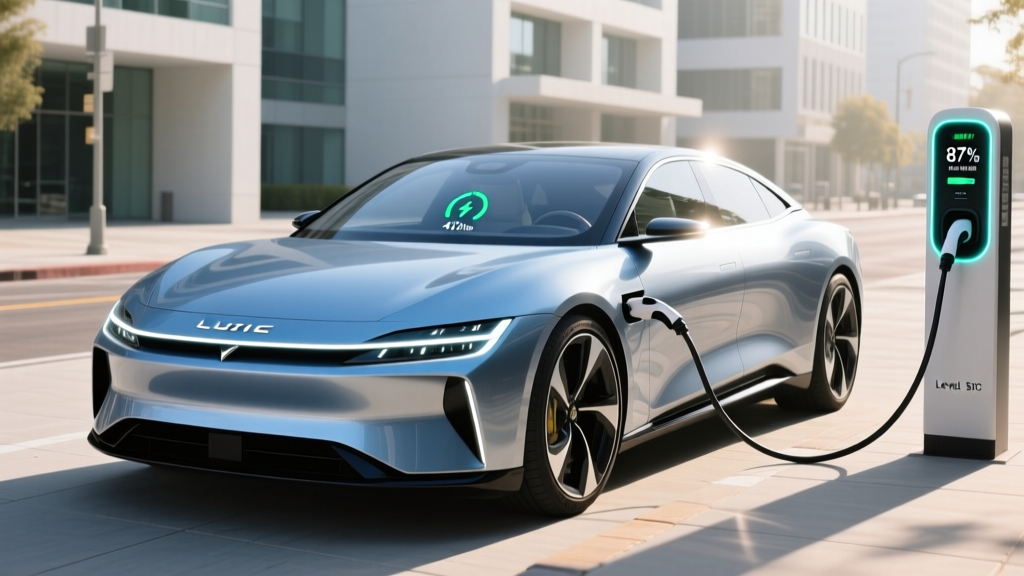
The Air Pure's 900V+ electrical architecture is the secret behind its charging performance. At a 350 kW Electrify America or Tesla Supercharger (with NACS adapter, which Lucid now includes), the Pure peaks near 300 kW and sustains above 200 kW through roughly 55% state of charge. The 10–80% sprint takes approximately 20 minutes under ideal conditions.
Here's where the charging curve matters: above 80% SoC, charge speed drops sharply to protect battery health. An 80–100% fill can take an additional 25–30 minutes. For road trips, plan your stops around the 10–80% window — it's faster and better for long-term battery health.
At home on a 19.2 kW Level 2 charger (Lucid's Connected Home unit or a hardwired ChargePoint Home Flex on a 100-amp circuit), a full overnight charge from 10% takes about 5 hours. Most owners on a standard 48A/11.5 kW setup will add roughly 46 miles per hour of charging — more than enough for daily commuting needs.
Performance and Driving Dynamics
The RWD Air Pure's 430 hp and 5.0-second 0–60 time won't embarrass you at a stoplight, but this is a grand tourer, not a track car. The dual-motor AWD variant's 620 hp and 3.8-second sprint are properly quick for a sedan that seats five adults comfortably.
Lucid's drive units — designed in-house and manufactured at their Arizona facility — are roughly the size of a carry-on suitcase yet produce more power per kilogram than most competitors. The result is a spacious cabin without the packaging compromises typical of EV platforms.
Ride quality is composed and quiet. The Air uses a multi-link front and rear suspension with available air springs (standard on higher trims, optional on Pure). Road isolation is a strong point, and the cabin remains remarkably hushed at 80 mph. Steering is precise but light — tuned for comfort over sportiness.
Interior Space, Tech, and Standout Features
The Air Pure's cabin is where the "Founder" connection resonates. Lucid's chief engineer and former Tesla Model S lead, Peter Rawlinson, prioritized interior volume through the miniaturized powertrain. The result:
- Rear legroom: 41.3 inches — more than a Mercedes S-Class
- Trunk: 22.1 cu ft (class-leading for the segment)
- Frunk: 10.0 cu ft (fits a carry-on plus groceries)
- Combined cargo: 32 cu ft
The 34-inch curved glass canopy display spans the driver's instrument cluster and infotainment. A secondary lower touchscreen handles climate and secondary controls. The interface is responsive but has drawn criticism for burying some functions in menus. Wireless Apple CarPlay and Android Auto are standard.
The DreamDrive Pro ADAS suite includes adaptive cruise control, lane centering, automatic emergency braking, and blind-spot monitoring. This is an SAE Level 2 driver-assistance system — it requires continuous driver attention and hands-on-wheel supervision. It is not autonomous driving. Lucid has not yet launched a hands-off highway system comparable to GM's Super Cruise or Ford's BlueCruise, which is a notable gap for a vehicle in this price range.
Standout features include the glass canopy roof (standard on all Airs, providing exceptional headroom and light), available Nappa leather, and a 21-speaker Surreal Sound audio system by Dolby Atmos.
Pricing, Trims, and Federal Tax Credit Eligibility
| Trim | Base MSRP | Destination | Est. Federal Credit (§30D) | Effective Price* |
|---|---|---|---|---|
| Air Pure RWD | $69,900 | $1,575 | Up to $7,500 | ~$64,000 |
| Air Pure AWD | $77,900 | $1,575 | Up to $7,500 | ~$71,975 |
*Effective price assumes full §30D credit eligibility. Actual credit depends on battery sourcing, buyer income, and MSRP caps. See IRS §30D guidelines for current-year rules.
The Air Pure RWD qualifies under the §30D MSRP cap for sedans ($55,000 cap does not apply — the Air is classified as a large vehicle with a $80,000 MSRP cap). However, the full $7,500 credit depends on two sourcing requirements: critical minerals (up to $3,750) and battery component manufacturing (up to $3,750). Lucid has worked to localize battery supply chains for their Arizona-built vehicles, but buyers should verify current-year eligibility on the IRS qualified vehicle list before purchase.
Buyer income caps also apply: $300,000 joint / $225,000 head of household / $150,000 single filers (modified AGI). The credit can now be transferred to the dealer at point of sale as a purchase-price reduction, which is a significant cash-flow advantage.
How the Lucid Air Pure Stacks Up Against Rivals
Pros
- Class-leading 419-mile EPA range (RWD)
- Best-in-segment efficiency at 146 MPGe
- Exceptional rear-seat legroom and cargo space
- 300 kW DC fast charging with 900V architecture
- Quiet, composed ride quality
- Panoramic glass roof standard
Cons
- DreamDrive Pro lacks hands-free highway driving
- Infotainment learning curve; some functions buried
- Limited service center network vs. Tesla/BMW
- No air suspension standard on Pure trim
- Brand resale value less established than German rivals
Against the Tesla Model S Long Range ($74,990, 402 mi EPA), the Air Pure offers more interior space, a quieter cabin, and slightly better range — but Tesla's Supercharger network advantage is narrowing as Lucid gains NACS access. The BMW i7 eDrive50 ($105,700, 318 mi EPA) is more luxurious but far less efficient and significantly more expensive. The Mercedes EQS 450+ ($104,400, 390 mi EPA) matches on range but can't touch the Lucid's rear-seat space or price.
Who Should Buy the 2026 Lucid Air Pure?
The Air Pure is ideal for daily commuters and road-trip-capable sedan buyers who prioritize range, efficiency, and interior space over badge prestige. If you drive 30–60 miles daily and want to charge at home once or twice a week, the 419-mile range means you'll rarely visit a public charger except on long trips.
It's less suited for buyers who demand hands-free highway driving (look at the BMW i7 with Highway Assistant or a Cadillac with Super Cruise) or those in areas without a nearby Lucid service center. Families needing three-row seating should look at the Grand Touring SUV segment instead.
The AWD variant earns its premium for buyers in snow-belt states who need all-weather traction without sacrificing the 410-mile range envelope.
Warranty and Long-Term Ownership
Lucid covers the battery and powertrain for 8 years or 100,000 miles, whichever comes first, with a capacity retention threshold of 70%. The limited vehicle warranty is 4 years / 50,000 miles — competitive with BMW and Mercedes but below Hyundai/Kia's 10-year coverage.
The 88 kWh NMC battery uses Lucid's proprietary cell-to-pack integration. Long-term degradation data is still maturing (the Air launched for the 2022 model year), but Lucid's thermal management system is robust, and the 900V architecture allows gentler charging profiles that should support longevity.
Frequently Asked Questions
What is the real-world range of the 2026 Lucid Air Pure?
Expect 340–385 miles in mixed real-world driving at highway speeds in mild weather. In sub-freezing conditions without preconditioning, range can drop to 290–320 miles. The EPA's 419-mile estimate (RWD) is achievable in city-dominant driving at moderate temperatures.
How fast does the Lucid Air Pure charge?
On a 350 kW DC fast charger, the Air Pure peaks near 300 kW and charges from 10–80% in approximately 20 minutes. At home on a 19.2 kW Level 2 charger, it adds roughly 76 miles of range per hour. On a standard 48A home charger, expect about 46 miles per hour.
How much does the Lucid Air Pure cost after the federal tax credit?
The Air Pure RWD starts at $69,900 plus $1,575 destination. If you qualify for the full $7,500 §30D credit (subject to battery sourcing rules, income caps, and MSRP limits), the effective price drops to roughly $64,000. Verify eligibility on the IRS qualified vehicle list before purchasing.
Does the Lucid Air Pure qualify for the federal EV tax credit?
The Air Pure falls under the $80,000 MSRP cap for large vehicles and is assembled in Arizona. Full $7,500 credit eligibility depends on current-year critical mineral and battery component sourcing requirements, plus buyer income limits ($150K single / $300K joint). Check the IRS clean vehicle credit page for the latest qualified vehicle list.
Is the Lucid Air Pure worth buying over a Tesla Model S?
If you value interior space, ride comfort, and efficiency, the Air Pure is the stronger choice — it offers more rear legroom, more cargo volume, and better MPGe. The Model S wins on Supercharger network maturity (though the gap is closing), hands-free FSD availability, and brand service infrastructure.
What is the biggest drawback of the Lucid Air Pure?
The most common owner complaint is the lack of a hands-free highway driving assist system. DreamDrive Pro requires hands-on-wheel supervision at all times (SAE Level 2). Competitors like GM's Super Cruise and Ford's BlueCruise offer eyes-off highway capability on mapped roads, which matters for frequent long-distance drivers.