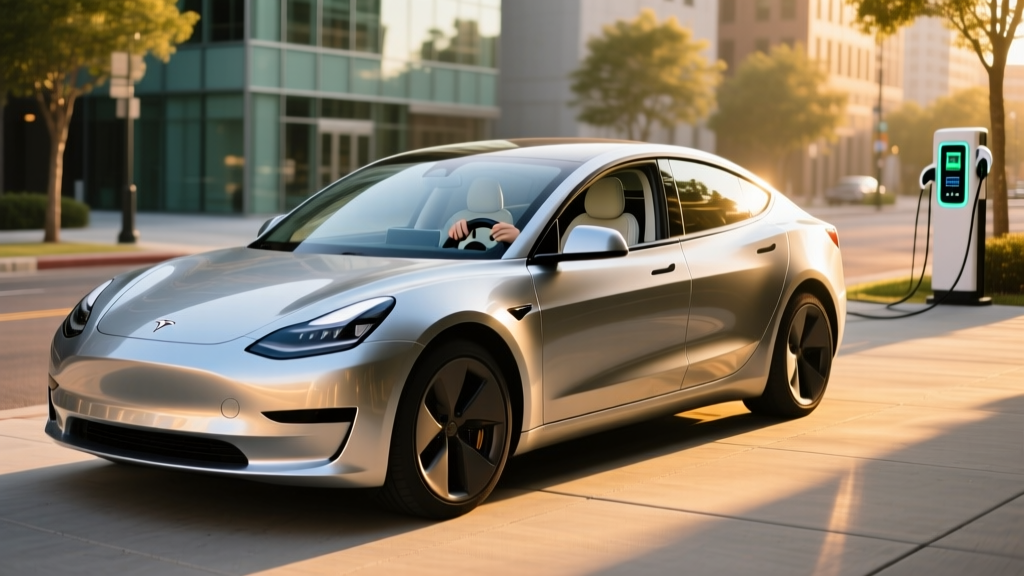
The 2022 Tesla Model 3 occupies a unique position in the used EV market. As the first model year to widely introduce the LFP (lithium iron phosphate) battery to the US Standard Range lineup, it offers a distinct value proposition for second-hand buyers in 2026. With Tesla's subsequent price adjustments and the evolving federal tax credit landscape, the 2022 vintage represents either a bargain or a compromise depending on which trim you choose and what you need from your daily driver.
This review covers what you need to know before purchasing a pre-owned 2022 Model 3 today — from the real-world implications of its two battery chemistries to its Supercharger network advantage and the tax credit rules that still apply to used EV purchases.
2022 Tesla Model 3 Specifications at a Glance
| Spec | RWD (Standard Range) | Long Range AWD | Performance |
|---|---|---|---|
| EPA Range | 272 miles | 358 miles | 315 miles |
| Battery (usable) | ~57.5 kWh (LFP) | ~75 kWh (NMC) | ~75 kWh (NMC) |
| Drivetrain | Rear-Wheel Drive | Dual-Motor AWD | Dual-Motor AWD |
| Horsepower | 283 hp | 346 hp | 450 hp |
| 0-60 mph | 5.8 sec | 4.2 sec | 3.1 sec |
| Peak DC Charge Rate | 170 kW | 250 kW | 250 kW |
| 10-80% DC Fast Charge | ~30 min | ~27 min | ~27 min |
| Level 2 Home Charging | 11.5 kW (~44 mi/hr) | 11.5 kW (~44 mi/hr) | 11.5 kW (~44 mi/hr) |
| EPA Efficiency | 132 MPGe / 25 kWh/100mi | 134 MPGe / 25 kWh/100mi | 113 MPGe / 30 kWh/100mi |
| Cargo Volume | 23 cu ft (trunk + frunk combined) | ||
| Battery Warranty (original) | 8 yr / 100,000 mi | 8 yr / 120,000 mi | |
Real-World Range: What the EPA Number Doesn't Tell You
The LFP battery in the RWD model behaves differently than the NMC packs in the Long Range and Performance trims. LFP chemistry has a flatter voltage curve, which means the car's range estimator can be less precise at mid-state-of-charge levels. Tesla recommends charging LFP batteries to 100% regularly — this is actually an advantage for daily commuters who want full range every morning without worrying about long-term degradation from sitting at full charge, a practice that degrades NMC batteries faster.
According to data from fueleconomy.gov, the Model 3 Long Range achieves 134 MPGe combined, making it one of the most efficient EVs in its class. That efficiency translates directly to lower charging costs and more miles per charging session.
Battery Chemistry: LFP vs NMC — Why It Matters for Used Buyers
The 2022 model year was pivotal because Tesla shifted the Standard Range RWD to CATL-sourced LFP cells while retaining NMC chemistry in the Long Range and Performance. Here's what that means four years into these vehicles' lives:
| Factor | LFP (RWD) | NMC (Long Range/Perf) |
|---|---|---|
| Cycle Life | Higher — 3,000+ cycles before significant degradation | Moderate — ~1,500-2,000 cycles |
| Cold-Weather Performance | Weaker — more range loss below freezing, slower cold charging | Better — retains more range, charges faster in cold |
| Daily Charging to 100% | Recommended by Tesla | Not recommended — 80-90% daily limit advised |
| Energy Density | Lower — smaller battery, less range | Higher — more range from similar pack size |
| Degradation at 4 Years | Typically 5-8% loss | Typically 8-12% loss |
For a used buyer in 2026, this means the RWD LFP model likely has a healthier battery percentage than a comparable-mileage Long Range. However, if you live in a cold climate, the NMC Long Range will serve you better in winter. Check the vehicle's State of Health (SoH) through the Tesla service menu or third-party diagnostic tools before purchasing.
Charging Speed and Network Access
| Charging Level | Power | Speed (Miles Added) | Best Use Case |
|---|---|---|---|
| Level 1 (120V) | ~1.4 kW | ~3-5 mi/hr | Emergency / overnight trickle |
| Level 2 (240V Home) | 11.5 kW (48A) | ~44 mi/hr | Daily home charging |
| DC Fast (V3 Supercharger) | Peak 250 kW (LR/Perf) / 170 kW (RWD) | ~170 mi in 15 min (LR) | Road trips |
The 2022 Model 3 uses the NACS (North American Charging Standard) connector natively — the same Tesla proprietary plug that has since been adopted by Ford, GM, Rivian, and most major automakers. This means you have full, unrestricted access to Tesla's Supercharger network, which remains the most reliable and extensive DC fast-charging network in the US. No adapter is needed.
Understanding the charge curve is critical for road-trip planning. The Long Range and Performance models peak at 250 kW but only sustain that rate briefly between roughly 10-30% SoC. From 30-60%, expect around 120-150 kW, and above 80%, the rate tapers sharply to under 40 kW. This is why Tesla's navigation system routes you through multiple shorter Supercharger stops rather than one long session to 100%. The RWD model peaks at 170 kW and follows a similar taper pattern, just at lower absolute numbers.
For home charging, a Tesla Wall Connector on a 60-amp circuit delivers the full 11.5 kW (48 amps continuous), replenishing roughly 44 miles of range per hour. A full charge from 10% takes about 6-7 hours for the Long Range — easily accomplished overnight. Installation typically runs $800-$2,000 depending on your electrical panel's capacity and the distance from panel to charger location. Always use a licensed electrician for this work.
Performance, Handling, and Daily Driving
Even the base RWD Model 3 delivers 283 horsepower and a 5.8-second 0-60 mph time — quicker than most gas-powered sport sedans. The single-motor rear-wheel-drive layout gives it a sporty, slightly tail-happy character that driving enthusiasts appreciate. The Long Range's dual-motor AWD system provides 346 hp and confident all-weather traction, while the Performance variant's 450 hp and 3.1-second sprint remain supercar territory.
Ride quality in the 2022 Model 3 is firm. Tesla improved the suspension tuning over the 2018-2020 models, but it's still a sport-oriented sedan — you'll feel sharp pavement imperfections more than in a Hyundai Ioniq 6 or BMW i4. Road noise at highway speeds is noticeable, a consequence of the frameless windows and minimal sound deadening to keep weight down.
The regenerative braking system in 2022 models offers only one mode (strong regen), which enables genuine one-pedal driving in most situations. Tesla removed the user-selectable regen level that existed in earlier model years, which frustrated some owners transitioning from gas vehicles.
Interior, Technology, and Cargo
The 2022 Model 3 interior is defined by its minimalism. Every function — climate, mirrors, glovebox, speedometer — routes through the 15-inch center touchscreen. There is no instrument cluster, no physical stalks for turn signals (they're on the steering wheel), and no traditional gauge readout. You either adapt to this philosophy or you don't.
Cargo space: The rear trunk offers 19.8 cu ft, and the front trunk (frunk) adds 3.1 cu ft, for a combined 23 cu ft. That's less than a Model Y (76 cu ft max) but competitive with compact sport sedans. The rear seats fold 60/40 for longer items.
Passenger space: Rear legroom measures 35.2 inches — adequate for adults on shorter trips but tighter than a midsize sedan. Headroom is generous thanks to the glass roof, though the roof offers no shade and can create a greenhouse effect in summer.
Driver assistance: Every 2022 Model 3 comes with Tesla's Basic Autopilot (adaptive cruise control and lane centering). Enhanced Autopilot ($6,000 option) added auto lane change and Navigate on Autopilot. Full Self-Driving (FSD) capability was a $12,000 option — note that FSD remains a SAE Level 2 system requiring constant driver supervision despite its name. It is not autonomous driving.
Used Pricing, Tax Credits, and Ownership Costs
As of early 2026, used 2022 Model 3 pricing varies significantly by trim, mileage, and condition:
| Trim | Original MSRP | Typical Used Price (2026) | Used EV Tax Credit (§25E)* |
|---|---|---|---|
| RWD (Standard Range) | $46,990 | $22,000 - $27,000 | Up to $4,000 |
| Long Range AWD | $53,990 | $28,000 - $34,000 | Up to $4,000 |
| Performance | $60,990 | $32,000 - $38,000 | Up to $4,000 |
*Used EV Tax Credit (§25E): The federal used clean vehicle credit provides 30% of the sale price, up to $4,000, for qualifying used EVs. Key eligibility rules per the IRS:
- Sale price must be $25,000 or less (this eliminates most used Long Range and Performance Model 3s from eligibility)
- Buyer income caps: $75,000 single / $112,500 head of household / $150,000 joint
- Vehicle must be at least 2 model years old (2022 qualifies in 2026)
- Must purchase from a licensed dealer (private-party sales do not qualify)
- Credit is non-refundable — you must have tax liability to benefit
This means the RWD model is the tax-credit sweet spot — a dealer-listed 2022 Model 3 RWD priced at $22,000-$25,000 can net the full $4,000 credit, bringing the effective cost to $18,000-$21,000 for income-eligible buyers. That's exceptional value for a 272-mile-range EV with Supercharger access.
Insurance: Model 3 insurance premiums remain above the segment average. Expect $1,800-$2,800 annually depending on your location, age, and driving record. Tesla's own insurance product is available in many states and can sometimes undercut third-party quotes, particularly for drivers with clean records.
Pros and Cons: The Honest Assessment
✅ Pros
- Supercharger network access — still the gold standard for reliability
- Class-leading efficiency (25 kWh/100mi on Long Range)
- LFP battery longevity on RWD models
- Over-the-air updates continue adding features years after purchase
- Strong performance even in base trim
- Minimal maintenance costs — no oil, filters, or spark plugs
- Used EV tax credit eligibility on RWD models
❌ Cons
- Touchscreen-dependent controls frustrate some drivers
- Firm ride quality and noticeable road noise
- Tight rear legroom for a sedan in this price class
- No Apple CarPlay or Android Auto integration
- LFP cold-weather range loss is significant in northern climates
- Insurance costs above segment average
- FSD purchase was a poor value proposition for most buyers
Who Should Buy a Used 2022 Model 3?
Choose the 2022 Model 3 RWD if:
- You're a commuter with home charging and a sub-100-mile daily round trip
- You live in a moderate climate (LFP cold-weather loss is a real concern)
- You want the lowest entry price with used EV tax credit eligibility
- You prioritize battery longevity over maximum range
Choose the 2022 Model 3 Long Range AWD if:
- You take regular road trips and need 300+ real-world miles
- You live in a cold climate and need winter range retention
- You need all-wheel drive for snow and ice
- You value faster DC charging (250 kW peak)
Look at competitors instead if:
- You need a spacious rear seat for car seats or tall passengers (consider Hyundai Ioniq 6 or BMW i4)
- You want physical buttons and Apple CarPlay (consider Polestar 2 or Ioniq 6)
- You want a softer, more luxury-oriented ride (consider BMW i4 eDrive40)
Frequently Asked Questions
What is the real-world range of the 2022 Tesla Model 3?
The Long Range AWD achieves 358 miles EPA but expect 290-310 miles in real-world highway driving and 230-260 miles in cold weather. The RWD model's 272-mile EPA rating drops to roughly 220-240 highway and 175-200 in winter. Your results will vary based on speed, temperature, terrain, and climate control usage.
How fast does the 2022 Model 3 charge at home and on the road?
At home on a Level 2 (240V) charger, the Model 3 charges at up to 11.5 kW, adding about 44 miles of range per hour — a full overnight charge is easy. On DC fast chargers, the Long Range and Performance peak at 250 kW (10-80% in roughly 27 minutes), while the RWD peaks at 170 kW (10-80% in about 30 minutes). Charging slows significantly above 80% SoC to protect battery health.
Does a used 2022 Model 3 qualify for any federal tax credit?
Yes — under the IRS §25E used clean vehicle credit, you can receive 30% of the sale price up to $4,000, but the vehicle must be sold for $25,000 or less by a licensed dealer, and the buyer must meet income caps ($75K single / $150K joint). This effectively limits the credit to the RWD trim for most buyers. The new-vehicle §30D credit does not apply to used purchases.
Is the 2022 Model 3 worth buying vs. competitors in 2026?
It depends on priorities. The Model 3 wins on Supercharger access, efficiency, and performance-per-dollar. It loses to the Hyundai Ioniq 6 on rear-seat space and ride comfort, to the BMW i4 on build quality and CarPlay support, and to the Polestar 2 on interior material quality. For the $18,000-$28,000 effective price range after tax credits, it remains one of the best-value EVs available used.
How long will the 2022 Model 3 battery last?
Tesla warranties the battery for 8 years/100,000 miles (RWD) or 8 years/120,000 miles (Long Range/Performance) with a minimum 70% capacity retention threshold. Real-world data suggests Tesla batteries typically lose 10-15% capacity over the first 150,000 miles before degradation slows significantly. The LFP battery in the RWD model is expected to outlast the NMC packs in cycle life. A 2022 model with 40,000-60,000 miles in 2026 should still have 90%+ battery health.
Should I buy a 2022 Model 3 with FSD (Full Self-Driving)?
Generally, no — don't pay a premium for used FSD. Tesla's FSD remains a Level 2 driver-assist system requiring full driver attention. The $12,000 original purchase price rarely transfers value in the used market. Basic Autopilot (included standard) handles highway adaptive cruise and lane centering competently, which is what most drivers actually need.
What are common issues with the 2022 Model 3?
The 2022 model year is considered one of the more reliable Model 3 vintages, as Tesla had resolved most early-production build-quality issues by this point. Reported concerns include occasional phantom braking with Autopilot, HVAC odor from the cabin filter (replace every 1-2 years), and tire wear (EVs are heavy and wear tires faster than gas cars — budget for replacement every 25,000-35,000 miles). Check for panel alignment and ensure all software updates are current.
Sources: EPA fuel economy data from fueleconomy.gov, IRS used clean vehicle credit rules from irs.gov, NHTSA safety ratings from nhtsa.gov.