The Short Answer on VW Beetle Electric Car Conversions
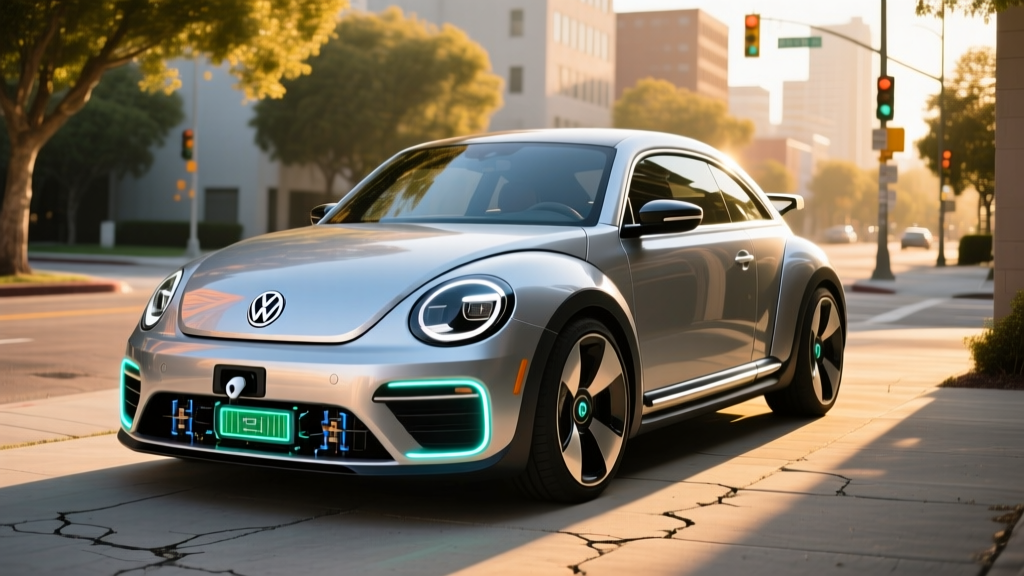
A professional VW Beetle electric car conversion typically costs $15,000 to $40,000+ on top of the donor vehicle price, yielding 60–150 miles of real-world range depending on battery pack size (20–60 kWh) and motor selection. Most conversions use a 60–100 kW electric motor and charge at 3–7 kW on Level 2 (adding roughly 10–25 miles per hour). DC fast charging is rarely included due to cost and complexity. For most buyers, a used production EV delivers more range, modern safety, and federal warranty protections at a similar total cost — but a Beetle conversion makes sense if you specifically want the classic car experience with zero tailpipe emissions.
What a VW Beetle Electric Conversion Actually Involves
Converting a classic Volkswagen Beetle (typically a 1960s–1974 model) to electric propulsion means removing the air-cooled flat-four engine, fuel tank, and exhaust system, then installing an electric motor, motor controller, battery pack, onboard charger, and associated wiring and thermal management. The Beetle's rear-engine, rear-wheel-drive layout is surprisingly well-suited to EV conversion: the motor mounts where the original engine sat, and batteries can be distributed between the front trunk (frunk) and rear compartment to maintain weight balance.
Popular conversion platforms include:
- NetGain HyPer 9 or WarP 9 DC motors (80–120 kW peak) paired with controllers from Sevcon or Curtis — the workhorse choice for air-cooled VWs.
- Tesla rear drive unit swaps (from salvaged Model S or Model 3 units) — more complex to adapt but offer regen braking and higher efficiency.
- Volkswagen Group MEB-derived crate motors — emerging in the aftermarket as VW's ID. platform matures, though availability and integration kits remain limited as of 2026.
Battery packs typically use salvaged or new lithium-ion modules (often NMC chemistry from production EV packs like the Chevy Bolt or Nissan Leaf) or, increasingly, LFP (lithium iron phosphate) prismatic cells sourced from companies like EVE or CATL. LFP is gaining favor for conversions because of its superior cycle life (3,000+ cycles vs ~1,500 for NMC), thermal stability, and tolerance for daily 100% charging — though it trades off some energy density, meaning more weight for the same kWh.
Cost Breakdown: Conversion vs. Buying a Production EV
The economics of a Beetle EV conversion rarely pencil out as a financial win compared to buying a modern used EV. Here's how the numbers stack up:
| Category | VW Beetle EV Conversion | Used 2023 Chevy Bolt EV (typical) |
|---|---|---|
| Vehicle / donor car | $5,000–$15,000 | $16,000–$22,000 |
| Conversion / purchase cost | $15,000–$40,000 | $0 (included above) |
| Total acquisition | $20,000–$55,000 | $16,000–$22,000 |
| Federal §30D tax credit | $0 (not eligible — not a new qualifying vehicle) | $0 used credit (§25E up to $4,000 if eligible) |
| Annual insurance | $1,200–$2,400 (specialty/classic car EV policies) | $1,100–$1,600 |
| Annual electricity (12,000 mi/yr) | ~$500–$700 (at 3.5–5 mi/kWh) | ~$450–$600 (at 3.5–4 mi/kWh) |
| Annual maintenance | $300–$800 (specialty, potential custom-fabrication repairs) | $200–$400 |
| 5-year total operating cost | $10,000–$19,000 | $8,500–$13,000 |
| 5-year total cost of ownership | $30,000–$74,000 | $24,500–$35,000 |
The conversion path costs roughly 1.5× to 2× more over five years while delivering significantly less range, no modern safety equipment (no airbags, no ABS on most classic Beetles, no ADAS), and limited charging infrastructure compatibility. The used Bolt, by contrast, offers 259 miles of EPA range, DC fast charging capability, and widely available replacement parts.
Range, Charging, and Performance: What to Expect
Real-world performance of a Beetle conversion depends heavily on pack size, motor choice, and vehicle weight. The classic Beetle weighs roughly 1,800–2,000 lbs stock; a conversion adds 300–600 lbs of batteries and motor hardware, bringing curb weight to approximately 2,200–2,600 lbs.
| Spec | Original Beetle (1970s) | Beetle EV Conversion (typical) |
|---|---|---|
| Powertrain | 1.6L flat-4, ~60 hp | Electric motor, 80–150 hp |
| 0–60 mph | ~18–22 seconds | 7–12 seconds |
| Energy capacity | ~10 gallon tank | 20–60 kWh battery (NMC or LFP) |
| Range | ~250–300 miles | 60–150 miles (real-world) |
| Efficiency | ~22–28 MPG | ~3.5–5.0 miles/kWh (~117–167 MPGe) |
| "Refueling" time | ~3 minutes at a gas station | 4–8 hours on Level 2; DC fast charge rarely available |
| Top speed | ~70–80 mph | ~75–95 mph (electronically limited in many builds) |
Range reality check: A 40 kWh pack in a Beetle conversion yields roughly 120–140 miles in mild weather at city speeds. Highway driving at 65+ mph cuts that by 15–25%. Cold weather (below 35°F) without active battery heating can reduce range by an additional 20–35%, bringing a 40 kWh Beetle down to as little as 70–80 miles on a winter highway trip. Most conversions lack the sophisticated thermal management systems found in production EVs, making cold-weather degradation more pronounced.
Charging limitations: Most Beetle conversions use a single-phase onboard charger rated at 3.3 kW or 6.6 kW. At 6.6 kW, you'll add roughly 20–25 miles of range per hour — adequate for overnight home charging but impractical for road trips. DC fast charging (CCS or CHAdeMO) requires a separate DC-DC charger module, high-voltage contactors, and communication protocol integration that adds $3,000–$8,000 to the build. Very few conversion shops include it as standard.
Who Should (and Shouldn't) Convert a Beetle to Electric
Decision Framework: Is a Beetle EV Conversion Right for You?
Choose the conversion if:
- You already own or specifically want a classic Beetle and want to drive it daily without maintaining an aging air-cooled engine
- Your daily driving is under 40–50 miles round-trip with reliable home Level 2 charging
- You value the aesthetic and emotional experience of a classic car and accept the trade-offs in range, safety, and convenience
- You have a budget of $30,000–$50,000+ and view this as a passion project, not a cost-saving measure
- You live in a mild climate (or can garage the car in winter) to minimize cold-weather range loss
Buy a production EV instead if:
- You need 200+ miles of range, DC fast charging for road trips, or all-weather reliability
- You want modern safety features (airbags, ABS, stability control, automatic emergency braking)
- You want to qualify for the §30D federal tax credit (up to $7,500 for qualifying new EVs) or the §25E used EV credit (up to $4,000)
- Your total budget is under $25,000
- You don't have access to home charging — a conversion with no DC fast charging capability is impractical on public infrastructure alone
Common Myths About EV Conversions — Corrected
| Myth | Fact |
|---|---|
| "Converting my Beetle to electric saves me money vs. buying an EV." | A conversion costs $20K–$55K total. A used Chevy Bolt EV costs $16K–$22K, offers 259 miles EPA range, DC fast charging, and qualifies for the up-to-$4,000 §25E used EV credit. The conversion costs more and delivers less. |
| "Electric conversions are maintenance-free." | The drivetrain requires less maintenance (no oil changes, no carburetor tuning), but you still maintain brakes, suspension, tires, and 12V systems. Custom-fabricated components may require specialist shops for repairs. |
| "I can use Tesla Superchargers with a converted Beetle." | Tesla Superchargers require vehicle-to-charger communication protocols (via NACS connector and Tesla's authentication system) that conversion vehicles cannot replicate. You're limited to Level 2 public chargers and, if equipped, CCS DC fast chargers. |
| "The battery will last forever." | LFP cells offer 3,000+ charge cycles (potentially 300,000+ miles), but NMC modules from salvaged packs may have unknown prior degradation. Budget for a potential pack refresh ($5,000–$12,000) within 8–12 years. |
| "I'll get the $7,500 federal tax credit." | Federal EV tax credits under §30D and §25E apply only to qualifying production vehicles meeting battery sourcing, MSRP, and buyer income requirements. Custom conversions do not qualify. See IRS guidelines for details. |
Real-World Ownership: What Daily Life Looks Like
Home charging is essential. Without DC fast charging capability, a converted Beetle is entirely dependent on Level 2 charging (240V). A home Level 2 installation with a 40-amp circuit (delivering ~9.6 kW to the car, though the car's onboard charger limits intake to 3.3 or 6.6 kW) costs $800–$2,500 including the charger unit and electrician labor, assuming your electrical panel has capacity. If a panel upgrade from 100A to 200A service is needed, add $1,500–$3,000.
Insurance requires specialty providers. Standard insurers often won't cover a custom EV conversion at its full value. Companies like Hagerty, Grundy, or specialty EV insurers offer agreed-value policies for converted classics, typically at $1,200–$2,400/year depending on the build value and your driving profile.
Registration and inspection vary by state. Most states require a converted vehicle to pass a special inspection (often a "specially constructed vehicle" or SPCC process) to receive a legal title reflecting the electric powertrain. Some states exempt EVs from emissions testing entirely; others require documentation of the conversion. Check your state DMV before beginning the build.
Resale value is niche. A well-executed conversion by a reputable shop (such as EV West, Zelectric, or Icon) can command $35,000–$70,000+ from the right buyer. A DIY conversion with unclear documentation may be difficult to sell. Document everything: battery cell sources, BMS (battery management system) specs, wiring diagrams, and dynamometer results.
Notable Conversion Shops and DIY Options
If you're committed to a Beetle EV conversion, here are the main paths:
- Zelectric Motors (San Diego, CA) — Known for air-cooled Porsche and VW conversions with Tesla-derived drivetrains. Builds typically start around $75,000–$120,000 turnkey. Premium craftsmanship, modern performance.
- EV West (Vista, CA) — Sells conversion kits and components for DIY builders. A complete Beetle kit (motor, controller, charger, wiring, but not batteries) runs $8,000–$15,000. Batteries add $5,000–$15,000 depending on capacity.
- Icon (Chatsworth, CA) — Derelict series includes electrified classic VWs. Build-to-order, typically $100,000+.
- DIY conversion — Using components from EV West, Thunderstruck Motors, or OpenInverter community designs. Budget $15,000–$25,000 in parts if you have fabrication and high-voltage electrical skills. Warning: working with 96–400V DC battery packs is lethal if mishandled. Proper training and safety equipment are mandatory.
Frequently Asked Questions
How much does a VW Beetle electric car conversion cost?
A DIY conversion using aftermarket components costs $15,000–$25,000 in parts (plus the donor car). A professional shop conversion ranges from $30,000 to $120,000+ depending on craftsmanship level, battery capacity, and whether the build includes modern amenities like air conditioning, power steering, and upgraded brakes.
What range can I expect from a converted Beetle?
Expect 60–150 miles of real-world range depending on battery pack size (20–60 kWh). A typical 40 kWh build achieves roughly 120 miles in city driving, dropping to 90–100 miles on the highway and potentially 70–80 miles in cold weather below freezing.
Can I fast-charge a Beetle conversion on a road trip?
Most conversions do not include DC fast charging due to the cost ($3,000–$8,000 additional) and packaging complexity. Without it, you're limited to Level 2 public chargers (adding ~15–25 miles per hour), making road trips impractical. Some high-end builds do include CCS capability, but this is the exception, not the rule.
Is a Beetle EV conversion street-legal?
Yes, but you must complete your state's process for registering a specially constructed or modified vehicle. This typically involves a visual inspection, brake test, and documentation of the electric drivetrain. Requirements vary significantly — California's BAR referee process differs from Texas's SPCV inspection, for example.
Does a Beetle EV conversion qualify for any tax credits?
No. Federal EV tax credits (§30D for new vehicles, §25E for used) apply only to qualifying production vehicles that meet specific battery sourcing, MSRP caps, and buyer income limits. Custom conversions are not eligible. Always verify current rules at IRS.gov.
How does a Beetle conversion compare to buying a VW ID.4 or ID. Buzz?
A new VW ID.4 starts around $39,000, offers 206–291 miles of EPA range, 170 kW DC fast charging (10–80% in ~28 minutes), modern safety systems, and may qualify for the §30D credit. The ID. Buzz starts around $60,000 with a retro aesthetic and 231–234 miles of range. Both are dramatically more practical daily drivers than a conversion, though they lack the classic Beetle's character.