The 2023 Lucid Air Touring occupies a rare space in the luxury EV sedan market: it delivers over 400 miles of EPA-rated range with dual-motor all-wheel drive and 620 horsepower, undercutting the Mercedes EQS and Tesla Model S Plaid on price while outperforming both on efficiency. As a second-tier trim in Lucid's lineup—sitting between the Air Pure and the Grand Touring—the Touring aims to be the value sweet spot for buyers who want serious range without stepping up to the $130,000+ trims. But how does it hold up in real-world driving, charging, and ownership? We break down every number that matters.
Range, Efficiency & Real-World Expectations
The 2023 Lucid Air Touring carries an EPA-estimated range of 425 miles on its 92 kWh usable battery pack (112 kWh gross capacity). That figure places it among the longest-range production EVs sold in the United States, trailing only the Air Grand Touring (516 mi) and the Air Pure (410 mi with the larger battery option).
EPA 425 miles is the combined-cycle estimate. In real-world highway driving at 70-80 mph, expect approximately 340-370 miles before needing a charge. In cold weather (below 32°F / 0°C), range can drop to 280-320 miles due to battery chemistry limitations and cabin heating demands. City driving with regenerative braking recapture can match or slightly exceed the EPA figure. Lucid's heat pump helps mitigate cold-weather losses compared to EVs without one, but the laws of lithium-ion physics still apply.
Efficiency is where Lucid's engineering shows. The Air Touring achieves an EPA-rated 131 MPGe combined (city/highway), translating to roughly 26 kWh per 100 miles. That is remarkably efficient for a 5,200-lb luxury sedan with dual motors—significantly better than the Mercedes EQS 450+ (97 MPGe) and competitive with the Tesla Model S Long Range (120 MPGe). Lucid's miniaturized drive units and 900V+ electrical architecture reduce resistive losses across the powertrain.
| Spec | Value |
|---|---|
| EPA Range | 425 miles |
| Battery (Usable / Gross) | 92 kWh / 112 kWh |
| Battery Chemistry | NMC (Nickel Manganese Cobalt) |
| Drivetrain | Dual-Motor AWD |
| Horsepower | 620 hp |
| 0-60 mph | 3.4 seconds |
| Top Speed | 145 mph |
| Efficiency (MPGe) | 131 MPGe combined |
| Max DC Fast Charge | 250 kW (peak) |
| 10-80% DC Charge Time | ~20 minutes |
| Level 2 Home Charging | 19.2 kW (up to 80 mi/hr) |
| Base MSRP | $107,400 (incl. destination) |
| Federal Tax Credit (§30D) | $7,500 (subject to eligibility) |
| Battery/Powertrain Warranty | 8 years / 100,000 miles |
Charging Speed: DC Fast, Level 2 & What to Expect
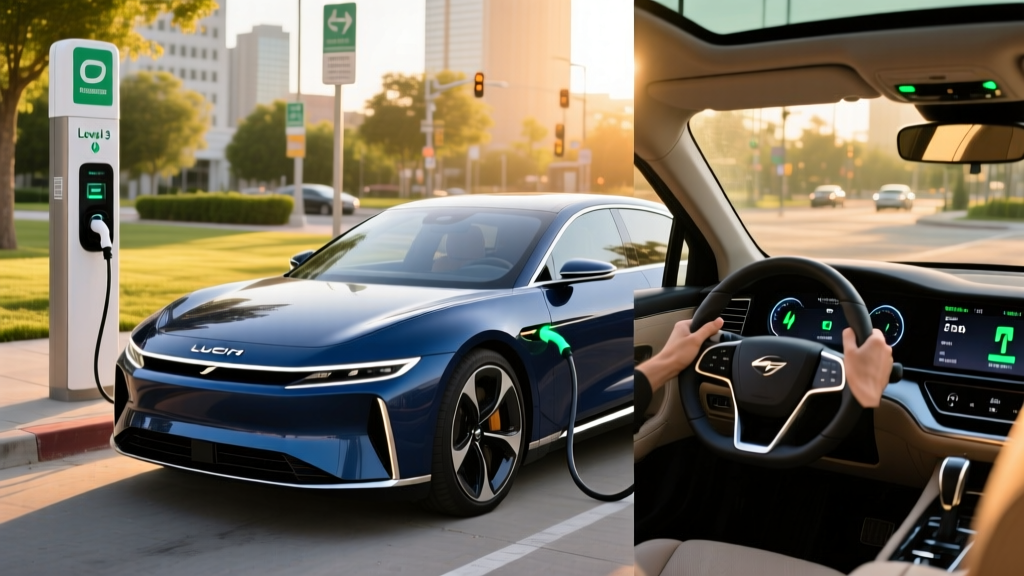
Charging is where the Air Touring's 900V+ architecture pays dividends. On a compatible 350 kW DC fast charger (such as Electrify America's latest stations), the Air Touring peaks at approximately 250 kW, adding up to 200 miles of range in roughly 14 minutes under ideal conditions. A 10-80% charge takes approximately 20 minutes.
However, the charge curve matters more than peak rate. The Air Touring sustains strong charging rates through the mid-SoC range but tapers noticeably above 80%, as all NMC batteries do to protect cell longevity. On a road trip, the practical strategy is charging to 80% and moving on—the time penalty from 80-100% is substantial and rarely worth the wait unless it's your final stop.
| Charge Level | Power (kW) | Miles Added Per Hour | Full Charge Time (0-100%) |
|---|---|---|---|
| Level 1 (120V / 12A) | ~1.4 kW | ~3-4 mi/hr | ~65+ hours |
| Level 2 (240V / 48A) | 11.5 kW | ~48 mi/hr | ~8 hours |
| Level 2 (240V / 80A) | 19.2 kW | ~80 mi/hr | ~5 hours |
| DC Fast Charge (peak) | 250 kW | ~800+ mi/hr (peak) | 10-80% in ~20 min |
For home charging, the Air Touring's onboard charger supports up to 19.2 kW on Level 2—but only if you install an 80-amp hardwired EVSE on a 100-amp circuit. Most home Level 2 installations (48-amp on a 60-amp circuit) deliver 11.5 kW, which still fully replenishes the 92 kWh usable battery overnight in about 8 hours. That 19.2 kW capability is a genuine advantage over competitors capped at 11.5 kW (Tesla Model S) or 9.6 kW (older EQS models) for owners who can support the higher-amperage circuit.
The Air Touring uses a CCS1 connector for DC fast charging and a J1772 inlet for Level 2. With the industry's shift to NACS (Tesla's connector), Lucid has confirmed NACS adapter support for Supercharger access, though availability of adapters has been gradual. Check Lucid's official site for current adapter compatibility before relying on the Tesla network.
Performance: 620 HP, 3.4-Second 0-60, and Composed Dynamics
The Air Touring's dual-motor all-wheel-drive powertrain produces 620 horsepower and achieves a 3.4-second 0-60 mph time. That puts it firmly in sports-sedan territory—quicker than a BMW M550i and only a few tenths behind the Tesla Model S Long Range (3.1 sec). The Grand Touring and Sapphire trims offer more power (819 hp and 1,234 hp respectively), but the Touring's output is more than sufficient for any real-world scenario.
What stands out in actual driving is not just straight-line speed but the composure of the chassis. The Air Touring rides on an adaptive air suspension that smooths out highway expansion joints while keeping body roll controlled on twisty roads. The steering is precise if slightly light on feedback. At 5,236 lbs, the car's weight is noticeable in tight corners but well-masked by the low center of gravity inherent to its skateboard-style battery pack.
Regenerative braking offers adjustable intensity through the infotainment system but does not provide true one-pedal driving to a complete stop in all modes—you'll still use the friction brake pedal at low speeds. Lucid's approach prioritizes a natural driving feel over the aggressive regen some EV competitors default to.
Interior, Cargo & Technology
The Air Touring's cabin seats five adults with generous dimensions. Front legroom measures 41.1 inches, rear legroom comes in at 36.3 inches—adequate for adults on longer trips though not class-leading versus the Mercedes EQS (which benefits from a longer wheelbase). Headroom is slightly compromised by the sloping roofline, particularly in the rear, where taller passengers may notice the glass canopy's taper.
Cargo capacity totals 32 cubic feet when combining the trunk (22.1 cu ft) and the front trunk, or "frunk" (9.9 cu ft). The trunk opening is wide and the load floor is flat, but the sedan body style limits utility compared to a liftback or SUV. You won't be hauling furniture, but luggage for a family of four on a road trip fits comfortably.
The infotainment system centers on a 34-inch curved glass cockpit display that spans the driver's instrument cluster and central touchscreen. A lower secondary touchscreen handles climate controls and secondary functions. The interface is visually striking but has drawn criticism for burying some common functions in submenus. Wireless Apple CarPlay and Android Auto are standard, which mitigates the native software's learning curve. A 21-speaker Surreal Sound Pro audio system (optional on Touring, standard on higher trims) delivers immersive audio quality.
Driver-assistance technology includes Lucid's DreamDrive Pro suite, which provides adaptive cruise control, lane-centering assist, automated emergency braking, blind-spot monitoring, and surround-view cameras. DreamDrive Pro is a SAE Level 2 system—the driver must remain fully engaged with hands on the wheel and eyes on the road at all times. It does not provide hands-free driving on highways the way GM's Super Cruise or Ford's BlueCruise do. Lucid has discussed future hands-free capability via over-the-air updates, but as delivered, the system requires active driver supervision.
Lucid DreamDrive Pro is an SAE Level 2 driver-assistance system. It is not self-driving. The driver must maintain full attention, keep hands on the steering wheel, and be prepared to take over immediately. It does not support hands-free operation on mapped highways. Do not confuse this with Level 4 autonomous systems like Waymo's robotaxi service.
Pricing, Tax Credit Eligibility & Total Cost
The 2023 Lucid Air Touring launched with a base MSRP of $107,400 (including $1,500 destination charge). Common option packages—including the Surreal Sound Pro audio, DreamDrive Pro advanced assist features, and larger 20-inch wheels—can push as-tested pricing to $115,000-$120,000.
Federal tax credit eligibility for the Air Touring requires navigating several IRS §30D rules:
- MSRP Cap: Sedars must have an MSRP at or below $55,000 to qualify. The Air Touring at $107,400 exceeds this cap, making it ineligible for the new-vehicle federal tax credit under current §30D rules.
- Income Limits: Even if MSRP-eligible, buyers must fall under modified adjusted gross income caps ($300K joint, $225K head of household, $150K individual).
- Battery Sourcing: The credit phases based on critical mineral and battery component sourcing requirements that tighten annually.
- Point-of-Sale Transfer: Eligible buyers can transfer the credit to the dealer at purchase for an immediate price reduction—but only if the vehicle itself qualifies.
Bottom line: The 2023 Lucid Air Touring does not qualify for the $7,500 federal new-vehicle tax credit due to its MSRP exceeding the $55,000 sedan cap. However, if purchasing as a used EV (model year 2023 bought in 2025 or 2026 from a dealer), the used clean vehicle credit (up to $4,000 or 30% of sale price, whichever is less) may apply under §25E, subject to a $25,000 maximum sale price cap—which the Air Touring will likely still exceed even on the used market for several years. Consult a tax professional for your specific situation, and always verify current rules at irs.gov.
| Item | Amount |
|---|---|
| Base MSRP (incl. destination) | $107,400 |
| Typical As-Tested Price | $115,000 - $120,000 |
| Federal Tax Credit (§30D New) | $0 (exceeds $55K sedan MSRP cap) |
| Estimated Effective Price After Credits | $107,400+ |
| Estimated 5-Year Electricity Cost (15K mi/yr) | ~$4,200 (at $0.14/kWh avg) |
| Battery/Powertrain Warranty | 8 years / 100,000 miles |
The 8-year/100,000-mile battery and powertrain warranty covers capacity degradation below 70% of original capacity—a standard threshold for the luxury EV segment. Lucid's bumper-to-bumper warranty runs 4 years/50,000 miles. For a vehicle at this price point, some buyers may find the warranty terms acceptable but not exceptional; Hyundai's 10-year/100,000-mile EV powertrain coverage is notably longer.
2023 Lucid Air Touring vs. Key Competitors
The Air Touring competes in a narrow band of six-figure luxury electric sedans. Here's how it stacks up against the most direct rivals:
vs. Tesla Model S Long Range (~$89,990): The Model S offers slightly quicker acceleration (3.1 sec 0-60), access to the Supercharger network, and a lower starting price. However, the Air Touring delivers more EPA range (425 vs. 405 mi), a more luxurious interior build, and a quieter ride. The Model S's aging interior design and panel-gap inconsistencies are well-documented. If charging infrastructure access is your top priority, Tesla still wins; if refinement and range-per-dollar matter more, the Air Touring has the edge.
vs. Mercedes-Benz EQS 450+ (~$105,550): The EQS offers a more opulent interior with the hyperscreen dashboard, superior rear-seat comfort, and a stronger dealership service network. But it falls short on range (350 mi EPA for the AWD 450 4MATIC, up to 390 mi for the RWD 450+), efficiency (97-102 MPGe), and DC charging speed (200 kW peak vs. 250 kW). The Air Touring is the driver's choice; the EQS is the chauffeur's choice.
vs. BMW i7 xDrive60 (~$120,295): The i7 is larger, more traditionally luxurious, and offers Level 2+ hands-free highway assist in certain conditions. But it sacrifices range (318 mi EPA) and weighs significantly more. It's a different vehicle for a different buyer—one who prioritizes rear-seat executive comfort over driving dynamics and range.
- Class-leading 425-mile EPA range with AWD
- Outstanding efficiency (131 MPGe / 26 kWh/100mi)
- 250 kW DC fast-charging capability
- 19.2 kW Level 2 onboard charger (best-in-class)
- Spacious frunk + trunk (32 cu ft total)
- Quiet, composed ride quality
- 900V+ architecture future-proofs charging
- No federal tax credit (MSRP exceeds cap)
- Infotainment learning curve; some functions buried
- DreamDrive Pro requires hands-on (no hands-free highway)
- Rear headroom limited by roofline taper
- Limited service center network vs. legacy luxury brands
- Brand-new company — long-term reliability unproven
- Resale value uncertainty compared to Tesla/Mercedes
Who Should Buy the 2023 Lucid Air Touring?
Choose the Air Touring if: You want maximum range in a luxury sedan, frequently take road trips where 400+ miles between charges reduces stops, value energy efficiency as an engineering achievement, and have reliable home Level 2 charging. It suits tech-forward executives, long-distance commuters, and EV enthusiasts who appreciate powertrain innovation.
Look elsewhere if: You need a hands-free highway driving system (consider BMW i7 or Mercedes EQS with Drive Pilot), prioritize a vast dealer service network (Mercedes, BMW), want tax-credit savings (consider vehicles under $55K MSRP), or need SUV practicality for family hauling.
The Air Touring is best understood as an engineer's luxury sedan. Lucid's powertrain team—many of whom came from Tesla's early engineering ranks—prioritized efficiency, range, and charging speed over marketing flash. If those metrics drive your purchase decision, the Touring trim offers the best value-to-range ratio in the Air lineup. If brand prestige, service convenience, or cutting-edge infotainment matter more, the established luxury marques still hold advantages that raw specs alone don't overcome.
Frequently Asked Questions
What is the real-world range of the 2023 Lucid Air Touring?
The EPA rates the Air Touring at 425 miles combined. In real-world highway driving at 70-80 mph, expect 340-370 miles. In cold weather below freezing, plan for 280-320 miles. City driving with regenerative braking can match or slightly exceed the EPA estimate. Always plan charging stops conservatively—arriving at a charger with 10-15% SoC is wiser than stretching for 5%.
How fast does the 2023 Lucid Air Touring charge?
On a 350 kW-capable DC fast charger, the Air Touring peaks at approximately 250 kW and charges from 10-80% in about 20 minutes. At home on a 48-amp Level 2 charger (11.5 kW), a full charge takes about 8 hours. On an 80-amp Level 2 circuit (19.2 kW), a full charge takes about 5 hours—among the fastest AC charging rates available in any production EV.
Does the 2023 Lucid Air Touring qualify for the federal EV tax credit?
No. Under current IRS §30D rules, new sedans must have an MSRP at or below $55,000 to qualify for the up-to-$7,500 federal tax credit. The Air Touring's $107,400 MSRP far exceeds this cap. State-level incentives may still apply depending on your jurisdiction—check your state's energy office or DMV for details.
What battery chemistry does the Lucid Air Touring use?
The Air Touring uses NMC (Nickel Manganese Cobalt) lithium-ion cells in its 112 kWh gross / 92 kWh usable battery pack. NMC chemistry offers high energy density—essential for achieving 425 miles in a sedan-sized package—but requires more careful thermal management than LFP (Lithium Iron Phosphate) chemistry. For longevity, Lucid recommends daily charging to 80-90% and reserving 100% charges for road trips.
Is the Lucid Air Touring worth buying over the Tesla Model S?
It depends on your priorities. The Air Touring wins on EPA range (425 vs. 405 mi), efficiency, interior material quality, and ride refinement. The Model S wins on Supercharger network access (though Lucid is gaining NACS adapter support), slightly quicker acceleration, a more mature software interface, and lower starting price. If you value driving refinement and range above all, the Air Touring is the stronger pick. If charging convenience and ecosystem maturity matter most, the Model S still has advantages.
What is the warranty coverage on the Lucid Air Touring battery?
Lucid covers the battery and powertrain for 8 years or 100,000 miles, whichever comes first. The warranty guarantees the battery will retain at least 70% of its original usable capacity during the coverage period. The bumper-to-bumper limited warranty covers 4 years or 50,000 miles. These terms are competitive within the luxury EV segment but fall short of Hyundai/Kia's 10-year powertrain coverage.
Sources: EPA fuel economy data via fueleconomy.gov, Lucid Motors official specifications, IRS §30D clean vehicle credit guidance at irs.gov. Pricing and incentive information reflects data available at time of publication; always verify current figures with the manufacturer and a qualified tax professional.