Rivian's 2026 Lineup and the Leasing Loophole Explained
If you've been tracking the EV market, you've likely heard that leasing can unlock federal tax credits on vehicles that don't qualify for the standard purchase credit. For Rivian's 2026 R1S SUV and R1T pickup, understanding the rivian lease credit landscape is essential before signing any paperwork. The commercial clean vehicle credit (§45W) has historically allowed lessors to pass through up to $7,500 in savings on leased EVs that exceed the consumer §30D MSRP caps — but IRS rules and manufacturer participation dictate whether that discount actually reaches your monthly payment.
This review covers the full 2026 Rivian R1S and R1T platform — updated with the latest Dual-Motor and Tri-Motor configurations, battery options, and real-world ownership data — while zeroing in on the credit and leasing mechanics that matter most to buyers.
Range, Battery, and Real-World Efficiency
Rivian offers multiple battery packs across the R1S and R1T for 2026. The chemistry choice directly affects range, longevity, and charging behavior.
| Battery Pack | Chemistry | Usable Capacity | EPA Range (R1S / R1T) | MPGe (Combined) |
|---|---|---|---|---|
| Standard | LFP (Lithium Iron Phosphate) | ~95 kWh | 270 mi / 270 mi | 2.0 kWh/mi (~169 MPGe) |
| Large | NMC (Nickel Manganese Cobalt) | ~117 kWh | 352 mi / 340 mi | 2.0 kWh/mi (~169 MPGe) |
| Max | NMC | ~141 kWh | 410 mi / 400 mi | 2.0 kWh/mi (~169 MPGe) |
The LFP Standard pack is notable: it's heavier and offers less range, but LFP chemistry tolerates daily 100% charging without degradation concerns — a significant advantage for commuters who can charge at home nightly. NMC packs should be kept between 20–80% for daily use and charged to 100% only before road trips, per Rivian's guidance.
Charging Speed: DC Fast and Home Level 2
Rivian's 2026 models retain the NACS (Tesla-style) charge port as standard, giving direct access to the Tesla Supercharger network — a major practical advantage over CCS-only competitors.
| Charge Level | Power / Rate | Estimated Time | Notes |
|---|---|---|---|
| Level 1 (120V) | 1.4 kW | ~3–4 mi/hr | Emergency/trickle only |
| Level 2 (240V, 48A) | 11.5 kW | ~25 mi/hr; Full charge in 10–13 hrs | Home Wall Connector or equivalent |
| DC Fast (Large/Max NMC) | Peak 220 kW | 10–80% in ~21 min | Sustains ~180 kW to 50%, tapers sharply above 80% |
| DC Fast (Standard LFP) | Peak 190 kW | 10–80% in ~25 min | Flatter charge curve, less taper |
The charge curve matters: Rivian's NMC packs peak at 220 kW only between roughly 10–35% state of charge, then step down through 180 kW, 150 kW, and below 100 kW past 60%. On a road trip, plan stops at 10–80% rather than attempting 80–100% fills, which can take as long as the initial 10–80% session. Battery preconditioning activates automatically when you navigate to a charger in the infotainment system — always use this feature in cold weather to avoid severely reduced charge speeds.
Source: Rivian Charging Overview
Performance, Drivetrain, and Capability
Every 2026 R1S and R1T comes with dual-motor AWD as standard. The Tri-Motor configuration adds a rear-axle motor for serious performance figures.
| Configuration | Horsepower | Torque (lb-ft) | 0–60 mph | Towing Capacity |
|---|---|---|---|---|
| Dual-Motor AWD | 533 hp | 610 | 4.5 sec | 7,700 lbs (R1T) / 7,700 lbs (R1S) |
| Tri-Motor AWD | 850 hp | 1,103 | 2.9 sec | 7,700 lbs |
The R1T's 4.5-foot bed includes the signature Gear Tunnel — a lockable, pass-through storage compartment behind the rear seats adding roughly 11 cu ft of enclosed space. Total R1T cargo capacity (bed + tunnel + frunk) reaches approximately 54 cu ft. The R1S three-row SUV provides 105 cu ft behind the first row, 58 cu ft behind the second row, and a usable 10.5 cu ft frunk.
Ground clearance adjusts from 7.9 inches (Standard ride height) up to 14.9 inches in Off-Road mode via the air suspension. Approach, departure, and breakover angles make both models genuinely trail-capable — this isn't a crossover pretending to be rugged. Water wading depth is rated at 36+ inches for the R1T.
Pricing, Trim Levels, and Tax Credit Eligibility
Rivian simplified its trim structure for 2026. Here's where pricing stands before any incentives:
| Model | Trim | Battery | MSRP (incl. destination) |
|---|---|---|---|
| R1T | Adventure | Standard (LFP) | $69,900 |
| R1T | Adventure | Large (NMC) | $75,900 |
| R1T | Adventure | Max (NMC) | $85,900 |
| R1T | Ascend (Tri-Motor) | Max (NMC) | $99,900 |
| R1S | Adventure | Standard (LFP) | $74,900 |
| R1S | Adventure | Large (NMC) | $79,900 |
| R1S | Adventure | Max (NMC) | $89,900 |
| R1S | Ascend (Tri-Motor) | Max (NMC) | $104,900 |
Does Rivian Qualify for the Federal EV Tax Credit?
This is where the rivian lease credit conversation gets nuanced. Under the consumer §30D purchase credit, the R1S qualifies (SUV MSRP cap: $80,000) on Standard and Large Pack Adventure trims, while the R1T does not qualify for purchase credits because all trims exceed the $80,000 pickup cap. Both models face additional hurdles: buyer income limits ($150K single / $300K joint modified AGI), critical-mineral sourcing requirements, and battery-component rules that have tightened through 2025–2026.
However, the lease pathway operates differently. Under §45W (commercial clean vehicle credit), the leasing company — technically the vehicle owner — may claim up to $7,500 on qualifying EVs regardless of MSRP caps or buyer income limits. Whether Rivian passes this credit through as a capitalized-cost reduction on your lease is a business decision that varies by model, trim, and promotional period. Rivian has historically offered lease credits on select configurations, but availability changes quarterly.
- ✅ R1S Adventure Standard & Large (under $80K SUV cap)
- ❌ R1S Max Pack & Ascend (exceeds $80K SUV cap)
- ❌ All R1T trims (exceeds $80K pickup cap)
- ⚠️ Buyer income: ≤$150K single / ≤$300K joint MAGI
- ⚠️ Battery critical-mineral and component sourcing must meet 2026 IRS thresholds
- ⚠️ Point-of-sale transfer available if dealer is registered with IRS
Source: IRS §30D Clean Vehicle Credit
For the most current Rivian lease incentive availability, check directly with Rivian's sales team or your local service center, as promotional offers shift monthly.
Tech, Driver Assistance, and Interior
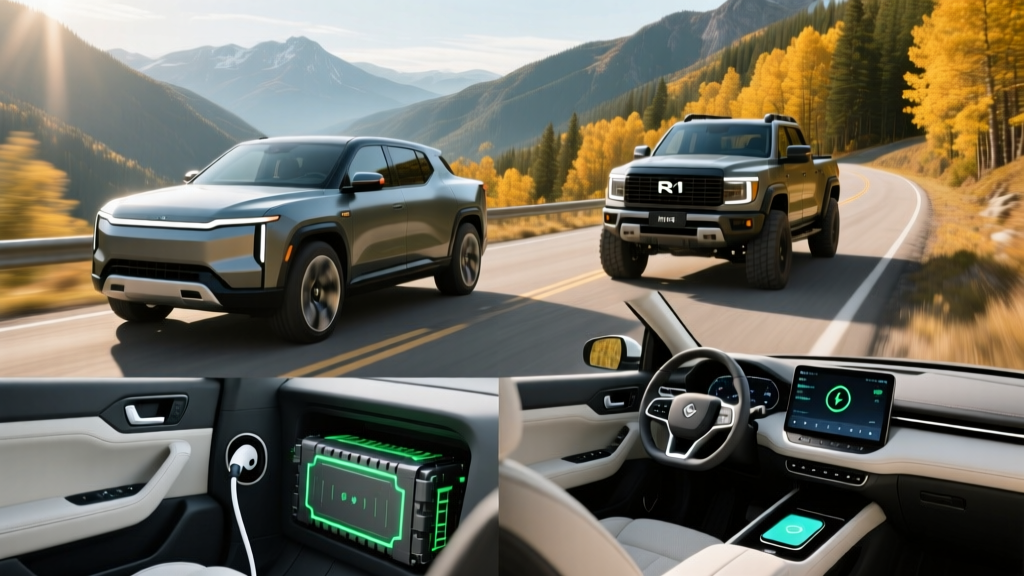
Rivian's 15.6-inch center touchscreen runs a proprietary, Linux-based OS that handles navigation, vehicle settings, and over-the-air updates without relying on Apple CarPlay or Android Auto — a deliberate choice that frustrates some buyers. Wireless phone charging, a 10.2-inch digital instrument cluster, and a 6.8-inch rear touchscreen (for climate and media) round out the cabin displays.
The Rivian Driver+ system is a Level 2 SAE driver-assist suite. It combines adaptive cruise control, lane-centering, and automatic lane changes on divided highways. This is not a self-driving system — hands must remain on the wheel and eyes on the road at all times. The system works well on interstates but requires active supervision on surface streets and in construction zones.
Standout features include the Camp Kitchen accessory (a slide-out induction cooktop and sink that mounts in the R1T Gear Tunnel), built-in air compressor, vehicle-to-load (V2L) capability providing up to 1,500W of 120V power from bed/cabin outlets, and a panoramic glass roof with electrochromic dimming on Ascend trims.
Notable drawbacks: the absence of Apple CarPlay/Android Auto remains a pain point; the R1S third row is best suited for children (28.5 inches of legroom); and insurance premiums run 15–25% higher than comparable ICE trucks due to repair costs and parts availability.
Warranty and Long-Term Ownership
| Coverage | Term |
|---|---|
| Bumper-to-Bumper | 5 years / 60,000 miles |
| Battery & Drive Units | 8 years / 175,000 miles |
| Battery Capacity Retention | ≥70% over 8 yr / 175,000 mi |
| Corrosion Perforation | 12 years / unlimited miles |
| Roadside Assistance | 5 years / 60,000 miles |
The 8-year/175,000-mile battery warranty is competitive and exceeds the federal minimum of 8/100,000. The 70% capacity-retention threshold is industry-standard. Rivian's early-production (2022–2023) vehicles have shown roughly 4–6% degradation at 40,000 miles based on owner-reported data — within expected NMC curve projections. LFP packs historically show slower degradation, though Rivian-specific long-term data is still accumulating.
Pros, Cons, and Who Should Buy
- Class-leading NACS access to Tesla Supercharger network
- Genuine off-road and towing capability (7,700 lbs)
- LFP battery option for daily 100% charging
- Up to 410 miles EPA range (Max Pack)
- Innovative storage (Gear Tunnel, frunk, V2L power)
- Strong battery warranty (8 yr / 175,000 mi)
- No Apple CarPlay or Android Auto
- R1T exceeds $80K §30D cap — no purchase credit
- Third-row space limited to children
- Higher insurance premiums than ICE trucks
- Service center network still expanding in rural areas
- Tri-Motor trims push past $100K
- Adventure-oriented families who need three rows (R1S) and tow boats or campers on weekends
- Outdoor professionals who want a daily-drivable electric truck (R1T) with real trail capability and V2L job-site power
- Home-charging households with Level 2 access who can exploit the LFP pack's 100% daily-charge tolerance
- Lease-minded buyers exploring the §45W commercial credit pathway on R1T trims that don't qualify for §30D purchase credits
Frequently Asked Questions
What is the real-world range of the 2026 Rivian R1S and R1T?
Expect 310–330 miles highway in the Large Pack (EPA 340–352 mi), with a 15–25% reduction in freezing temperatures. The Max Pack delivers roughly 360–380 real-world highway miles. City driving with regen often exceeds EPA by 5–8%.
How fast does a Rivian charge at home and on DC fast chargers?
Home Level 2 (11.5 kW) adds about 25 miles per hour — a full overnight charge in 10–13 hours. DC fast charging peaks at 220 kW (NMC packs) with a 10–80% time of roughly 21 minutes. LFP Standard packs peak at 190 kW with a ~25-minute 10–80% session.
How much does a Rivian cost after tax credits?
For purchase: R1S Adventure Standard ($69,900) and Large ($75,900) may qualify for up to $7,500 via §30D if you meet income, sourcing, and MSRP-cap requirements — bringing effective pricing to ~$62,400–$68,400. The R1T does not qualify for the purchase credit. Lease pricing depends on whether Rivian is currently passing through the §45W commercial credit, which varies by quarter.
Does the Rivian R1T qualify for the federal EV tax credit?
Not for purchase — all R1T trims exceed the $80,000 pickup MSRP cap under §30D. However, leasing an R1T may unlock savings via the §45W commercial credit if Rivian offers it as a lease incentive at the time of your order.
Is Rivian worth buying over the Tesla Cybertruck or Ford F-150 Lightning?
The R1T excels in off-road capability, interior refinement, and NACS charging-network access. The F-150 Lightning offers a larger bed, lower starting price, and broader dealer service network. The Cybertruck provides stainless-steel construction and polarizing design. Choose Rivian if trail capability, adventure features, and build quality matter more than maximum bed length or lowest price.
What are the biggest drawbacks of owning a Rivian?
No Apple CarPlay/Android Auto, limited third-row space in the R1S, higher-than-average insurance costs, and a service network that's still growing outside major metros. The R1T's pricing also excludes it from the purchase tax credit entirely.