Vehicle Overview: The Volvo EX90 Redefines Family EV Safety
When it comes to transporting your most precious cargo, few automakers carry the historical weight and engineering pedigree of Volvo. The Volvo EX90 represents a monumental shift for the Swedish brand, stepping in as the all-electric flagship successor to the venerable XC90. Designed from the ground up as a premium three-row electric family SUV, the EX90 is not merely a battery-powered evolution; it is a technological tour de force that prioritizes safety, sustainability, and Scandinavian luxury above all else.
In this comprehensive review, we delve deep into what makes the EX90 a standout contender in the rapidly expanding electric vehicle market. From its groundbreaking standard LiDAR integration to its real-world range capabilities, we evaluate how this heavy-hauler performs when the rubber meets the road. Whether you are cross-shopping against other best three-row electric SUVs or simply curious about Volvo's electric future, this guide covers every critical aspect of ownership, performance, and daily usability.
Real-World Range & Efficiency
Range anxiety remains a primary concern for families transitioning to electric vehicles, especially when planning cross-country road trips or hauling heavy cargo. The Volvo EX90 is equipped with a massive 111 kWh (usable) battery pack, providing a substantial energy reservoir. According to official EPA ratings, the EX90 Twin Motor achieves an estimated range of up to 310 miles on a single charge, while the more powerful Twin Motor Performance variant sees a slight dip to around 300 miles due to its stickier tires and increased power output.
However, independent test results and real-world highway driving evaluations often tell a slightly different story. When cruising at a steady 70 mph in moderate temperatures, the EX90 typically delivers between 260 and 280 miles of actual range. The vehicle's aerodynamic profile, despite its boxy, traditional SUV stature, helps mitigate drag, while the standard heat pump ensures that cabin heating during colder months does not drastically cannibalize the battery's reserves.
Efficiency in city driving and stop-and-go traffic is where the EX90 truly shines, thanks to an aggressive and highly tunable regenerative braking system. In urban environments, it is entirely possible to exceed the EPA estimates, making it an exceptional daily driver for school runs and grocery trips. For a deeper dive into how this compares to the broader market, be sure to check out our EV comparison guides.
Charging Speed & Infrastructure Compatibility
A large battery is only as good as the speed at which it can be replenished. The Volvo EX90 utilizes a 400-volt electrical architecture capable of accepting up to 250 kW of DC fast charging. Under optimal conditions at a high-speed charging station, the EX90 can charge from 10% to 80% in approximately 30 minutes. While this is slightly slower than the 800-volt architectures found in some Hyundai and Kia competitors, the sheer size of the battery means you are adding significantly more actual miles of range in that half-hour window.
For home charging, the EX90 supports Level 2 AC charging at up to 11 kW. Using a standard 48-amp home wall connector, a full charge from empty takes roughly 11 to 12 hours. This is perfectly suited for overnight charging, ensuring you wake up to a full 'tank' every morning. One of the most highly anticipated features is the vehicle's bidirectional charging capability, allowing the EX90 to act as a massive mobile power bank to run appliances or even feed energy back into your home during an outage. To learn more about optimizing your home setup, visit our ultimate EV charging guide.
Interior Space, Comfort & Technology
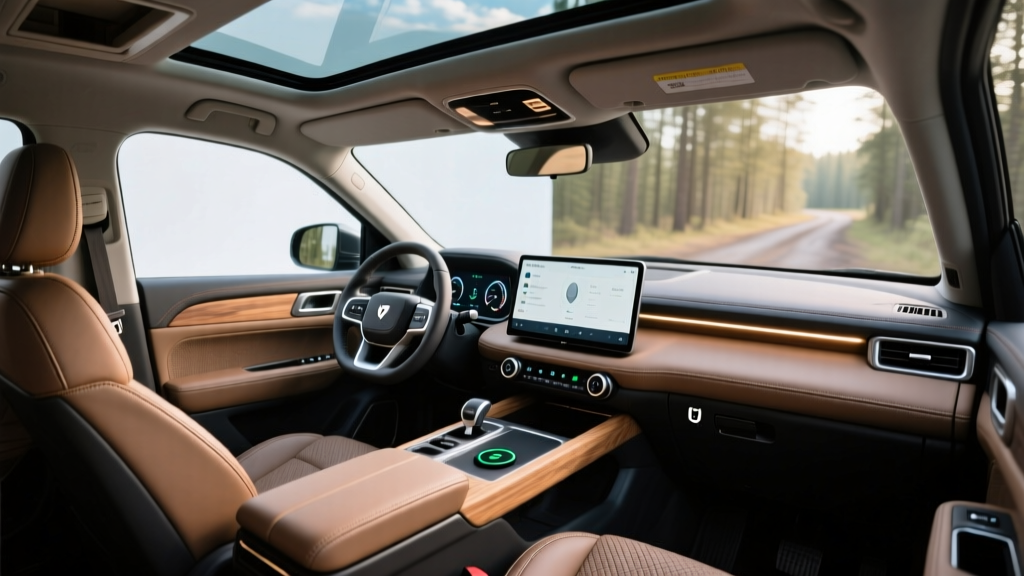
Stepping inside the EX90 is an exercise in minimalist Scandinavian luxury. Volvo has stripped away the cluttered button layouts of the past, replacing them with a stunning 14.5-inch vertical center touchscreen powered by Google Built-in. This system offers native access to Google Maps, Google Assistant, and the Play Store, ensuring that navigation and voice commands are as intuitive as using a high-end smartphone. An 8-inch digital driver display sits behind the steering wheel, showing only the most critical driving information to minimize distraction.
The cabin materials reflect Volvo's commitment to sustainability. The brand has moved away from traditional leather, opting instead for 'Nordico', a premium bio-based material created from recycled PET bottles, cork, and forestry by-products. It feels incredibly soft, durable, and luxurious, proving that eco-friendly choices do not require sacrificing premium aesthetics. The optional Bowers & Wilkins audio system, featuring Dolby Atmos spatial audio and 25 speakers, transforms the cabin into a rolling concert hall.
As a three-row family hauler, space is paramount. The second row offers generous legroom and features sliding and reclining captain's chairs or a bench, depending on the configuration. The third row is best suited for children or shorter adults on brief trips, which is typical for the segment. However, cargo space behind the third row is somewhat limited compared to some rivals, though folding the third row flat opens up a cavernous cargo area perfect for strollers, luggage, and sporting equipment.
Driving Dynamics & Ride Quality
The Volvo EX90 is a heavy vehicle, tipping the scales at over 6,200 pounds, largely due to its massive battery pack. Yet, the driving dynamics are remarkably composed. The standard Twin Motor setup produces 408 horsepower and 568 lb-ft of torque, while the Twin Motor Performance variant bumps this up to a staggering 496 horsepower and 671 lb-ft, enabling a 0-60 mph sprint in just 4.7 seconds. The instantaneous torque provides effortless highway merging and confident passing power, even when fully loaded with passengers and cargo.
Ride quality is where the EX90 truly distinguishes itself as a luxury flagship. The available active air suspension continuously monitors the road surface and adjusts the damping in real-time, effectively isolating the cabin from harsh imperfections, potholes, and speed bumps. The steering is light and precise, making this large SUV surprisingly easy to maneuver in tight parking lots and school drop-off zones. Furthermore, the one-pedal driving mode is smoothly calibrated, allowing drivers to bring the heavy SUV to a complete halt without touching the friction brakes, reducing wear and tear over the vehicle's lifespan.
Safety First: LiDAR & Advanced Driver Assistance
Volvo's core identity is safety, and the EX90 introduces a suite of hardware and software that sets a new industry benchmark. Most notably, every EX90 comes standard with a roof-mounted LiDAR sensor developed by Luminar. This sensor uses laser pulses to create a precise 3D map of the vehicle's surroundings, capable of detecting small objects like a tire tread on a dark highway from over 250 meters away. This far exceeds the capabilities of traditional cameras and radar, providing the vehicle's computer with unprecedented situational awareness.
Inside the cabin, Volvo has implemented a groundbreaking occupant sensing system. Using sub-millimeter radar sensors integrated into the overhead console and trunk, the EX90 can detect the microscopic breathing movements of a sleeping infant or a small pet left in the vehicle. If the system detects an occupant after the driver exits and locks the doors, it automatically keeps the climate control running and alerts the driver via their smartphone, effectively eliminating the risk of heatstroke tragedies.
The Pilot Assist system, enhanced by the LiDAR data, offers some of the most reliable and smooth lane-centering and adaptive cruise control on the market. While it is not a fully autonomous system, it significantly reduces driver fatigue on long highway stretches, keeping the vehicle perfectly centered and maintaining safe following distances with human-like smoothness.
Ownership Costs & Value Proposition
Purchasing a flagship luxury SUV is a significant investment, and the EX90's starting price places it firmly in the premium tier. However, when evaluating the total cost of ownership, the math begins to shift in the EV's favor. Electricity costs are a fraction of premium gasoline, and the elimination of routine maintenance associated with internal combustion engines—such as oil changes, spark plugs, and transmission fluid flushes—results in substantial annual savings.
Furthermore, the regenerative braking system drastically extends the life of the physical brake pads, often allowing them to last well over 100,000 miles. Insurance premiums for high-performance EVs can be slightly higher than average, but Volvo's extensive safety suite and over-the-air update capabilities help maintain the vehicle's relevance and resale value over time. For families looking at long-term ownership, the EX90 offers a compelling blend of luxury, safety, and operational efficiency.
Pros & Cons
Pros:
- Standard LiDAR and cutting-edge interior occupant radar safety systems.
- Exceptional ride quality and cabin isolation thanks to the available air suspension.
- Massive 111 kWh battery provides excellent real-world range for family road trips.
- Stunning, sustainable interior materials and top-tier Bowers & Wilkins audio.
- Bidirectional charging capabilities for home backup and appliance power.
Cons:
- Third-row seating and rear cargo space are tighter than some key competitors.
- Heavy reliance on the touchscreen for basic climate and mirror adjustments.
- 400V architecture means DC fast charging is slightly slower than 800V rivals.
- Premium pricing places it out of reach for many budget-conscious family buyers.
Volvo EX90 Key Specifications & Comparison
How does the Volvo EX90 stack up against the heavyweights in the three-row EV segment? Below is a comparison table highlighting key manufacturer specifications against its primary rivals.
| Feature | Volvo EX90 (Twin Motor) | Kia EV9 (AWD) | Rivian R1S (Dual Motor) |
|---|---|---|---|
| Battery Capacity (Usable) | 111 kWh | 99.8 kWh | 106 kWh (Standard) |
| EPA Estimated Range | ~310 miles | ~283 miles | ~270 miles |
| Horsepower | 408 hp | 379 hp | 533 hp |
| Max DC Fast Charging | 250 kW | 350 kW (800V) | 220 kW |
| Standard LiDAR | Yes | No | No |
| Towing Capacity | 5,000 lbs | 5,000 lbs | 7,700 lbs |
Note: For more details on hauling capabilities, check out our comprehensive EV towing guides.
Frequently Asked Questions
Is the Volvo EX90 good for towing boats or trailers?
The Volvo EX90 is rated to tow up to 5,000 pounds when properly equipped with the factory tow package. This is sufficient for pulling a small to medium-sized boat, a pair of jet skis, or a lightweight camping trailer. However, as with all electric vehicles, owners should expect a significant reduction in real-world range—often up to 40-50%—when towing heavy loads at highway speeds due to increased aerodynamic drag and weight.
How comfortable is the third row for adults?
Like most mid-size and large three-row SUVs, the EX90's third row is best suited for children, teenagers, or adults on very short trips. While the panoramic glass roof helps the space feel airy and less claustrophobic, knee room and thigh support are limited for taller adults. If you frequently need to transport six or seven adults, you may want to look into full-size minivans or extended-wheelbase luxury SUVs.
Does the EX90 support over-the-air (OTA) software updates?
Yes, the Volvo EX90 is built on a centralized core computing architecture designed specifically for continuous improvement. Volvo regularly deploys over-the-air software updates that can enhance everything from battery management and charging curves to infotainment features and advanced driver assistance systems. This ensures the vehicle can actually improve and gain new features long after it has left the dealership lot.
What happens if the LiDAR sensor gets dirty or covered in snow?
Volvo has engineered the LiDAR housing with integrated heating elements and aerodynamic shaping to help shed water, snow, and ice. In the event that the sensor becomes completely obstructed by heavy mud or severe ice buildup, the system will alert the driver and gracefully degrade to rely on its secondary camera and radar networks. The vehicle remains safe to drive, but the most advanced predictive safety features will be temporarily limited until the sensor is cleaned.
How does the Google Built-in infotainment system work without a phone?
The Google Built-in system operates independently of your smartphone, utilizing the vehicle's embedded data connection. You can log into your Google account directly on the car's screen to sync your calendars, access your preferred navigation routes, and use Google Assistant for voice commands. While wireless Apple CarPlay and Android Auto are also supported for those who prefer mirroring their phones, the native Google integration offers a seamless, deeply integrated experience that controls vehicle functions like climate and media without needing a secondary device.