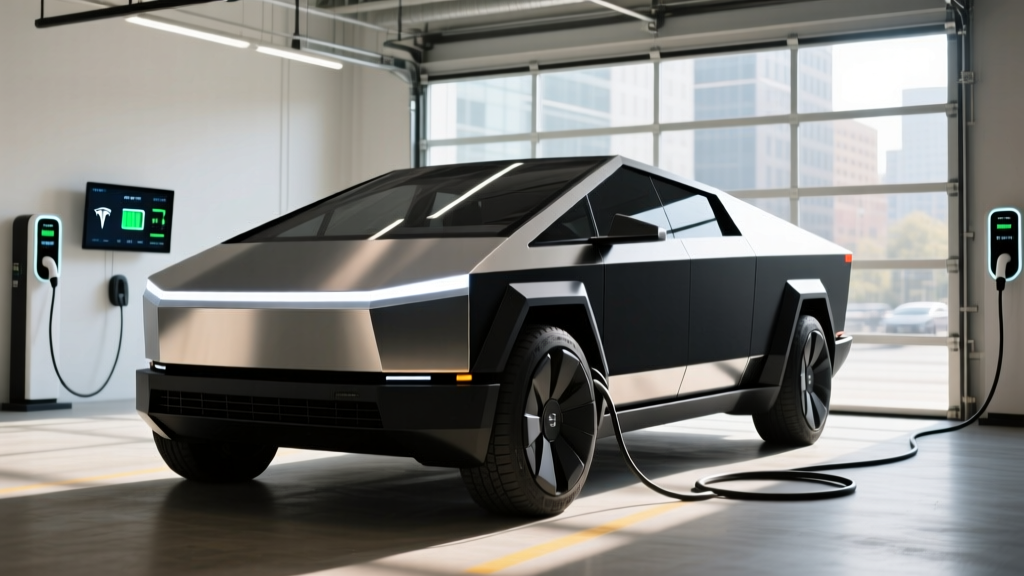
Tesla's Cybertruck polarized the truck world with its stainless-steel exoskeleton and six-figure price tags. Now, the EV community is buzzing about a smaller, more affordable sibling — colloquially dubbed the baby Cybertruck. First hinted at by Elon Musk in mid-2023 and referenced sporadically in Tesla earnings calls since, this compact electric pickup aims to slot below the Cybertruck in size and price, targeting the heart of the midsize truck market where the Ford Maverick Hybrid and upcoming electric rivals compete.
As of early 2026, Tesla has not officially unveiled the baby Cybertruck, nor has it appeared on Tesla's configurator or in EPA filings. What follows is a comprehensive preview based on Tesla's public statements, patent filings, supply-chain reporting, and analysis of Tesla's existing platform architecture. All specifications are preliminary estimates and subject to change when Tesla formally reveals the vehicle.
What Is the Baby Cybertruck and When Will It Arrive?
The baby Cybertruck is an anticipated compact or midsize electric pickup from Tesla, expected to ride on a shortened or modified version of Tesla's next-generation unboxed platform — the same architecture underpinning the company's next wave of affordable vehicles. Where the full-size Cybertruck measures 231.7 inches long and starts above $80,000, the baby Cybertruck is expected to target a footprint closer to the Ford Maverick (roughly 195-200 inches) with a starting price potentially in the $40,000-$50,000 range.
Tesla CEO Elon Musk confirmed in a 2023 product roadmap discussion that a smaller truck was in the pipeline, though no firm timeline was given. Industry analysts and supply-chain reports from late 2025 suggest a reveal could come in late 2026 or 2027, with deliveries following 6-12 months later. Until Tesla publishes official specs on its website or submits the vehicle for EPA certification, everything below carries an "estimated" or "projected" qualifier.
Estimated Range, Battery, and Efficiency
If the baby Cybertruck follows Tesla's recent platform strategy, expect two battery options mirroring the approach used in the Model 3 and Model Y lineup:
| Spec | Standard Range (Est.) | Long Range (Est.) |
|---|---|---|
| Battery Capacity (usable) | ~60 kWh | ~78 kWh |
| Chemistry | LFP (Lithium Iron Phosphate) | NMC (Nickel Manganese Cobalt) |
| EPA Est. Range | ~250 miles | ~330 miles |
| Efficiency (est.) | ~24 kWh/100mi (140 MPGe) | ~23 kWh/100mi (146 MPGe) |
| Drivetrain | RWD (single motor) | AWD (dual motor) |
EPA estimates are measured under controlled conditions. For the projected ~330-mile Long Range AWD model, plan on approximately 270-290 miles on sustained highway driving at 70-75 mph, where aerodynamic drag disproportionately affects pickups. In cold weather (below 30°F), expect a further 15-25% range reduction, bringing effective winter range to roughly 210-250 miles depending on cabin heating use. The LFP Standard Range variant (~250 mi EPA) may realistically deliver 190-210 miles in mixed cold-weather highway driving. If Tesla includes a standard heat pump (as on the refreshed Model 3), cold-weather losses will be at the lower end of that range.
The LFP chemistry choice for the base model is strategic: LFP cells are cheaper to produce, contain no cobalt or nickel (simplifying critical-mineral sourcing for tax credit purposes), and tolerate frequent 100% charging without degradation concerns. The trade-off is lower energy density, meaning the Standard Range pack will be heavier per kWh — a factor that slightly reduces efficiency and potentially payload capacity.
Charging Speed: DC Fast Charging and Home Level 2
Tesla's North American Charging Standard (NACS) connector is now the industry norm, and the baby Cybertruck will ship with a native NACS port — no adapter needed for Tesla's Supercharger network, which as of 2026 exceeds 7,500 stations and 65,000+ stalls across North America.
| Charging Level | Max Rate | Speed (Approx.) | Notes |
|---|---|---|---|
| Level 1 (120V household) | ~1.4 kW | ~3-4 mi/hr | Emergency/trickle only |
| Level 2 (240V home, 48A) | ~11.5 kW | ~30-35 mi/hr | Full charge overnight (~8-10 hrs) |
| DC Fast Charge (Supercharger V4) | ~250 kW (peak) | 10-80% in ~20-25 min | Charge curve tapers sharply above 80% |
The critical metric for road trips is the 10-80% DC fast-charge time. Tesla's current 4680-cell architecture (used in the Cybertruck and Model Y from the Austin Gigafactory) supports peak rates around 250 kW on V3 and V4 Superchargers. However, peak rate is not sustained rate: the charging curve typically holds near maximum for the 10-50% window, then progressively tapers. Expect 10-80% in approximately 20-25 minutes for the Long Range NMC pack. LFP packs historically accept charge slightly slower at high SoC, so the Standard Range variant may take 25-30 minutes for the same 10-80% session.
Key distinction — kW vs kWh: The battery stores energy measured in kilowatt-hours (kWh) — think of it as the "gallon" equivalent. Charging speed is measured in kilowatts (kW) — the "gallons per minute" flow rate. A 250 kW charger can theoretically add 250 kWh in one hour, but in practice, the battery's acceptance rate and charge curve mean a 78 kWh battery won't absorb energy at peak rate for the full session.
Performance: 0-60, Horsepower, and Drivetrain
| Metric | RWD Standard Range | AWD Long Range |
|---|---|---|
| Horsepower (est.) | ~280 hp | ~420 hp |
| 0-60 mph (est.) | ~6.0 seconds | ~4.2 seconds |
| Drivetrain | Rear-Wheel Drive (single motor) | Dual-Motor AWD |
| Towing Capacity (est.) | ~3,500 lbs | ~5,000-7,500 lbs |
| Payload (est.) | ~1,200 lbs | ~1,500 lbs |
These figures position the baby Cybertruck squarely against the Ford Maverick (250 hp hybrid, 4,000-lb max tow with the 2.0L EcoBoost) and the anticipated Chevrolet Montana EV. The dual-motor AWD variant's projected ~4.2-second 0-60 time would make it one of the quickest compact pickups on the market, though Tesla buyers have come to expect this kind of straight-line performance as standard.
Towing is where compact pickups hit a wall compared to full-size trucks. Even the full Cybertruck (11,000-lb rated) loses roughly 40-50% of its range when towing at capacity. Expect the baby Cybertruck to shed range even more dramatically when towing near its limit — a 3,500-5,000 lb trailer could cut effective range to 130-180 miles. If towing is a primary use case, the full-size Cybertruck or a heavy-duty ICE truck remains more practical.
Pricing, Trims, and Federal Tax Credit Eligibility
Tesla's stated goal with its next-generation platform is to slash production costs by up to 50% compared to the Model 3/Y architecture. If those savings translate to the baby Cybertruck, pricing could look approximately like this:
| Trim | Est. Base MSRP | §30D Credit Eligibility | Effective Price (with credit) |
|---|---|---|---|
| Standard Range RWD | ~$39,990 | Likely eligible (up to $7,500) | ~$32,490 |
| Long Range AWD | ~$47,990 | Likely eligible (up to $7,500) | ~$40,490 |
| Performance / Off-Road | ~$54,990 | Eligible (under $80K truck cap) | ~$47,490 |
Federal tax credit (§30D) eligibility — key rules for 2026:
- MSRP cap: Pickup trucks must have an MSRP at or below $80,000 to qualify. All projected baby Cybertruck trims clear this threshold easily.
- Buyer income cap: Modified adjusted gross income must not exceed $150,000 (single), $225,000 (head of household), or $300,000 (married filing jointly).
- Battery sourcing: To receive the full $7,500, the vehicle must meet both critical-mineral sourcing (increasing percentages each year) and battery-component manufacturing requirements as defined by the IRS. Tesla's LFP cells have historically sourced from CATL in China, which could complicate the critical-minerals portion. The NMC variant using Tesla's in-house 4680 cells from Austin may more easily qualify.
- Point-of-sale transfer: As of 2024, buyers can transfer the credit to the dealer at purchase, reducing the purchase price directly rather than waiting for a tax refund.
- FEOC restriction: Vehicles with battery components from a "foreign entity of concern" (primarily Chinese companies) face phase-outs. This is the single biggest risk to the Standard Range LFP trim's credit eligibility. Check Tesla's official documentation and the IRS qualified-vehicles list before purchasing.
Consult a tax professional to confirm your personal eligibility — income limits, filing status, and tax liability all affect whether you can claim the full credit.
Interior, Cargo, and Technology
Exterior dimensions are projected at roughly 195-200 inches long with a ~4.5-foot bed (similar to the Ford Maverick's 4.5-foot bed). This puts the baby Cybertruck firmly in compact-pickup territory — urban-friendly but limited for hauling sheet goods or long cargo.
| Dimension | Estimate |
|---|---|
| Overall Length | ~197 inches |
| Bed Length | ~4.5 feet (54 inches) |
| Bed Volume (est.) | ~30-35 cu ft |
| Frunk Volume (est.) | ~5-7 cu ft |
| Rear Legroom (est.) | ~34-36 inches |
| Seating | 5 passengers (2-row) |
Technology highlights (projected):
- Infotainment: Expect a 15.4-inch center touchscreen running Tesla's latest software, wireless Apple CarPlay/Android Auto (finally added to Tesla vehicles in 2025), and over-the-air update capability.
- Driver assistance: Tesla Autopilot (adaptive cruise + lane centering) standard; Full Self-Driving (Supervised) available as a $8,000 option or $99/month subscription. FSD Supervised is an SAE Level 2 system — the driver must remain fully engaged and hands-on at all times. It is not autonomous driving.
- Power features: Likely includes a powered tonneau bed cover, 120V/240V bed outlets (similar to Cybertruck's Powershare), and potential V2L (vehicle-to-load) capability for powering tools or camping gear.
- Camera system: Tesla's 8-camera surround-view for Autopilot and Sentry Mode, with the dashcam and security recording features owners rely on.
Warranty and Long-Term Ownership
| Component | Coverage (Est.) |
|---|---|
| Basic Vehicle | 4 years / 50,000 miles |
| Battery & Drive Unit | 8 years / 120,000 miles (min 70% retention) |
| Roadside Assistance | 4 years / 50,000 miles |
Tesla's battery warranty guarantees a minimum of 70% capacity retention over the warranty period. In practice, Tesla's NMC packs on the Model 3 and Model Y have shown approximately 10-12% degradation over the first 100,000 miles based on fleet data, with the curve flattening significantly after the initial break-in period. LFP packs tend to show even less degradation but require periodic 100% calibration charges for accurate state-of-charge readings.
Long-term ownership costs for a Tesla are generally favorable on the maintenance side — no oil changes, minimal brake wear thanks to regenerative braking, and no transmission fluid — but insurance premiums for Tesla vehicles remain 20-40% above segment averages due to high repair costs after collisions. Get insurance quotes before committing.
How the Baby Cybertruck Compares to Competitors
- Access to Tesla Supercharger network (65,000+ stalls, highest reliability of any network)
- Projected sub-$40K starting price after tax credit
- OTA software updates continuously add features
- Strong performance even in base RWD trim
- Native NACS connector — no adapter needed
- Tesla's energy ecosystem integration (Powerwall, solar)
- Not yet announced — no firm timeline or guaranteed specs
- Short bed (~4.5 ft) limits utility for large cargo
- LFP base model may lose full $7,500 credit due to FEOC battery sourcing rules
- Tesla's panel gaps and build quality remain inconsistent
- Insurance costs 20-40% above compact truck average
- No physical controls — touchscreen-only HVAC, mirrors, wipers
- Resale value uncertain for a new nameplate
Who Should Wait for the Baby Cybertruck?
- You want an electric daily-driver truck for commuting and light hauling, not heavy towing
- You already use or plan to use Tesla's Supercharger network for road trips
- A sub-$40K effective price (with tax credit) is critical to your budget
- You value OTA updates, Sentry Mode, and Tesla's software ecosystem
- You can wait until late 2026 or 2027+ for delivery
- You need a truck now — the Ford Maverick Hybrid (42 MPG city, ~$28K) is available today
- Heavy towing (7,500+ lbs) is a regular requirement
- You prefer physical buttons, knobs, and traditional truck ergonomics
- You need a full-size 6+ foot bed for work
- You want a proven track record — Tesla's Cybertruck has had significant recall and quality issues in its first two years
Frequently Asked Questions
What is the real-world range of the baby Cybertruck?
Since the vehicle is unreleased, there are no real-world tests yet. Based on the projected ~330-mile EPA Long Range variant, expect approximately 270-290 miles in warm-weather highway driving and 210-250 miles in cold-weather conditions. The Standard Range LFP model (~250 mi EPA) will likely deliver 190-220 miles in real-world mixed driving.
How fast does the baby Cybertruck charge?
Projected DC fast-charge peak rate is ~250 kW on Tesla V3/V4 Superchargers, with a 10-80% session taking approximately 20-25 minutes for the Long Range pack and 25-30 minutes for the LFP Standard Range pack. At home on a 240V Level 2 charger (48A/11.5 kW), expect roughly 30-35 miles of range added per hour, or a full overnight charge in 8-10 hours.
How much will the baby Cybertruck cost after tax credits?
If the base Standard Range RWD model prices at ~$39,990 MSRP and qualifies for the full $7,500 federal credit, the effective price drops to approximately $32,490. However, LFP battery sourcing from Chinese manufacturers (CATL) could disqualify the base trim under FEOC rules. The Long Range AWD at ~$47,990 (effective ~$40,490) is more likely to qualify fully if it uses Tesla's US-built 4680 NMC cells. Always verify current eligibility on IRS.gov before purchasing.
Is the baby Cybertruck worth waiting for vs. buying a Ford Maverick or Rivian?
If you need a compact truck immediately, the Ford Maverick Hybrid offers 42 MPG city and starts around $28,000 — an excellent value, though it's not electric. The full-electric compact truck space is still developing: Rivian has not announced a smaller truck, and the Chevrolet Montana/Silverado EV targets a larger segment. The baby Cybertruck could be compelling at its projected price point, but waiting means uncertainty on timeline, final specs, and tax credit eligibility.
Does the baby Cybertruck qualify for the federal EV tax credit?
It's projected to qualify, but final eligibility depends on battery sourcing at time of sale. The MSRP (well under the $80K truck cap) and buyer income limits are the primary gates. The critical risk is the FEOC (Foreign Entity of Concern) restriction on Chinese-sourced battery components and critical minerals — this particularly threatens the LFP Standard Range variant. Tesla's US-manufactured 4680 NMC cells give the Long Range variant a stronger path to the full $7,500 credit. Check the IRS qualified vehicle list at the time of purchase.
Will the baby Cybertruck have a frunk?
Based on Tesla's design patterns (Model 3, Model Y, Cybertruck all include front trunks), a frunk of approximately 5-7 cubic feet is expected — enough for a charging cable kit, groceries, or a small tool bag. This is supplementary to the ~30-35 cu ft bed.