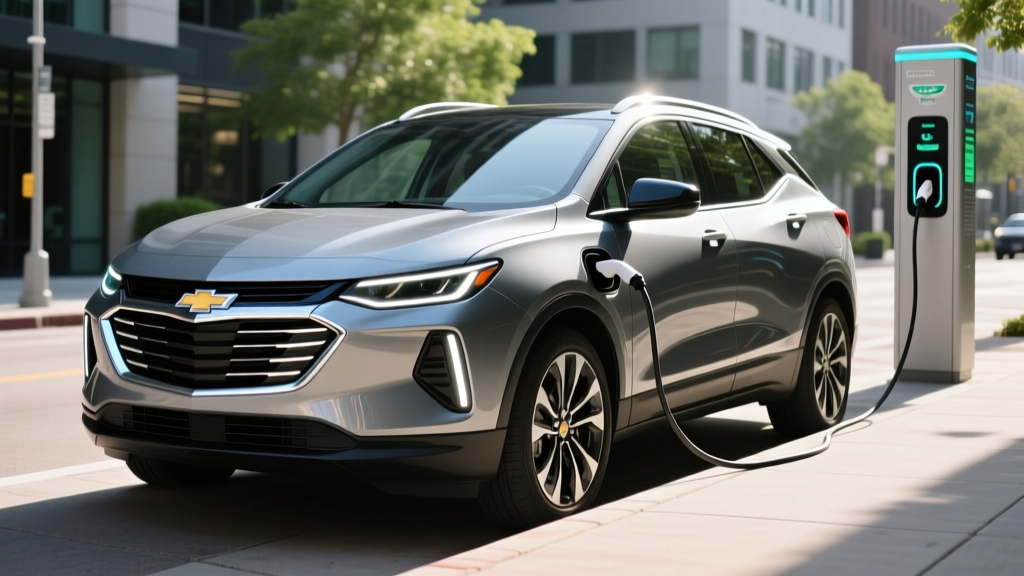
Quick Verdict: The 2026 Chevrolet Equinox EV delivers up to 319 miles of EPA-estimated range starting at $33,600 (before incentives), making it one of the most affordable long-range electric SUVs on the market. It qualifies for the full $7,500 federal tax credit under current IRS §30D rules when purchased new, potentially dropping the effective price below $27,000. Real-world highway range lands closer to 250–270 miles, and DC fast charging peaks at 150 kW (10–80% in roughly 30 minutes). It's the right pick for budget-conscious buyers who want genuine road-trip range without stepping up to a Tesla Model Y or Ioniq 5 price bracket.
Range, Battery, and Efficiency: What the EPA Number Doesn't Tell You
The 2026 Equinox EV rides on GM's Ultium platform with an 85 kWh usable lithium-ion battery pack (NMC chemistry). Front-wheel-drive trims (LT and RS with the larger battery) achieve an EPA-estimated 319 miles of range, while all-wheel-drive variants drop to approximately 285 miles. Efficiency clocks in at roughly 3.0–3.3 miles per kWh depending on trim and wheel size.
EPA Range vs. Real-World Expectation
EPA sticker: 319 miles (FWD, 19" wheels). In practice, expect 270–290 miles in mixed driving at moderate temperatures. Sustained highway speeds above 70 mph reduce that to roughly 250–265 miles. In freezing conditions (below 32°F), plan for a 20–30% reduction, putting real winter range in the 220–255 mile window. The Equinox EV includes a heat pump on all trims, which helps mitigate cold-weather cabin-heating losses compared to resistive systems.
GM's decision to stick with NMC chemistry prioritizes energy density over the ultra-long cycle life of LFP packs found in some competitors. For most owners keeping the vehicle 5–8 years, degradation should remain within the 8-year/100,000-mile battery warranty threshold (GM guarantees at least 70% capacity retention).
Charging Speed and Infrastructure: Home and Public
Understanding the difference between kW (power, or how fast energy flows) and kWh (energy, or how much the battery holds) is essential here. The Equinox EV's 85 kWh battery is the tank size; the charge rate in kW determines how quickly you fill it.
| Charging Level | Power (kW) | Miles Added per Hour | Full Charge Time (0–100%) |
|---|---|---|---|
| Level 1 (120V outlet) | ~1.4 kW | ~4–5 miles | ~60+ hours |
| Level 2 (240V, 48A) | 11.5 kW | ~34 miles | ~8–9 hours |
| DC Fast Charge (peak) | 150 kW | N/A | 10–80% in ~30 min |
The Equinox EV's onboard AC charger accepts up to 11.5 kW on Level 2, which is competitive for the segment. On DC fast chargers, it peaks at 150 kW — adequate but not class-leading. Competitors like the Hyundai Ioniq 5 (up to 240 kW peak) and Tesla Model Y (up to 250 kW peak on V3 Superchargers) replenish significantly faster on road trips.
Charging-curve reality check: Like all EVs, the Equinox EV does not sustain its peak 150 kW rate for the full session. Expect peak speeds between 10–50% state of charge, tapering to roughly 80–100 kW from 50–70%, and dropping further above 80%. For road-trip efficiency, charge from 10–80% and skip the slow top-off unless you need every mile.
GM has adopted the NACS (Tesla-style) charging port on the 2026 Equinox EV, granting access to Tesla's Supercharger network with no adapter required. This is a significant practical advantage for buyers in areas where Electrify America or EVgo coverage is sparse.
Equinox EV vs. Gas Equinox: The Real Cost Breakdown
The most common question from cross-shoppers: does the electric Equinox actually save money compared to the gasoline version? Here's a five-year ownership comparison using national averages.
| Cost Category (5 Years / 75,000 Miles) | 2026 Equinox EV (LT FWD) | 2026 Equinox Gas (LT FWD) |
|---|---|---|
| Base MSRP | $33,600 | $28,600 |
| Federal Tax Credit (§30D) | −$7,500 (if eligible) | $0 |
| Effective Purchase Price | $26,100 | $28,600 |
| Fuel / Electricity (75k mi) | $2,400 (home charging avg) | $7,500 (27 MPG, $3.50/gal) |
| Maintenance (5 yr) | $800 | $3,200 |
| Insurance (5 yr avg) | $9,500 | $7,800 |
| Total 5-Year Cost | $38,800 | $47,100 |
The math favors the EV strongly — but with critical caveats. The $7,500 federal credit under IRS §30D is subject to buyer income caps ($150,000 single / $300,000 joint modified AGI), vehicle MSRP caps ($80,000 for SUVs), and battery critical-mineral sourcing requirements. The Equinox EV currently meets sourcing thresholds, but always verify eligibility at the point of sale. The credit can now be transferred to the dealer at purchase, reducing your out-of-pocket cost immediately rather than waiting until tax filing.
Insurance runs 15–25% higher on the EV due to elevated repair costs and battery replacement risk. Home electricity costs vary enormously — the $2,400 figure assumes $0.14/kWh national average with predominantly home charging. If you rely entirely on public DC fast charging at $0.35–$0.50/kWh, your five-year fuel cost climbs to $4,500–$6,500, narrowing the gap.
Performance, Interior, and Daily Livability
The FWD Equinox EV produces 213 horsepower and 236 lb-ft of torque, with a 0–60 mph time of approximately 8.0 seconds. The AWD variant bumps output to 288 hp and drops 0–60 to roughly 6.5 seconds. Neither is a performance vehicle, but the instant torque delivery makes city merging and passing feel more responsive than the numbers suggest.
Inside, the cabin centers on a 17.7-inch diagonal infotainment touchscreen running GM's Google Built-in system with native Google Maps, Google Assistant, and Play Store apps. Wireless Apple CarPlay and Android Auto are standard. The interior materials are hard-plastic-heavy in the lower door panels and center console — a visible cost-saving measure at this price point, but not unusual for the segment.
Cargo volume measures 26.4 cubic feet behind the rear seats and 57.2 cubic feet with the rear row folded. There is no front trunk (frunk), which some buyers expect at this price. Rear legroom is generous at 38.7 inches, making it practical for families with rear-facing car seats.
Tax Credit Eligibility: Do You Actually Qualify?
The Equinox EV's affordability story hinges on the §30D credit. Here's what determines your eligibility under current 2026 rules:
- Income cap: Modified AGI must not exceed $150,000 (single), $225,000 (head of household), or $300,000 (married filing jointly)
- MSRP cap: Vehicle base price plus factory-installed options must not exceed $80,000 for SUVs (the Equinox EV clears this easily at ~$33,600–$43,400)
- Battery sourcing: A percentage of critical minerals and battery components must be sourced from the US or free-trade-agreement countries — GM has confirmed the Equinox EV qualifies, but verify the specific VIN at the dealer
- Point-of-sale transfer: You can elect to transfer the credit to the dealer, reducing your purchase price by $7,500 at signing rather than claiming it on your tax return
- One vehicle per four years: You cannot claim the new-vehicle credit more than once per 4-year period per taxpayer
If your income exceeds the cap or you've claimed the credit recently, the used-EV credit (§25E) offers up to $4,000 on qualifying pre-owned models priced under $25,000 — worth monitoring as 2024–2025 Equinox EVs enter the used market.
Decision Framework: Is the Equinox EV Right for You?
Choose the Equinox EV if:
- You have access to Level 2 home charging (a 240V outlet or installed charger) and drive under 60 miles round-trip daily
- Your household income falls within §30D limits, making the effective price highly competitive
- You want 300+ mile EPA range without paying $45,000+ for a Model Y or Ioniq 5
- Supercharger network access matters to you (NACS port is native on the 2026 model)
- You plan to keep the vehicle 5+ years to recoup the upfront cost differential through fuel and maintenance savings
Look elsewhere if:
- You have no home or workplace charging access and your area has sparse public DC fast-charging infrastructure
- You regularly tow — the Equinox EV is not rated for towing
- You need maximum road-trip charging speed (the Ioniq 5 or Model Y charge roughly 40–60% faster)
- You live in a region with extreme winters and no garage — a PHEV like the Toyota RAV4 Prime may offer more flexibility
- You exceed the §30D income cap and cannot absorb the $5,000 price premium over the gas Equinox
Common Misconceptions About the Equinox EV
| Myth | Fact |
|---|---|
| "The battery will need replacing in 5 years and cost $20,000" | GM warrants the battery for 8 years/100,000 miles at ≥70% capacity. Industry data shows typical degradation of 10–15% over 8 years for liquid-cooled NMC packs. Full replacement is rare and usually covered under warranty. |
| "It can't handle road trips — charging takes too long" | A 10–80% DC fast charge takes ~30 minutes at a 150 kW station. Combined with 319 miles of range, most drivers will need only one stop on a 500-mile trip — similar to a gas-car bathroom-and-snack break. |
| "The tax credit is gone / I definitely won't qualify" | The Equinox EV currently qualifies for the full $7,500 credit, and it can be applied at the point of sale. Income and sourcing rules apply, but the majority of buyers in the target demographic qualify. |
| "EVs are worse in winter" | Range drops 20–30% in freezing temps — real, but manageable with preconditioning and the standard heat pump. The Equinox EV's instant torque and low center of gravity actually improve winter traction vs. the gas version. |
Ownership Practicalities: What First-Time EV Buyers Should Know
Home charging is the foundation. A Level 2 home charger (240V, 48-amp circuit) costs roughly $500–$800 for the unit and $800–$2,500 for professional installation depending on your electrical panel's capacity. If your panel needs an upgrade from 100A to 200A service, budget an additional $1,500–$3,000. Always get a quote from a licensed electrician before purchasing — do not assume your panel has capacity. A full overnight charge from near-empty takes 8–9 hours, meaning you wake up to a full "tank" every morning.
Maintenance is minimal but not zero. Expect cabin air filter replacements ($30–$60), tire rotations, windshield washer fluid, and brake fluid checks. The regenerative braking system means brake pads last 100,000+ miles in most cases. There are no oil changes, spark plugs, timing belts, or transmission fluid services. Budget roughly $150–$200 per year in maintenance.
Insurance is higher. Get a quote before purchasing. EV insurance premiums run 15–25% above comparable gas vehicles due to specialized repair requirements and battery cost exposure. Shop multiple carriers — some insurers now offer EV-specific policies with battery coverage riders.
Public charging costs vary wildly. Home charging at $0.14/kWh means a full 85 kWh charge costs about $12. The same fill at a DC fast charger running $0.40/kWh costs $34. For daily driving, home charging is non-negotiable for cost savings; public charging is a road-trip expense, not a daily strategy.
Frequently Asked Questions
What is the real-world range of the 2026 Chevrolet Equinox EV?
The EPA rates the FWD model at 319 miles. In real-world mixed driving at moderate temperatures, expect 270–290 miles. Highway-only driving at 75+ mph reduces that to approximately 250–265 miles, and freezing winter conditions can drop range to 220–255 miles depending on cabin heat usage and whether you precondition the battery.
Does the 2026 Equinox EV qualify for the $7,500 federal tax credit?
Yes, under current IRS §30D rules, the Equinox EV qualifies for the full $7,500 credit. You must meet income caps ($150K single / $300K joint), and the credit can be transferred to the dealer at point of sale. Always confirm eligibility for your specific VIN and tax situation with the dealer and a tax professional.
How long does it take to charge the Equinox EV at home?
On a Level 2 home charger (240V, 11.5 kW), a full charge from near-empty takes approximately 8–9 hours. Most owners plug in overnight and wake to a full battery. On a standard 120V household outlet (Level 1), expect 60+ hours for a full charge — practical only for emergency topping or very low daily mileage.
Can the Equinox EV use Tesla Superchargers?
Yes. The 2026 Equinox EV comes with a native NACS (Tesla-style) charging port, giving it direct access to the Tesla Supercharger network without an adapter. This significantly expands road-trip charging options, particularly in rural areas where other networks have limited coverage.
How does the Equinox EV compare to the Hyundai Ioniq 5 or Tesla Model Y?
The Equinox EV undercuts both on price ($33,600 vs. ~$42,000–$45,000 base) while offering comparable EPA range. However, the Ioniq 5 charges significantly faster (up to 240 kW vs. 150 kW), and the Model Y offers access to Tesla's software ecosystem and Supercharger network (though the Equinox EV now has native NACS access). If budget is the primary driver, the Equinox EV wins. If charging speed or performance matters more, the Ioniq 5 or Model Y justify the premium.
What is the battery warranty on the Equinox EV?
GM covers the Ultium battery pack for 8 years or 100,000 miles (whichever comes first), guaranteeing at least 70% capacity retention. The electric powertrain components carry the same 8-year/100,000-mile warranty. This aligns with federal mandates and industry norms for the segment.