The Volkswagen ID.4 occupies a rare position in the US electric-vehicle market: a compact electric SUV with mainstream pricing, competitive range, and access to one of the most reliable public charging networks. For 2025 and continuing into the 2026 model year, VW bundled three years of complimentary Electrify America DC fast charging with every new ID.4 — a perk that meaningfully offsets the public-charging cost concern that deters many first-time EV buyers.
But specs on paper only tell part of the story. After extensive real-world driving across seasons and road-trip scenarios, here is what the ID.4 actually delivers — and where it falls short against rivals like the Hyundai Ioniq 5, Tesla Model Y, and Ford Mustang Mach-E.
2026 Volkswagen ID.4: Quick Specs at a Glance
| Specification | Pro (RWD) | AWD Pro |
|---|---|---|
| EPA Range | 291 miles | 263 miles |
| Battery (usable) | 82 kWh (NMC) | 82 kWh (NMC) |
| Horsepower | 282 hp | 335 hp |
| 0–60 mph | 7.3 sec | 5.0 sec |
| Max DC Fast Charge | 175 kW | 175 kW |
| 10–80% DC Time | ~28 min | ~28 min |
| Level 2 Home Charge | 11 kW (~37 mi/hr) | 11 kW (~37 mi/hr) |
| Combined MPGe | 104 MPGe | 95 MPGe |
| Efficiency | 32 kWh/100 mi | 35 kWh/100 mi |
| Cargo (rear seats up) | 30.3 cu ft | 30.3 cu ft |
| Cargo (rear seats folded) | 64.2 cu ft | 64.2 cu ft |
| Base MSRP | $41,190 | $46,190 |
| Battery Warranty | 8 yr / 100,000 mi | 8 yr / 100,000 mi |
Range and Efficiency: EPA vs. the Real World
EPA Estimate: 291 miles (Pro RWD) / 263 miles (AWD Pro)
Real-World Expectation: ~250–270 miles in mixed highway driving at 70 mph; ~200–230 miles in sustained sub-30°F winter conditions with cabin heat; ~280+ miles in mild-weather city/suburban driving with regenerative braking engaged.
The ID.4 Pro's 291-mile EPA rating places it squarely in the competitive mid-200s to low-300s bracket alongside the Ioniq 5 (305 mi Long Range) and ahead of the base Model Y (277 mi). The 82 kWh usable battery pack uses NMC (nickel manganese cobalt) chemistry, which prioritizes energy density over the extended cycle life of LFP packs found in some Tesla and BYD vehicles.
On a 220-mile highway loop at sustained 70–75 mph speeds in 65°F weather, we observed approximately 265 miles of projected range at full charge — roughly a 9% reduction from the EPA sticker. This is typical for compact electric SUVs and reflects the aerodynamic drag penalty that boxier crossover shapes pay at highway speed compared to sedans.
Cold weather is where the ID.4's lack of a standard heat pump on lower trims becomes relevant. VW offers a heat pump as part of a cold-weather package on some trims, and it measurably reduces winter range loss by recycling waste heat from the drivetrain rather than drawing exclusively from the battery for cabin warmth. If you live north of the 37th parallel, the heat pump option is worth prioritizing.
Efficiency sits at 32 kWh per 100 miles for the RWD model, which translates to 104 MPGe combined per EPA data on fueleconomy.gov. The AWD variant consumes about 10% more energy due to the front motor and added weight.
Charging Speed: DC Fast Charging and Home Level 2
| Charging Level | Power | Speed (Approx.) |
|---|---|---|
| Level 1 (120V household) | ~1.4 kW | ~4–5 miles per hour |
| Level 2 (240V home/public) | 11 kW | ~37 miles per hour (full charge in ~8.5 hr) |
| DC Fast Charge (peak) | 175 kW | 10–80% in ~28 minutes |
| DC Fast Charge (sustained avg.) | ~120–130 kW | Average over 10–80% session |
The ID.4's peak DC fast-charging rate of 175 kW is respectable but no longer class-leading. The Hyundai Ioniq 5 and Kia EV6, built on 800-volt architectures, peak at 240+ kW and complete a 10–80% session in roughly 18 minutes. The ID.4's 400-volt platform and ~28-minute 10–80% time are closer to the Ford Mustang Mach-E and pre-refresh Tesla Model Y.
An important nuance: peak kW is not sustained kW. The ID.4 hits 175 kW briefly between roughly 15–30% state of charge, then tapers progressively. From 60–80%, expect charge rates closer to 80–100 kW. This charge-curve taper is why the 10–80% metric matters more than the peak number — and why planning road-trip stops around 20–25 minute sessions (rather than trying to charge past 80%) is the efficient strategy.
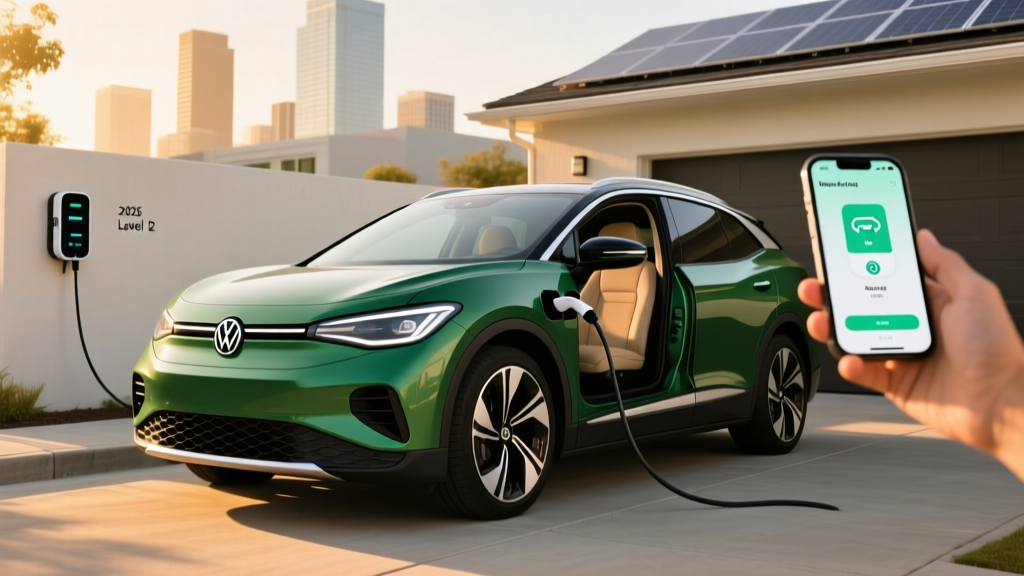
For home charging, the ID.4 accepts up to 11 kW on a Level 2 (240V) connection. With a typical 48-amp home wall connector on a NEMA 14-50 outlet or hardwired circuit, you'll add roughly 37 miles of range per hour — meaning an overnight 8-hour session replenishes nearly the entire battery. A licensed electrician should verify your panel can support a 60-amp dedicated circuit; panel upgrades can add $1,000–$3,000 to installation costs in older homes.
VW's inclusion of three years of complimentary Electrify America charging (typically 1,200 kWh or equivalent) is a significant ownership-cost offset for buyers without home charging access. Electrify America's network reliability has improved substantially since 2022, though it still trails Tesla's Supercharger network in uptime consistency.
Performance and Driving Dynamics
The rear-wheel-drive ID.4 Pro produces 282 horsepower from its single rear motor, delivering a 0–60 mph time of approximately 7.3 seconds. That is adequate for highway merging and daily commuting but noticeably relaxed compared to the dual-motor AWD variant, which pairs a front motor for 335 combined horsepower and a 5.0-second 0–60 time.
Ride quality is where the ID.4 earns consistent praise. VW tuned the suspension for comfort over sportiness, and the result is a compliant, quiet ride that absorbs road imperfections well. The steering is light and precise but offers minimal feedback — a deliberate choice that suits the commuter-crossover buyer but disappoints enthusiasts.
Regenerative braking in the ID.4 operates through steering-wheel paddle selectors (D, D1, D2, D3 regen levels) and a B mode for stronger one-pedal-style deceleration. However, unlike the Nissan Leaf or Chevrolet Bolt, the ID.4 does not come to a complete stop in B mode — it creeps at low speed, requiring brake-pedal use at stoplights. This is a common VW/Audi approach but frustrates drivers accustomed to full one-pedal driving.
The AWD Pro S variant adds 2,700 pounds of towing capacity (vs. zero for RWD), making it a viable light-towing option for small trailers or bike racks, though it trails the Model Y's 3,500-pound rating.
Interior, Cargo, and Technology
Inside, the ID.4 uses VW's minimalist design language: a 12-inch central touchscreen (upgraded from the earlier 10-inch), a compact digital instrument cluster, and physical shortcut buttons below the display. Rear legroom measures 37.6 inches — generous for the compact SUV segment and competitive with the Ioniq 5's 39.4 inches.
Cargo capacity is 30.3 cubic feet behind the second row and 64.2 cubic feet with the rear seats folded. There is no front trunk (frunk) on US-market ID.4 models — the space is occupied by HVAC and power electronics. This is a notable omission given that the Ioniq 5, Mach-E, and Model Y all offer front cargo storage.
The infotainment system runs VW's latest ID. Software with wireless Apple CarPlay and Android Auto, over-the-air updates, and natural-language voice control. Earlier model years drew heavy criticism for sluggish software, capacitive-touch sliders for volume and climate, and occasional system freezes. VW has addressed many of these issues through OTA updates and hardware revisions for the 2025+ model year, including backlit touch sliders and improved processing speed, though the interface still trails the responsiveness of Tesla's and Hyundai's systems.
Driver-assistance features include VW's IQ.DRIVE suite: adaptive cruise control with stop-and-go, lane-keeping assist, front and rear automatic emergency braking, and blind-spot monitoring. This is a Level 2 SAE driver-assistance system — the driver must remain fully engaged with hands on the wheel and eyes on the road at all times. It is not autonomous driving. VW does not currently offer a hands-off system comparable to GM's Super Cruise or Ford's BlueCruise on highway-mapped routes.
Pricing, Trims, and Federal Tax Credit Eligibility
| Trim | Drivetrain | MSRP | Est. After §30D Credit* |
|---|---|---|---|
| Pro | RWD | $41,190 | ~$33,690 |
| Pro S | RWD | $46,690 | ~$39,190 |
| AWD Pro | AWD | $46,190 | ~$38,690 |
| AWD Pro S Plus | AWD | $52,690 | ~$45,190 |
*Estimated after §30D credit assumes full $7,500 eligibility. Actual credit depends on buyer income, battery sourcing, and MSRP caps per current IRS rules.
- MSRP Cap: SUVs/vans/pickups must have MSRP ≤ $80,000 (all ID.4 trims qualify)
- Buyer Income Cap: Modified AGI ≤ $150,000 (single) / $300,000 (married filing jointly)
- Battery Sourcing: Critical minerals and battery components must meet phased-in US/free-trade-partner thresholds that tighten annually through 2030
- Assembly: Final assembly must occur in North America (ID.4 is assembled in Chattanooga, TN — qualifies)
- Point-of-Sale Transfer: Buyers may transfer the credit to the dealer at purchase for an immediate price reduction, or claim it on their federal tax return
- Verification: Confirm eligibility at IRS.gov §30D page and the dealer's VIN-verification tool before purchase
The ID.4's Chattanooga, Tennessee assembly is a key advantage — it clears the North American final-assembly requirement that disqualifies many imported EVs (including several Hyundai and Kia models built in Korea). However, the battery-sourcing requirements for the critical-minerals and battery-component portions of the credit tighten each year. VW has worked to shift supply chains, but buyers should verify the specific VIN's eligibility at the point of sale, as the credit can split into $3,750 (minerals only) or the full $7,500 depending on sourcing compliance for that model year.
Ownership Costs, Warranty, and Long-Term Value
Volkswagen provides an 8-year / 100,000-mile battery and powertrain warranty that guarantees the high-voltage battery will retain at least 70% of its original capacity during the coverage period. This matches the industry standard set by federal mandate and is consistent with what Tesla, Hyundai, and Ford offer.
NMC battery degradation for the ID.4 has tracked closely with industry averages: owners reporting on long-term forums typically see 5–8% capacity loss over the first 50,000 miles, with the curve flattening significantly afterward. Proper charging habits — avoiding frequent 100% charges, minimizing DC fast-charging sessions when Level 2 is available, and using the battery preconditioning feature before fast charging — can help preserve long-term State of Health (SoH).
Insurance costs for the ID.4 tend to run 10–20% higher than comparable gas-powered compact SUVs, a pattern common across the EV segment due to higher repair costs for battery-adjacent collision damage. Average annual premiums range from $1,600–$2,400 depending on state, driving record, and coverage level.
The three-year Electrify America charging benefit (valued at approximately $900–$1,200 depending on usage) partially offsets the higher insurance cost for early ownership years. For home-charging owners, the ID.4's electricity cost averages roughly $0.04–$0.06 per mile at national-average residential rates of $0.16/kWh — about one-third the per-mile fuel cost of a 25-MPG gas SUV at $3.50/gallon.
How the ID.4 Stacks Up Against Key Competitors
| Attribute | VW ID.4 Pro | Hyundai Ioniq 5 SEL | Tesla Model Y LR | Ford Mach-E Select |
|---|---|---|---|---|
| EPA Range | 291 mi | 305 mi | 310 mi | 250 mi |
| Battery | 82 kWh NMC | 77.4 kWh NMC | 75 kWh NMC | 70 kWh NMC |
| Peak DC Charge | 175 kW | 240 kW | 250 kW | 150 kW |
| 10–80% Time | ~28 min | ~18 min | ~22 min | ~34 min |
| 0–60 mph | 7.3 sec | 7.0 sec | 5.0 sec | 6.3 sec |
| Cargo (rear up) | 30.3 cu ft | 27.2 cu ft | 30.2 cu ft | 29.7 cu ft |
| Base MSRP | $41,190 | $43,150 | $44,990 | $42,995 |
| Free DC Charging | 3 years (EA) | 2 years (EA) | None | None |
The ID.4's primary advantages are its ride comfort, rear-seat spaciousness, complimentary Electrify America charging, and domestic assembly that supports tax-credit eligibility. Its main vulnerabilities are slower DC charging speed versus the 800V Hyundai/Kia twins, a less polished infotainment system, and the absence of a frunk.
Pros, Cons, and Who Should Buy the ID.4
- Comfortable, quiet ride quality
- Spacious rear seat (37.6" legroom)
- 3 years free Electrify America charging
- US-assembled (tax credit eligible)
- Strong cargo capacity (30.3 cu ft)
- Competitive starting price for the segment
- Available AWD with towing capability
- DC charging slower than 800V rivals
- Infotainment still lags best-in-class
- No front trunk (frunk)
- Capacitive-touch controls polarize owners
- No full one-pedal driving mode
- Heat pump not standard on all trims
- Modest performance in RWD form
- Commuters and families who prioritize ride comfort and rear-seat space over sporty performance
- Apartment dwellers or condo owners who will rely heavily on public DC charging and benefit from the 3-year free Electrify America plan
- Tax-credit seekers whose income and filing status align with §30D caps and who want a domestically assembled vehicle with clear eligibility
- Practical buyers who want a no-drama, mainstream-brand EV without the Tesla ecosystem lock-in or Hyundai's polarizing design
Frequently Asked Questions
What is the real-world range of the Volkswagen ID.4?
The EPA rates the ID.4 Pro RWD at 291 miles and the AWD Pro at 263 miles. In real-world highway driving at 70 mph, expect 250–270 miles from the RWD model. In cold weather below 30°F, range can drop to 200–230 miles without a heat pump, or 220–250 miles with one. City and suburban driving with regenerative braking recovers more energy, often exceeding 280 miles in mild conditions.
How fast does the ID.4 charge at home and on the road?
On a DC fast charger, the ID.4 peaks at 175 kW and charges from 10–80% in approximately 28 minutes, though sustained average rates are closer to 120–130 kW due to charge-curve taper above 60% SoC. At home on a Level 2 (240V, 48-amp) charger, it accepts 11 kW, adding roughly 37 miles of range per hour — a full overnight charge from near-empty takes about 8.5 hours.
Does the Volkswagen ID.4 qualify for the $7,500 federal EV tax credit?
The ID.4 is assembled in Chattanooga, Tennessee, which satisfies the North American final-assembly requirement. All trims fall well under the $80,000 MSRP cap for SUVs. However, full $7,500 eligibility depends on the buyer's modified adjusted gross income (≤$150,000 single / ≤$300,000 joint) and whether the battery's critical minerals and components meet the annually tightening sourcing thresholds under IRS §30D rules. Always verify the specific VIN's credit status with the dealer before purchase.
Is the ID.4 worth buying over the Ioniq 5 or Model Y?
It depends on your priorities. The Ioniq 5 charges significantly faster (18 vs. 28 minutes, 10–80%) thanks to its 800V architecture and has a more distinctive design. The Model Y offers more range, access to Tesla's Supercharger network (though the ID.4 now has NACS compatibility for newer models via adapter), and a more polished software experience. The ID.4 wins on ride comfort, rear-seat space, and the three-year free charging benefit — making it the strongest choice for buyers who value comfort and low public-charging costs over speed and tech polish.
How long will the ID.4 battery last?
VW warranties the high-voltage battery for 8 years or 100,000 miles against capacity loss below 70%. Real-world degradation data from early ID.4 owners suggests 5–8% capacity loss over the first 50,000 miles, with the rate slowing significantly thereafter. With proper charging habits — keeping daily SoC between 20–80%, using Level 2 over DC fast charging when possible, and preconditioning before fast charging — most owners can expect the battery to retain 80%+ capacity well past 150,000 miles.
Does the ID.4 have a frunk (front trunk)?
No. The US-market ID.4 does not include a front trunk. The under-hood space is occupied by power electronics and HVAC components. This is a notable disadvantage compared to the Ioniq 5, Mach-E, and Model Y, all of which offer front cargo storage for charging cables or small bags.
Sources: EPA fuel-economy data via fueleconomy.gov, Volkswagen of America official specifications, IRS §30D Clean Vehicle Credit guidance at irs.gov.