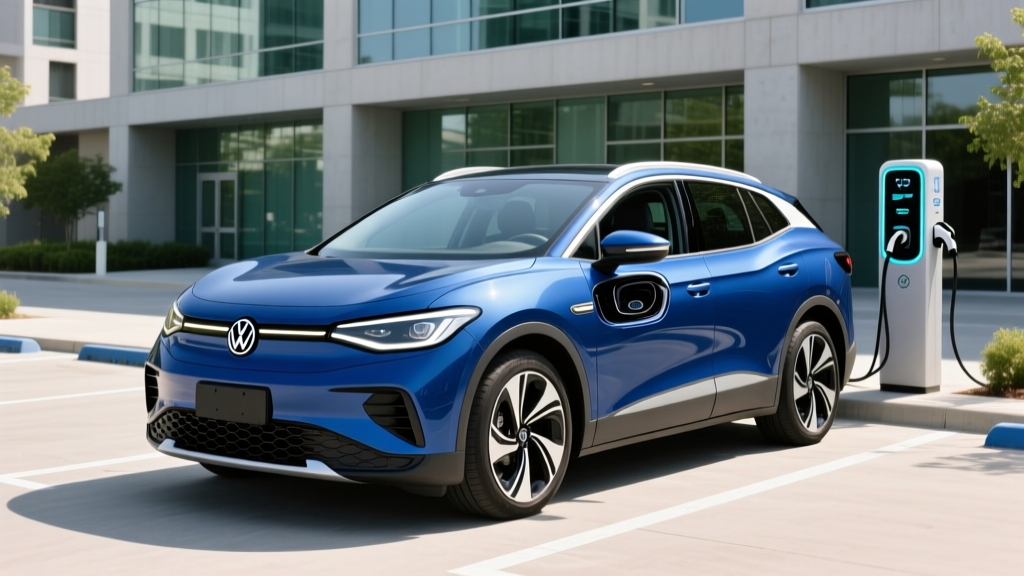
The Volkswagen ID.4 occupies a specific niche in the compact electric SUV segment: practical, approachable, and increasingly well-priced after a significant 2025 MSRP cut carried into the 2026 model year. For buyers researching Volkswagen ID.4 finance options, the math has shifted meaningfully — a base Pro trim now starts under $40,000 before incentives, and the federal §30D tax credit can bring effective ownership cost into territory that competes directly with gas-powered compact crossovers.
This review covers everything a prospective buyer or lessee needs to run the numbers: exact EPA range, real-world expectations, charging speeds across all three levels, current MSRP by trim, battery warranty details, and the specific requirements to claim the federal EV tax credit in 2026.
Range and Efficiency: EPA Sticker vs. Real-World Driving
EPA Estimated Range: 291 miles (Pro, Pro S — RWD, 82 kWh battery)
Real-World Expectation: Plan for approximately 245–265 miles in mixed highway driving at 70+ mph. In cold weather (below 32°F), expect a 20–30% reduction, bringing usable range to roughly 200–230 miles before needing a charge stop. City and suburban driving with regenerative braking can push closer to or slightly above the EPA figure.
The 2026 ID.4 Pro and Pro S (rear-wheel drive) carry an 82 kWh usable battery pack using NMC (nickel manganese cobalt) chemistry. VW does not currently offer an LFP variant in the US market. The EPA rates the RWD Pro at 104 MPGe combined (111 city / 96 highway), translating to roughly 32 kWh per 100 miles in mixed driving, per fueleconomy.gov.
The AWD Pro S models (dual-motor) drop to 263 miles EPA with a combined rating of 98 MPGe. If your commute involves significant hills, frequent high-speed highway stretches, or regular winter driving, the AWD range penalty is worth factoring into your finance calculations — fewer miles per charge means more charging sessions over the ownership period.
Charging Speed: DC Fast, Level 2, and Level 1
Charging capability is where the ID.4 earns its reputation as a competent road-trip vehicle. The 2026 model supports up to 175 kW peak DC fast charging on compatible CCS connectors, and VW includes three years of complimentary 30-minute charging sessions on the Electrify America network for new buyers.
| Charging Level | Power / Voltage | Rate (Miles Added) | Time (10–80% or Full) |
|---|---|---|---|
| Level 1 (120V household) | ~1.2 kW | ~3–4 miles per hour | ~45+ hours (full charge) |
| Level 2 (240V home/public) | 11 kW (onboard charger max) | ~32 miles per hour | ~7.5 hours (0–100%) |
| DC Fast Charge (CCS) | Up to 175 kW peak | ~186 miles in 30 min (claimed) | ~28 minutes (10–80%) |
Charging curve reality: The ID.4 does not sustain 175 kW throughout the session. Peak rate is available between roughly 5–30% state of charge, tapering to approximately 120 kW by 50% and dropping further to 50–70 kW above 80%. This is typical for NMC packs without extreme thermal preconditioning. If you arrive at a 150+ kW charger with a cold battery, expect slower initial rates — use the ID.4's built-in navigation route planner to trigger battery preconditioning en route.
For home charging, the ID.4's 11 kW onboard charger is among the better offerings in the segment. On a 48-amp Level 2 circuit (the common home install), you'll recover a full battery overnight in about 7.5 hours. Most daily commuters adding 30–60 miles will replenish in under two hours.
Performance and Drivetrain
The 2026 ID.4 is offered in rear-wheel drive (single motor) and all-wheel drive (dual motor) configurations:
| Spec | Pro / Pro S (RWD) | AWD Pro S / Pro S Plus |
|---|---|---|
| Drivetrain | Rear-wheel drive | Dual-motor AWD |
| Horsepower | 282 hp | 335 hp |
| Torque | 339 lb-ft | 339 lb-ft (front) + 339 lb-ft (rear) |
| 0–60 mph | ~7.7 seconds | ~5.4 seconds |
| Battery (usable) | 82 kWh NMC | 82 kWh NMC |
| EPA Range | 291 miles | 263 miles |
| Towing Capacity | 2,700 lbs (with brake) | 2,700 lbs (with brake) |
The RWD variant's 7.7-second 0–60 time is adequate for commuting and highway merging but won't thrill enthusiasts. The AWD model's 5.4-second sprint is genuinely quick for a family crossover. Both versions feature strong regenerative braking, though the ID.4 does not offer true one-pedal driving — the regen doesn't bring the car to a complete stop, requiring a brake pedal application at the end. This is a common complaint among EV drivers accustomed to Tesla or Hyundai/Kia systems.
2026 Pricing, Trims, and Volkswagen ID.4 Finance Breakdown
Volkswagen simplified the ID.4 lineup for 2026 following the aggressive price cuts introduced in mid-2025. Here is the current MSRP structure by trim:
| Trim | Drivetrain | MSRP (incl. destination) | Est. Price After §30D Credit* |
|---|---|---|---|
| Standard Range S | RWD | $39,735 | ~$32,235 |
| Pro | RWD | $43,735 | ~$36,235 |
| Pro S | RWD | $46,235 | ~$38,735 |
| AWD Pro S | AWD | $50,235 | ~$42,735 |
| AWD Pro S Plus | AWD | $54,235 | ~$46,735 |
*Estimated effective price assumes full $7,500 federal tax credit applied at point of sale. Eligibility is not universal — see tax credit section below.
Finance considerations: At the $39,735 base price, the ID.4 Standard Range S undercuts the Hyundai Ioniq 5 (~$42,500) and Ford Mustang Mach-E (~$43,000) on MSRP. With the $7,500 point-of-sale credit, effective pricing drops into the low $30,000s — a zone previously occupied only by the Chevy Bolt EUV (now discontinued). Monthly payments on a 60-month loan at 6.5% APR with $5,000 down would run approximately $570/month for the base trim, or roughly $460/month after applying the full credit as a down-payment reduction. Actual rates and terms vary by lender and creditworthiness.
VW also offers lease incentives that have historically stacked with the federal credit (passed through as a lease cash bonus). Lessees should confirm current VW Financial Services promotions, as these change quarterly.
Federal Tax Credit Eligibility (§30D Rules for 2026)
The ID.4 qualifies for the federal EV tax credit, but eligibility depends on multiple factors governed by IRS §30D rules. Here is the checklist:
- MSRP cap: The ID.4 must have an MSRP at or below $80,000 for SUVs — all trims qualify.
- Buyer income cap: Adjusted gross income must not exceed $150,000 (single), $225,000 (head of household), or $300,000 (joint filers).
- Battery sourcing: The ID.4 is assembled in Chattanooga, Tennessee, and VW has progressively shifted battery component sourcing to comply with critical-mineral and battery-component requirements. Confirm the specific VIN's eligibility at fueleconomy.gov before purchase, as sourcing rules tighten annually.
- Point-of-sale transfer: Since 2024, buyers can transfer the credit to the dealer at purchase, reducing the sale price by up to $7,500 upfront rather than waiting for a tax refund.
- One-time use: The credit is limited to one vehicle per taxpayer per year.
Critical caveat: Battery-sourcing requirements become stricter each year under the Inflation Reduction Act. A VIN that qualified in 2025 may face different critical-mineral thresholds in 2026. Always verify your specific vehicle's eligibility on the DOE/Fueleconomy.gov portal before signing paperwork, and consult a tax professional if your situation is complex.
Cargo, Interior Space, and Daily Practicality
The ID.4 was designed as a family-first crossover, and interior volume reflects that priority:
- Cargo volume: 30.3 cubic feet behind the rear seats; 64.2 cubic feet with rear seats folded.
- Rear legroom: 37.6 inches — generous for the segment and sufficient for rear-facing child seats without front-passenger compromise.
- Front headroom: 41.1 inches (with panoramic roof, slightly reduced).
- Frunk: The ID.4 does not have a front trunk — the space under the hood houses electronics and the HVAC system.
The flat floor (no transmission tunnel) and upright seating position make the cabin feel larger than exterior dimensions suggest. However, the center console storage is modest, and the rear seats do not recline. For families needing max cargo, the Hyundai Ioniq 5 offers slightly more volume at 35.7 cu ft behind the rear row.
Tech, Driver Assistance, and Notable Drawbacks
The 2026 ID.4 comes equipped with VW's latest ID. Software 4.0 infotainment running on a 12.9-inch touchscreen (up from the problematic 12-inch unit in early model years). Key technology highlights:
- Wireless Apple CarPlay and Android Auto (standard on all trims)
- Travel Assist: SAE Level 2 driver assistance combining adaptive cruise control with lane-centering on highways. This is not autonomous driving — the driver must keep hands on the wheel and eyes on the road at all times.
- Park Assist Plus: Automated parallel and perpendicular parking with memory parking for repeated spots (available on Pro S and above).
- Head-up display with AR overlay (Pro S Plus) — projects navigation arrows onto the windshield in apparent road alignment.
- IQ.Light LED matrix headlights with automatic high-beam adaptation.
What Travel Assist does NOT do: This is an SAE Level 2 system. It will not navigate interchanges, stop at traffic lights without driver input, or handle construction zones autonomously. You remain the responsible driver at all times. For hands-free highway driving, look to GM's Super Cruise or Ford's BlueCruise — neither of which is currently available on the ID.4.
Notable drawbacks: The capacitive-touch steering wheel controls and climate slider strips remain frustrating to use while driving — physical buttons would be a significant improvement. Rear drum brakes (on RWD models) draw criticism despite VW's justification that regen handles most braking duty. The absence of a frunk limits under-hood storage. And the infotainment system, while improved with Software 4.0, still lags behind the responsiveness of Tesla, Hyundai, and Kia interfaces.
Warranty and Long-Term Battery Outlook
| Coverage | Term |
|---|---|
| Battery (high-voltage) | 8 years / 100,000 miles (whichever comes first), guaranteed to retain ≥70% capacity |
| Powertrain (e-motor, reduction gear) | 8 years / 100,000 miles |
| Bumper-to-bumper (limited) | 4 years / 50,000 miles |
| Corrosion perforation | 7 years / 100,000 miles |
| Roadside assistance | 3 years / 36,000 miles |
The 8-year/100,000-mile battery warranty with a 70% capacity retention floor is standard for the segment. Real-world data from European ID.4 fleets (some exceeding 100,000 miles) suggests NMC degradation of approximately 8–12% in the first three years, leveling off thereafter. VW's thermal management system (liquid-cooled pack) has proven effective at limiting accelerated degradation, though owners in extreme-heat climates should monitor state of health via the onboard diagnostics or third-party OBD2 tools.
Who Should Buy the 2026 Volkswagen ID.4?
Choose the ID.4 if:
- You want a mainstream EV with a strong dealer network and competitive sub-$40K pricing after credits.
- Your daily commute is under 80 miles round-trip and you have home Level 2 charging access.
- You need a practical family crossover with ample rear-seat room and straightforward controls.
- You value the included Electrify America charging for road trips without subscription fees.
Look elsewhere if:
- You need the longest range in the segment (Tesla Model Y: 330 mi EPA; Hyundai Ioniq 5: 318 mi EPA).
- You want hands-free highway driving (GM Super Cruise, Ford BlueCruise).
- You require one-pedal driving with full-stop regen.
- You frequently tow — the 2,700-lb capacity is modest for the class.
Pros and Cons at a Glance
Pros
- Competitive pricing after MSRP cuts — starts at $39,735
- Spacious rear seat (37.6 in. legroom) and flat floor
- 175 kW DC fast charging; 28 min 10–80%
- 3 years free Electrify America charging included
- Federal §30D tax credit eligible (verify VIN)
- Strong 8-yr/100k-mi battery warranty
- Comfortable ride quality; quiet cabin at highway speed
Cons
- Capacitive-touch controls remain frustrating
- No frunk (front trunk) for additional storage
- Regen does not bring car to full stop — no one-pedal driving
- Real-world highway range drops to ~245–265 mi
- Infotainment still lags best-in-class for responsiveness
- No hands-free driving option (only lane-centering assist)
- Rear drum brakes on RWD trims
Frequently Asked Questions
What is the real-world range of the 2026 Volkswagen ID.4?
The EPA rates the RWD ID.4 Pro at 291 miles. In real-world highway driving at 70+ mph, expect approximately 245–265 miles. In cold weather below freezing, range can drop 20–30%, yielding roughly 200–230 miles. AWD models are rated at 263 miles EPA with proportionally lower real-world figures.
How fast does the ID.4 charge at home and on the road?
At a DC fast charger, the ID.4 peaks at 175 kW, achieving a 10–80% charge in approximately 28 minutes (though the rate tapers significantly above 80%). On a home Level 2 charger (240V, 48A), the 11 kW onboard charger adds roughly 32 miles of range per hour, fully charging the 82 kWh battery in about 7.5 hours. Level 1 (120V) adds only 3–4 miles per hour and is suitable only for overnight top-ups on very low daily mileage.
How much does the 2026 ID.4 cost after the federal tax credit?
If you qualify for the full $7,500 §30D credit (meeting income, sourcing, and MSRP requirements), the base Standard Range S drops from $39,735 to an effective ~$32,235. The Pro trim falls to ~$36,235. The credit can be transferred to the dealer at point of sale as an upfront price reduction. Always verify your specific VIN's eligibility on fueleconomy.gov and confirm income thresholds with a tax professional.
Does the 2026 Volkswagen ID.4 qualify for the federal EV tax credit?
Yes — the ID.4 is assembled in Chattanooga, Tennessee, and currently meets the §30D battery-sourcing and critical-mineral requirements for the full $7,500 credit. However, eligibility depends on your income (capped at $150K single / $300K joint), the vehicle's MSRP (must be under $80K for SUVs — all trims qualify), and the specific VIN's battery sourcing compliance. Sourcing thresholds tighten annually, so confirm eligibility before purchase at fueleconomy.gov.
Is the Volkswagen ID.4 worth buying over the Hyundai Ioniq 5 or Tesla Model Y?
It depends on priorities. The ID.4 wins on base pricing (lower MSRP than both competitors), rear-seat comfort, and the included Electrify America charging plan. The Ioniq 5 offers faster 800V charging (up to 350 kW), a frunk, and more cargo space. The Model Y delivers longer range (330 mi EPA), access to the Supercharger network, and stronger software features. For budget-conscious buyers who value dealer support and straightforward ownership, the ID.4 is a strong pick. For tech enthusiasts or frequent road-trippers, the Ioniq 5 or Model Y may justify their higher price.
What are the biggest ownership costs to budget for?
Beyond the purchase price, budget for home Level 2 charger installation ($500–$2,000 depending on electrical panel capacity), insurance (EV premiums run 10–20% higher than comparable gas vehicles on average), and electricity costs (approximately $0.04–$0.06 per mile at residential rates, vs. $0.12–$0.16/mile for a 28-MPG gas crossover at $3.50/gallon). The ID.4 requires no oil changes, and brake pad replacement intervals are extended due to regenerative braking — typically 80,000+ miles.