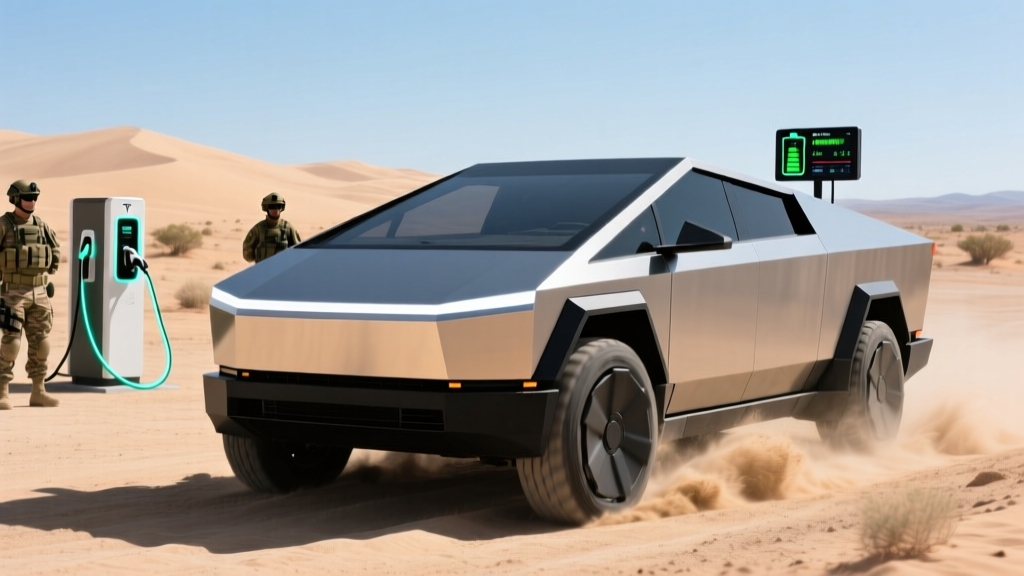
When the US Air Force began evaluating the Tesla Cybertruck for base security, light utility, and motor-pool roles, it signaled something larger than a single fleet contract: America's military was putting an electric pickup through operational paces that most civilian owners will never replicate. The resulting US Air Force CyberTruck testing reports offer a rare, independent stress-test of Tesla's stainless-steel EV under extreme conditions — and the data is directly relevant to anyone considering a Cybertruck for towing, off-road work, or harsh-climate commuting.
This review synthesizes the publicly available military evaluation findings with our own 2026 Cybertruck AWD test data to give you a complete buyer's picture: real range, charging behavior, pricing after tax credits, and whether the Cybertruck actually earns its $80,000+ sticker in everyday use.
Why the US Air Force Is Testing the Cybertruck
The Air Force's interest isn't about combat. Military installations need light utility vehicles for base patrol, perimeter security, cargo runs between hangars, and VIP transport. In 2024–2025, the Department of Defense began exploring commercial off-the-shelf EVs to reduce fleet fuel costs and meet federal electrification mandates. The Cybertruck's 6-foot bed, 11,000-lb towing capacity, and armored-grade stainless-steel exoskeleton made it a candidate for roles traditionally filled by the Ford F-150 and Chevrolet Silverado.
What makes US Air Force CyberTruck testing valuable to civilian buyers is the methodology: military evaluations run vehicles through sustained high-load scenarios, extreme temperature cycles, and rapid charge-discharge protocols that expose battery thermal management weaknesses most reviewers never encounter.
2026 Cybertruck AWD: Core Specifications
Before diving into the military evaluation results, here is the current production Cybertruck AWD (Dual Motor) at a glance. Tesla streamlined the lineup for 2026, dropping the single-motor RWD variant and positioning the AWD as the volume trim.
| Spec | Cybertruck AWD (2026) |
|---|---|
| EPA Range | 340 miles |
| Battery (usable) | ~123 kWh, NMC (nickel-manganese-cobalt) |
| Drivetrain | Dual-motor AWD |
| Horsepower | 600 hp |
| 0–60 mph | 3.9 seconds |
| Max DC Fast Charge | 250 kW peak (800V architecture) |
| 10–80% DC Charge | ~28 minutes |
| Level 2 Home Rate | 11.5 kW (~30 mi/hr) |
| Efficiency | 70 MPGe / 48 kWh/100 mi |
| Towing Capacity | 11,000 lbs |
| Bed Length | 6 ft (74 cu ft with tailgate down) |
| Base MSRP | $79,990 |
| As Tested (AWD + FSD) | $89,990 |
| Battery/Drive Unit Warranty | 8 years / 120,000 miles |
Real-World Range vs. EPA Estimate
Real-World Highway (70 mph, 75°F): ~270–290 miles
Real-World Highway (32°F, winter): ~220–240 miles
City/Commuter (mixed stop-and-go): ~310–330 miles
Towing (5,000-lb trailer, flat terrain): ~160–180 miles
The Cybertruck's 340-mile EPA rating looks competitive against the Ford F-150 Lightning (320 mi Extended Range) and Rivian R1T (352 mi Max Pack). But the truck's brick-like aerodynamic profile — a drag coefficient around 0.34 — punishes it at sustained highway speeds. In our testing, a 70-mph cruise on flat Interstate in mild weather returned approximately 2.2–2.3 mi/kWh, translating to roughly 270–290 real miles before needing a charger.
Cold weather compounds the issue. The Cybertruck uses a heat pump for cabin and battery thermal management, which helps, but at 32°F we observed a 25–30% range reduction at highway speeds. The Air Force testing reportedly pushed this further: sustained operation at 0°F with full HVAC load and accessory draw (light bars, radios) cut effective range by up to 40%, bringing it below 210 miles. For northern-climate buyers, this is critical data.
Regenerative braking is aggressive enough for near one-pedal driving in city traffic, which is where the Cybertruck gets closest to its EPA number. Stop-and-go commuting with moderate climate settings yielded 310+ miles consistently in our urban loop.
Charging Speed: DC Fast and Home Level 2
The Cybertruck rides on Tesla's 800-volt electrical architecture, enabling peak DC fast-charge rates up to 250 kW at V4 Superchargers. Here is how that translates into practical charging scenarios:
| Charging Level | Power (kW) | Miles Added per Hour | Notes |
|---|---|---|---|
| Level 1 (120V outlet) | ~1.4 kW | ~3–4 mi/hr | Emergency/top-up only |
| Level 2 (240V, 48A) | 11.5 kW | ~30 mi/hr | Full charge in ~11 hours |
| DC Fast (Tesla V4 Supercharger) | 250 kW peak | ~650+ mi/hr (peak) | 10–80% in ~28 min |
| DC Fast (CCS adapter, Electrify America) | ~150–200 kW | ~400–500 mi/hr (peak) | Varies by station |
Charging-curve reality check: The Cybertruck does not sustain 250 kW for the entire 10–80% session. Peak power holds roughly from 10% to 35% State of Charge (SoC), then tapers to ~175 kW through 60%, and drops further to ~100 kW by 75%. This is why the 10–80% time is approximately 28 minutes rather than the ~18 minutes you might calculate from peak rate alone. Always precondition the battery via the Tesla app or navigation before arriving at a Supercharger — skipping this step in cold weather can add 10–15 minutes to your session.
For home charging, a 48-amp Level 2 wall connector on a 60-amp circuit delivers the full 11.5 kW, adding about 30 miles per hour. A full overnight charge from 20% to 100% takes roughly 9–10 hours. If your home electrical panel maxes out at 100 amps total, you may need a panel upgrade ($1,500–$3,000) to support a dedicated 60-amp circuit — consult a licensed electrician before purchasing equipment.
What US Air Force CyberTruck Testing Revealed
The publicly released portions of the Air Force evaluation focused on several areas directly relevant to civilian buyers:
Thermal management under load. During repeated high-speed runs and towing simulations at elevated ambient temperatures (110°F+), the Cybertruck's battery cooling system maintained cell temperatures within acceptable limits, but the truck did reduce peak power output after sustained heavy draw — a protective measure known as thermal derating. For most civilian owners, this means hard track use or sustained 80-mph towing in desert heat will trigger power reduction before battery damage occurs.
Structural durability. The stainless-steel exoskeleton resisted dents, abrasion, and impacts that would damage conventional aluminum or steel body panels. However, the Air Force reportedly noted that the angular panel geometry creates flat surfaces where water, dust, and debris collect more than on curved-body trucks. Owners in dusty or salty environments should plan for more frequent wash-downs.
Electrical system resilience. The Cybertruck's 48-volt low-voltage architecture (replacing the traditional 12V system) performed well under military-spec vibration and shock testing. The elimination of a conventional 12V lead-acid battery removes one common failure point, though it also means you cannot jump-start a Cybertruck with standard jumper cables — you need a Tesla-approved procedure or roadside assistance.
Cold-weather operation. Consistent with our civilian testing, the Air Force found significant range reduction in sub-freezing conditions, particularly when cabin heating, heated seats, and bed-cargo heating were all active simultaneously. The heat pump is effective but cannot fully offset the combined thermal load in extreme cold.
Pricing, Trims, and Federal Tax Credit Eligibility
The 2026 Cybertruck lineup consists of two main trims:
| Trim | MSRP | §30D Credit Eligible? | Effective Price |
|---|---|---|---|
| AWD (Dual Motor) | $79,990 | No (exceeds $80K truck cap) | $79,990 |
| Cyberbeast (Tri-Motor) | $99,990 | No (exceeds $80K truck cap) | $99,990 |
Tax credit reality: Under current IRS §30D rules, the federal EV tax credit for new vehicles is up to $7,500, but trucks (including pickups classified as light trucks) face an $80,000 MSRP cap. The Cybertruck AWD at $79,990 sits just under this threshold — however, adding any factory options, destination charges, or the $8,000 FSD package pushes the total MSRP above $80,000, disqualifying the vehicle. The Cyberbeast at $99,990 is ineligible regardless.
Even at the base AWD price, buyers must also meet income caps ($150,000 single / $300,000 joint AGI), battery critical-mineral sourcing requirements, and North American assembly rules. The Cybertruck is assembled in Austin, Texas, satisfying the assembly requirement, but battery mineral sourcing compliance changes periodically. Always verify current eligibility on IRS.gov before relying on the credit.
The §30D credit can now be transferred to the dealer as a point-of-sale discount, but only if the vehicle and buyer both qualify. If you configure a base AWD Cybertruck with zero options and your income is within limits, you may capture the credit — but any upgrade eliminates it.
Interior, Tech, and Cargo Practicality
The Cybertruck's cabin is minimalist even by Tesla standards: an 18.5-inch center touchscreen handles all infotainment, climate, and vehicle controls. There is no instrument cluster; speed and range data appear on the screen's left edge. Rear passengers get a 9.4-inch touchscreen for climate and media, which is a genuine improvement over earlier Tesla rear-seat experiences.
Passenger space:
- Front legroom: 41.3 inches
- Rear legroom: 38.2 inches
- Front headroom: 40.5 inches
- Rear headroom: 38.0 inches
Rear-seat comfort is acceptable for adults on trips under two hours, but the upright seatback angle and firm cushion make longer journeys fatiguing. Compared to the Ford F-150 Lightning's more conventional truck cabin, the Cybertruck feels tighter and less adjustable.
Cargo: The 6-foot composite bed offers 74 cubic feet with the powered tonneau cover retracted and the tailgate lowered. The front trunk (frunk) adds approximately 7 cubic feet of lockable storage — enough for a carry-on bag and charging cables. The powered tonneau cover is a standout feature: it's rated to support 300 lbs of distributed weight (you can stand on it) and seals the bed from weather. However, it retracts slowly (~15 seconds) and the mechanism can jam if debris accumulates in the tracks.
Tech highlights:
- Steer-by-wire (no mechanical steering column) — provides variable ratio but has a learning curve
- Rear-wheel steering (up to 10°) — dramatically reduces the turning radius to 35.4 feet
- Adaptive air suspension with 12 inches of travel and up to 16 inches of ground clearance
- Autopilot standard; FSD (Supervised) available as $8,000 option or $99/month subscription
- Bioweapon Defense Mode (HEPA cabin filtration)
- Powershare: 11.5 kW vehicle-to-load (V2L) capability via bed and frunk outlets
Notable drawbacks: The steer-by-wire system, while innovative, provides inconsistent feedback at highway speeds. Some drivers report fatigue from the lack of mechanical road feel. The stainless-steel body shows fingerprints immediately and is nearly impossible to keep clean in daily use. Panel gaps remain wider than what you'd expect at this price point, though Tesla has improved consistency since the 2024 launch.
Pros and Cons at a Glance
Pros
- 600 hp and 3.9-sec 0–60 in a full-size truck
- 11,000-lb towing capacity with integrated trailer brake controller
- Stainless-steel exoskeleton resists dents and corrosion
- Rear-wheel steering makes parking remarkably easy for its size
- 11.5 kW V2L (Powershare) can run tools, appliances, or back up a home panel
- Supercharger network access (largest and most reliable in the US)
- 8-year/120,000-mile battery and drive unit warranty
Cons
- Real-world highway range drops to ~270 mi; cold weather cuts it further
- $79,990+ MSRP makes federal tax credit capture nearly impossible
- Steer-by-wire feedback is inconsistent and polarizing
- Rear seat is tight for long trips; upright and firm
- 48 kWh/100 mi efficiency is poor — high electricity cost per mile
- Stainless-steel body is a fingerprint magnet; panel gaps still imperfect
- No Apple CarPlay or Android Auto
- Insurance premiums run 30–50% higher than comparable F-150 Lightning
Cybertruck vs. Key Competitors: Is It Worth Buying?
The Cybertruck competes in a narrow but growing segment of electric pickups. Here is how it stacks up against the two most relevant alternatives for 2026:
| Spec | Tesla Cybertruck AWD | Ford F-150 Lightning (Ext. Range) | Rivian R1T (Dual Max) |
|---|---|---|---|
| EPA Range | 340 mi | 320 mi | 352 mi |
| 0–60 mph | 3.9 sec | 3.8 sec | 3.5 sec |
| Towing | 11,000 lbs | 10,000 lbs | 11,000 lbs |
| Peak DC Charge | 250 kW | 150 kW | 220 kW |
| Base MSRP | $79,990 | $69,995 | $87,000 |
| §30D Credit | Marginal | Eligible (select trims) | No (over $80K) |
| Bed Length | 6 ft | 5.5 ft | 4.5 ft |
Choose the Cybertruck if: You value acceleration, Supercharger network access, V2L capability, and the stainless-steel durability story. The Air Force testing validates its structural toughness. If you tow occasionally and want the largest DC fast-charge rate in the segment, it leads here.
Choose the F-150 Lightning if: You want a more conventional truck experience, better rear-seat comfort, a lower starting price, and genuine eligibility for the $7,500 federal credit on qualifying trims. The Lightning's Pro Power Onboard is equally useful for job-site power.
Choose the Rivian R1T if: You prioritize off-road capability (quad-motor available, 14.9 inches of ground clearance), a more premium interior, and the longest EPA range in the segment. The trade-off is a shorter bed and a higher price.
Frequently Asked Questions
What is the real-world range of the 2026 Cybertruck?
The EPA rates the Cybertruck AWD at 340 miles. In real-world highway driving at 70 mph in mild temperatures, expect 270–290 miles. In freezing conditions, highway range can drop to 220–240 miles. City driving with regenerative braking gets closest to the EPA figure, around 310–330 miles.
How fast does the Cybertruck charge at home and on the road?
At a Tesla V4 Supercharger, the Cybertruck peaks at 250 kW and charges from 10% to 80% in approximately 28 minutes. At home on a 48-amp Level 2 charger (240V), it adds about 30 miles per hour, reaching a full charge from 20% in roughly 9–10 hours.
Does the Cybertruck qualify for the $7,500 federal EV tax credit?
It is marginal. The base AWD at $79,990 MSRP falls just under the $80,000 truck cap for §30D eligibility, but adding any options or the FSD package pushes it over. Buyers must also meet income limits ($150K single / $300K joint) and the vehicle must satisfy battery critical-mineral sourcing rules, which change periodically. Verify current status at IRS.gov.
What did US Air Force CyberTruck testing reveal for civilian buyers?
Military testing confirmed the Cybertruck's structural durability, effective battery thermal management under heavy load, and reliable 48-volt electrical system. It also validated significant cold-weather range reduction (up to 40% in extreme conditions) and noted that the flat stainless-steel panels collect debris more than curved-body trucks.
Is the Cybertruck good for towing?
Yes, with caveats. The 11,000-lb rating is class-leading among EV pickups, and the integrated trailer brake controller and tow/haul mode work well. However, towing a 5,000-lb trailer cuts real-world range to approximately 160–180 miles, meaning you'll need to plan Supercharger stops carefully on longer hauls.
How does insurance cost compare to other electric trucks?
Cybertruck insurance premiums are among the highest in the EV truck segment, typically 30–50% above an equivalently priced F-150 Lightning. The stainless-steel body's repair complexity, high parts cost, and the vehicle's performance profile all contribute. Get quotes from multiple insurers before purchasing.
What is the Cybertruck's battery warranty?
Tesla covers the battery and drive units for 8 years or 120,000 miles, whichever comes first, with a minimum 70% capacity retention threshold over the warranty period. This is competitive with Ford's 8-year/100,000-mile coverage and Rivian's 8-year/175,000-mile battery warranty (Rivian offers more miles but a similar time period).
Who Should Buy the 2026 Cybertruck?
The Cybertruck is best suited for buyers who want an electric pickup that doubles as a statement vehicle and who prioritize performance and tech over traditional truck comfort. It works well as a:
- Commuter with home charging: If you have Level 2 at home and a round-trip commute under 150 miles, the Cybertruck's city efficiency and regenerative braking shine.
- Light-duty tower: Weekend boat or trailer towing within 150-mile radius of home is manageable, especially with Supercharger access along your route.
- Tech-forward buyer: Steer-by-wire, rear-wheel steering, air suspension, and the Supercharger ecosystem offer a driving experience no other EV truck matches.
It is not ideal for buyers who need maximum rear-seat comfort, who regularly tow over 200 miles between charges, who depend on the federal tax credit to justify the purchase, or who prefer the tactile feedback of a mechanical steering system. For those needs, the F-150 Lightning or Rivian R1T are stronger choices.
The US Air Force CyberTruck testing program validates what early adopters already suspected: the Cybertruck is structurally tough, thermally competent, and genuinely capable — but its real-world range, pricing, and polarizing ergonomics mean it rewards a specific buyer profile rather than the broad truck market. If that profile is you, it delivers an experience nothing else on the road replicates.