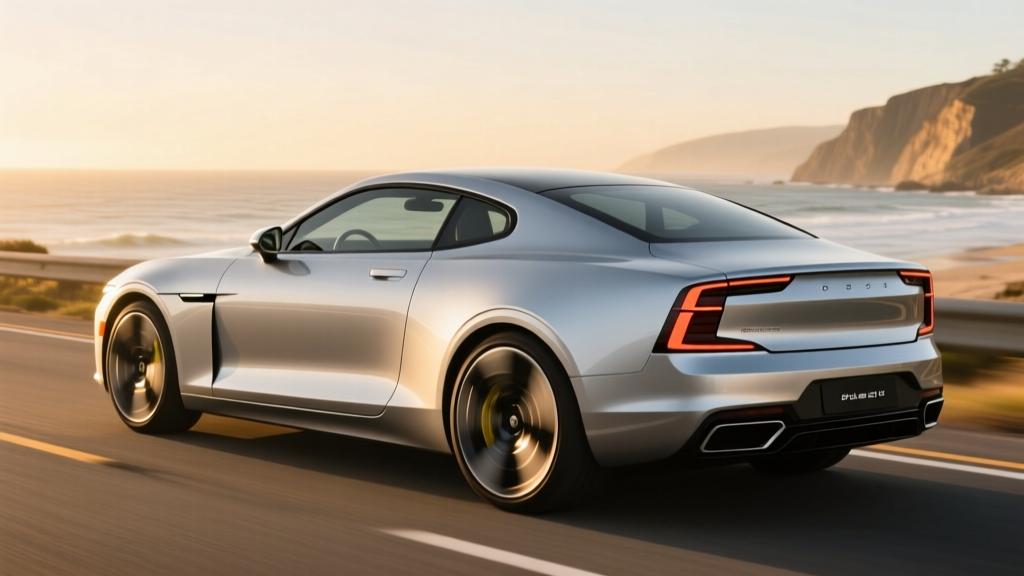
The Polestar 1 occupies a strange, fascinating corner of the electrified automotive world. Built on Volvo's Scalable Product Architecture and wrapped in a carbon-fiber body, this plug-in hybrid grand tourer was Polestar's opening statement — a limited-production halo car that bridged Volvo's combustion past with an all-electric future. With production capped at 1,500 units globally and the final cars delivered by late 2021, the Polestar 1 is now exclusively a used-market proposition. But its powertrain specs, particularly the frequently searched Polestar 1 HP figure of 619 horsepower, continue to draw enthusiasts researching what this rare machine actually delivers.
This profile breaks down every critical number — horsepower, electric range, charging speeds, efficiency, cargo space, and what ownership actually costs in 2026. Because the Polestar 1 is a PHEV rather than a full BEV, buyers need to evaluate two parallel powertrains: the electric-only system for daily commuting and the combined hybrid output for grand-touring performance.
Polestar 1 HP and Powertrain: Where 619 Horsepower Comes From
The Polestar 1's powertrain is a dual-system affair that combines a turbocharged and supercharged 2.0-liter four-cylinder engine driving the front wheels with two rear-mounted electric motors. The result is all-wheel-drive traction and a combined system output that puts it firmly in supercar GT territory.
| Specification | Value |
|---|---|
| Combined System Horsepower | 619 hp (462 kW) |
| Combined System Torque | 738 lb-ft (1,000 Nm) |
| Gas Engine | 2.0L turbo + supercharged I4, 326 hp / 317 lb-ft |
| Rear Electric Motors | Twin motors, 232 hp combined (ERAD + E2) |
| Drivetrain | AWD (ICE front, electric rear) |
| 0–60 mph | 4.1 seconds (manufacturer est.) |
| Top Speed | 155 mph (electronically limited) |
| Transmission | 8-speed automatic (front), 2-speed (rear E-motors) |
The 619 hp figure represents peak combined output when both the combustion engine and electric motors deliver maximum power simultaneously — what Polestar calls "Power" mode. In everyday "Pure" mode, the car operates as a rear-wheel-drive EV with 232 hp from the electric motors alone, which is more than adequate for highway merging and city driving. The twin rear motors also enable torque vectoring across the rear axle, sharpening cornering behavior beyond what a traditional AWD layout provides.
For context on the Polestar 1 HP output: 619 hp places it alongside the BMW M8 Competition (617 hp) and well above the Lexus LC 500h hybrid coupe (354 hp). The torque figure of 738 lb-ft is even more impressive, delivering the instant thrust characteristic of electric motors blended with the sustained pull of the turbo-supercharged four.
Electric Range, Battery, and Real-World Efficiency
As a plug-in hybrid, the Polestar 1's electric range is the metric that determines whether it functions as a daily EV commuter or a gas-dependent grand tourer. The EPA rated its all-electric range at 52 miles when new; however, Polestar later offered a software update (available on later-build cars and retrofittable to earlier units) that unlocked the battery's previously reserved buffer, pushing the effective EV range higher.
EPA Electric-Only Range: 52 miles (post-update estimates reach ~58–62 miles in ideal conditions)
Real-World Expectation: 42–48 miles in mixed driving; 35–40 miles at sustained 70+ mph highway speeds; 30–35 miles in freezing temperatures with cabin heat active.
Total Range (Gas + Electric): Approximately 470–520 miles combined with the 15.9-gallon fuel tank.
The battery pack is a 34 kWh total capacity unit (approximately 27–28 kWh usable after buffer management) using NMC (nickel-manganese-cobalt) lithium-ion chemistry. It's positioned in a T-shape running through the center tunnel and behind the rear seats, which preserves the car's low center of gravity but significantly compromises rear-seat and cargo space.
| Metric | Value |
|---|---|
| Combined MPGe (electric + gas) | 58 MPGe |
| Electric Energy Consumption | 58 kWh/100 mi |
| Gas-Only Combined MPG | 26 MPG |
| Gas-Only Highway MPG | 28 MPG |
| Fuel Tank Capacity | 15.9 gallons |
The 58 MPGe combined figure from fueleconomy.gov reflects the blended efficiency when using both powertrains. In practice, owners who charge nightly and commute under 45 miles round-trip will use almost zero gasoline during the week. Those who let the battery deplete and drive on the gas engine alone will see 24–28 MPG — respectable for a 5,100-pound carbon-fiber GT, but not Prius territory.
Charging Speeds: DC Fast Charge and Home Level 2
Charging is where the Polestar 1's PHEV architecture shows its age relative to modern 800V BEV platforms. The car was designed in an era when PHEV charging infrastructure expectations were modest, and the specs reflect that. Still, for a plug-in hybrid with a ~28 kWh usable battery, the charging experience is manageable.
| Charging Level | Connector | Max Rate | Speed / Time |
|---|---|---|---|
| Level 1 (120V) | J1772 | ~1.4 kW | ~5 miles of EV range per hour; 0–100% in ~20 hours |
| Level 2 (240V) | J1772 | 3.7 kW (onboard charger limit) | ~13 miles of EV range per hour; 0–100% in ~7.5 hours |
| DC Fast Charge | CCS1 | 50 kW | 10–80% in approximately 35–40 minutes |
The 3.7 kW onboard AC charger is the limiting factor for home charging. Even if you install a 48-amp (11.5 kW) Level 2 home charger, the Polestar 1 can only accept 3.7 kW — meaning an overnight charge on a standard 240V outlet or Level 2 station will fully replenish the battery in roughly 7.5 hours. For most PHEV owners who plug in every night, this is perfectly adequate; the battery is small enough that you wake up to a full charge regardless.
The 50 kW DC fast-charge capability is modest by 2026 BEV standards (where 150–350 kW is common), but it's notable that the Polestar 1 offers DC fast charging at all — many PHEVs of its era lacked CCS capability entirely. A 10–80% top-up takes roughly 35–40 minutes, which is practical during a road-trip lunch stop but not something you'd rely on for quick highway turnarounds.
Pricing, Tax Credits, and Used-Market Value in 2026
The Polestar 1 launched with a base MSRP of $155,000 (with destination), and because it was offered in a single, fully loaded specification, the as-tested price hovered around $156,500–$160,000 depending on paint color and any dealer-installed accessories. There were no trim levels — every Polestar 1 came equipped with the Öhlins dual-flow dampers, 21-inch forged wheels, Bowers & Wilkins audio, and the full carbon-fiber body.
| Item | Amount |
|---|---|
| Original Base MSRP (new) | $155,000 |
| As-Tested Price (typical) | $156,500–$160,000 |
| Federal §30D Credit (New Purchase) | Not eligible — exceeds MSRP cap |
| Federal §25E Credit (Used Purchase, 2026) | Up to $4,000 or 30% of sale price (whichever is less) |
| Current Used-Market Range (2026) | $85,000–$125,000 depending on mileage and condition |
The Polestar 1 did not qualify for the $7,500 federal new-EV tax credit (§30D) when sold new because its $155,000 MSRP far exceeded the IRS MSRP cap of $55,000 for sedans and coupes. Additionally, many original buyers exceeded the income caps ($150,000 single / $300,000 joint filers). Full eligibility rules for current-year credits are published at IRS.gov §30D.
However, as a used vehicle in 2026, the Polestar 1 may qualify for the §25E Used Clean Vehicle Credit — up to $4,000 or 30% of the sale price, whichever is lower. To qualify, the used sale price must be $25,000 or less from a licensed dealer, which effectively disqualifies the Polestar 1 from this credit as well given its current used values of $85,000+. Prospective buyers should consult a tax professional and verify current-year rules before counting on any federal incentive.
Interior, Cargo Space, and Technology
The Polestar 1's cabin is unmistakably Volvo in its Scandinavian restraint — clean lines, premium materials, and a portrait-oriented 9-inch Sensus touchscreen. But the GT coupe proportions and the T-shaped battery pack exact a heavy toll on practicality.
| Feature | Specification |
|---|---|
| Front Legroom | 42.1 inches |
| Rear Legroom | 29.5 inches (effectively a 2+2) |
| Cargo Volume (Trunk) | 4.4 cubic feet |
| Infotainment | 9" Sensus touchscreen, Apple CarPlay, Android Auto |
| Audio System | Bowers & Wilkins, 14 speakers |
| Digital Cluster | 12.3" driver display |
| Driver Assists | Pilot Assist (adaptive cruise + lane centering, SAE Level 2) |
| Notable Absence | No over-the-air updates; no Android Automotive OS |
The 4.4 cubic feet of trunk space is the Polestar 1's most damning practicality figure. That's roughly the volume of a large weekend bag — enough for two carry-on suitcases and nothing more. The rear seats, technically present, are best described as parcel shelves; the 29.5 inches of rear legroom makes them suitable only for small children or additional luggage. This is a grand tourer for two people, and Polestar made no attempt to pretend otherwise.
The Sensus infotainment system, while adequate, dates the car. It lacks the Android Automotive OS that Polestar adopted for the Polestar 2 and later models, and it does not support over-the-air software updates. The Pilot Assist driver-assistance suite provides adaptive cruise control with lane-centering — an SAE Level 2 system requiring full driver attention at all times. It is competent on highways but does not approach the capability of GM's Super Cruise or Ford's BlueCruise on mapped roads.
Warranty, Battery Health, and Long-Term Ownership
When sold new, the Polestar 1 carried the following warranty coverage, much of which remains transferable to subsequent owners:
| Coverage Area | Term |
|---|---|
| Basic Vehicle Warranty | 4 years / 50,000 miles |
| Powertrain Warranty | 4 years / 50,000 miles |
| Hybrid/EV Battery Components | 8 years / 100,000 miles |
| Corrosion Protection | 12 years / unlimited miles |
| Roadside Assistance | 4 years / unlimited miles |
The 8-year/100,000-mile hybrid battery warranty is the critical coverage item. As of 2026, the earliest Polestar 1 examples (delivered in mid-2019) are approaching or have exceeded the time limit on this warranty. Buyers evaluating used examples should request a battery State of Health (SoH) report from a Polestar service center. NMC batteries in PHEV applications typically experience 10–15% capacity loss over 5–7 years depending on charge habits and climate, though the Polestar 1's relatively conservative buffer management has generally preserved SoH better than some competitors.
Long-term ownership costs are elevated by the car's limited production run. Body panels are carbon fiber, which requires specialist repair facilities. Replacement parts — from Öhlins dampers to bespoke trim pieces — carry premium pricing and sometimes long lead times. Insurance premiums for a $100,000+ limited-production hybrid GT are correspondingly steep; expect annual premiums in the $4,000–$7,000 range depending on your profile and state.
Who Should Buy the Polestar 1 in 2026?
Wrong Fit: Families, daily commuters exceeding 50 miles one-way, anyone who regularly carries rear passengers or cargo, and buyers seeking the latest in infotainment or autonomous driving features. If you need practicality alongside electrification, the Polestar 2, BMW i4, or Tesla Model 3 are vastly more rational choices.
Pros
- 619 hp and 738 lb-ft from a plug-in hybrid — genuine GT performance
- Carbon-fiber body is lightweight, rigid, and visually stunning
- 52 miles EPA EV range covers most daily commutes gas-free
- Öhlins dampers standard — adjustable, track-capable ride quality
- Limited to 1,500 units — exclusivity and potential collectibility
- DC fast charging (rare for PHEVs of its era)
Cons
- 4.4 cu ft trunk — barely usable for road trips
- Rear seats are essentially decorative
- 3.7 kW AC charging limits home charge speed
- Dated Sensus infotainment with no OTA updates
- Carbon-fiber body repair is expensive and specialist-dependent
- No federal tax credit eligibility (new or used, at current prices)
- Depreciation from $155K MSRP to ~$100K used — significant
Polestar 1 vs. the Competition
The Polestar 1 doesn't have direct rivals — it's too rare, too specific, and occupies a price-performance niche that few automakers attempted. But buyers cross-shopping the used market will encounter these alternatives:
| Metric | Polestar 1 | BMW i8 (2020) | Lexus LC 500h |
|---|---|---|---|
| Powertrain | PHEV (2.0L + twin E-motors) | PHEV (1.5L 3-cyl + E-motor) | HEV (3.5L V6 + E-motor) |
| Combined HP | 619 hp | 369 hp | 354 hp |
| EV-Only Range | 52 mi (EPA) | 18 mi (EPA) | N/A (not plug-in) |
| 0–60 mph | 4.1 sec | 4.2 sec | 4.7 sec |
| Cargo Space | 4.4 cu ft | 4.7 cu ft | 5.4 cu ft |
| Used Price (2026) | $85K–$125K | $65K–$90K | $60K–$80K |
The BMW i8 offers more mid-engine exotic drama but far less electric range (18 miles) and considerably less power. The Lexus LC 500h is a refined, reliable luxury coupe but is not a plug-in — you'll burn gas on every trip. The Polestar 1's combination of 52 miles of EV range, 619 hp, and carbon-fiber construction is genuinely unique; nothing else on the used market replicates this exact formula.
Frequently Asked Questions
What is the real-world electric range of the Polestar 1?
The EPA rated the Polestar 1 at 52 miles of all-electric range (post-software-update cars may reach 58–62 miles in ideal conditions). In real-world mixed driving, expect 42–48 miles. Sustained highway driving at 75+ mph reduces this to roughly 35–40 miles, and freezing temperatures with cabin heating active can drop it to 30–35 miles. Total combined range (electric + 15.9-gallon fuel tank) is approximately 470–520 miles.
How fast does the Polestar 1 charge at home and on DC fast chargers?
At home on a 240V Level 2 charger, the Polestar 1 accepts a maximum of 3.7 kW, fully charging its ~28 kWh usable battery in about 7.5 hours. On a CCS1 DC fast charger, it peaks at 50 kW, reaching 10–80% in approximately 35–40 minutes. Level 1 (120V) charging is possible but takes roughly 20 hours for a full charge.
Does the Polestar 1 qualify for the federal EV tax credit?
When sold new, the Polestar 1 did not qualify for the §30D new-vehicle credit because its $155,000 MSRP exceeded the IRS cap of $55,000 for sedans/coupes. As a used vehicle in 2026, it also does not qualify for the §25E used-vehicle credit because its current sale price (~$85,000–$125,000) exceeds the $25,000 cap for used-vehicle credit eligibility. Always verify current-year rules at IRS.gov and consult a tax professional.
Is the Polestar 1 worth buying over a BMW i8 or other hybrid coupe?
If you prioritize electric-only commuting range (52 miles vs. the i8's 18), significantly more horsepower (619 vs. 369), and carbon-fiber exclusivity, the Polestar 1 is the stronger choice. The BMW i8 is more affordable on the used market and offers more exotic mid-engine styling, but its shorter EV range and lower output make it less practical as a daily electric commuter. The Polestar 1's primary drawbacks — minuscule trunk, dated infotainment, and expensive carbon-fiber repairs — are deal-breakers for some buyers.
How long will the Polestar 1's battery last?
The NMC battery pack was warranted for 8 years / 100,000 miles against defects and excessive degradation. NMC chemistry in PHEV applications typically retains 85–90% of original capacity after 5–7 years with normal use. Because the Polestar 1's battery is relatively small (~34 kWh total) and the car's buffer management is conservative, degradation has generally been modest in owner reports. Request a State of Health (SoH) diagnostic from a Polestar service center before purchasing any used example. Battery replacement, if ever needed, is estimated at $10,000–$15,000+ given the car's limited production and specialist parts requirements.
What are the biggest ownership costs to budget for?
Beyond the purchase price, budget for: insurance ($4,000–$7,000/year), premium fuel for the 2.0L turbo-supercharged engine when running on gas, annual maintenance at a Polestar/Volvo specialist ($1,500–$3,000), and potential carbon-fiber body repair ($5,000–$15,000+ for panel damage). Home Level 2 charging installation, if not already in place, typically costs $800–$2,500 depending on your electrical panel. Tires for the 21-inch forged wheels run $350–$500 per corner.