The Quick Answer on Toyota EV Trucks
As of early 2026, Toyota does not sell a fully electric pickup truck in the United States. The brand's truck lineup — the midsize Tacoma and full-size Tundra — remains powered by turbocharged four-cylinder hybrids (i-FORCE MAX) and a conventional turbo four. Toyota has shown the EPU (Electric Pick-Up) concept and has confirmed an electric Tacoma is in development, but no production model, EPA range figure, or on-sale date has been announced. If you need a Toyota truck today, you're choosing between the gas Tacoma/Tundra or the hybrid i-FORCE MAX variants. If you specifically want a battery-electric truck, you'll need to look at the Ford F-150 Lightning, Rivian R1T, Chevrolet Silverado EV, or Tesla Cybertruck — or wait for Toyota's entry, likely no earlier than the 2027 model year.
Where Toyota's EV Truck Plans Actually Stand
Toyota has been characteristically cautious about full electrification in its truck segment, and that caution shows in the current lineup. Here is what is confirmed versus what remains speculative:
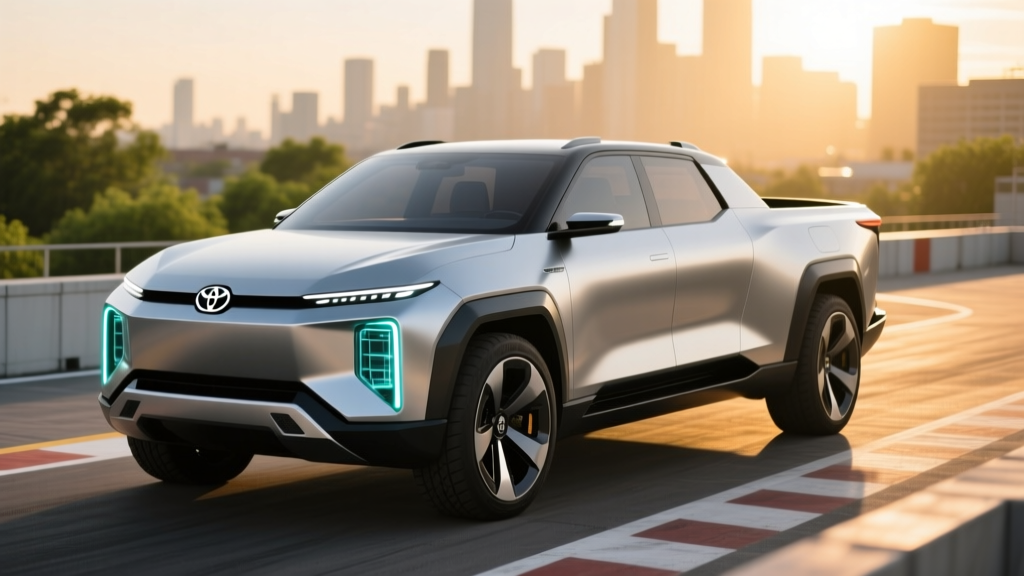
- Toyota EPU Concept (shown 2023): A compact electric pickup roughly the size of a Maverick or early Tacoma, featuring a unibody platform and a projected range of over 300 miles. Toyota displayed it at the Japan Mobility Show but has not confirmed production specs, pricing, or a timeline.
- Electric Tacoma (announced, in development): Toyota's North American leadership has acknowledged that an electrified Tacoma is part of the brand's multi-pathway strategy. However, no battery capacity (kWh), motor output (kW), EPA range, or MSRP has been published. Treat any online "leaked specs" as unverified.
- Tundra EV: No official announcement. The current Tundra i-FORCE MAX hybrid (326 HP combined, up to ~20 MPG combined per fueleconomy.gov) remains the most electrified Tundra available.
This measured approach contrasts with competitors who rushed EV trucks to market and then scaled back production. Toyota's strategy prioritizes proven battery supply chains and profitability over being first — a trade-off that frustrates EV enthusiasts but may benefit buyers who get a more refined product later.
What You Can Buy Today: Toyota Truck Lineup vs. EV Competitors
Since Toyota EV trucks aren't on dealer lots yet, here's how the current Toyota truck lineup stacks up against the electric trucks you can buy in 2026:
| Model | Powertrain | EPA Range / MPG | 0–60 mph | Towing (max) | Starting MSRP |
|---|---|---|---|---|---|
| Toyota Tacoma i-FORCE MAX (Hybrid) | 2.4L Turbo Hybrid | ~23 MPG combined | ~6.5 sec | 6,500 lbs | ~$41,000 |
| Toyota Tundra i-FORCE MAX (Hybrid) | 3.4L Twin-Turbo V6 Hybrid | ~20 MPG combined | ~5.7 sec | 12,000 lbs | ~$58,000 |
| Ford F-150 Lightning (Extended Range) | Dual Motor BEV, ~131 kWh usable | EPA 320 mi | ~3.8 sec | 10,000 lbs | ~$62,000 |
| Rivian R1T (Dual-Motor, Max Pack) | Dual Motor BEV, ~141 kWh usable | EPA 410 mi | ~3.5 sec | 11,000 lbs | ~$82,000 |
| Chevrolet Silverado EV (4WT Extended) | Dual Motor BEV, ~200 kWh usable | EPA 440 mi | ~4.5 sec | 10,000 lbs | ~$60,000 |
Key takeaway: Toyota's hybrid trucks prioritize towing capacity and proven reliability over acceleration and efficiency. The F-150 Lightning and Silverado EV offer dramatically faster acceleration and lower per-mile energy costs, but they carry higher starting prices and real-world range that drops 20–35% in cold weather or when towing heavy loads.
Real Costs: EV Truck vs. Gas/Hybrid Truck Ownership
The purchase price is only part of the equation. Here's a five-year cost projection comparing a hypothetical Toyota EV truck (using EPU concept estimates) against the current Tacoma hybrid and the F-150 Lightning, assuming 15,000 miles/year:
| Cost Factor | Tacoma Hybrid (Gas) | F-150 Lightning (EV) | Toyota EV Truck (Projected) |
|---|---|---|---|
| Purchase Price (est.) | $45,000 | $65,000 | $50,000–$60,000 |
| Federal Tax Credit (§30D) | $0 | Up to $7,500* | Up to $7,500* |
| Fuel/Energy (5 years) | ~$11,250 (gas @ $3.50/gal, 23 MPG) | ~$4,500 (home charging @ $0.14/kWh) | ~$4,200 (projected) |
| Maintenance (5 years) | ~$3,500 | ~$1,500 | ~$1,500 (projected) |
| Insurance (5 years, avg) | ~$7,500 | ~$9,500 | ~$8,500 (projected) |
| 5-Year Total (est.) | ~$67,250 | ~$81,000 | ~$65,700–$75,700 |
*Federal EV tax credit eligibility under IRS §30D depends on buyer income caps ($150K single / $300K joint), vehicle MSRP caps ($80K for trucks), battery critical-mineral sourcing requirements, and point-of-sale transfer rules. Check IRS.gov for current-year eligibility before purchasing.
EV trucks save substantially on fuel and maintenance — no oil changes, fewer brake replacements thanks to regenerative braking, and electricity costing roughly one-third of gasoline per mile. But higher insurance premiums (often 15–30% more for EVs) and higher upfront costs narrow the gap. The break-even point against a Tacoma hybrid typically arrives around year 4–6 depending on your local electricity rates and driving patterns.
Real-World Ownership Considerations for EV Truck Buyers
Before committing to any electric truck — Toyota's future entry or a competitor's current model — honestly assess these factors:
Home Charging Access
This is the single biggest determinant of EV truck satisfaction. A Level 2 home charger (240V, 40–48 amps / 9.6–11.5 kW) adds roughly 25–35 miles of range per hour of charging and can fully replenish a 100+ kWh truck battery overnight. Without home charging, you'll rely on public DC fast chargers, which cost 2–4× more per kWh and add wear from repeated high-rate charging.
Installation cost: Expect $800–$2,500 for a Level 2 charger and basic electrical work if your panel has capacity. If you need a 200-amp panel upgrade, add $1,500–$3,500. Always get a quote from a licensed electrician before purchasing an EV.
Climate and Range Reality
EPA range estimates assume moderate temperatures and mixed driving. Real-world EV truck range drops significantly in adverse conditions:
- Cold weather (below 30°F): Expect 20–35% range loss due to battery chemistry limitations and cabin heating demands. A truck rated at 320 miles EPA may deliver 210–250 miles in a Midwest winter.
- Towing: Pulling a 5,000+ lb trailer can cut range by 40–50%. The F-150 Lightning's 320-mile EPA range drops to roughly 150–180 miles when towing near its limit.
- Highway speeds (75+ mph): Aerodynamic drag hits trucks hard. Expect 10–15% below EPA range at sustained highway speeds.
Charging Speed and Road Trips
Most EV trucks peak between 150–350 kW on DC fast chargers, but sustained charging speed matters more than peak. A truck that peaks at 250 kW but tapers sharply above 60% SoC may take 35–45 minutes for a 10–80% charge, not the 18–22 minutes marketing materials suggest. Plan road trips around charger locations and expect 30–50 minute stops every 200–250 miles.
Common Toyota EV Truck Myths — Fact-Checked
| Myth | Fact |
|---|---|
| "Toyota already sells an electric Tacoma" | False. As of 2026, no production Toyota EV truck is on sale. The EPU is a concept; the electric Tacoma is in development with no confirmed specs or sale date. |
| "EV trucks can't tow as much as gas trucks" | Partially true in practice. EV trucks like the F-150 Lightning and Silverado EV post competitive max tow ratings (10,000+ lbs), but towing devastates range. A gas Tundra can tow 12,000 lbs for 350+ miles on a tank; an EV truck towing the same load may need a charge stop every 150 miles. |
| "Toyota's hybrids are just as green as EVs" | Not equivalent. A Tacoma hybrid at 23 MPG still emits roughly 384 grams of CO₂ per mile (tailpipe). An EV truck's emissions depend on your local grid — roughly 100–200 g/mi equivalent on an average US grid, and near zero on renewable-heavy grids. Source: EPA. |
| "EV truck batteries need replacing every few years" | Modern EV batteries (NMC or LFP chemistry) are warrantied for 8 years / 100,000 miles minimum, with most retaining 85–90%+ capacity at that point. Replacement is rare and typically costs $10,000–$20,000 if needed out of warranty — but most batteries outlast the vehicle. |
| "I'll save $10,000+ immediately by going electric" | Unlikely. Higher purchase prices, insurance premiums, and potential home charging installation costs mean savings accumulate over 4–6 years of ownership, not day one. The §30D tax credit helps but has strict eligibility requirements. |
Decision Framework: Should You Wait for Toyota or Buy Now?
Choose to WAIT for a Toyota EV Truck if:
- You're a loyal Toyota owner who values the brand's long-term reliability record and resale value above all else
- Your current truck is running fine and you can comfortably wait until 2027–2028 for a production model
- You primarily drive under 200 miles/day and want a midsize electric pickup (EPU segment) rather than a full-size
- You want Toyota's dealer network and service infrastructure for EV maintenance in your area
Choose to BUY an EV Truck NOW (Ford, Rivian, Chevy, Tesla) if:
- You need an electric truck within the next 6–12 months for work or personal use
- You have home charging access and your daily driving is under 250 miles
- You want to take advantage of current §30D tax credit rules, which could change after 2026
- You need specific capabilities now — Rivian's quad-motor off-road performance, the Lightning's Pro Power Onboard, or the Silverado EV's 440-mile range
Choose a TOYOTA HYBRID Truck NOW if:
- You frequently tow heavy loads over long distances where EV range loss is unacceptable
- You lack reliable home charging access and your area has limited DC fast-charging infrastructure
- You live in an extreme cold climate where EV range loss would make daily life difficult
- You want lower upfront cost and proven long-term durability without battery degradation concerns
Frequently Asked Questions
When will Toyota release an electric pickup truck?
Toyota has not announced a specific release date for a production electric truck. The EPU concept was shown in late 2023, and an electric Tacoma is confirmed to be in development. Industry estimates place a production model no earlier than the 2027 model year, but Toyota has not verified this timeline. Any truck you see advertised as a "Toyota EV truck" for sale today is either a concept render or misinformation.
Will a Toyota EV truck qualify for the $7,500 federal tax credit?
It's too early to say definitively. Under current IRS §30D rules, eligibility requires the vehicle to meet MSRP caps ($80,000 for trucks/vans), buyer income limits ($150,000 single / $300,000 joint filing), and strict battery component and critical mineral sourcing requirements that favor North American supply chains. Toyota's battery sourcing strategy is evolving, and eligibility will depend on the specific model's final supply chain. Always verify on IRS.gov at the time of purchase.
How does a Toyota hybrid truck compare to an EV truck for daily commuting?
For a 30–50 mile daily commute with home charging, an EV truck costs roughly $0.04–$0.06 per mile in electricity versus $0.15–$0.18 per mile in gasoline for the Tacoma hybrid (at $3.50/gal and 23 MPG). Over a year of commuting, that's roughly $1,200–$1,800 in fuel savings with an EV. However, the Tacoma hybrid has no range anxiety, no charging wait times, and a lower purchase price — making it the pragmatic choice if you also take frequent long road trips or tow regularly.
What battery chemistry will Toyota's EV trucks use?
Toyota has not confirmed battery chemistry for its upcoming electric trucks. The brand has invested heavily in both NMC (nickel manganese cobalt) and bipolar LFP (lithium iron phosphate) technologies, and has announced next-generation battery roadmaps targeting higher energy density and faster charging. LFP chemistry would offer longer cycle life and lower cost but slightly lower energy density; NMC would maximize range. We'll update this guide when Toyota publishes official specs.
Is it worth waiting for Toyota's EV truck or should I buy a Ford F-150 Lightning now?
If you need an electric truck today and have home charging, the F-150 Lightning is a proven, well-reviewed product with EPA ranges up to 320 miles, DC fast charging up to ~150 kW (10–80% in roughly 40 minutes on a 150 kW charger), and strong towing capability. Waiting 18–36 months for a Toyota EV truck that hasn't been spec'd or priced is only worthwhile if Toyota's brand loyalty, resale value, and dealer experience are your top priorities — or if the compact EPU form factor specifically appeals to you over the full-size Lightning.