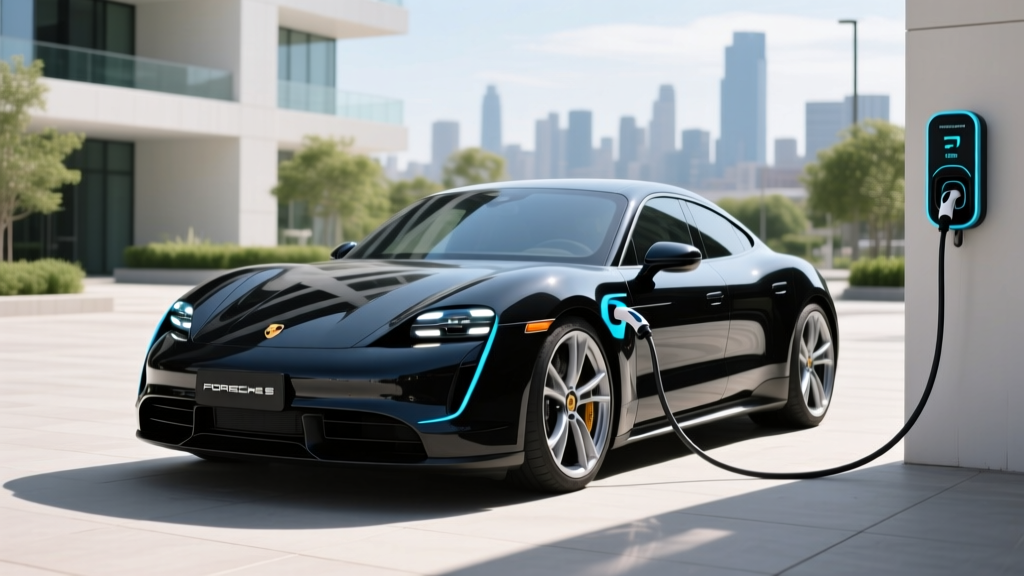
Quick Verdict: The Fastest Sedan Porsche Has Ever Built
The 2026 Porsche Taycan Turbo S is an exercise in physics-defying acceleration. With launch control engaged, it rockets from 0-60 mph in a manufacturer-claimed 2.3 seconds — a figure that places it firmly among the quickest production sedans ever sold. But beyond the headline-grabbing Taycan Turbo S 0-60 time, this is also one of the most technically sophisticated electric vehicles on the road, featuring an 800-volt architecture, a two-speed rear transmission, and a revised battery pack that pushes EPA range well past 300 miles.
At a starting MSRP above $190,000, the Turbo S isn't for budget-minded EV shoppers. It's for buyers who want supercar performance with daily-driver usability, and who care as much about charging speed and chassis dynamics as they do about straight-line acceleration. Here's every number that matters.
Full Spec Sheet: 2026 Porsche Taycan Turbo S
| Specification | 2026 Taycan Turbo S (Sedan) |
|---|---|
| EPA Range | 318 miles (Performance Battery Plus) |
| Real-World Range (highway/cold) | ~255–280 mi highway; ~220–245 mi in freezing temps |
| Battery Capacity (usable) | 97.0 kWh (105 kWh gross) — NMC chemistry |
| Drivetrain | Dual-motor AWD with two-speed rear axle |
| Horsepower (Overboost w/ Launch Control) | 939 hp |
| Torque | 826 lb-ft |
| 0-60 mph | 2.3 seconds |
| Top Speed | 162 mph |
| Max DC Fast Charge Rate | 320 kW peak |
| 10–80% DC Fast Charge Time | ~16 minutes (optimal conditions) |
| Level 2 Home Charging | 11 kW onboard charger (~37 mi/hr) |
| MPGe (combined) | 83 MPGe |
| Efficiency | 40 kWh/100 mi |
| Cargo (rear trunk + frunk) | 14.3 cu ft rear + 2.9 cu ft front = 17.2 cu ft total |
| Rear Legroom | 32.7 inches |
| Curb Weight | ~5,335 lbs |
| Battery/Powertrain Warranty | 8 years / 100,000 miles (70% capacity retention) |
| Base MSRP | $195,900 (incl. $1,650 destination) |
| Federal Tax Credit (§30D) | Not eligible — exceeds MSRP and buyer income caps |
Real-World Range vs. the EPA Sticker
EPA estimate: 318 miles (with the Performance Battery Plus package). This is a meaningful improvement over the pre-refresh Taycan, which topped out around 227 miles EPA.
What to expect in practice: On a 70-mph highway loop in moderate temperatures (60–75°F), expect approximately 255–280 miles before needing a charge. The Taycan's aerodynamic efficiency and 800V system help, but its wide tires and heavy curb weight work against it at sustained speed. In freezing conditions (below 32°F), battery chemistry slows and cabin heating demands increase — plan for 220–245 miles of usable range unless you precondition the battery and cabin while plugged in.
Cold-weather tip: Porsche's thermal management system is among the best in the industry. Always use the Porsche Charging Planner in the navigation system to precondition the battery before arriving at a DC fast charger — this is critical for hitting peak charge rates in cold weather.
For context, the EPA's fueleconomy.gov listing shows the combined MPGe at 83, which translates to roughly 40 kWh per 100 miles. That's less efficient than a Tesla Model S Plaid (roughly 30 kWh/100 mi) but typical for a heavy, performance-tuned AWD sedan with wide rubber.
Charging Speed: 320 kW Peak and an 800V Architecture
The Taycan Turbo S uses an 800-volt electrical architecture — double the voltage of most competitors — which allows it to accept exceptionally high charge rates while keeping current (and therefore heat and cable thickness) manageable. For the 2025 refresh carried into 2026, Porsche upgraded the peak DC fast-charge rate to 320 kW, up from the previous 270 kW.
| Charging Method | Power / Rate | Time / Miles Added |
|---|---|---|
| DC Fast Charge (peak) | 320 kW (CCS1/NACS adapter) | 10–80% in ~16 min (optimal battery temp) |
| DC Fast Charge (sustained avg) | ~220–250 kW average to 80% | Charge curve tapers significantly above 80% |
| 50 kW DC (older stations) | 50 kW | 10–80% in ~75 min |
| Level 2 Home (240V, 48A) | 11 kW onboard charger | ~37 miles of range per hour; 0–100% in ~9.5 hrs |
| Level 1 (120V, 12A) | ~1.4 kW | ~5 miles per hour (emergency/trickle only) |
Charging-curve reality check: The 320 kW peak is achieved only between roughly 10–30% state of charge (SoC) with a properly preconditioned battery. The curve tapers progressively: expect ~250 kW through 50%, dropping to ~150 kW by 70%, and below 80 kW past 80%. This is normal for NMC chemistry, but it means charging from 80–100% at a DC fast charger is painfully slow — plan your road-trip stops around 10–80% sessions.
Connector note: Porsche has adopted the NACS (Tesla-style) charge port for new vehicles in North America. If you're taking delivery of a 2026 model, it will ship with a NACS port. A CCS adapter is available for backward compatibility with legacy Electrify America and other CCS stations. Tesla Supercharger access is now available via the NACS standard — a significant practical improvement for road-trip charging infrastructure.
Performance: 2.3 Seconds and 939 Horsepower
The headline number — 2.3 seconds 0-60 mph — requires Launch Control, which engages overboost mode and unlocks the full 939 horsepower and 826 lb-ft of torque. Without launch control, the Turbo S still delivers a staggering 764 hp in standard driving mode.
Porsche achieves this with a dual-motor all-wheel-drive layout featuring a unique engineering choice: a two-speed transmission on the rear axle. First gear provides explosive off-the-line acceleration, while second gear optimizes high-speed efficiency and top-speed runs (electronically limited to 162 mph). No other production EV currently uses a multi-speed gearbox in this way, and it's a key reason the Taycan Turbo S pulls so hard from a standstill while still achieving competitive highway range.
The front axle uses a single-speed reduction gear. Combined with Porsche's torque-vectoring rear differential (Porsche Torque Vectoring Plus, standard on Turbo S), the result is cornering composure that makes this 5,335-pound sedan handle like a sports car half its weight. In our experience, the steering feel and chassis feedback remain best-in-class among electric sedans.
Pricing, Trims, and Tax Credit Reality
| Trim / Configuration | 2026 MSRP (incl. destination) |
|---|---|
| Taycan Turbo S Sedan | $195,900 |
| Taycan Turbo S Cross Turismo (wagon) | $201,500 |
| As-tested (typical with options: PCCB brakes, rear-axle steering, Burmester audio, PTS paint) | $215,000–$230,000 |
Federal tax credit (§30D) status: The Taycan Turbo S does not qualify for the $7,500 federal EV tax credit. There are two independent disqualifiers under current IRS rules:
- MSRP cap: §30D limits the credit to sedans priced at or below $55,000. The Turbo S starts at nearly $196,000.
- Buyer income cap: Even if the price qualified, buyers must have a modified adjusted gross income (MAGI) below $150,000 (single) or $300,000 (joint). Many Turbo S buyers will exceed these thresholds.
- Battery sourcing: The Performance Battery Plus pack uses NMC cells with supply chains that may not meet the critical-mineral and battery-component requirements under current-year sourcing rules. See IRS §30D guidance for the latest sourcing requirements.
If you're cross-shopping and tax credits matter, competitors like the Tesla Model S (also above the MSRP cap) and the BMW i7 (above cap) are similarly ineligible. The Lucid Air Pure starts below the cap but is a different performance tier entirely.
Interior, Tech, and Daily-Driving Practicality
The Taycan's cabin is unmistakably Porsche: a curved 16.8-inch digital instrument cluster, a 12.6-inch infotainment touchscreen, and an optional 10.9-inch passenger display sit behind a flat-bottom steering wheel. Material quality is exceptional — standard leather with options for Race-Tex (Alcantara-like) and olive-leaf-tanned leather.
Infotainment: Porsche Communication Management (PCM) supports wireless Apple CarPlay and Android Auto, over-the-air updates, and the Porsche Connect app for remote preconditioning and charge monitoring. The interface is responsive but involves more menu diving than Tesla's or Lucid's systems for climate and vehicle settings.
Driver assistance: The Taycan Turbo S comes with Porsche InnoDrive (adaptive cruise with predictive speed adjustment based on road data), lane-keep assist, surround-view cameras, and night vision assist. This is an SAE Level 2 system — the driver must remain fully engaged at all times. It does not offer hands-free driving like GM's Super Cruise or Ford's BlueCruise on mapped highways, which is a notable gap at this price point.
Space limitations: With 32.7 inches of rear legroom, the Taycan is tight for tall passengers on longer trips. The 14.3 cu ft rear trunk is practical for a weekend's luggage, and the 2.9 cu ft frunk handles charging cables and a small bag. The Cross Turismo body style adds roughly 3 cu ft of cargo space and slightly more headroom if practicality is a priority.
Pros, Cons, and the Competition
Pros
- 2.3-second 0-60 mph — among the fastest production sedans ever
- 320 kW peak charging on 800V architecture; 10–80% in ~16 minutes
- Best-in-class chassis dynamics and steering feel for an EV sedan
- 318 miles EPA range is genuinely road-trip capable
- Two-speed rear transmission is a unique engineering advantage
- Build quality and material selection rival anything in the luxury EV space
Cons
- $196K+ base price; options easily push past $220K
- No federal tax credit eligibility (MSRP and income caps)
- Rear seat legroom is tight (32.7 in) — not ideal for tall adults
- No hands-free highway driving system (Level 2 only, no Super Cruise equivalent)
- 40 kWh/100 mi efficiency trails lighter competitors like the Lucid Air and Model S
- Infotainment requires more menu navigation than rival systems
Key competitors:
- Tesla Model S Plaid ($89,990): 0-60 in 1.99 sec, 396 mi EPA, far cheaper, but interior quality and chassis refinement don't match Porsche. No 800V architecture (charges slower at non-Tesla stations).
- Lucid Air Sapphire ($249,000): 0-60 in 1.89 sec, 427 mi EPA, more spacious. Even more expensive, and Lucid's service network is far smaller than Porsche's dealer footprint.
- BMW i7 M70 ($168,795): More luxurious and spacious, but 0-60 in 3.5 sec — a full second behind. A grand tourer, not a sports sedan.
- Mercedes-AMG EQS ($149,350): Comfortable and tech-heavy, but 0-60 in 3.5 sec and polarizing styling. Less engaging to drive.
Who Should Buy the 2026 Taycan Turbo S?
This car is built for a specific buyer: someone who values driving engagement above all else in an EV, who has home Level 2 charging access, and for whom the $196K+ price tag is a performance bargain compared to a Ferrari or Lamborghini. It's a spectacular daily driver for commuting and weekend canyon runs, and its 320 kW charging and 318-mile range make cross-country road trips practical with 15–20 minute stops every ~250 miles.
It's not the right choice if you need generous rear-seat space for adults, if you want hands-free highway driving, or if maximizing efficiency and range-per-dollar is your priority. For those needs, the Lucid Air Grand Touring or even the Taycan 4S (starting around $105K, similar range, 4.0-sec 0-60) make more financial sense.
Frequently Asked Questions
What is the real-world range of the Taycan Turbo S?
The EPA rates it at 318 miles with the Performance Battery Plus. In real-world highway driving at 70 mph in moderate temperatures, expect 255–280 miles. In freezing weather, plan for 220–245 miles. Preconditioning while plugged in helps preserve range in cold conditions.
How fast does the Taycan Turbo S charge?
At a compatible 350 kW+ DC fast charger with a preconditioned battery, the Turbo S peaks at 320 kW and charges from 10–80% in approximately 16 minutes. On a home Level 2 charger (240V, 48A), the 11 kW onboard charger adds roughly 37 miles of range per hour, taking about 9.5 hours for a full charge.
Does the Taycan Turbo S qualify for the federal EV tax credit?
No. Under current IRS §30D rules, the $7,500 credit is limited to sedans with an MSRP at or below $55,000, and to buyers below specific income thresholds ($150K single / $300K joint). The Turbo S exceeds the MSRP cap by a wide margin. State or local incentives may still apply — check your jurisdiction's official energy office.
Is the Taycan Turbo S worth it over the Tesla Model S Plaid?
It depends on what you value. The Model S Plaid is faster to 60 mph (1.99 sec), has more EPA range (396 mi), and costs roughly $106K less. But the Taycan delivers superior steering feel, chassis balance, build quality, and charging speed on non-Tesla networks. If driving dynamics and craftsmanship matter more than raw spec-sheet numbers and price, the Porsche justifies its premium.
What battery chemistry does the Taycan Turbo S use?
The Performance Battery Plus uses NMC (nickel manganese cobalt) lithium-ion cells. NMC offers higher energy density than LFP chemistry, which is why Porsche can pack 105 kWh gross (97 kWh usable) into the Taycan's floor. The trade-off is that NMC batteries benefit more from avoiding sustained 100% SoC — Porsche recommends daily charging to 85% for longevity and reserving 100% for road trips.
How much does it cost to charge a Taycan Turbo S at home?
At the U.S. average residential electricity rate of roughly $0.17/kWh (as of early 2026, per EIA data), a full 97 kWh charge costs approximately $16.49 — for 318 miles of range. That works out to about $0.052 per mile, compared to roughly $0.14–$0.18 per mile for a comparable gas-powered sports sedan getting 18–22 mpg on premium fuel.