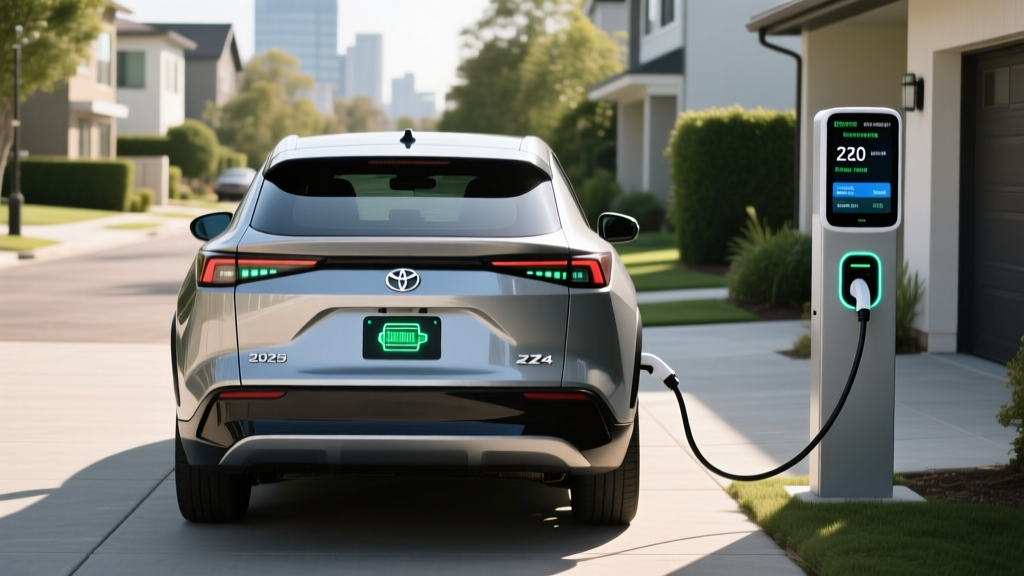
The 2026 Toyota bZ4X sits in a crowded compact electric SUV segment, competing against the Hyundai Ioniq 5, Tesla Model Y, and Ford Mustang Mach-E on price and practicality. But beyond the EPA range sticker and monthly lease deals, the real purchase decision hinges on total cost of ownership — and whether the Toyota bZ4X EV tax credit actually applies to your situation under current IRS §30D rules.
This guide walks through every ownership cost layer: the federal credit eligibility checklist with battery-sourcing caveats, five-year total cost projections, real charging-versus-gas math, insurance premiums, maintenance savings, and resale-value trends. All figures reflect 2026 model-year pricing and the latest IRS guidance.
2026 Toyota bZ4X Quick Specs
| Spec | XLE FWD | XLE AWD | Limited AWD |
|---|---|---|---|
| Base MSRP | $38,465 | $41,065 | $46,850 |
| EPA Range | 252 mi | 228 mi | 222 mi |
| Battery (usable) | 71.4 kWh, NMC lithium-ion | ||
| Peak DC Fast Charge | 150 kW (CCS1/NACS via adapter) | ||
| 10–80% DC Charge | ~30 minutes | ||
| Level 2 Rate | 7.2 kW (~25 mi/hr) | ||
| Horsepower | 201 hp | 214 hp | |
| 0–60 mph | 7.1 sec | 6.5 sec | |
| Combined MPGe | 114 MPGe | 102 MPGe | 100 MPGe |
| Battery/Powertrain Warranty | 8 years / 100,000 miles | ||
Does the Toyota bZ4X Qualify for the Federal EV Tax Credit?
The short answer: it depends on your income, the vehicle's MSRP, and battery-sourcing compliance. Under IRS §30D, the new clean vehicle credit offers up to $7,500, split into two halves — $3,750 for critical-minerals sourcing and $3,750 for battery-component manufacturing. As of 2026, the bZ4X's battery sourcing has been a moving target, and Toyota has historically had the bZ4X qualify for the full $7,500 on certain build dates, but buyers must verify the specific VIN at the time of purchase.
Beginning in 2024, buyers can elect to transfer the credit to the dealer at the point of sale, effectively reducing the purchase price upfront rather than waiting to claim it on their tax return. This is available regardless of tax liability, which is a significant advantage over the old rules.
- Buyer Income Caps (Modified AGI): $300,000 joint filers / $225,000 head of household / $150,000 individual — applies to the year of delivery or the prior year, whichever is lower
- MSRP Cap: $80,000 for SUVs, pickups, and vans; $55,000 for sedans. The bZ4X is classified as an SUV, so the $80,000 cap applies — all trims qualify on price
- Battery Sourcing: Critical minerals must meet increasing domestic/free-trade-partner thresholds (80% in 2026). Battery components must be 100% manufactured or assembled in North America for the component half. Verify VIN-level eligibility at purchase
- Final Assembly: Must occur in North America — the bZ4X is assembled in Japan, which is a disqualifying factor for the new-vehicle §30D credit unless leased
- Lease Loophole (§45W): If you lease the bZ4X, the commercial clean vehicle credit under §45W may pass through as a lease incentive, regardless of assembly location. Many dealers advertise "all bZ4X leases qualify for $7,500" under this provision
- Point-of-Sale Transfer: Available — reduce your out-of-pocket cost at the dealership by up to $7,500 if eligible
Critical caveat for the bZ4X: Because Toyota assembles the bZ4X at its Motomachi plant in Japan, the vehicle does not meet the North American final assembly requirement for the purchase-based §30D credit. If you buy a bZ4X outright, you will likely not qualify for the federal tax credit. However, leasing through Toyota Financial Services often qualifies under the separate §45W commercial credit, and many dealerships pass the $7,500 savings directly to lessees. Always confirm with the dealer and your tax professional before signing.
5-Year Total Cost of Ownership Breakdown
Below is a five-year ownership projection for the 2026 Toyota bZ4X XLE FWD ($38,465 MSRP) compared to a similarly priced gas compact SUV — the 2026 Toyota RAV4 XLE ($32,000 MSRP, 30 MPG combined). This assumes 15,000 miles/year, home Level 2 charging at the national average electricity rate, and no federal tax credit applied (purchase scenario).
| Cost Category | bZ4X XLE FWD (5 yr) | RAV4 XLE Gas (5 yr) |
|---|---|---|
| Purchase Price (MSRP) | $38,465 | $32,000 |
| Federal Tax Credit | $0 (Japan assembly) | $0 |
| Charging / Fuel (75,000 mi) | $5,625 | $11,250 |
| Insurance (5 yr avg) | $10,500 | $8,250 |
| Maintenance (5 yr) | $1,800 | $3,750 |
| Depreciation (est.) | $18,500 | $12,800 |
| Total 5-Year Cost | $74,890 | $68,050 |
| Cost Per Mile | $0.50/mi | $0.45/mi |
Charging vs. Gas: The Per-Mile Cost Reality
The bZ4X's efficiency is rated at approximately 29 kWh/100 miles (combined cycle for the XLE FWD). Here's how that translates to real dollars:
| Scenario | Rate | Cost per 100 Miles | Cost per Mile |
|---|---|---|---|
| Home L2 Charging (national avg) | $0.17/kWh | $4.93 | $0.049 |
| Home L2 (California avg) | $0.28/kWh | $8.12 | $0.081 |
| Public DC Fast Charging | $0.40/kWh | $11.60 | $0.116 |
| RAV4 Gas (30 MPG, $3.50/gal) | $3.50/gallon | $11.67 | $0.117 |
| RAV4 Gas (30 MPG, $4.50/gal) | $4.50/gallon | $15.00 | $0.150 |
At the national average residential electricity rate of $0.17/kWh (EIA data), the bZ4X costs roughly $0.05 per mile to fuel at home — less than half the cost of the RAV4 at $3.50/gallon gas. Even in higher-cost states like California, home charging undercuts gasoline. However, if you rely exclusively on public DC fast charging at $0.40/kWh, the bZ4X's fuel cost nearly matches gas at $3.50/gallon, eliminating the economic advantage.
Key takeaway: The charging-cost advantage of the bZ4X is almost entirely dependent on home charging access. Without it, you're paying near-gasoline rates at public chargers and losing the primary operating-cost benefit.
Maintenance Savings: Where EVs Actually Win
Electric vehicles eliminate several recurring maintenance items that internal-combustion vehicles require. The bZ4X's single-speed reduction gear and electric motors have far fewer wear components than a gas powertrain.
| Maintenance Item | bZ4X (EV) | RAV4 (Gas) |
|---|---|---|
| Oil Changes (every 10k mi) | Not required | ~$350 over 75k mi |
| Transmission Fluid | Sealed, lifetime | $200–$400 at 60k mi |
| Brake Pad Replacement | $0–$200 (regen extends life) | $600–$900 over 75k mi |
| Engine Air Filter | Not applicable | $100 over 75k mi |
| Spark Plugs | Not applicable | $300–$500 at 60k mi |
| Coolant Flush | Every 100k mi (~$150) | Every 60k mi (~$200) |
| Cabin Air Filter | $50–$80 every 20k mi | $50–$80 every 20k mi |
| Tire Rotation | $25–$50 every 7,500 mi | $25–$50 every 7,500 mi |
| Estimated 5-Year Total | ~$1,800 | ~$3,750 |
The bZ4X's regenerative braking significantly reduces brake pad wear — many EV owners report original brake pads lasting 100,000+ miles. Combined with no oil changes, spark plugs, or transmission service, the five-year maintenance savings of approximately $1,950 is realistic. However, EV tires tend to wear faster due to higher vehicle weight and instant torque, so budget for a tire replacement around 40,000–50,000 miles (~$800–$1,200 for a set).
Insurance Costs: The EV Premium Explained
Insurance is where the bZ4X costs more than a comparable gas SUV, and this catches many buyers off guard. Based on national averages, insuring the bZ4X runs approximately $2,100/year for a full-coverage policy (comp, collision, liability at 100/300/100), compared to roughly $1,650/year for the RAV4 — a 25–30% premium.
Why EVs cost more to insure:
- Higher repair costs: EV battery packs and power electronics are expensive to replace after collision damage. A minor rear-end collision that damages the battery enclosure can total a vehicle that a gas car would survive with a $2,000 repair
- Specialized labor: High-voltage system repairs require certified EV technicians, which are still less common and command higher shop rates
- Parts availability: EV-specific components (inverters, onboard chargers, battery modules) have longer lead times and higher unit costs
- Total-loss frequency: Insurers are more likely to declare an EV a total loss after battery-adjacent damage due to safety protocols and uncertain long-term battery integrity
Depreciation and Resale Value
The bZ4X has faced steeper-than-average depreciation since its 2023 launch, driven by three factors: aggressive lease incentives that flood the used market, the Japan-assembly tax-credit limitation reducing new-buyer demand, and a crowded segment with strong competitors. Based on 2026 market data, the bZ4X retains approximately 52–55% of its MSRP after three years, compared to 58–62% for the RAV4 Hybrid and 55–58% for the Tesla Model Y.
Over five years, expect the bZ4X to retain roughly 40–45% of its original MSRP — translating to approximately $15,400–$17,300 in residual value for the XLE FWD at $38,465. This means five-year depreciation of approximately $18,500–$21,000, which is the single largest ownership cost for any vehicle.
Factors that could improve bZ4X resale values include continued battery-health data showing minimal degradation (Toyota's 8-year/100,000-mile warranty helps), and growing consumer confidence in used EVs as the market matures. Factors that could worsen depreciation include future price cuts on new models, battery-chemistry advances that make older packs less desirable, and any reliability concerns that emerge as the fleet ages.
State, Local, and Utility Incentives
- California (CVRP): Up to $2,000 rebate for income-qualified buyers (AGI caps apply); some utilities offer additional $500–$1,500
- Colorado: State tax credit of up to $5,000 for new EVs under $80,000 MSRP (income caps apply)
- New York (Drive Clean Reset): Point-of-sale rebate up to $2,000 based on income and vehicle price
- Utility rebates: Many utilities offer $250–$1,000 for Level 2 home charger purchase/installation, or time-of-use rate discounts. Check with your provider
- HOV lane access: Several states (CA, CO, FL, VA, MD) grant solo HOV lane access to EVs — a non-monetary incentive with real daily value
These incentives stack with — or compensate for the absence of — the federal credit. In states like Colorado, a $5,000 state credit can partially offset the bZ4X's ineligibility for the federal purchase credit.
Frequently Asked Questions
How much does it really cost to own a Toyota bZ4X over 5 years?
Without the federal tax credit (purchase scenario), the 5-year total cost of ownership for the bZ4X XLE FWD is approximately $74,890, or $0.50 per mile. With a lease that includes the $7,500 pass-through credit, it drops to approximately $67,390 — competitive with or cheaper than a gas RAV4. The biggest variables are your electricity rate, insurance premium, and whether you charge at home or rely on public DC fast chargers.
Do I qualify for the Toyota bZ4X federal EV tax credit?
If you purchase the bZ4X outright, you likely do not qualify for the §30D credit because the vehicle is assembled in Japan, failing the North American final assembly requirement — regardless of your income or the MSRP. If you lease the bZ4X, the dealer may pass through a $7,500 credit under the §45W commercial vehicle provision. Income caps still apply to some state incentives. Always confirm VIN-level eligibility and consult a tax professional.
How much do I save on fuel and maintenance with the bZ4X?
At the national average electricity rate ($0.17/kWh) and $3.50/gallon gas, the bZ4X saves approximately $5,625 in fuel over 75,000 miles compared to a 30 MPG gas SUV. Maintenance savings add another $1,950 over five years. Combined operating savings of roughly $7,575 are significant but are partially offset by higher insurance costs (~$2,250 more over five years) and steeper depreciation.
Are EVs more expensive to insure than gas cars?
Yes, typically 20–30% more expensive. The bZ4X averages around $2,100/year for full coverage versus $1,650/year for the RAV4. Higher repair costs, specialized labor requirements, expensive battery components, and greater total-loss frequency all drive the premium. Shop multiple carriers and ask about EV-specific discounts.
How well does the Toyota bZ4X hold its value?
The bZ4X retains approximately 52–55% of MSRP after three years and 40–45% after five years — below the RAV4 Hybrid but in line with many non-Tesla EVs. Steep lease incentives, Japan assembly limiting federal credit eligibility, and strong segment competition have pressured resale values. Toyota's reputation for reliability and the 8-year battery warranty may help stabilize long-term residuals.
Should I buy or lease the bZ4X?
From a pure cost perspective, leasing is currently the more financially advantageous path for the bZ4X. The §45W commercial credit pass-through effectively reduces the capitalized cost by $7,500, and you avoid the depreciation risk entirely. If you prefer ownership and your state offers a substantial credit (Colorado's $5,000, for example), purchasing can still make sense — but run the numbers with your specific incentives, insurance quotes, and electricity rates before deciding.