Why Your Tesla Model Y VIN Number Matters in 2026
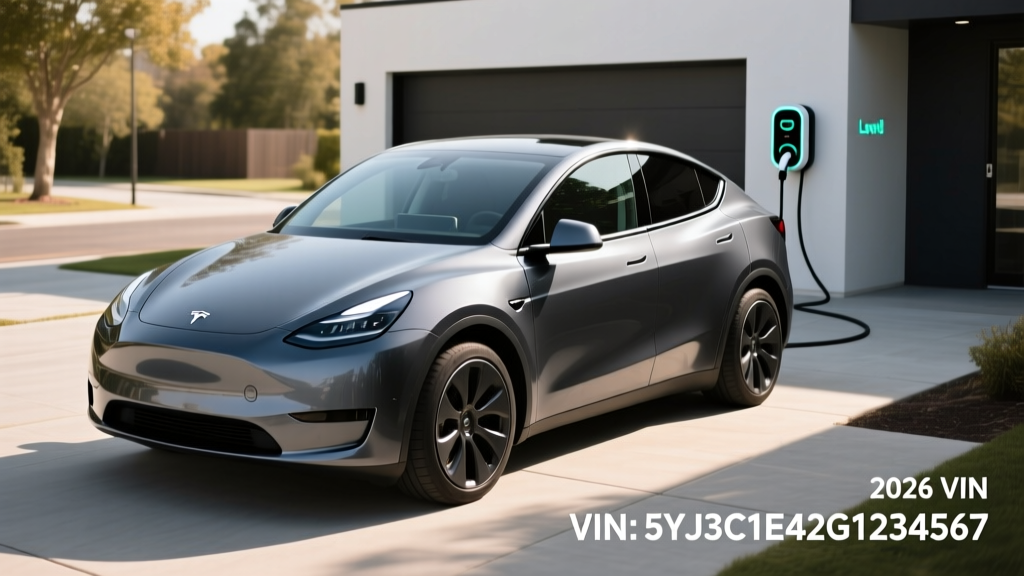
If you're researching the 2026 Tesla Model Y VIN number, you're likely either preparing to order, verifying a delivery, or evaluating a specific build for federal tax credit eligibility. The 17-character Vehicle Identification Number on a Model Y isn't just a serial tag — it encodes the vehicle's factory of origin, battery chemistry, drivetrain layout, and production sequence. In 2026, with shifting IRS §30D critical-mineral sourcing rules and Tesla's ongoing Juniper-refresh production ramp, that VIN is your single source of truth for what's actually under the floor and whether you qualify for the point-of-sale credit.
This review walks through the 2026 Model Y lineup — Long Range AWD, Performance, and the anticipated Standard Range RWD — with the exact specs, charging data, real-world range expectations, and tax-credit math you need before signing.
2026 Tesla Model Y Lineup: Trim Specs at a Glance
| Spec | Long Range AWD | Performance AWD | Standard Range RWD* |
|---|---|---|---|
| EPA Range | 320 mi | 298 mi | ~280 mi (est.) |
| Battery (usable) | ~75 kWh NMC | ~75 kWh NMC | ~60 kWh LFP |
| Drivetrain | Dual-Motor AWD | Dual-Motor AWD | Rear-Wheel Drive |
| Horsepower | 384 hp | ~456 hp | ~295 hp |
| 0–60 mph | 4.8 sec | 3.5 sec | ~6.5 sec |
| Peak DC Charge | 250 kW | 250 kW | ~170 kW |
| 10–80% DC Time | ~27 min | ~27 min | ~30 min |
| Level 2 (11.5 kW) | ~44 mi/hr | ~44 mi/hr | ~38 mi/hr |
| Efficiency | 122 MPGe / 28 kWh/100mi | 115 MPGe / 29 kWh/100mi | ~125 MPGe (est.) |
| Base MSRP | $48,990 | $53,990 | ~$42,990 (est.) |
*Standard Range RWD is anticipated for 2026 based on Tesla's production roadmap; specs marked est. are projected from prior LFP Model Y variants. Confirm on your VIN-specific build sheet.
Decoding the 2026 Model Y VIN: What Each Position Tells You
A Tesla VIN follows the global 17-character standard. For a 2026 Model Y built at Giga Texas (or Giga Berlin for non-US markets), the positions that matter most to buyers are:
- Position 1–3 (WMI):
7G6or5YJ— Tesla USA. The 7G6 WMI appeared on Texas-built vehicles and signals Giga Austin origin, which matters because §30D battery-sourcing rules tie credit eligibility to North American assembly and mineral supply chains. - Position 4–8 (VDS): Encodes restraint system, body style (Model Y SUV), and drivetrain. Position 7 typically differentiates dual-motor from RWD.
- Position 10 (Model Year):
T= 2026 model year. - Position 11 (Plant Code):
Afor Austin, confirming domestic assembly — a prerequisite for the full §30D credit. - Position 12–17 (Serial): Build sequence. Early serials on a refreshed platform may carry first-year-production quirks worth tracking via owner forums.
Before accepting delivery, pull the VIN from your Tesla app or the driver's door jamb and cross-check it against the IRS qualified clean vehicles list to confirm your specific build still qualifies.
Real-World Range: What the EPA Sticker Doesn't Tell You
Real-World Highway (70 mph, 75°F): ~270–285 mi
Cold-Weather Highway (30°F, heater on): ~225–245 mi
City/Stop-and-Go with Regen: ~300–315 mi
The Long Range AWD's 320-mile EPA figure is legitimate in mixed suburban driving where regenerative braking recovers energy. But sustained 70–80 mph highway running pushes consumption to roughly 300–320 Wh/mi, trimming range to ~275 miles. In freezing temperatures, cabin heating and battery thermal management add load; expect a 20–30% reduction unless you precondition the pack while plugged in. The heat pump Tesla introduced on earlier Juniper-adjacent platforms helps, but physics still wins below 20°F.
For the Standard Range LFP variant, plan conservatively around 230 miles of usable highway range — adequate for commuting but a constraint on road trips without Supercharger stops.
Charging Speed: DC Fast, Level 2, and the Curve Reality
| Level | Power | Delivery | Notes |
|---|---|---|---|
| Level 1 (120V) | ~1.4 kW | ~4 mi/hr | Emergency/trickle only |
| Level 2 (240V, 48A) | 11.5 kW | ~44 mi/hr | Overnight full charge in ~8 hr |
| DC Fast (peak) | 250 kW | ~1,000 mi/hr (at peak) | Sustained only to ~50% SoC |
| DC Fast (10–80%) | Avg ~130 kW | ~27 min (LR AWD) | Taper above 80% is steep |
The headline 250 kW peak on NACS is real but short-lived. On a V3/V4 Supercharger, the Long Range NMC pack pulls 240–250 kW only between roughly 10% and 35% SoC, then tapers to ~150 kW by 60% and ~80 kW past 75%. That's why the 10–80% time averages ~27 minutes rather than the ~18 minutes peak power alone would suggest. Preconditioning via the onboard nav routing to a Supercharger is essential — arriving cold can double your charge time.
Home charging at 11.5 kW (Tesla Wall Connector on a 60A circuit) adds ~44 miles per hour of charging, fully replenishing the Long Range pack in about 8 hours — ideal for overnight top-ups.
Tax Credits, Pricing, and the §30D Eligibility Check
| Trim | MSRP | §30D Credit (if eligible) | Effective Price |
|---|---|---|---|
| Long Range AWD | $48,990 | Up to $7,500 POS | ~$41,490 |
| Performance AWD | $53,990 | Up to $7,500 POS | ~$46,490 |
| Standard Range RWD* | ~$42,990 | Up to $7,500 POS | ~$35,490 |
Federal credit eligibility under IRS §30D for 2026 hinges on three gates:
- MSRP cap: SUVs must sticker at or below $80,000 — all Model Y trims clear this easily.
- Buyer income cap: AGI ≤ $150,000 single / $300,000 married filing jointly.
- Battery sourcing: Critical minerals and battery components must meet escalating North American/free-trade-agreement thresholds that tighten annually. Tesla's LFP cells (often CATL-sourced) have historically complicated the full $7,500; the NMC Long Range from Giga Texas with Panasonic cells has more consistently qualified, but verify your specific VIN against the IRS qualified list at point of sale.
Since 2024, the credit can transfer to the dealer as a point-of-sale discount, reducing your out-of-pocket at delivery rather than waiting for tax filing. Confirm with your Tesla advisor before signing.
Interior, Cargo, and Daily Livability
The Juniper-refreshed cabin carries forward the minimalist 15.4-inch center touchscreen with ventilated front seats, ambient lighting, and a rear-seat entertainment tablet. Cargo volume remains a class strength:
- Behind 2nd row: 30.2 cu ft
- Seats folded: 72.1 cu ft
- Front trunk (frunk): 4.1 cu ft
- Rear legroom: 40.5 in
Towing capacity for AWD trims is 3,500 lbs — adequate for a small utility trailer or a pair of dirt bikes, but not a camper. The absence of physical stalks (turn signals live on the steering wheel rim) remains a polarizing choice that takes roughly a week of muscle-memory adaptation.
Driver Assistance: Autopilot, FSD, and SAE Level 2 Reality
Autopilot and FSD (Supervised) are not self-driving systems.
Standard Autopilot (traffic-aware cruise + lane centering) is included. The $8,000 FSD (Supervised) upgrade adds automated lane changes, traffic-light recognition, and city-street navigation, but the driver must remain engaged with hands on the wheel and eyes on the road. This is fundamentally different from Level 4 robotaxi services like Waymo, which operate without a human fallback in geofenced areas. For 2026, FSD remains a premium driver-assist — impressive on divided highways, still occasionally hesitant in construction zones and unprotected left turns.
Warranty, Ownership Costs, and Who Should Buy
Tesla covers the Model Y with:
- Basic vehicle: 4 years / 50,000 miles
- Battery & drive units: 8 years / 120,000 miles (Long Range/Performance), 8 years / 100,000 miles (Standard Range)
- Capacity retention threshold: 70% during warranty period
Per fueleconomy.gov, the Long Range AWD's 28 kWh/100mi efficiency translates to roughly $0.045–$0.06 per mile on residential electricity at $0.16/kWh — versus ~$0.13/mi for a comparable gas crossover at 25 mpg and $3.30/gallon. Over five years and 75,000 miles, that's ~$6,000–$7,000 in fuel savings, partially offset by typically higher EV insurance premiums (budget 15–25% above ICE equivalents).
Consider alternatives if: You need 3-row seating, you lack home charging access, or you want traditional dealer service.
Pros, Cons, and the Competitive Question
- Best-in-class Supercharger network access (17,000+ NA stalls)
- Strong efficiency (122 MPGe LR AWD)
- Class-leading cargo volume
- Over-the-air updates add features post-purchase
- Stalkless steering wheel requires adaptation
- FSD remains Level 2 despite the price tag
- LFP Standard Range may face §30D sourcing limits
- Ride firmness on 20-inch wheels over broken pavement
Against the Hyundai Ioniq 5, Ford Mustang Mach-E, and BMW iX3, the Model Y wins on charging-network convenience and cargo space, but the Ioniq 5's 800V architecture delivers faster 10–80% DC times (~18 min on a 350 kW charger) and the Mach-E offers a more conventional interior. Choose the Model Y if Supercharger ubiquity and software polish outweigh those trade-offs.
FAQ: 2026 Tesla Model Y VIN and Ownership
Where do I find my Model Y VIN?
The VIN is etched on the driver's door jamb, visible through the lower windshield from outside, and listed in the Tesla app under your vehicle's details. Use it to pull the build sheet and verify §30D eligibility.
Does every 2026 Model Y qualify for the $7,500 tax credit?
No. Eligibility depends on MSRP (all trims qualify), buyer income (AGI caps apply), and battery-sourcing compliance that varies by cell supplier. Always verify your specific VIN against the IRS qualified list before committing.
Is the LFP battery in the Standard Range a drawback?
LFP trades energy density for longevity and lower cost. It handles 100% daily charging better than NMC and degrades more slowly, but delivers less range per kWh and loses more capacity in cold weather. For commuters with home charging, LFP is often the smarter long-term pick.
What's the real 10–80% charging time on a road trip?
Expect ~27 minutes at a V3/V4 Supercharger when preconditioned. Add 5–10 minutes if the pack is cold or you arrive below 10% SoC. Plan stops around 20–80% rather than 0–100% to avoid the steep taper above 80%.
Should I wait for a later 2026 build?
Early Juniper-production vehicles sometimes carry fit-and-finish quirks. Later serials typically benefit from line-side refinements. If your delivery timeline allows, a mid-year VIN often reflects the most stable build quality of the model year.