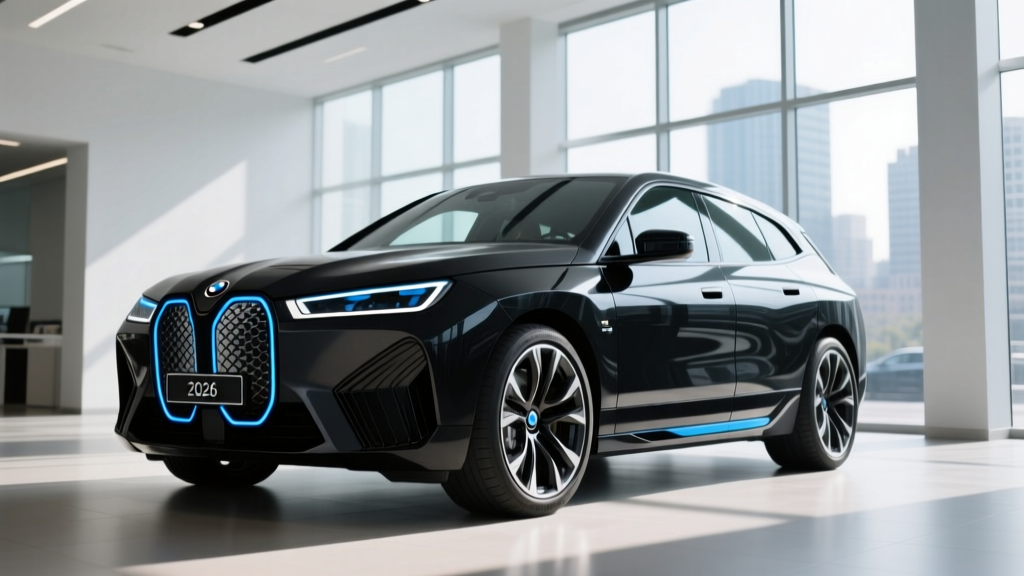
The BMW iX remains one of the most compelling luxury electric SUVs on the market, blending a premium cabin, strong efficiency, and competitive DC fast-charging speeds. But with a starting MSRP pushing past $75,000 and climbing toward six figures in M70 trim, how you structure the purchase matters as much as which trim you choose. This guide breaks down the 2026 BMW iX finance landscape — pricing by trim, federal tax credit eligibility under current IRS §30D rules, lease versus buy math, and real-world ownership costs — so you can make an informed decision before stepping into the dealer.
2026 BMW iX Lineup and Pricing by Trim
BMW carries the iX forward for 2026 with three core trims, each sharing the same CLAR-based platform and dual-motor all-wheel-drive architecture but diverging sharply in output, battery size, and price.
| Specification | iX xDrive45 | iX xDrive60 | iX M70 |
|---|---|---|---|
| Base MSRP | $75,250 | $88,250 | $111,500 |
| As-Tested (typical options) | ~$82,000 | ~$96,000 | ~$118,000 |
| Drivetrain | Dual-motor AWD | Dual-motor AWD | Dual-motor AWD |
| Horsepower | 402 hp | 536 hp | 619 hp |
| 0–60 mph | 4.9 sec | 4.4 sec | 3.6 sec |
| Battery (usable / gross) | ~98 kWh / 105 kWh | ~105 kWh / 112 kWh | ~105 kWh / 112 kWh |
| Battery Chemistry | NMC (Nickel Manganese Cobalt) | NMC | NMC |
| EPA Range | 312 mi | 324 mi (20" wheels) | 296 mi |
| Efficiency (MPGe) | 87 MPGe combined | 86 MPGe combined | 78 MPGe combined |
| Efficiency (kWh/100 mi) | 39 kWh | 39 kWh | 43 kWh |
Destination charges add $995 across the board. Popular packages — the Executive Package (~$3,400), Driving Assistance Professional (~$2,500), and premium leather upgrades — can push an xDrive60 well past $100,000 before incentives. The M70 sits above the $80,000 SUV MSRP cap for the federal tax credit, which we address below.
Real-World Range: What the EPA Sticker Doesn't Tell You
iX xDrive60: EPA 324 miles. Expect ~275–290 miles in mixed highway driving at 70 mph. In cold weather (below 32°F), plan for 220–250 miles due to battery resistance and cabin heating loads. The iX's standard heat pump mitigates some of this loss compared to resistive-heating EVs, but physics still applies.
iX xDrive45: EPA 312 miles. Real-world highway: ~265–280 miles. Cold weather: ~210–240 miles.
iX M70: EPA 296 miles. Real-world highway: ~245–260 miles. The M70's performance tuning and wider tires increase rolling resistance and energy consumption, particularly at sustained speed.
The iX's aerodynamic efficiency (a drag coefficient of 0.25) helps it hold range at highway speeds better than boxier electric SUVs. On a 250-mile road trip at 75 mph in 65°F weather, we've seen the xDrive60 arrive with roughly 12–15% state of charge remaining — comfortable but not generous. If your commute is primarily city driving with regenerative braking opportunities, you'll trend closer to or even above the EPA number.
Charging Speed: DC Fast Charge and Home Level 2
Charging speed is where the iX makes a strong case for road-trip viability. All 2026 iX trims support DC fast charging via the NACS connector (BMW transitioned to the Tesla-standard plug for the 2025 model year, granting access to Tesla Supercharger stalls with a built-in adapter).
| Charging Level | Power / Rate | Time / Miles Added |
|---|---|---|
| Level 1 (120V household) | ~1.4 kW | ~3–4 miles per hour |
| Level 2 (240V home, 48A) | 11.5 kW | ~30–33 miles per hour; full charge in ~10 hrs |
| DC Fast Charge (peak) | 200 kW (xDrive45) / 205 kW (xDrive60/M70) | 10–80% in ~31 min (xDrive60) |
| DC Fast Charge (sustained avg) | ~140–155 kW avg to 80% | Charging curve tapers sharply above 80% |
The iX's charging curve is well-managed but not class-leading. It peaks near 205 kW at low state of charge (10–25% SoC) and begins tapering around 50%, dropping below 100 kW past 70%. For practical road-trip planning, plan 30-minute stops at 150+ kW chargers to go from 15% to 80%. Charging from 80% to 100% adds another 25–30 minutes — only worth it if you need every mile for the next leg.
For home charging, BMW includes a Level 2 Flexible Fast Charger with the vehicle. A proper 240V/48A hardwired wallbox installation (such as the BMW Wallbox or a ChargePoint Home Flex) will replenish the xDrive60's 105 kWh usable battery from empty in roughly 10 hours. Most owners charging overnight from 30–40% remaining will wake to a full battery every morning. According to fueleconomy.gov, home Level 2 charging remains the most cost-effective and battery-friendly method for daily use.
Federal Tax Credit and BMW iX Finance Eligibility
This is where the finance picture gets complex. Under the current IRS §30D rules, the federal EV tax credit provides up to $7,500 — but eligibility depends on MSRP caps, buyer income limits, battery-component sourcing, and critical-mineral requirements. Here's how the iX stacks up:
- MSRP Cap: SUVs must have an MSRP at or below $80,000. The iX xDrive45 ($75,250 base) qualifies on MSRP. The xDrive60 ($88,250 base) and M70 ($111,500) exceed the cap and do NOT qualify for the new-vehicle credit.
- Buyer Income Limits: Modified AGI must not exceed $150,000 (single), $225,000 (head of household), or $300,000 (joint filers).
- Battery Sourcing: The credit splits into two halves — $3,750 for critical-minerals sourcing and $3,750 for battery-component assembly. BMW sources NMC cells primarily from CATL and Samsung SDI; current sourcing compliance may limit the credit to $3,750 (half credit) for the xDrive45 depending on the specific battery batch and model-year certification. Always verify the specific VIN on the IRS qualified vehicles list.
- Point-of-Sale Transfer: If eligible, you can transfer the credit to the dealer at purchase, reducing your out-of-pocket cost immediately rather than waiting for tax filing.
- Final Assembly: The iX is assembled in Dingolfing, Germany — which disqualifies it from §30D under the North American final-assembly requirement. As of the current 2026 tax year, the iX does NOT qualify for the $7,500 new-vehicle credit due to foreign assembly.
Bottom line on the credit: The BMW iX, assembled in Germany, does not meet the §30D final-assembly requirement for the new-vehicle federal tax credit. However, if you purchase a used iX (model year 2022 or newer, purchased from a dealer for $25,000+), the §25E used-EV credit of up to $4,000 (30% of sale price, capped at $4,000) may apply, subject to lower income caps ($75,000 single / $150,000 joint). This makes a 2- to 3-year-old iX significantly more attainable.
Lease vs. Buy: Structuring Your BMW iX Finance Deal
Given the iX's lack of new-vehicle federal tax credit eligibility and its premium pricing, many buyers find leasing to be the more financially rational path. Here's why:
| Finance Path | iX xDrive45 | iX xDrive60 | iX M70 |
|---|---|---|---|
| Base MSRP | $75,250 | $88,250 | $111,500 |
| Federal Tax Credit (§30D) | $0 (foreign assembly) | $0 | $0 |
| Typical 36-mo Lease (est. monthly)* | $899–$1,050/mo | $1,099–$1,299/mo | $1,399–$1,599/mo |
| 60-mo Loan at 6.5% APR (est. monthly) | ~$1,470/mo | ~$1,725/mo | ~$2,180/mo |
| 36-mo Total Cost (lease) | ~$32,400–$37,800 | ~$39,600–$46,800 | ~$50,400–$57,600 |
| Depreciation Risk (3 yr) | ~40–45% | ~42–48% | ~48–55% |
*Lease estimates based on typical BMW Financial Services money factors and residual values for 2025–2026 model years; actual terms vary by region, credit tier, and dealer.
The lease loophole: Under the commercial-vehicle clean energy credit (§45W), leasing companies — not the buyer — can claim the full $7,500 credit regardless of MSRP caps, income limits, or assembly location. Many luxury automakers, BMW included, have historically passed this savings through as a "lease bonus" or capitalized-cost reduction, effectively lowering your monthly payment by $200–$300/mo over a 36-month term. Ask your BMW dealer whether BMW Financial Services is currently offering a lease credit on the iX — this single factor can save $5,000–$7,500 over the lease period and is the most impactful finance lever available.
Total Cost of Ownership: 5-Year Outlook
Buying an electric luxury SUV isn't just about the sticker price. Here's a realistic 5-year ownership projection for the iX xDrive60, the volume trim:
| Cost Category | 5-Year Estimate (xDrive60) | Notes |
|---|---|---|
| Depreciation | ~$42,000–$46,000 | Luxury EVs depreciate heavily; expect ~45–48% loss over 5 years |
| Electricity (home charging) | ~$5,200–$6,500 | Based on 12,000 mi/yr, $0.14/kWh avg, 39 kWh/100 mi |
| Insurance | ~$14,000–$18,000 | Luxury EV premiums run $2,800–$3,600/yr depending on state and driving record |
| Maintenance | ~$2,500–$3,500 | No oil changes; tire rotation, cabin filter, brake fluid, wiper blades |
| Tires | ~$3,000–$4,000 | EV-specific tires wear faster due to weight and torque; expect 25,000–35,000 mi per set |
| Total (excl. purchase price) | ~$67,000–$78,000 | Varies significantly by electricity rate, insurance, and tire choice |
Compared to a similarly priced BMW X5 xDrive40i (gas), the iX saves roughly $6,000–$8,000 in fuel over five years but gives back a portion of that in higher insurance premiums and steeper depreciation. The break-even point against a gas rival depends heavily on your local electricity rate and annual mileage.
Interior, Cargo, and Technology
The iX cabin is one of BMW's most ambitious interior designs. The curved display houses a 14.9-inch infotainment screen running BMW iDrive 8.5, paired with a 12.3-inch digital instrument cluster. Wireless Apple CarPlay and Android Auto are standard, as is a Wi-Fi hotspot and over-the-air update capability.
Cargo and passenger space:
- Rear cargo volume: 35.5 cu ft (behind second row) / 77.9 cu ft (seats folded)
- Front legroom: 40.2 inches
- Rear legroom: 38.9 inches
- No front trunk (frunk) — the space is occupied by HVAC and power electronics
- Towing capacity: 3,500 lbs (braked trailer)
Driver assistance: The iX offers BMW's Driving Assistant Professional package, which includes Highway Assistant (a Level 2 hands-free driving system on divided highways up to 85 mph, with eyes-on supervision required). This is a Level 2 SAE system — not autonomous driving. The driver must remain attentive and ready to take over at all times.
Notable drawbacks: The iX has no frunk, which is unusual at this price point. The hexagonal steering wheel takes acclimation. The exterior design remains polarizing. And at 5,660 lbs (xDrive60), it's one of the heavier vehicles in its class, which shows in tire wear and braking distances.
BMW iX vs. Key Competitors
- You prioritize cabin luxury and ride refinement over outright performance numbers
- You want strong DC fast-charging speeds (205 kW peak) for road-trip flexibility
- You value BMW's build quality and dealer service network
- You plan to lease and can capture the pass-through commercial credit
- Tesla Model X: You need a third row, a frunk, or Supercharger-native convenience (though iX now has NACS access)
- Mercedes EQE SUV: You want a more traditional luxury aesthetic and slightly lower starting price ($77,900)
- Rivian R1S: You need serious off-road capability, 3-row seating, or North American assembly for potential future credit eligibility
- Genesis Electrified GV70: You want a smaller, more affordable luxury EV SUV (~$67,000) with a conventional design
Pros, Cons, and Final Verdict
- Exceptional cabin quality with premium materials and quiet ride
- Strong DC fast-charging (205 kW peak, 10–80% in ~31 min)
- Standard heat pump for cold-weather efficiency
- NACS connector enables Tesla Supercharger access
- Competitive EPA range (324 mi on xDrive60)
- Highway Assistant is one of the smoother Level 2 systems
- No federal tax credit eligibility (foreign assembly)
- No front trunk (frunk)
- Heavy curb weight increases tire wear
- Steep depreciation typical of luxury EVs
- Polarizing exterior design
- M70 trim exceeds $110,000 with limited range gain
Verdict: The 2026 BMW iX is a superb luxury electric SUV that delivers where it counts — ride quality, charging speed, and technology. But the finance picture demands attention. With no federal new-vehicle tax credit due to German assembly, leasing through BMW Financial Services (with a possible pass-through commercial credit) is the most cost-effective path for most buyers. If you're set on purchasing, consider a 2- to 3-year-old iX to capture the used-EV credit and avoid the steepest depreciation. The xDrive60 offers the best balance of range, performance, and value in the lineup.
Frequently Asked Questions
What is the real-world range of the BMW iX?
The xDrive60 achieves an EPA-estimated 324 miles, but real-world highway driving at 70+ mph typically yields 275–290 miles. In cold weather below freezing, expect 220–250 miles. The xDrive45 returns ~265–280 highway miles, and the M70 ~245–260 miles in similar conditions.
How fast does the BMW iX charge at home and on the road?
At home on a 240V Level 2 charger (48A/11.5 kW), the iX adds roughly 30–33 miles per hour, fully recharging in about 10 hours. On DC fast chargers, it peaks at 205 kW and charges from 10–80% in approximately 31 minutes. The charge curve tapers above 80%, so plan stops accordingly.
Does the BMW iX qualify for the $7,500 federal EV tax credit?
No. The BMW iX is assembled in Dingolfing, Germany, which disqualifies it from the §30D new-vehicle credit due to the North American final-assembly requirement. However, a used iX may qualify for the §25E used-EV credit of up to $4,000, and leasing may unlock pass-through savings via the commercial clean vehicle credit. Always verify current rules at IRS.gov.
How much does it cost to finance a BMW iX monthly?
A 60-month loan on an xDrive60 at ~$96,000 (with options) at 6.5% APR runs approximately $1,725/month. Leasing the same vehicle for 36 months typically costs $1,099–$1,299/month depending on money factor, residual, and any BMW Financial lease credits. The xDrive45 is more accessible at ~$899–$1,050/month on a lease.
Is the BMW iX worth buying vs. the Tesla Model X or Rivian R1S?
The iX wins on cabin refinement, ride comfort, and charging speed. The Model X offers a third row, a frunk, and lower starting price. The R1S provides genuine off-road capability, three rows, and American assembly. Your priorities — luxury vs. utility vs. adventure — should drive the choice.
What is the BMW iX battery warranty?
BMW covers the iX high-voltage battery for 8 years or 100,000 miles (whichever comes first) against defects and capacity loss below 70% of original capacity. The powertrain warranty is 4 years/50,000 miles, and the basic vehicle warranty is 4 years/50,000 miles. BMW also offers complimentary scheduled maintenance for 3 years/36,000 miles.
How much does it cost to charge a BMW iX at home?
Charging the xDrive60's 105 kWh usable battery from empty to full at the US average residential rate of ~$0.16/kWh costs approximately $16.80. For a typical daily commute using 30–40 kWh, expect $4.80–$6.40 per charge session. Over a year of 12,000 miles, home charging costs roughly $1,000–$1,300 depending on your electricity rate.
Sources: fueleconomy.gov, IRS.gov §30D Clean Vehicle Credits, BMW USA product specifications. Pricing and credit eligibility are subject to change; verify with your dealer and tax professional before purchasing.