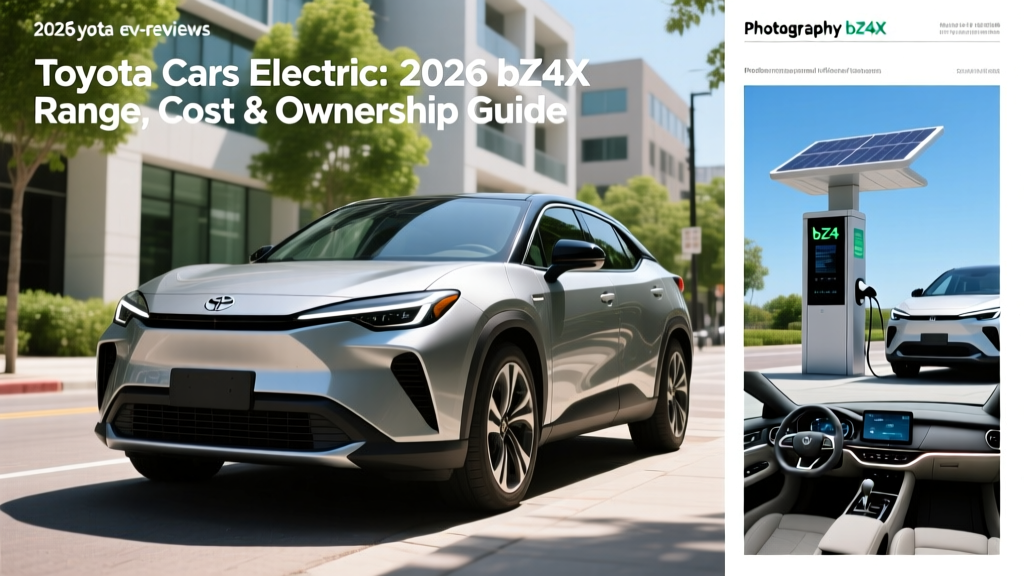
If you're researching Toyota cars electric in 2026, the answer is narrow but getting clearer: Toyota's only mass-market battery-electric vehicle (BEV) available in the U.S. is the bZ4X, a compact electric crossover built on the e-TNGA platform. For the 2026 model year, it carries over with a 71.4 kWh usable battery, EPA-estimated range of 236–252 miles depending on trim and drivetrain, and DC fast charging that peaks around 150 kW. Pricing starts near $38,000 MSRP before incentives. However, the bZ4X does not currently qualify for the full $7,500 federal §30D tax credit due to battery-sourcing rules — a critical factor in the purchase math. For most Toyota buyers, a RAV4 Hybrid or RAV4 Prime PHEV still delivers better total-cost-of-ownership numbers unless you have reliable home Level 2 charging and a short-to-moderate commute.
Quick Answer: Should You Buy a Toyota Electric Car in 2026?
Buy the bZ4X if: you want a Toyota-branded EV, have home Level 2 charging, drive under 200 miles round-trip daily, and live in a mild climate.
Skip it and choose a RAV4 Hybrid/PHEV if: you road-trip frequently, live in extreme cold, lack home charging, or need the $7,500 federal tax credit to make the math work.
Look at competitors if: you want 300+ miles of range, faster DC charging, or tax-credit eligibility (Hyundai Ioniq 5, Tesla Model Y, Chevrolet Equinox EV).
Toyota's 2026 Electric Lineup: What's Actually for Sale
Toyota's electrification strategy has leaned heavily on hybrids (over 20 HEV/PHEV models) rather than full EVs. As of the 2026 model year, the BEV lineup for U.S. buyers is essentially one vehicle:
- bZ4X (compact crossover): The only Toyota BEV widely available. Sold alongside the mechanically identical Subaru Solterra.
- Upcoming/announced: Toyota has previewed a next-generation battery-electric platform and a three-row SUV concept, but no additional 2026-model-year BEVs are confirmed for U.S. showrooms as of early 2026.
This is a deliberate choice by Toyota, which has publicly argued that a diversified powertrain strategy (HEV, PHEV, BEV, hydrogen) better serves global markets. For U.S. buyers specifically searching "Toyota cars electric," the bZ4X is your current option — so the rest of this guide focuses on whether it earns your garage spot.
bZ4X Specs: Range, Battery, and Charging Numbers That Matter
| Spec | 2026 Toyota bZ4X XLE FWD | 2026 Toyota bZ4X Limited AWD |
|---|---|---|
| EPA Range | 252 miles | 228 miles |
| Battery (usable) | 71.4 kWh (NMC lithium-ion) | 71.4 kWh (NMC lithium-ion) |
| Efficiency | 119 MPGe combined | 104 MPGe combined |
| Peak DC Fast Charge | ~150 kW | ~150 kW |
| 10–80% DCFC Time | ~30 minutes (ideal conditions) | ~30 minutes |
| Level 2 AC Charge Rate | ~7.4 kW (onboard charger limited) | ~7.4 kW |
| Horsepower | 201 hp | 214 hp |
| 0–60 mph | ~7.1 sec | ~6.5 sec |
| Battery Warranty | 8 years / 100,000 miles (70% capacity retention) | 8 years / 100,000 miles |
| Base MSRP | ~$38,465 | ~$43,465 |
Real-World Range vs. EPA Sticker
The EPA estimates 252 miles for the FWD XLE. In practice, expect 210–230 miles on mixed highway driving at 70 mph, and as low as 160–180 miles in sub-30°F winter conditions without preconditioning. The AWD Limited's 228-mile sticker drops proportionally. The bZ4X's DC charge curve also tapers sharply above 80% state of charge — you'll rarely see the 150 kW peak sustained for more than a few minutes. Real-world 10–80% sessions at a 150+ kW Electrify America or EVgo stall typically run 32–38 minutes, not the 30-minute marketing figure.
bZ4X vs. RAV4 Hybrid vs. RAV4 Prime: The Cost & Ownership Comparison
Most Toyota shoppers cross-shop the bZ4X against the RAV4 Hybrid (HEV) and RAV4 Prime (PHEV). Here's how the numbers stack up for a buyer driving 12,000 miles per year over 5 years, with home electricity at $0.16/kWh and gas at $3.40/gallon:
| Metric | bZ4X XLE FWD | RAV4 Hybrid XLE | RAV4 Prime SE |
|---|---|---|---|
| Base MSRP (approx.) | $38,465 | $33,975 | $44,590 |
| Federal Tax Credit (§30D) | $0 (battery sourcing) | $0 (HEV ineligible) | Up to $7,500* |
| Effective Purchase Price | $38,465 | $33,975 | ~$37,090 |
| EPA Combined Efficiency | 119 MPGe (28 kWh/100mi) | 39 MPG combined | 94 MPGe / 38 MPG |
| 5-Year Fuel/Energy Cost | ~$2,740 | ~$5,230 | ~$2,200 (mixed EV/gas) |
| 5-Year Maintenance Est. | ~$1,800 | ~$3,200 | ~$2,600 |
| 5-Year Total (purchase + fuel + maint.) | ~$43,005 | ~$42,405 | ~$41,890 |
*RAV4 Prime §30D eligibility depends on current-year IRS battery sourcing and MSRP/income rules. Always verify at irs.gov before purchasing.
The bZ4X's fuel savings are real — roughly $2,500 less energy cost than the RAV4 Hybrid over 5 years. But without the federal tax credit, the effective purchase price gap narrows only slightly. The RAV4 Prime PHEV, when the credit applies, often beats both on total cost while offering 42 miles of electric-only range for daily commuting plus a gas engine for road trips. For buyers without home charging, the RAV4 Hybrid remains the lowest-friction choice.
Charging at Home vs. Public: What bZ4X Owners Actually Face
The bZ4X's 7.4 kW onboard Level 2 charger is a weak point compared to competitors. A Hyundai Ioniq 5 or Tesla Model Y can accept 11–19 kW on Level 2, meaning a full overnight replenish is faster. Here's what bZ4X charging looks like in practice:
| Charging Level | Power | Miles Added per Hour | 0–100% Full Charge Time |
|---|---|---|---|
| Level 1 (120V outlet) | ~1.2 kW | ~4 miles/hr | ~60 hours |
| Level 2 (240V, 32A home charger) | ~7.4 kW (car-limited) | ~25 miles/hr | ~10 hours |
| DC Fast Charge (150 kW stall) | Peak ~150 kW | N/A | 10–80% in ~32 min |
Home charging reality: A Level 2 home charger installation (240V, 40-amp circuit) typically costs $800–$2,000 including equipment and electrician labor, depending on panel proximity. If your electrical panel needs an upgrade to 200A, add $1,500–$3,000. The bZ4X's 7.4 kW ceiling means even a 48A charger won't speed things up — you're paying for the car's limitation.
Public charging: The bZ4X uses the CCS1 connector (not NACS). Toyota has announced future NACS adoption, but 2026-model bZ4X vehicles still ship with CCS1. This means access to Electrify America, EVgo, and ChargePoint DC networks, but not Tesla Superchargers without an adapter (availability varies). Public DC charging costs $0.35–$0.55/kWh in most U.S. markets, erasing much of the home-charging cost advantage.
Tax Credit Reality: Why the bZ4X Misses the $7,500 Federal Credit
The IRS §30D clean vehicle credit requires that a qualifying EV meet battery-component and critical-minerals sourcing thresholds that phase in stricter percentages each year. For 2026, the bZ4X's battery supply chain does not satisfy these requirements, making it ineligible for the $3,750 battery-component half or the $3,750 critical-minerals half of the credit.
§30D Credit Requirements (2026 Model Year)
- MSRP cap: SUVs/vans/pickups ≤ $80,000; sedans/other ≤ $55,000 (bZ4X qualifies at ~$38–$46K)
- Buyer income cap: MAGI ≤ $150K single / $225K HOH / $300K joint
- Battery components: Must be manufactured/assembled in North America at escalating % thresholds
- Critical minerals: Must be sourced from U.S. or FTA partners at escalating % thresholds
- FEOC exclusion: No battery components from foreign entities of concern (China, Russia, etc.)
- Point-of-sale transfer: Eligible buyers can apply the credit as a dealer discount at purchase
The bZ4X clears the MSRP and (for most buyers) income caps, but fails the sourcing tests. This is the single biggest financial disadvantage versus credit-eligible competitors like the Tesla Model Y, Hyundai Ioniq 5 (certain builds), and Chevrolet Equinox EV. Always confirm eligibility at the time of purchase — rules tighten annually.
Common Misconceptions About Toyota Electric Cars
| Myth | Fact |
|---|---|
| "Toyota doesn't make electric cars." | The bZ4X is a production BEV available nationwide since 2023, with 2026 models in dealerships now. |
| "The bZ4X gets 252 miles of range no matter what." | 252 miles is the EPA estimate for FWD XLE in ideal conditions. Highway, cold, and mountain driving reduce this by 15–35%. |
| "It charges as fast as a Tesla." | The bZ4X peaks at ~150 kW and tapers early. A Model Y on a V3 Supercharger sustains ~250 kW longer, reaching 80% roughly 10 minutes faster. |
| "The bZ4X qualifies for the $7,500 federal tax credit." | As of 2026, it does not meet §30D battery-sourcing requirements. Always verify at fueleconomy.gov and irs.gov. |
| "Toyota EVs are unreliable." | Early 2023 models had a wheel-hub bolt recall (NHTSA 23V-384). Post-recall models have no systemic reliability flags, but long-term data is limited. See nhtsa.gov/recalls. |
| "I can use Tesla Superchargers." | 2026 bZ4X models use CCS1. NACS native ports are expected in future model years. Adapter access varies by network. |
Decision Framework: Is the Toyota bZ4X Your Next Car?
Choose the Toyota bZ4X If:
- You're a loyal Toyota buyer who wants to stay in the brand ecosystem and values Toyota Safety Sense 3.0 standard ADAS features.
- You have confirmed home Level 2 charging (garage or driveway with 240V access).
- Your daily round-trip commute is under 150 miles, leaving comfortable range buffer.
- You live in a temperate climate (California, Southeast, Pacific Northwest lowlands) where cold-weather range loss is minimal.
- You value the 8-year/100,000-mile battery warranty and Toyota dealer network for service.
Choose a RAV4 Hybrid or RAV4 Prime Instead If:
- You take road trips longer than 250 miles more than a few times per year.
- You live in a region with harsh winters (Upper Midwest, Northeast, Mountain states).
- You live in an apartment or lack access to reliable home or workplace charging.
- You want the $7,500 federal tax credit to offset purchase cost (RAV4 Prime may qualify; verify annually).
- You need towing capacity (RAV4 Hybrid: up to 1,750 lbs; bZ4X: not rated for towing).
Choose a Competitor BEV If:
- You want 300+ miles of EPA range: Tesla Model Y (320 mi), Hyundai Ioniq 5 (303 mi), Chevrolet Equinox EV (319 mi).
- You want faster DC charging: Ioniq 5 (800V architecture, 10–80% in ~18 min at 350 kW).
- You need NACS/Supercharger access today: Tesla Model Y, or upcoming NACS-native models.
- Federal tax credit eligibility is a deal-breaker: multiple competitors currently qualify for the full $7,500.
Frequently Asked Questions
Is Toyota releasing more electric cars in 2026 or 2027?
Toyota has announced a next-generation EV platform with improved batteries (including a "performance" lithium-ion variant promising 400+ miles of range) targeted for 2027–2028 production. A three-row electric SUV has been previewed as a concept. However, no additional Toyota BEVs beyond the bZ4X are confirmed for U.S. 2026 model-year sale. Toyota's near-term U.S. electrification push remains hybrid-focused.
How does the bZ4X compare to the Subaru Solterra?
The Solterra is mechanically identical to the bZ4X — same e-TNGA platform, 71.4 kWh battery, and powertrain. The differences are cosmetic (badging, minor styling, slight trim variations). Subaru typically prices the Solterra a few hundred dollars differently and may offer distinct dealer incentives. Both share the same range, charging, and tax-credit limitations. Cross-shop both and buy whichever dealer offers the better out-the-door price.
What does bZ4X insurance cost compared to a RAV4?
EV insurance premiums run 15–25% higher than comparable gas vehicles due to higher repair costs and battery replacement risk. Expect annual premiums of $1,800–$2,400 for the bZ4X depending on your state, driving record, and coverage level, versus $1,400–$1,900 for a RAV4 Hybrid. Get quotes from your insurer before committing — the delta varies significantly by provider.
Can I charge the bZ4X on a regular 120V outlet?
Yes, but Level 1 charging at ~1.2 kW adds only about 4 miles of range per hour. A full 0–100% charge takes roughly 60 hours. Level 1 is practical only as a trickle top-up for low-mileage drivers (under 30 miles/day). For any regular use, a 240V Level 2 home charger is strongly recommended.
What is the real cost per mile to drive the bZ4X?
At the U.S. average residential electricity rate of ~$0.16/kWh and the bZ4X's efficiency of ~28 kWh/100 miles, your cost is approximately $0.045 per mile charging at home. Compare that to a RAV4 Hybrid at 39 MPG and $3.40/gallon gas: $0.087 per mile. That's roughly $500/year in fuel savings at 12,000 miles — meaningful but not transformative without the tax credit to amplify the advantage.
Is the bZ4X's battery warranty competitive?
Toyota covers the bZ4X battery for 8 years or 100,000 miles against defects and capacity loss below 70%. This matches the industry standard set by federal mandate. Hyundai/Kia offer 10 years/100,000 miles. Tesla covers the Model Y battery at 8 years/120,000 miles with a 70% retention threshold. Toyota's warranty is adequate but not class-leading.
Sources: fueleconomy.gov for EPA range and MPGe data; irs.gov for §30D clean vehicle credit rules; nhtsa.gov for recall and safety data. All pricing reflects estimated 2026 MSRP and is subject to dealer variation. Always confirm tax credit eligibility with a tax professional before purchase.