Quick Answer: Chinese EV Brands in the US (2026)
As of 2026, the Chinese electric car brands list with confirmed US availability remains extremely short due to 100%+ import tariffs enacted in 2024 and expanded in 2025. Polestar (Volvo/Geely-backed, manufactured in South Carolina and China) is the only Chinese-affiliated brand with mainstream US retail presence. BYD, NIO, Xpeng, Li Auto, and Zeekr do not sell vehicles in the US market. Several brands (BYD in Mexico, NIO in Europe) sell internationally, but US buyers cannot purchase them new, and importing one privately faces prohibitive homologation and tariff barriers.
If you've searched for a "Chinese electric car brands list" hoping to find a $25,000 BYD Seagull or a NIO ET7 with battery-swap technology available at a US dealership, the reality in 2026 is frustrating. Tariff policy—not product capability—keeps these vehicles off American roads. Here's what you actually need to know about these brands, what they cost abroad, why they aren't here, and what to buy instead.
The Full Chinese Electric Car Brands List (Global Players, 2026)
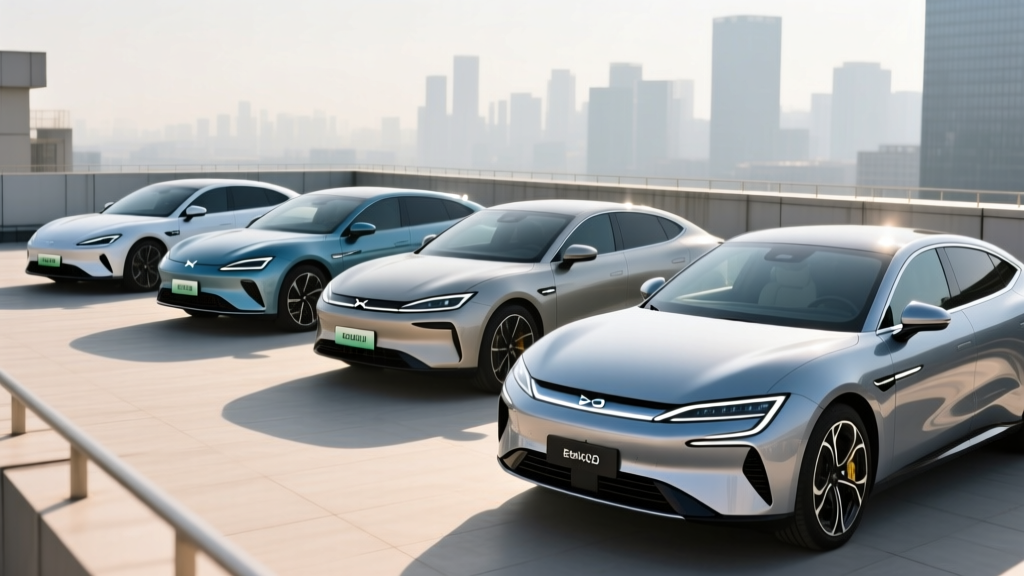
China produces more EVs than any other nation, and the domestic market supports dozens of competitive brands. Below is the definitive list of major Chinese-origin EV manufacturers with global ambitions, their flagship models, and their US availability status.
| Brand | Parent Company | Flagship Model | Battery / Range (WLTP) | US Status |
|---|---|---|---|---|
| BYD | BYD Company | Seal / Atto 3 | 82.5 kWh LFP / ~350 mi | Not available |
| NIO | NIO Inc. | ET7 / EL8 | 100 kWh NMC / ~370 mi | Not available |
| Xpeng | XPeng Inc. | G9 / P7+ | 98 kWh NMC / ~340 mi | Not available |
| Li Auto | Li Auto Inc. | L9 (EREV) | 44.5 kWh NMC / ~130 mi EV | Not available |
| Zeekr | Geely | 001 / X | 100 kWh NMC / ~345 mi | Not available |
| Polestar | Geely / Volvo | Polestar 4 | 100 kWh NMC / EPA 300 mi | Available (US-assembled) |
| MG (SAIC) | SAIC Motor | MG4 EV | 64 kWh LFP / ~270 mi | Not available |
| Leapmotor | Stellantis (minority) | C10 | 67 kWh LFP / ~260 mi | Not available |
WLTP vs. EPA note: Chinese and European brands quote WLTP range, which runs 10–15% higher than US EPA estimates. A BYD Seal rated at 350 miles WLTP would likely sticker around 295–310 miles EPA if it were certified for US sale.
Why Aren't Chinese EVs Sold in the US?
The barrier is policy, not quality. In May 2024, the Biden administration raised tariffs on Chinese-made EVs from 25% to 100% under Section 301 trade authority. The Trump administration maintained and expanded these tariffs through 2025, adding restrictions on Chinese battery components and critical-mineral sourcing that also affect the §30D federal EV tax credit. Any Chinese-built EV imported to the US effectively doubles in price before it reaches a dealership.
For context, a BYD Seal that sells for roughly $38,000 USD-equivalent in China would face:
- 100% Section 301 tariff: +$38,000
- 2.5% standard auto tariff: +$950
- Shipping and homologation: +$3,000–$5,000
- Dealer margin and logistics: +$5,000–$8,000
That pushes the effective US price above $85,000—eliminating the value proposition entirely.
Homologation is a separate wall. Chinese-market vehicles are certified under GB standards, not US FMVSS (Federal Motor Vehicle Safety Standards). Converting a NIO ET7 or Xpeng G9 to meet NHTSA crash-test, lighting, and software requirements would require a multi-year, multi-million-dollar engineering program for a market where the tariff already destroys the business case.
What Chinese-Affiliated EVs Can US Buyers Actually Purchase?
The Chinese electric car brands list with genuine US availability narrows to essentially one name with caveats:
Polestar (Geely/Volvo — Available)
Polestar is headquartered in Sweden and co-owned by Volvo (Geely Holding). The Polestar 4 (2026 model year) is assembled at a Geely-Volvo facility and, for the US market, production is localized at the Volvo plant in Ridgeville, South Carolina to avoid tariffs. Key specs:
- Battery: 100 kWh NMC (CATL cells)
- EPA Range: 300 miles (Single Motor), 275 miles (Dual Motor)
- Charging: 200 kW peak DC, 10–80% in ~27 minutes
- 0–60 mph: 3.5 sec (Dual Motor), 7.1 sec (Single Motor)
- MSRP: $54,900 (Single Motor) / $61,400 (Dual Motor Performance)
- Tax Credit: Eligibility depends on battery-sourcing compliance under §30D rules; check the IRS qualified vehicles list before purchase
Volvo EX30 / EX90 (Geely-owned, US-market production)
Volvo is a Swedish brand, but its parent company is Zhejiang Geely Holding Group (China). The EX30 and EX90 are assembled for US delivery in South Carolina, sidestepping Chinese-import tariffs. These are effectively Swedish-designed, Chinese-owned, American-built EVs.
The "Loophole" Myth: Importing Through Mexico or Canada
A common misconception is that you can buy a BYD in Mexico and drive it home. This doesn't work: US Customs applies the country-of-origin tariff regardless of where you purchase the vehicle. A Chinese-VIN car crossing the US border faces the full 100% duty. The USMCA free-trade agreement only applies to vehicles with substantial North American content (75%+ regional value), which no Chinese-brand EV currently meets.
What These Brands Cost Abroad (And the Price Gap Reality)
The frustration behind the Chinese electric car brands list search is understandable when you see international pricing. Here's how flagship models price in their home markets versus what comparable US-market EVs cost:
| Chinese Model | China Price (USD-equiv.) | US Comparable | US Price | Price Gap |
|---|---|---|---|---|
| BYD Seagull | $10,000 | Chevy Equinox EV | $33,600 | $23,600 |
| BYD Seal | $28,000 | Tesla Model 3 LR | $42,630 | $14,630 |
| Xpeng G9 | $40,000 | Hyundai Ioniq 5 LR | $47,400 | $7,400 |
| NIO ET7 | $55,000 | BMW i5 eDrive40 | $67,100 | $12,100 |
| Zeekr X | $28,500 | Volvo EX30 | $36,245 | $7,745 |
The gap is real, but it narrows significantly after accounting for US safety equipment requirements, dealer networks, warranty infrastructure, and the fact that Chinese domestic prices benefit from local subsidies and lower labor costs. Even without tariffs, a BYD Seal would likely price around $35,000–$38,000 in the US to support a service network—not the $28,000 sticker seen in Shanghai.
Real-World Ownership Considerations: Why Brand Origin Matters Less Than You Think
Whether you're considering a Polestar 4 or any other EV available in the US in 2026, the ownership calculus stays consistent:
Home Charging Access
Roughly 70% of US EV owners charge primarily at home. A Level 2 home charger (7.2–11.5 kW) adds 25–44 miles of range per hour and costs $800–$2,500 installed, depending on whether your electrical panel needs an upgrade. Without home charging, public DC fast charging at $0.35–$0.50/kWh pushes your cost-per-mile close to a hybrid's fuel cost.
Cold-Weather Range Loss
All lithium-ion EVs lose 15–30% of their EPA range in sustained sub-30°F driving. A Polestar 4 rated at 300 miles EPA will realistically deliver 210–255 miles in a Minnesota January. LFP chemistry (used in many Chinese-market BYD models) suffers slightly worse cold-weather loss than NMC but offers superior cycle life and lower degradation over time.
Charging Speed Reality
Chinese-market EVs often advertise 800V architectures (Xpeng G9, BYD Seal) that peak at 300+ kW on compatible chargers. The US charging network is still catching up: Electrify America and Tesla Superchargers (now open to NACS-equipped non-Teslas) offer 150–350 kW stalls, but sustained rates taper significantly above 80% state of charge. A "300 kW peak" charge curve typically averages 180–220 kW over a 10–80% session.
Cost Breakdown: What You'll Actually Spend (US EV vs. Gas vs. Chinese Import Fantasy)
| Cost Factor (5 Years / 75,000 mi) | US EV (e.g., Tesla Model 3 LR) | Gas Sedan (e.g., Toyota Camry) | Hypothetical BYD Seal (If Available) |
|---|---|---|---|
| Purchase Price (after credits) | $35,130 ($42,630 − $7,500) | $30,000 | $78,000+ (after tariffs) |
| Fuel / Energy | $4,200 (home charging) | $9,375 (28 MPG, $3.50/gal) | $4,200 |
| Maintenance | $1,800 | $3,500 | $2,500 (est., no dealer network) |
| Insurance | $9,500 | $7,200 | $12,000+ (est., import surcharge) |
| Depreciation (est.) | $18,000 | $12,000 | $35,000+ (no resale market) |
| 5-Year Total Cost | $68,630 | $62,075 | $131,700+ |
| Cost Per Mile | $0.92 | $0.83 | $1.76+ |
The takeaway: even a "cheap" Chinese EV becomes uncompetitive in the US once tariffs, insurance uncertainty, and lack of dealer infrastructure are factored in. The §30D tax credit (up to $7,500, subject to MSRP caps of $55,000 for sedans / $80,000 for SUVs, buyer income limits, and battery-sourcing requirements) makes US-available EVs like the Model 3, Ioniq 5, and Equinox EV more competitive than their tariff-burdened Chinese alternatives.
Common Misconceptions About Chinese EVs in the US
| Myth | Fact |
|---|---|
| "I can import a BYD through a gray-market dealer." | FMVSS compliance requires manufacturer certification. No Chinese brand has homologated a vehicle for US sale. Private importation of non-compliant vehicles is restricted to show/display status (limited miles per year). |
| "Chinese EVs are low quality." | BYD, NIO, and Xpeng score well in Euro NCAP and C-NCAP crash tests. Build quality in 2025–2026 models rivals Korean and German competitors. The barrier is trade policy, not engineering. |
| "Tariffs will drop and these cars will come." | Bipartisan US political support for EV tariffs remains strong as of 2026. Even if reduced to 50%, the effective price doubling still eliminates the value proposition for most models. |
| "Polestar is a Chinese car." | Polestar is Swedish-headquartered with Geely ownership. US-market Polestar 4 vehicles are assembled in South Carolina. It is no more "Chinese" than Volvo, which is also Geely-owned but universally considered Swedish. |
| "The $7,500 tax credit applies to any EV I buy." | §30D has MSRP caps ($55k sedans, $80k SUVs/trucks), buyer income limits ($150k single / $300k joint), and critical-mineral/battery-component sourcing rules that disqualify some vehicles. Always verify on the IRS qualified-vehicle list. |
Decision Framework: What Should You Buy Instead?
If you were drawn to the Chinese electric car brands list because you want an affordable, well-equipped EV, here's your actionable path:
Choose a US-available budget EV if:
- You want a sub-$35,000 EV → Chevy Equinox EV ($33,600, EPA 315 mi, eligible for §30D credit)
- You want mid-range value → Hyundai Ioniq 5 ($42,400, EPA 310 mi, 800V architecture, 10–80% in 18 min)
- You want premium with Chinese-affiliated engineering → Polestar 4 ($54,900, EPA 300 mi, US-assembled)
- You want maximum range for the dollar → Tesla Model 3 Long Range ($42,630, EPA 363 mi, Supercharger network access)
Consider a PHEV instead if:
- You lack reliable home charging access
- You regularly drive 400+ miles in cold weather where DC charging infrastructure is sparse
- The Toyota RAV4 PHEV (42 miles EV-only, 38 MPG combined after depletion) or Chrysler Pacifica PHEV (32 miles EV-only) offer flexibility without range anxiety
Wait and monitor if:
- BYD announces a Mexico-assembly plant with USMCA-compliant supply chains (not confirmed as of 2026)
- US tariff policy shifts significantly (unlikely in current political environment)
- You're considering a used EV — the previously-owned clean vehicle credit offers up to $4,000 on qualifying used EVs under $25,000
Frequently Asked Questions
Can I legally import a BYD or NIO to the US in 2026?
Practically, no. You would face a 100%+ tariff, FMVSS compliance costs exceeding $100,000 for crash-testing and software modification, and no pathway to register the vehicle for normal road use. The NHTSA's "show or display" import exemption limits driving to 2,500 miles per year and applies only to vehicles of historical or technological significance.
Are Chinese EV batteries less reliable than Korean or Japanese cells?
No. CATL (Contemporary Amperex Technology Co. Limited), the world's largest battery manufacturer, supplies Tesla, BMW, Volvo/Polestar, and others. BYD's Blade Battery (LFP chemistry) has demonstrated strong thermal-stability performance in nail-penetration tests. Degradation data from Chinese-market fleets shows 8–12% capacity loss over 100,000 miles, comparable to LG and Panasonic NMC cells.
Will BYD ever sell cars in the US?
BYD has not announced US passenger-vehicle plans as of 2026. The company sells electric buses (commercial vehicles) in the US through a Lancaster, California facility, but passenger-car entry would require either building a US assembly plant (years of investment) or absorbing tariffs that eliminate their price advantage. BYD's current international expansion focuses on Europe, Southeast Asia, South America, and Mexico.
Does buying a Polestar support a Chinese company?
Polestar is majority-owned by Geely (China) but operates from Gothenburg, Sweden, and US-market vehicles are built in South Carolina. Your purchase supports American manufacturing jobs at the Ridgeville plant. Whether Geely's ownership matters to you is a personal decision, but the vehicle's supply chain is substantially more Western than a China-built BYD or NIO would be.
What's the cheapest EV I can actually buy in the US in 2026?
The Nissan Leaf S starts at approximately $28,140 (EPA 149 miles, 40 kWh battery, CHAdeMO connector). The Chevy Equinox EV LT at $33,600 (EPA 315 miles, 85 kWh battery, CCS/NACS) offers dramatically more range and faster charging for roughly $5,500 more before tax credits. After the §30D credit (if eligible), the Equinox EV can drop below $27,000—making the tariff-free US market more competitive than the Chinese-brand pricing suggests.
The Chinese electric car brands list ultimately reveals a global EV market fractured by trade policy. The vehicles are real, the engineering is competitive, and the prices abroad are genuinely low—but for US buyers in 2026, the practical path runs through domestically available models with established service networks, tax-credit eligibility, and charging compatibility. The BYD Seagull may cost $10,000 in Shenzhen, but the Chevy Equinox EV at $26,000 after credits is the car you can actually drive home.