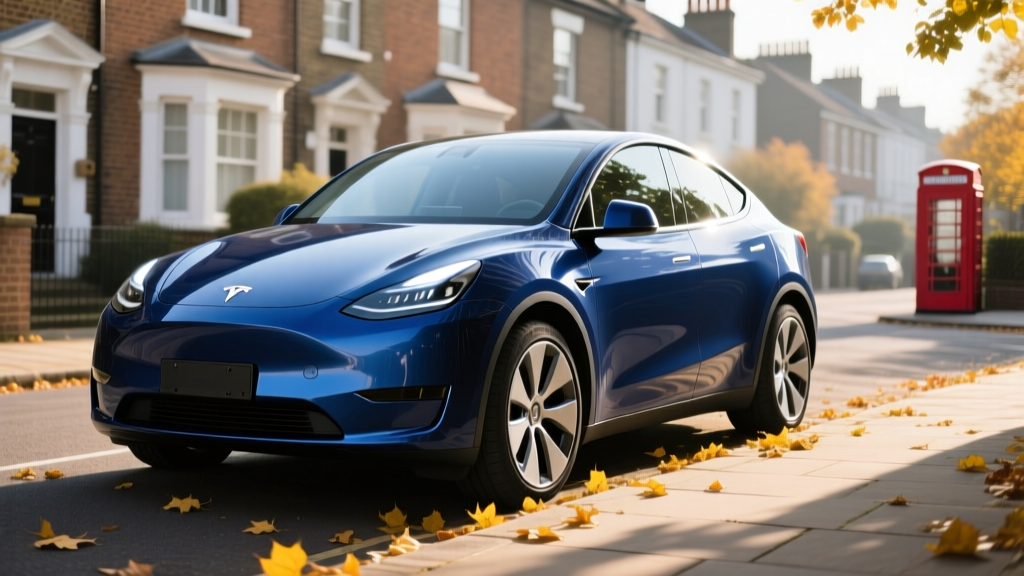
The headlines are hard to ignore. Across the Atlantic, the Tesla UK sales slump has dominated automotive news cycles, with registration data showing steep year-over-year declines as rivals like the MG4, Hyundai Ioniq 5, and BMW iX3 capture market share. But for US-based EV shoppers, the real question isn't what's happening in Britain — it's whether the refreshed 2026 Tesla Model Y Long Range AWD, the vehicle Tesla is banking on to reverse that slide globally, still holds up as the default electric crossover in America.
After spending time with the 2026 Model Y Long Range AWD and cross-referencing its specs against EPA data on fueleconomy.gov, here's the full picture: range, charging, pricing, tax credit eligibility, and whether this is still the EV to beat — or whether the competition has finally caught up.
2026 Tesla Model Y Long Range AWD: Spec Snapshot
| Specification | 2026 Model Y Long Range AWD |
|---|---|
| EPA Range | 320 miles |
| Battery Capacity (usable) | 78.1 kWh (NMC) |
| Drivetrain | Dual-Motor AWD |
| Horsepower | 384 hp (combined) |
| 0–60 mph | 4.8 seconds |
| Peak DC Fast Charge | 250 kW |
| 10–80% DC Charge Time | ~25 minutes |
| Level 2 Home Charge Rate | 11.5 kW (~44 mi/hr) |
| MPGe (combined) | 111 MPGe |
| Efficiency | 30 kWh/100 mi |
| Cargo Volume (rear seats up) | 30.2 cu ft |
| Cargo Volume (rear seats folded) | 72.0 cu ft |
| Rear Legroom | 40.5 in |
| Battery Warranty | 8 years / 120,000 miles |
| Base MSRP | $48,630 (before incentives) |
Range and Efficiency: EPA Sticker vs. Real-World Driving
The 2026 Model Y Long Range AWD carries an EPA-estimated 320 miles of range. That's a slight bump from the pre-refresh generation, aided by improved aerodynamics (a reshaped front fascia, revised underbody panels, and a slightly lower roofline) and a more efficient heat pump system that reduces HVAC energy draw.
The NMC (nickel manganese cobalt) battery chemistry in the Long Range variant provides higher energy density than the LFP (lithium iron phosphate) cells found in the base RWD model. That means more range in a similar physical package, though NMC cells benefit from being kept between 20–80% state of charge for daily use to maximize long-term longevity. Tesla's battery management system (BMS) handles most of this automatically, but owners should still avoid routinely charging to 100% unless a long trip demands it.
Efficiency lands at 30 kWh per 100 miles (combined), translating to 111 MPGe. That's competitive with the Hyundai Ioniq 5 (114 MPGe combined) and slightly behind the Kia EV6 (117 MPGe), but ahead of the Ford Mustang Mach-E Extended Range AWD (101 MPGe). In practical terms, you're spending roughly $0.04–$0.06 per mile on electricity at national average residential rates — versus $0.12–$0.15/mile in a comparable gas crossover at $3.50/gallon.
Charging Speed: DC Fast Charging and Home Setup
Tesla's Supercharger network remains the gold standard for public charging reliability, and the 2026 Model Y Long Range takes full advantage of it.
| Charging Level | Power | Speed (Miles Added/Hour) | Notes |
|---|---|---|---|
| Level 1 (120V household) | ~1.4 kW | ~5 mi/hr | Emergency/trickle only |
| Level 2 (240V home wall connector) | 11.5 kW | ~44 mi/hr | Full charge in ~7 hours |
| DC Fast Charge (Tesla Supercharger V3/V4) | 250 kW peak | ~1,000+ mi/hr (peak) | 10–80% in ~25 min |
| DC Fast Charge (CCS adapter, Electrify America, etc.) | Up to 250 kW | Varies by station | CCS adapter included |
The 250 kW peak charge rate is strong, but it's important to understand the charge curve. The Model Y Long Range sustains its peak rate only between roughly 10–30% state of charge. From 30–60%, it tapers to approximately 150–175 kW, and from 60–80%, it drops further to around 80–100 kW. This is why the 10–80% time is approximately 25 minutes — not the ~15 minutes you might calculate from the peak number alone.
For home charging, Tesla's Wall Connector on a 60-amp circuit delivers 11.5 kW (48 amps continuous), adding about 44 miles of range per hour. A full overnight charge from 10% to 90% takes roughly 7 hours. Installation costs vary widely: expect $500–$1,500 if your electrical panel has capacity, or $2,000–$4,000+ if a panel upgrade (to 200A service) is needed. Always get a quote from a licensed electrician before committing.
One notable advantage: since Tesla opened its Supercharger network to non-Tesla EVs (via the NACS standard now adopted by Ford, GM, Rivian, and others), the competitive moat that once exclusively benefited Tesla owners has narrowed. You still get seamless plug-and-charge integration and the best network uptime, but the exclusivity factor has diminished.
Performance and Driving Dynamics
The dual-motor AWD powertrain produces 384 combined horsepower and rockets the Model Y Long Range to 60 mph in 4.8 seconds. That's genuinely quick for a family crossover and noticeably faster than most competitors in this price bracket (the Ioniq 5 Long Range AWD does it in 5.1 seconds; the Mach-E Extended Range AWD in 5.5 seconds).
Ride quality has improved with the Juniper refresh. Tesla retuned the suspension with softer damping and added acoustic glass to reduce road noise — addressing two of the most common complaints from prior Model Y owners. The result is a more composed, quieter highway cruiser that still handles confidently through corners thanks to the low center of gravity inherent to its skateboard battery architecture.
Regenerative braking remains strong and predictable, enabling genuine one-pedal driving in most conditions. The steering is quick and precise, though some drivers may find it artificially light in Comfort mode. Overall, the driving experience has matured from "fast but raw" to "fast and refined."
Interior, Cargo, and Technology
The 2026 Model Y interior is cleaner and more premium than any previous Tesla. The Juniper update brought ventilated front seats (finally), ambient lighting, a rear-seat touchscreen for climate and media control, improved materials (soft-touch surfaces replacing the hard plastics Tesla was criticized for), and a power-folding second row.
Cargo space is generous: 30.2 cubic feet behind the second row and 72.0 cubic feet with the rear seats folded. The front trunk (frunk) adds another 4.1 cubic feet for charging cables or a small bag. Rear legroom measures 40.5 inches — adequate for adults on longer trips, though the sloping roofline cuts into headroom for passengers over 6 feet tall.
The 15.4-inch center touchscreen runs Tesla's proprietary infotainment system, which remains fast and feature-rich but still lacks native Apple CarPlay and Android Auto. Navigation, media, and vehicle controls all route through the screen — there are virtually no physical buttons. This minimalist approach is polarizing: tech-forward buyers love it; traditionalists find it distracting. The new rear 8-inch screen is a welcome addition for family duty.
Driver assistance comes via Tesla Autopilot (standard) and the optional Full Self-Driving (Supervised) package at $8,000 (or $99/month subscription).
Pricing, Tax Credits, and Total Cost
| Trim | MSRP | Est. Federal Credit (§30D) | Effective Price |
|---|---|---|---|
| Model Y Long Range AWD | $48,630 | Up to $7,500* | ~$41,130* |
| Model Y Performance AWD | $52,630 | Up to $7,500* | ~$45,130* |
*Federal tax credit eligibility under IRS §30D depends on several factors that change frequently:
- MSRP cap: SUVs/crossovers must be priced at or below $80,000 (Model Y qualifies).
- Buyer income cap: Modified AGI must not exceed $150,000 (single), $225,000 (head of household), or $300,000 (joint filers).
- Battery sourcing requirements: Critical minerals and battery components must meet phased-in percentage thresholds from US or FTA-partner countries. Tesla's shifting supply chain means eligibility can change month to month — always verify current status on the IRS clean vehicle credit page or with your tax professional before purchasing.
- Point-of-sale transfer: As of 2024, qualifying buyers can transfer the credit to the dealer at purchase, reducing the upfront price rather than waiting for a tax refund.
For the 2026 Model Y Long Range AWD, the effective price after the maximum federal credit lands around $41,130 — putting it squarely in competition with the Hyundai Ioniq 5 SEL AWD (~$49,500 MSRP, ~$42,000 after credit) and the Kia EV6 Wind AWD (~$50,500 MSRP, ~$43,000 after credit). Add state incentives (which vary by jurisdiction — check your local DMV or energy office) and the deal improves further in states like California, Colorado, and Massachusetts.
Pros, Cons, and Who Should Buy
Pros
- 320-mile EPA range is among the best in the segment
- Access to Tesla Supercharger network (most reliable public charging in the US)
- 4.8-second 0–60 with dual-motor AWD
- Strong cargo capacity (72 cu ft max) and practical frunk
- Over-the-air updates continuously add features
- Improved ride quality and cabin quietness post-refresh
- Strong resale value relative to most EV competitors
Cons
- No Apple CarPlay or Android Auto
- FSD (Supervised) is expensive ($8,000) and still Level 2 only
- Touchscreen-only controls can be distracting while driving
- NMC battery requires more careful SoC management than LFP
- Insurance premiums tend to run 15–25% higher than comparable gas crossovers
- Tesla's brand perception has become polarizing, affecting resale in some markets
- Competition has caught up significantly in range, charging, and build quality
Who This EV Suits Best
Choose the 2026 Model Y Long Range AWD if: You take regular road trips and value the Supercharger network's reliability, you want strong performance with family practicality, you're comfortable with a touchscreen-centric interface, and you qualify for the federal tax credit.
Look at competitors if: You need Apple CarPlay/Android Auto (Ioniq 5, EV6), you want hands-free highway driving on mapped routes (GM Super Cruise in the Cadillac Lyriq or Chevy Equinox EV), you prefer a more traditional interior with physical controls, or you want an LFP battery for worry-free daily 100% charging (base Model Y RWD or standard-range rivals).
The UK Sales Slump Context: What It Means for US Buyers
The Tesla UK sales slump — driven by rising competition from Chinese and Korean automakers, brand fatigue, and shifting political perceptions of Tesla's CEO — is a useful signal but not a direct predictor of US market performance. The UK market is smaller, more price-sensitive, and has different incentive structures. However, it does highlight a broader trend: Tesla no longer competes in a vacuum.
For US buyers, this means two things. First, Tesla is under pressure to offer more value — the Juniper refresh is a direct response, with better build quality, more standard features, and competitive pricing. Second, you have more credible alternatives than ever before. The Hyundai Ioniq 5, Kia EV6, Ford Mustang Mach-E, and Chevrolet Equinox EV are all legitimate competitors with strong range, fast charging, and improving reliability records.
The Model Y remains a strong product on its merits — not because it's the only option. If it fits your needs and budget, it's still a compelling choice. But the era of buying a Tesla simply because nothing else compared is over.
Warranty and Long-Term Ownership
Tesla covers the Model Y's battery and drive units for 8 years or 120,000 miles (whichever comes first), with a guaranteed minimum 70% capacity retention over that period. The basic vehicle warranty is 4 years / 50,000 miles.
Real-world data from high-mileage Tesla owners suggests NMC batteries in the Model Y typically retain 85–92% capacity at 100,000 miles when charged responsibly (avoiding frequent 100% charges, using preconditioning for fast charging). Battery replacement outside of warranty currently runs approximately $12,000–$16,000 for the Long Range pack — a figure worth factoring into long-term ownership plans if you intend to keep the vehicle past the warranty period.
For the latest safety ratings, the Model Y earned a 5-star overall rating from NHTSA and was named an IIHS Top Safety Pick+ when equipped with acceptable headlights.
Frequently Asked Questions
What is the real-world range of the 2026 Tesla Model Y Long Range?
The EPA rates it at 320 miles. In real-world highway driving at moderate temperatures, expect 275–290 miles. In cold weather (below 30°F), plan for 230–255 miles. City driving with regenerative braking can reach or slightly exceed the EPA estimate.
How fast does the Model Y Long Range charge?
On a Tesla Supercharger V3/V4, it peaks at 250 kW and charges from 10–80% in approximately 25 minutes. At home on a Level 2 Wall Connector (11.5 kW), it adds about 44 miles per hour, fully charging overnight in roughly 7 hours.
How much does the 2026 Model Y cost after tax credits?
The Long Range AWD starts at $48,630. If you qualify for the full $7,500 federal tax credit under IRS §30D (subject to income, MSRP, and battery-sourcing rules), the effective price drops to approximately $41,130. State incentives may reduce it further.
Does the Tesla Model Y qualify for the $7,500 federal EV tax credit?
It can, but eligibility is not guaranteed. The MSRP is under the $80,000 SUV cap, but you must also meet income limits ($150K single / $300K joint) and the vehicle's battery components and critical minerals must meet current-year sourcing thresholds. These requirements phase in over time and can change. Verify current eligibility on IRS.gov or with a tax professional before purchasing.
Is the Model Y still worth buying vs. the Ioniq 5 or EV6?
It depends on priorities. The Model Y wins on Supercharger access, cargo space, and software integration. The Ioniq 5 and EV6 offer faster peak charging (up to 350 kW on 800V architecture), Apple CarPlay/Android Auto, and more distinctive interior designs. All three are strong — test-drive each before deciding.
Is Tesla's FSD actually self-driving?
No. FSD (Supervised) is an SAE Level 2 driver-assistance system. It can handle many highway and some city driving scenarios, but it requires constant driver supervision, makes errors, and does not replace an attentive human driver. Only Level 4 services like Waymo operate without a human driver, and those are limited to specific geofenced areas.