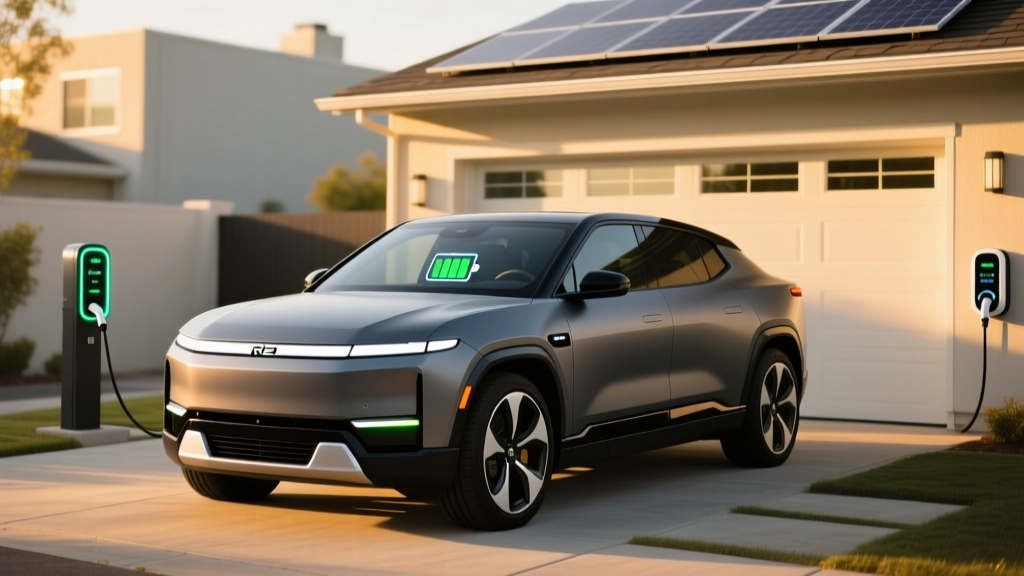
Rivian's smallest SUV has arrived with its most aggressive pricing yet. The R3X — the performance-oriented variant of the R3 platform — slots below the R1S and R1T in the lineup but inherits the Georgia-built automaker's torque-vectoring AWD architecture and rugged design language. If you've been searching for the Rivian R3X cost of ownership, this review breaks down every dollar: MSRP by trim, realistic tax credit scenarios, charging expenses, and five-year running costs against the compact electric SUV competition.
2026 Rivian R3X Pricing and Trim Breakdown
Rivian structures the R3X in two core trims for the 2026 model year, both featuring dual-motor AWD as standard. Unlike the R1 line's quad-motor option, the R3X uses a refined dual-motor setup optimized for efficiency and daily usability while still delivering serious power.
| Trim | Battery | Drivetrain | MSRP | Est. After §30D Credit |
|---|---|---|---|---|
| R3X Standard | 75 kWh (LFP) | Dual-Motor AWD | $44,900 | $37,400* |
| R3X Performance | 90 kWh (NMC) | Dual-Motor AWD | $54,900 | $47,400* |
*Estimated price assumes full $7,500 federal tax credit under IRS §30D. Eligibility depends on buyer income, MSRP caps, and battery component/critical mineral sourcing. See IRS guidelines for current requirements.
Does the Rivian R3X Qualify for the Federal EV Tax Credit?
This is the question driving most R3X cost searches, and the answer requires understanding three interlocking rules under IRS §30D:
- MSRP Cap: SUVs must have an MSRP at or below $80,000. Both R3X trims clear this threshold comfortably.
- Income Cap: Modified adjusted gross income (MAGI) must not exceed $150,000 (single), $225,000 (head of household), or $300,000 (joint filing).
- Battery Sourcing: The $7,500 credit splits into two halves — $3,750 for critical minerals and $3,750 for battery components. Sourcing requirements tighten annually, and Rivian's LFP Standard pack and NMC Performance pack face different compliance paths.
Range, Battery, and Efficiency: What to Expect in the Real World
Rivian offers two battery configurations for the R3X, and the chemistry choice significantly impacts both range and long-term ownership economics.
| Spec | R3X Standard (LFP) | R3X Performance (NMC) |
|---|---|---|
| Battery Capacity (usable) | 75 kWh | 90 kWh |
| Chemistry | LFP (Lithium Iron Phosphate) | NMC (Nickel Manganese Cobalt) |
| EPA Est. Range | 278 miles | 330 miles |
| Efficiency (combined) | 112 MPGe / 30 kWh/100mi | 118 MPGe / 27 kWh/100mi |
| Cycle Life Advantage | ~3,000+ cycles to 80% SoH | ~1,500 cycles to 80% SoH |
R3X Standard (278 mi EPA): Expect 240–255 miles in mixed highway/city driving at moderate temperatures. Sustained 75+ mph highway runs drop this to roughly 220–235 miles. In sub-30°F winter conditions without preconditioning, plan for 190–210 miles.
R3X Performance (330 mi EPA): Real-world mixed driving yields approximately 285–305 miles. Highway-heavy trips at 75+ mph net around 260–280 miles. Cold-weather range with heat pump engaged (standard on Performance) sits around 235–260 miles.
The LFP chemistry in the Standard trim sacrifices about 52 miles of EPA range compared to the Performance's NMC pack, but LFP offers a meaningful trade-off: far superior cycle life, the ability to charge routinely to 100% without degradation concern, and lower sensitivity to heat. For daily commuters who charge at home overnight and rarely road-trip beyond 200 miles, the LFP Standard is arguably the smarter long-term ownership play despite the shorter range sticker.
Charging Speed: DC Fast Charging and Home Level 2
Rivian equips the R3X with a native NACS (North American Charging Standard) port, granting direct access to Tesla's Supercharger network without an adapter — a significant practical advantage over CCS-only competitors in 2026.
| Charging Level | R3X Standard (75 kWh) | R3X Performance (90 kWh) |
|---|---|---|
| Level 1 (120V, 12A) | ~1.4 kW / 4 mi/hr | ~1.4 kW / 4 mi/hr |
| Level 2 (240V, 48A) | 11.5 kW / 33 mi/hr | 11.5 kW / 33 mi/hr |
| DC Fast Charge (peak) | 190 kW | 220 kW |
| 10–80% DCFC Time | ~28 minutes | ~25 minutes |
| Full Level 2 Charge (0–100%) | ~7 hours | ~8.5 hours |
Charging curve reality: The peak kW figures above represent the maximum rate achieved roughly between 10–40% State of Charge (SoC). Above 60%, charge speed tapers significantly — expect roughly 80–100 kW between 60–80%, and a steep drop to under 40 kW above 85%. This is standard lithium-ion behavior, but it means that 10–80% time is a more honest metric than peak kW alone. On a 250 kW V3 Supercharger, the R3X Performance will sustain close to its 220 kW peak in ideal thermal conditions (battery preconditioned, 65–85°F ambient), but at a cold-soaked 30°F battery without preconditioning, peak rates may drop to 120–140 kW initially.
For home charging, the 11.5 kW onboard charger is competitive for the segment. A full overnight charge on a 48A Level 2 circuit adds roughly 33 miles of range per hour of charging — enough to fully replenish either battery pack during a standard 8-hour sleep cycle.
Performance and Drivetrain
| Spec | R3X Standard | R3X Performance |
|---|---|---|
| Horsepower | 402 hp | 508 hp |
| Torque | 450 lb-ft | 580 lb-ft |
| 0–60 mph | 4.5 seconds | 3.6 seconds |
| Drivetrain | Dual-Motor AWD | Dual-Motor AWD w/ torque vectoring |
| Ground Clearance | 8.3 inches | 8.3 inches |
| Towing Capacity | 3,500 lbs | 3,500 lbs |
The R3X Performance's 3.6-second 0-60 time puts it in the territory of Porsche's Macan EV and well ahead of the Volvo EX40. Rivian's dual-motor torque-vectoring system can independently modulate torque to each rear wheel, providing genuine off-road traction management rather than the brake-based torque vectoring used by many competitors. This matters if you plan to take the R3X on forest service roads or light trail use — an area where Rivian's adventure branding isn't just marketing.
Interior Space, Cargo, and Technology
The R3X is a compact SUV, and buyers should calibrate expectations accordingly. It's designed for couples, small families, and solo adventurers — not three-row hauling.
- Cargo volume (behind rear seats): 25.4 cu ft
- Cargo volume (rear seats folded): 58.2 cu ft
- Front trunk (frunk): 7.1 cu ft — lockable, drainable, useful for wet gear or charging cables
- Rear legroom: 37.8 inches
- Front headroom: 40.6 inches
The frunk is a genuine differentiator in this segment. Most compact electric SUVs have eliminated the front trunk entirely or reduced it to a token cable-storage bin. Rivian's 7.1 cu ft drainable frunk is practical for muddy hiking boots, wet rain gear, or groceries that you want to keep separated from the main cabin.
Infotainment and tech: The R3X runs Rivian's latest software stack on a 15.6-inch center display. Wireless Apple CarPlay and Android Auto are standard. The digital instrument cluster is a 12.3-inch display with configurable drive-mode layouts. Over-the-air updates continue to add features post-purchase, consistent with Rivian's approach on the R1 platform.
Driver assistance: Rivian's Driver+ system is a SAE Level 2 driver-assist suite — it provides adaptive cruise control, lane-centering, and automatic lane changes on divided highways. The driver must remain attentive and keep hands on or near the steering wheel at all times. This is not a self-driving system, and Rivian does not market it as one.
Warranty and Long-Term Ownership
| Coverage | Term |
|---|---|
| Basic Vehicle Warranty | 5 years / 60,000 miles |
| Battery & Drive Unit | 8 years / 100,000 miles (70% capacity retention minimum) |
| Roadside Assistance | 5 years / 60,000 miles |
| Corrosion Perforation | 5 years / unlimited miles |
The 8-year/100,000-mile battery warranty with a 70% capacity retention floor meets the industry standard set by most EV manufacturers and aligns with federal requirements for battery warranty disclosure. For the LFP-equipped Standard trim, real-world degradation data from similar LFP packs in the market suggests capacity loss of roughly 5–8% over the first 100,000 miles, making a warranty claim unlikely. NMC packs in the Performance trim typically show 8–12% degradation over the same interval, still well within the 70% threshold.
Rivian R3X vs. Competitors: Cost and Capability Comparison
| Vehicle | Starting MSRP | EPA Range | DCFC Peak | 0–60 mph | AWD? |
|---|---|---|---|---|---|
| Rivian R3X Std | $44,900 | 278 mi | 190 kW | 4.5s | Standard |
| Rivian R3X Perf | $54,900 | 330 mi | 220 kW | 3.6s | Standard |
| Volvo EX40 Twin Motor | $53,550 | 293 mi | 200 kW | 4.6s | Standard |
| Hyundai Ioniq 5 AWD | $49,600 | 290 mi | 240 kW | 5.1s | Optional |
| Tesla Model Y LR AWD | $47,990 | 320 mi | 250 kW | 4.8s | Standard |
| BMW iX xDrive45 | $69,900 | 312 mi | 205 kW | 4.9s | Standard |
The R3X Standard undercuts nearly every AWD competitor on price while offering a unique combination of standard AWD, a usable frunk, and genuine ground clearance. The Tesla Model Y Long Range remains the efficiency and charging-speed benchmark, but the R3X differentiates on build quality, off-road capability, and interior material quality. The R3X Performance competes directly with the Volvo EX40 and BMW iX on acceleration, while coming in thousands below the BMW.
Pros
- Standard dual-motor AWD on every trim
- Native NACS port — no adapter for Superchargers
- Class-leading ground clearance (8.3 in) for off-road use
- LFP option offers superior long-term cycle life
- Functional drainable frunk (7.1 cu ft)
- 3,500-lb towing capacity in a compact package
- Sub-$45,000 starting price for AWD EV SUV
Cons
- DCFC speed (190–220 kW) trails Hyundai's 800V architecture
- Compact rear cargo area vs. Model Y (25.4 vs 30.2 cu ft)
- Rivian service center network still expanding in rural areas
- No third-row or large-family seating option
- Performance trim pushes past $55K before options
- Driver+ system is solid but not class-leading in refinement
Who Should Buy the Rivian R3X?
Choose the R3X Standard ($44,900) if:
- You commute under 60 miles round-trip and charge at home nightly
- You want the lowest entry cost with AWD and don't need 300+ mile range
- Long-term battery longevity matters more to you than maximum range
- You regularly charge to 100% (LFP tolerates this without degradation penalty)
Choose the R3X Performance ($54,900) if:
- You take regular road trips exceeding 250 miles and want range buffer
- You want sub-4-second acceleration and sportier driving dynamics
- You live in a cold climate where the NMC pack's heat-pairing optimization matters
- You value the additional 52 miles of EPA range as insurance against charging-desert gaps
Look elsewhere if:
- You need maximum cargo space or three rows (consider the R1S or Kia EV9)
- Fastest possible DC charging is your top priority (Hyundai Ioniq 5's 800V architecture charges 10-80% in ~18 min)
- You live far from a Rivian service center and cannot tolerate mobile-service-only coverage
Frequently Asked Questions
What is the real-world range of the Rivian R3X?
The R3X Standard delivers approximately 240–255 miles in mixed driving, dropping to 220–235 on sustained highway runs and 190–210 in cold weather below 30°F. The R3X Performance returns roughly 285–305 miles mixed, 260–280 highway, and 235–260 in cold conditions. These figures assume moderate climate control use and a battery preconditioned for the drive.
How fast does the R3X charge at home and on the road?
On a 48A Level 2 home charger (240V), the R3X adds approximately 33 miles of range per hour, fully charging either pack overnight. On DC fast charging, the Standard peaks at 190 kW (10-80% in ~28 minutes) and the Performance peaks at 220 kW (10-80% in ~25 minutes) under optimal thermal conditions. Both use the native NACS connector for direct Tesla Supercharger access.
How much does the Rivian R3X cost after tax credits?
If you qualify for the full $7,500 federal tax credit under IRS §30D, the R3X Standard drops to an effective $37,400 and the R3X Performance to $47,400. Eligibility requires meeting income caps ($150K single / $300K joint), the $80K SUV MSRP cap (both trims qualify), and battery sourcing requirements that vary by model year. State incentives may stack on top — check your state's energy office for local programs.
Is the Rivian R3X worth buying over the Tesla Model Y?
The Model Y Long Range AWD ($47,990) still leads on DC charging speed (250 kW), efficiency, and Supercharger network maturity. The R3X wins on ground clearance, frunk utility, build material quality, off-road capability, and starting price for the Standard trim. If you prioritize adventure utility and interior quality over absolute charging speed, the R3X is a compelling alternative. If charging speed and efficiency are paramount, the Model Y remains the benchmark.
Does the R3X qualify for the federal EV tax credit?
Both trims fall under the $80,000 SUV MSRP cap for §30D eligibility. Whether you receive the full $7,500, a partial $3,750, or nothing depends on your income, the current-year battery sourcing compliance of the specific pack chemistry, and your tax filing status. Rivian publishes sourcing disclosures on its website, and the IRS maintains a qualified vehicles list at fueleconomy.gov. Verify eligibility before purchase, as sourcing compliance can change with model year production batches.
What is Rivian's service and support network like?
As of 2026, Rivian operates over 50 service centers across the U.S., concentrated in major metro areas, supplemented by a mobile service fleet that handles many routine repairs at your location. Coverage in rural and Mountain West areas remains thinner than legacy automaker dealer networks. Before ordering, check Rivian's service locator for your area and assess whether mobile-only coverage meets your comfort level.