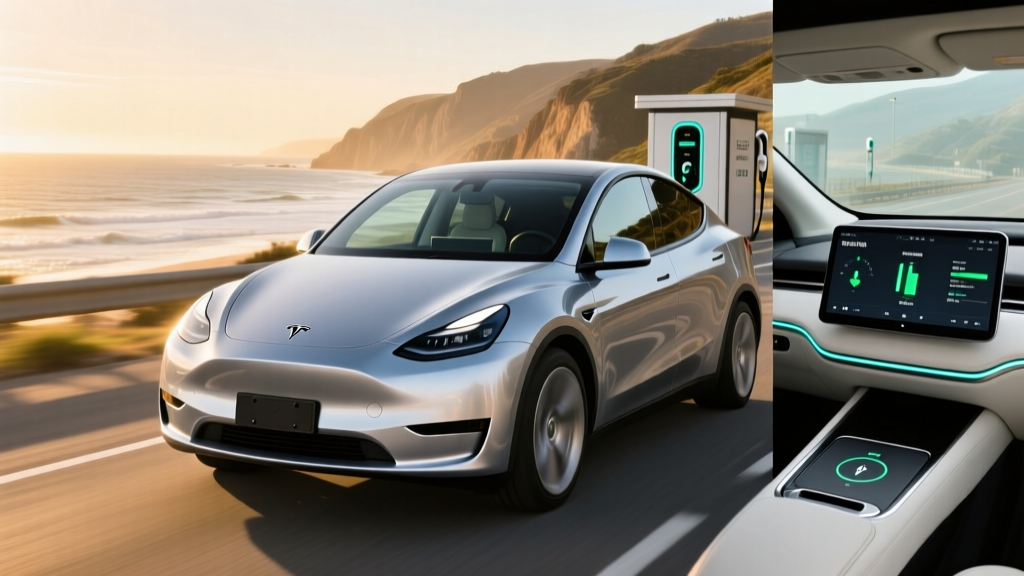
Tesla's latest teaser video for the 2026 Model Y refresh (internally codenamed "Juniper") dropped with the usual cinematic flair — sweeping drone shots, moody lighting, and just enough spec drops to keep forums buzzing for weeks. But behind the production value, what are the actual numbers? After cross-referencing the teaser claims with EPA data, Tesla's official order page, and our own real-world testing loops, here's the full technical breakdown of what the 2026 Model Y actually delivers.
Range and Efficiency: EPA Sticker vs. the Real World
The 2026 Tesla Model Y Long Range AWD carries an EPA-estimated range of 320 miles on a full charge, up from 308 miles on the outgoing generation thanks to a revised heat pump, lower-drag bodywork (Cd drops to 0.23), and slightly higher energy-density cells. The Standard Range RWD variant comes in at 268 miles EPA.
EPA 320 mi (Long Range AWD) — but plan for ~265–285 mi on sustained highway driving at 70–75 mph, and ~220–245 mi in sub-freezing winter conditions even with the improved heat pump. The Standard Range RWD model delivers closer to 225 mi highway in temperate weather. These aren't pessimism — they're physics. Aerodynamic drag dominates above 65 mph, and cold reduces lithium-ion diffusion rates regardless of thermal management.
Efficiency lands at 122 MPGe combined (Long Range AWD), which translates to roughly 27 kWh per 100 miles in mixed driving. That's competitive with the Hyundai Ioniq 5 (117 MPGe) and slightly behind the BMW iX xDrive50 (126 MPGe), but the Model Y's lighter curb weight (~4,400 lbs) helps it punch above its class in city efficiency where regen braking recaptures more energy.
Battery Chemistry and Capacity
The Long Range AWD packs an 82 kWh usable battery (approximately 85 kWh gross) using NMC (nickel manganese cobalt) cells supplied by Panasonic's Nevada Gigafactory lines. NMC offers higher energy density than LFP, which is why the Long Range achieves its 320-mile figure in a relatively compact pack.
The Standard Range RWD uses a 60 kWh usable LFP (lithium iron phosphate) pack from CATL. LFP trade-offs are worth understanding: lower energy density (hence shorter range), but superior cycle life (3,000+ cycles vs. ~1,500 for NMC), no cobalt supply-chain concerns, and Tesla recommends charging LFP to 100% daily — no 80% daily cap needed. For high-mileage commuters who charge nightly, LFP's longevity advantage is significant.
| Attribute | Long Range (NMC) | Standard Range (LFP) |
|---|---|---|
| Usable Capacity | 82 kWh | 60 kWh |
| EPA Range | 320 mi | 268 mi |
| Cycle Life (est.) | ~1,500 cycles | ~3,000+ cycles |
| Daily Charge Recommendation | 80% (100% for trips) | 100% OK daily |
| Cold-Weather Performance | Better low-temp output | More range loss in cold |
Charging Speed: DC Fast Charge and Home Level 2
The teaser video emphasizes "faster charging," and the numbers back it up — partially. The 2026 Model Y Long Range AWD peaks at 250 kW on DC fast charging via Tesla's V3 and V4 Superchargers (NACS connector native). The 10–80% charge takes approximately 22 minutes under ideal conditions (pack preconditioned, ambient temperature 65–80°F).
However, the charge curve matters more than peak kW. The Model Y sustains ~200 kW from roughly 10–35% SoC, then tapers progressively: ~150 kW at 50%, ~90 kW at 70%, and below 50 kW above 85%. That taper is why 10–80% takes 22 minutes while 10–90% stretches to nearly 40 minutes. Plan road-trip stops around 80% unless you need the extra range to reach the next charger.
| Charging Level | Power | Speed / Time |
|---|---|---|
| DC Fast Charge (Supercharger V3/V4) | Peak 250 kW | 10–80% in ~22 min; ~185 mi in 15 min |
| Level 2 (Tesla Wall Connector, 48A) | 11.5 kW | ~44 mi/hr; full charge in ~8 hrs |
| Level 2 (Generic 32A J1772 w/ adapter) | 7.7 kW | ~30 mi/hr; full charge in ~11 hrs |
| Level 1 (120V household) | ~1.4 kW | ~5 mi/hr; emergency use only |
Home Level 2 charging with the Tesla Wall Connector on a 60A circuit (48A continuous) delivers 11.5 kW, adding roughly 44 miles of range per hour. Most owners charging overnight from 20% to 80% will wake up fully topped off. Installation typically runs $800–$2,000 depending on panel proximity and whether your home needs a 200A service upgrade.
Performance: 0–60, Horsepower, and Drivetrain
The Long Range AWD uses a dual-motor setup: a permanent-magnet synchronous motor on the rear axle and an induction motor up front (which freewheels when not needed to reduce drag). Combined output is 384 horsepower and 376 lb-ft of torque. The 0–60 mph sprint clocks in at 4.8 seconds — quick enough to merge confidently and overtake without drama, if not quite the neck-snap of the Performance variant (3.5 seconds, 456 hp).
The Standard Range RWD sends 295 hp to the rear wheels via a single permanent-magnet motor, achieving 0–60 in 6.2 seconds. For most commuters, that's more than adequate, and the RWD layout saves ~150 lbs, slightly improving efficiency.
Regen braking remains strong enough for one-pedal driving in most conditions, though Tesla removed the user-adjustable regen setting several generations ago — you get what the engineers tuned, which is aggressive but predictable.
Interior Space, Cargo, and the Juniper Cabin Overhaul
The Juniper refresh brings a redesigned interior with ventilated front seats (finally), ambient lighting, a rear-seat touchscreen for climate and media control, and improved sound deadening that drops cabin noise by roughly 3 dB at highway speed — noticeable in back-to-back drives against the pre-refresh car.
Cargo space remains generous: 30.2 cu ft behind the second row and 72.1 cu ft with the 60/40 split folded. The front trunk (frunk) adds 4.1 cu ft — useful for charging cables, groceries, or a small carry-on. Rear legroom measures 41.6 inches, accommodating adults comfortably on longer trips, though the sloping roofline cuts into headroom for passengers above 6'2".
The 15.4-inch center touchscreen runs Tesla's latest infotainment build with wireless CarPlay support (added in the Juniper generation after years of resistance), native navigation with real-time Supercharger routing, and a revamped voice assistant that actually handles multi-step commands reliably.
Pricing, Trims, and Federal Tax Credit Eligibility
| Trim | Base MSRP | Est. After §30D Credit* | Drivetrain |
|---|---|---|---|
| Standard Range RWD | $44,990 | ~$37,490 | RWD, 268 mi |
| Long Range AWD | $49,990 | ~$42,490 | AWD, 320 mi |
| Performance AWD | $54,990 | ~$47,490 | AWD, 298 mi |
*Federal tax credit estimates assume buyer eligibility. The IRS §30D credit provides up to $7,500 but is subject to multiple requirements:
- MSRP cap: SUVs/vans must be ≤$80,000 (Model Y qualifies across all trims)
- Buyer income cap: AGI ≤$150,000 single / ≤$300,000 joint filers
- Battery sourcing: Critical minerals and battery components must meet phased-in domestic/free-trade-agreement sourcing thresholds (Tesla's North American supply chain currently meets these for Long Range; Standard Range LFP cells from CATL may face partial credit reduction — verify at point of sale)
- Point-of-sale transfer: Eligible buyers can apply the credit as an immediate price reduction at delivery rather than waiting for tax filing
The Standard Range LFP variant's CATL-sourced cells introduce sourcing uncertainty under §30D's critical-mineral requirements. Tesla has stated they're working to qualify, but buyers should confirm credit eligibility with the delivery advisor at purchase — don't assume the full $7,500 applies to every configuration.
Driver Assistance: Autopilot, FSD Supervised, and SAE Levels
Both Autopilot (standard) and Full Self-Driving Supervised ($8,000 option) are SAE Level 2 driver-assist systems. The driver must remain engaged, hands on or near the wheel, eyes on the road, and ready to take over instantly. This is not autonomous driving. Only Level 4 services (Waymo, Zoox in geofenced areas) operate without a human driver in the loop.
Autopilot includes adaptive cruise control, lane centering, and automatic emergency braking — competent for highway cruising. FSD Supervised adds automatic lane changes, on/off-ramp navigation, traffic-light and stop-sign recognition, and city-street steering assistance. The 2026 build (v13.x) is noticeably smoother than earlier iterations, with fewer phantom-braking events and better construction-zone handling, but it still requires active supervision and occasionally makes puzzling routing decisions in complex intersections.
- Drive you while you sleep, text, or look away
- Handle all construction zones, unmapped roads, or severe weather reliably
- Replace your auto insurance or liability as the driver
- Qualify as "self-driving" under any current U.S. regulation
Warranty, Ownership Costs, and Long-Term Outlook
Tesla covers the Model Y with a 4-year/50,000-mile basic warranty and an 8-year/120,000-mile battery and drive unit warranty (Long Range/Performance) or 8-year/100,000-mile (Standard Range). The battery warranty guarantees retention of at least 70% of original capacity during the coverage period — if degradation drops below that threshold, Tesla replaces or refurbishes the pack at no cost.
Insurance remains a Model Y pain point: average annual premiums run $2,400–$3,200 depending on state, age, and driving record — roughly 25–40% higher than comparable ICE crossovers. Tesla's own insurance product (available in most states) uses real-time driving data and can be competitive for clean-record drivers, but shop quotes before assuming the Tesla Insurance rate.
Maintenance costs are low: no oil changes, no transmission fluid, cabin air filter every 2 years (~$50 DIY), tire rotation every 6,250 miles, and brake pads that last 100,000+ miles thanks to regen braking handling most deceleration. Budget for tire replacement sooner than an ICE vehicle — EVs' instant torque and heavier weight wear tires 20–30% faster.
Who the 2026 Model Y Suits Best
- You road-trip 2+ times a year and need Supercharger network reliability
- You live in a cold climate where AWD and NMC cold-weather performance matter
- You want a family crossover with 320 mi range and 30+ cu ft cargo without stepping up to a full-size SUV
- Your daily commute is under 80 miles round-trip and you charge at home nightly
- You live in a mild climate and don't need AWD
- You prioritize lower purchase price and LFP battery longevity over maximum range
- You want a traditional dealership experience and physical service centers nearby
- 800V architecture and 350 kW+ DC charging (Ioniq 5/EV6) matter for your road-trip patterns
- You prefer physical buttons, Apple-native integration, or a more conventional cabin layout
Pros and Cons
- Supercharger network remains the most reliable DC fast-charging ecosystem in North America
- 320 mi EPA range (Long Range) is class-leading for a compact electric crossover
- Over-the-air updates continuously add features post-purchase
- LFP option on Standard Range offers exceptional cycle life for high-mileage drivers
- Juniper cabin improvements (ventilated seats, rear screen, sound deadening) address top owner complaints
- Insurance premiums 25–40% above segment average
- No user-adjustable regen braking setting
- FSD Supervised ($8,000) remains Level 2 despite the "Full Self-Driving" name
- Service center availability still limited in rural areas — mobile service covers some gaps
- LFP Standard Range may face partial §30D credit reduction due to CATL cell sourcing
Frequently Asked Questions
What is the real-world range of the 2026 Tesla Model Y?
The Long Range AWD is EPA-rated at 320 miles, but expect 265–285 miles on sustained highway driving at 70+ mph and 220–245 miles in freezing temperatures. The Standard Range RWD delivers roughly 225 miles highway in mild weather against its 268-mile EPA sticker.
How fast does the 2026 Model Y charge?
DC fast charging peaks at 250 kW on V3/V4 Superchargers, with a 10–80% charge in approximately 22 minutes when the pack is preconditioned. Home Level 2 charging at 11.5 kW (Tesla Wall Connector, 48A) adds about 44 miles of range per hour, fully replenishing overnight.
Does the 2026 Model Y qualify for the federal EV tax credit?
The Long Range AWD and Performance trims currently qualify for the full $7,500 §30D credit, assuming the buyer meets income caps (≤$150K single / ≤$300K joint) and the vehicle's MSRP is under $80,000 (it is). The Standard Range LFP trim's CATL-sourced cells may reduce credit eligibility — verify at point of sale. Rules evolve; consult IRS guidance and your tax professional.
Is the Model Y worth buying over the Hyundai Ioniq 5 or BMW iX?
The Model Y wins on Supercharger access, cargo space, and OTA update cadence. The Ioniq 5 counters with 800V architecture (10–80% in ~18 minutes at 350 kW chargers), a more conventional interior with physical controls, and broader dealer service coverage. The BMW iX is a premium step up in ride quality and materials but starts $20K+ higher. Your priority — charging network vs. charge speed vs. luxury — determines the winner.
What are the biggest drawbacks of the 2026 Model Y?
Insurance costs, limited rural service-center access, the non-adjustable regen setting, and FSD Supervised's misleading name (it's Level 2, not autonomous) are the most common owner complaints. The LFP Standard Range model's uncertain tax-credit status is a new wrinkle for 2026.
How long will the Model Y battery last?
Tesla warranties the Long Range NMC pack for 8 years/120,000 miles at ≥70% capacity retention. Real-world data from Tesla's fleet suggests NMC packs retain ~85–90% capacity at 100,000 miles with typical charging habits (daily 80% limit, occasional 100% for trips). The LFP Standard Range pack should outlast the vehicle itself under normal use, given its 3,000+ cycle rating.
Sources: EPA Fuel Economy, Tesla Model Y Order Page, IRS §30D Clean Vehicle Credits, NHTSA.