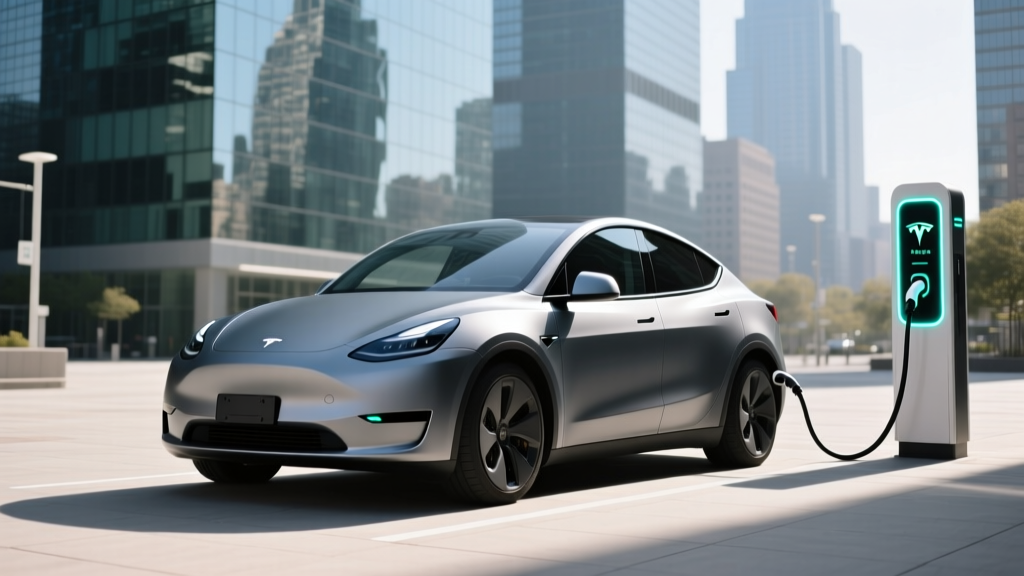
If you follow EV market analysis, you've likely seen the recurring headline: Tesla stock warning Adam Jonas — the Morgan Stanley analyst who has oscillated between bullish and cautious on the automaker. For actual car buyers, stock volatility matters less than what's sitting in the showroom. So let's separate Wall Street noise from driveway reality with a comprehensive look at the 2026 Tesla Model Y — the vehicle that still anchors Tesla's sales volume and remains one of the most spec-competitive electric crossovers on the market.
2026 Tesla Model Y at a Glance
| Spec | Long Range AWD | Performance |
|---|---|---|
| EPA Range | 320 miles | 295 miles |
| Battery (usable) | ~75 kWh (NMC) | ~75 kWh (NMC) |
| Drivetrain | Dual-Motor AWD | Dual-Motor AWD |
| Horsepower | 384 hp | 456 hp |
| 0–60 mph | 4.8 sec | 3.5 sec |
| Peak DC Fast Charge | 250 kW | 250 kW |
| 10–80% DC Time | ~25 min | ~25 min |
| Level 2 Home Charge | 11.5 kW (~44 mi/hr) | 11.5 kW (~44 mi/hr) |
| MPGe (combined) | 111 MPGe | 102 MPGe |
| Base MSRP | $47,990 | $53,990 |
| Battery Warranty | 8 years / 120,000 miles | |
Range and Efficiency: EPA vs. the Real World
The Long Range AWD posts an EPA-estimated 320 miles, while the Performance variant drops to 295 miles due to stickier tires and more aggressive tuning. Efficiency lands at 111 MPGe combined (30 kWh/100 mi) for the Long Range — competitive with the Hyundai Ioniq 5 and slightly behind the Ford Mustang Mach-E Extended Range.
EPA: 320 miles (Long Range AWD)
Highway (70 mph, moderate weather): ~265–280 miles. Tesla's aerodynamic efficiency helps, but sustained highway speeds still consume 15–20% more energy than the mixed-cycle EPA test.
Cold weather (below 32°F): Expect 220–250 miles. The Model Y uses a heat pump for cabin and battery thermal management, which limits cold-weather losses compared to older EVs without one — but physics still wins. LFP chemistry isn't offered on the AWD trims, so NMC performance in cold is slightly better than LFP but still subject to range reduction.
City / stop-and-go: Near or slightly above EPA thanks to aggressive regenerative braking recapturing energy.
Charging: Supercharger Network and Home Setup
Tesla's 250 kW V3 Supercharger architecture remains the benchmark for public charging reliability. On a preconditioned battery (the car warms the pack automatically when you navigate to a Supercharger), you'll see peak rates of 250 kW up to roughly 50% state of charge, after which the curve tapers. The 10–80% session takes approximately 25 minutes — not class-leading (the Ioniq 5's 800V architecture hits 10–80% in ~18 minutes at 350 kW chargers), but bolstered by the sheer density of Tesla's Supercharger network, now exceeding 6,000 U.S. stations.
| Charging Level | Power | Miles Added per Hour | Notes |
|---|---|---|---|
| Level 1 (120V) | ~1.4 kW | ~5 mi/hr | Emergency/top-up only |
| Level 2 (240V, 48A) | 11.5 kW | ~44 mi/hr | Tesla Wall Connector; full overnight charge in ~7 hours |
| DC Fast (V3 Supercharger) | 250 kW peak | ~1,000 mi/hr at peak | 10–80% in ~25 min; tapers above 80% |
Home charging reality: Most owners install a Tesla Wall Connector on a 60-amp circuit, delivering the full 11.5 kW. If your home has a 200-amp electrical panel with spare capacity, installation typically runs $800–$2,000 including the $400 Wall Connector unit and electrician labor. Older homes with 100-amp panels may need a $2,000–$4,000 service upgrade — a cost many buyers overlook until the electrician's quote arrives.
With the Model Y now featuring the NACS (North American Charging Standard) port natively, Tesla owners have native access to Superchargers without adapters. Non-Tesla EVs are increasingly gaining Supercharger access via NACS adapters or native NACS ports, which slightly dilutes Tesla's charging-moat advantage heading into 2026 and beyond.
Performance and Driving Dynamics
The Long Range AWD's 4.8-second 0–60 mph time is quick by any measure and effortless for highway merging. The Performance trim's 3.5-second sprint ventures into sports-car territory, though at the cost of 25 miles of EPA range and a firmer ride.
Both trims feature dual-motor all-wheel drive with independent front and rear motors, providing excellent traction in rain and light snow. The low center of gravity (battery pack under the floor) keeps body roll composed through corners, though the steering is numb by enthusiast standards — this is a crossover optimized for efficiency and comfort, not canyon carving.
Regenerative braking is strong and adjustable. Tesla removed true one-pedal driving customization in recent years (the "stop mode" toggle was simplified), but lifting off the accelerator still brings the car to a near-stop in most conditions, reducing brake wear significantly.
Interior, Cargo, and Technology
The 2026 Model Y continues Tesla's minimalist interior approach — a single 15-inch center touchscreen handles infotainment, climate, and vehicle settings. There's no traditional instrument cluster; speed and navigation info appear on the upper-left corner of the main screen. The refreshed "Juniper" interior (introduced in 2025) added ambient lighting, ventilated front seats, a rear-seat touchscreen for passengers, and improved sound insulation that noticeably reduces road noise compared to pre-2025 models.
Cargo and passenger space:
- Rear cargo (behind 2nd row): 30.2 cu ft
- Cargo with seats folded: 72.1 cu ft
- Front trunk (frunk): 4.1 cu ft
- Rear legroom: 41.6 inches
- Front headroom: 41.0 inches
These numbers place the Model Y squarely in the compact-to-midsize crossover segment. It comfortably fits two adults in the rear with decent knee room, but the sloping roofline cuts into headroom for anyone over 6 feet. Cargo capacity trails the Hyundai Ioniq 5 (behind the rear seats) but the frunk adds useful space for charging cables or a laptop bag.
Tech highlights:
- Over-the-air updates that add features post-purchase (recent additions include improved battery preconditioning algorithms and UI refinements)
- Sentry Mode dashcam recording with USB export
- Dog Mode and Camp Mode for climate control when parked
- Tesla app with remote climate, location, and charging management
Notable drawbacks: The absence of Apple CarPlay and Android Auto remains a dealbreaker for some buyers. Tesla's native navigation is competent but doesn't match Waze or Google Maps for real-time traffic in all markets. Panel gap quality, while improved post-Fremont and Austin production refinements, still occasionally draws complaints versus legacy automakers.
Pricing, Tax Credits, and Ownership Cost
| Trim | Base MSRP | Destination | Est. Federal Credit (§30D) | Effective Price |
|---|---|---|---|---|
| Long Range AWD | $47,990 | $1,390 | Up to $7,500* | ~$41,880* |
| Performance | $53,990 | $1,390 | Up to $7,500* | ~$47,880* |
*Critical tax credit caveats: The IRS §30D federal EV tax credit has multiple eligibility gates that change frequently:
- MSRP cap: SUVs/crossovers must be under $80,000 — both Model Y trims qualify.
- Buyer income cap: Modified AGI must not exceed $150,000 (single), $225,000 (head of household), or $300,000 (joint). Above these thresholds, no credit.
- Battery sourcing: Critical minerals and battery components must meet escalating domestic-content and FEOC (Foreign Entity of Concern) thresholds that tighten each year. Tesla's supply chain has adapted, but confirm current-year eligibility on fueleconomy.gov before purchasing.
- Point-of-sale transfer: As of 2024+, you can transfer the credit to the dealer for an immediate price reduction rather than waiting for tax filing — but the dealer must be IRS-registered.
Always verify your personal eligibility with a tax professional. State incentives (California's CVRP, Colorado's innovative motor vehicle credit, etc.) stack on top but vary by jurisdiction and funding availability.
5-year ownership snapshot (Long Range AWD, 15,000 mi/yr):
- Electricity cost (home charging at $0.14/kWh national avg): ~$4,200
- Equivalent gasoline cost (25 MPG ICE crossover at $3.50/gal): ~$10,500
- Maintenance: Minimal — no oil changes, reduced brake wear. Budget ~$600 for cabin air filters, wiper fluid, and tire rotations over 5 years.
- Insurance: Higher than comparable ICE crossovers — expect $1,800–$2,800/year depending on state and driving record. Tesla's own insurance product is available in select states and can be competitive.
Autopilot and FSD: What You're Actually Getting
Tesla's Autopilot (included) and Full Self-Driving Supervised ($8,000 add-on or $99/month subscription) are Level 2 driver-assistance systems, not autonomous driving. The driver must remain attentive, keep hands on the wheel, and be prepared to take over at any moment. SAE Level 4 (driverless in defined areas) is currently only available through robotaxi services like Waymo in select cities — not in any consumer vehicle you can purchase.
Basic Autopilot includes Traffic-Aware Cruise Control and Autosteer (lane centering) and works well on divided highways. FSD Supervised adds automatic lane changes, navigate-on-autopilot for highway interchanges, and Traffic Light and Stop Sign Control. As of early 2026, FSD's city-street capability has improved significantly but still requires active supervision — it can misjudge unprotected left turns, construction zones, and unusual intersections.
- Drive you while you sleep, text, or look away from the road
- Handle all weather conditions (heavy rain, snow, fog degrade performance)
- Navigate unmapped or heavily modified construction zones reliably
- Replace an attentive human driver — NHTSA continues to investigate Autopilot/FSD-involved incidents
See NHTSA's automated vehicle safety guidance for regulatory context.
How It Stacks Up: Model Y vs. Key Competitors
| Spec | 2026 Tesla Model Y LR | 2026 Hyundai Ioniq 5 LR AWD | 2026 Ford Mach-E ER AWD |
|---|---|---|---|
| EPA Range | 320 mi | 305 mi | 312 mi |
| Peak DC Charge | 250 kW | 350 kW (800V) | 150 kW |
| 10–80% Time | ~25 min | ~18 min | ~38 min |
| 0–60 mph | 4.8 sec | 5.1 sec | 5.6 sec |
| Cargo (rear seats up) | 30.2 cu ft | 27.2 cu ft | 29.7 cu ft |
| Apple CarPlay | No | Yes (wireless) | Yes (wireless) |
| Base MSRP | $47,990 | $49,400 | $48,995 |
The Ioniq 5 wins on charging speed (its 800V architecture is genuinely faster at compatible 350 kW stations) and offers CarPlay. The Mach-E provides a more traditional crossover feel with physical buttons and CarPlay. The Model Y wins on Supercharger network access (though this moat is narrowing as NACS opens up), cargo volume, software ecosystem, and over-the-air feature additions.
Pros, Cons, and the Adam Jonas Context
- 320-mile EPA range covers most road trips with one stop
- Supercharger network still the most reliable public charging option
- Strong 250 kW DC fast-charging with good charge-curve management
- Spacious cargo area and frunk for the segment
- Continuous OTA updates add value post-purchase
- Competitive pricing after potential $7,500 federal credit
- No Apple CarPlay / Android Auto
- FSD is expensive and still Level 2 — not autonomous
- 250 kW peak charge rate trails 800V competitors
- Rear headroom limited by coupe-like roofline
- Insurance costs above segment average
- Minimalist interior isn't for everyone
So what about the Tesla stock warning from Adam Jonas? Jonas's bear case has historically centered on increased competition, margin compression from price cuts, and the risk that Tesla's valuation prices in robotaxi and AI revenue that hasn't materialized at scale. For car buyers, these macro concerns translate into a practical silver lining: Tesla has been aggressively pricing the Model Y to maintain volume, making it one of the most value-competitive electric crossovers on the market — especially after the §30D credit. Wall Street anxiety can be a buyer's opportunity.
Who Should Buy the 2026 Model Y?
Choose the Model Y Long Range AWD if: You want a daily-driver EV crossover with strong range, access to the Supercharger network for road trips, a spacious cabin for a small family, and you're comfortable with a screen-centric interior without CarPlay.
Choose the Performance trim if: You want sports-car acceleration and don't mind sacrificing 25 miles of range and paying a $6,000 premium.
Look elsewhere if: You need Apple CarPlay, prefer physical controls, want the fastest possible DC charging (Ioniq 5 at 800V stations), or need three-row seating (consider the Kia EV9 or Rivian R1S).
Frequently Asked Questions
What is the real-world range of the 2026 Tesla Model Y?
The EPA rates the Long Range AWD at 320 miles. In real-world highway driving at 70 mph, expect 265–280 miles. In cold weather below freezing, plan for 220–250 miles. City driving with regenerative braking can match or slightly exceed the EPA number.
How fast does the Model Y charge at home and on the road?
At home on a Level 2 Tesla Wall Connector (11.5 kW), you'll add roughly 44 miles of range per hour — a full charge takes about 7 hours. On a V3 Supercharger at 250 kW peak, a 10–80% session takes approximately 25 minutes with battery preconditioning active.
How much does the 2026 Model Y cost after tax credits?
The Long Range AWD starts at $49,380 including destination. If you qualify for the full $7,500 federal §30D credit (income under $150K single / $300K joint, and the vehicle meets battery-sourcing requirements), the effective price drops to approximately $41,880. State incentives may reduce this further.
Does the 2026 Model Y qualify for the federal EV tax credit?
As of current IRS guidance, the Model Y qualifies for up to $7,500 under §30D — it is below the $80,000 SUV MSRP cap and Tesla's battery supply chain has been restructured to meet critical-mineral and domestic-content thresholds. However, your personal income must also fall under the AGI caps. Verify on fueleconomy.gov and with a tax professional before purchasing.
Is the Model Y worth buying vs. the Ioniq 5 or Mach-E?
The Model Y wins on Supercharger network access, cargo space, and software ecosystem. The Ioniq 5 charges faster at 800V stations and offers CarPlay. The Mach-E provides a more conventional interior with physical controls. All three are strong choices — your decision should hinge on charging access, interior preference, and which ecosystem you trust for long-term ownership.
What battery chemistry does the Model Y use?
The 2026 Model Y Long Range and Performance trims use NMC (nickel manganese cobalt) chemistry in a ~75 kWh usable battery pack. Tesla previously offered LFP (lithium iron phosphate) on the RWD Standard Range trim; LFP offers longer cycle life and can be charged to 100% daily without degradation concerns, but is heavier and less energy-dense, which is why it's reserved for the lower-range trim.