If you drive a Tesla — or any EV — you've probably done the back-of-napkin math: what if my roof produced the electricity my car consumes? Tesla's Solar Roof is the company's attempt to close that loop, replacing conventional roofing with integrated photovoltaic glass tiles that look like a premium roof first and a power plant second. The 2026 iteration refines the product line Tesla has shipped since late 2019, but it still occupies a very specific niche: homeowners who need a new roof anyway and are willing to pay a design premium to avoid the look of bolted-on panels.
This review frames the Tesla Solar Roof around the question EV owners actually ask: does it pencil out as a charging strategy, or is it a lifestyle product masquerading as an energy investment? We'll walk through installed costs, real-world production, Powerwall pairing, and how it compares to conventional solar panels for EV charging.
What the Tesla Solar Roof Actually Is in 2026
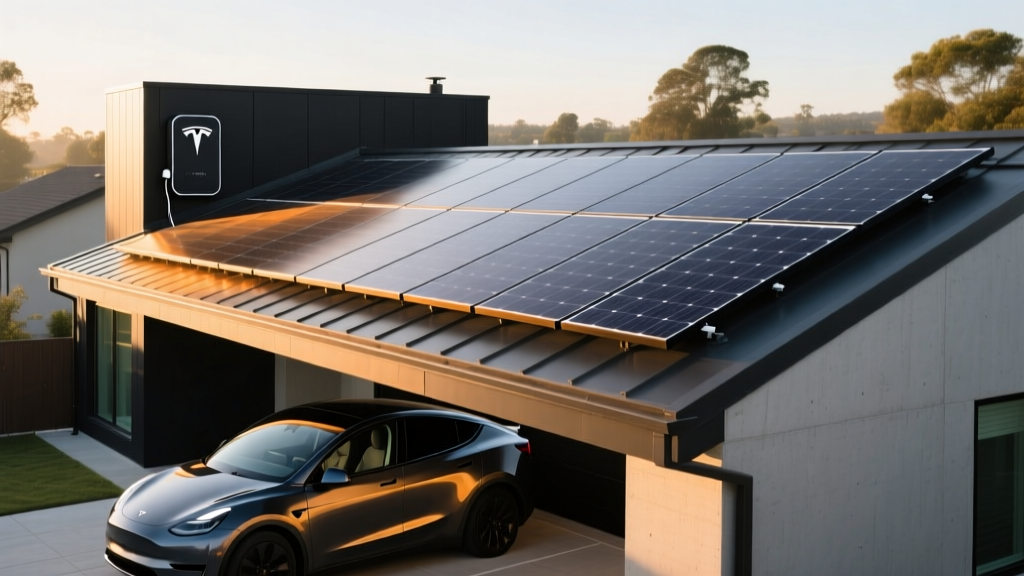
The Solar Roof is not a solar panel system mounted on top of shingles. It is the roof. Tempered glass tiles — some active (photovoltaic), some inactive (aesthetic-only, placed where shading or angles don't justify cells) — replace asphalt, tile, or metal roofing entirely. Inverters and a Tesla Powerwall (now typically required for new installs) sit on the side of the house, and the Tesla app ties generation, storage, home load, and EV charging into one dashboard.
For 2026, Tesla continues to sell the Solar Roof primarily through its own installation network and a limited set of certified partners. The product is available in most U.S. states, though install timelines still stretch 4–10 months from deposit to power-on in many markets, driven more by permitting and utility interconnection than by hardware availability.
Specs at a Glance: Tesla Solar Roof (2026)
| Spec | Value |
|---|---|
| Tile type | Tempered glass, integrated PV |
| Module efficiency (active tiles) | ~21–22% |
| System size typical range | 5 kW – 20 kW DC |
| Warranty — tiles | 25 years (weatherization + mechanical) |
| Warranty — power output | 25 years, ≥70% of nameplate |
| Inverter | Tesla Solar Inverter, integrated |
| Storage pairing | Powerwall 3 (13.5 kWh usable, 11.5 kW continuous) |
| App monitoring | Tesla app, per-tile production view |
| Wind rating | ANSI FM 4473, Class F (up to ~130 mph equivalent) |
| Fire rating | Class A |
Source: Tesla Solar Roof spec pages and installation documentation.
Installed Cost: The Number That Decides Everything
The Solar Roof's sticker shock is real, and it's the single biggest reason most EV owners end up choosing conventional panels instead. Pricing varies heavily by roof complexity, pitch, number of stories, and local labor, but 2026 ballpark figures look like this:
| Item | Tesla Solar Roof | Conventional panels on existing roof |
|---|---|---|
| Hardware + install (before incentives) | $58,000 – $78,000 | $27,000 – $35,000 |
| Per-Watt installed | $5.80 – $7.80/W | $2.70 – $3.50/W |
| Powerwall 3 (required in most installs) | ~$12,000 – $14,000 installed | Optional, same range |
| Federal ITC (30%, IRC §25D) | −$17,400 – $23,400 | −$8,100 – $10,500 |
| Net cost after federal credit | $40,600 – $54,600+ | $18,900 – $24,500 |
A few critical nuances:
- The Solar Roof includes a new roof. If your existing roof is 15–20+ years old and needs replacement anyway ($15k–$30k for asphalt on a typical home), the relevant comparison is Solar Roof vs. "new roof + panels on top." That gap narrows significantly.
- The federal credit is IRC §25D (residential clean energy), not §30D (the EV credit). It is 30% with no dollar cap, but it is non-refundable — you need sufficient tax liability to use it, though unused portions can carry forward. Consult a tax professional; see IRS guidance on §25D.
- State and utility incentives stack on top in many jurisdictions (NYSERDA in New York, California's SGIP for storage, various net-metering regimes), but they vary so widely that you must check local programs — we don't publish state-specific dollar amounts because they change quarterly.
Real-World Energy Production for EV Charging
A 10 kW Solar Roof in a high-insolation market (Phoenix, Southern California, Texas) produces roughly 14,000 – 16,500 kWh per year. The same system in Seattle or Boston produces closer to 10,500 – 12,500 kWh. For context, the average U.S. EV driven 12,000 miles/year at 3.5 miles/kWh (a reasonable blended efficiency for a Model Y or Ioniq 5) consumes about 3,430 kWh per year — so a 10 kW system can, on paper, cover 2–4 EVs' worth of driving, plus meaningful household load.
Two real-world caveats matter more than the annual total:
- Production is seasonal. A 10 kW system in Ohio may produce 55 kWh/day in June and 18 kWh/day in December. Your EV's consumption, meanwhile, often rises in winter (cold battery, cabin heat, denser air). Net metering or a Powerwall smooths this, but you are still a net grid importer in winter in most northern states.
- Roof orientation kills output fast. South-facing roofs produce ~100% of modeled output; east/west produce ~80–85%; north-facing is rarely worth tiling with active PV. The Solar Roof's advantage — active tiles only where production justifies them — is also a constraint: a complex roof with many dormers, chimneys, and shade sources will have a much smaller active-tile area than its total square footage suggests.
How It Pairs With Powerwall and EV Charging
By 2026, Tesla effectively requires a Powerwall 3 for most new Solar Roof installs, partly to comply with evolving utility interconnection rules (California's NEM 3.0, for example, severely reduced the value of pure net metering). The Powerwall 3's 13.5 kWh usable capacity and 11.5 kW continuous output are meaningful: that's enough to run a Level 2 EV charger at 48A (11.5 kW) off battery alone during an outage, though you'd drain the pack in roughly an hour.
Smart charging matters here. Tesla's app can schedule EV charging to align with peak solar production (midday) or with off-peak grid rates, and can prioritize battery charging over vehicle charging when the house needs it. Non-Tesla EVs lose some of this integration but still benefit from the production/storage side. If you drive a Ford, Hyundai, or Rivian, expect to use your vehicle's native scheduling plus the Tesla app's solar/export view rather than a single unified dashboard.
Tesla Solar Roof vs Conventional Panels: The Honest Comparison
| Factor | Tesla Solar Roof | Conventional panels (e.g., REC, Qcells, Maxeon) |
|---|---|---|
| Aesthetics | Winner — looks like a premium roof | Visible racks and panels |
| Cost per watt installed | $5.80 – $7.80/W | $2.70 – $3.50/W |
| Efficiency | ~21–22% (tile-level) | 21–24% (module-level, tier-1) |
| Roof replacement included | Yes | No — requires sound existing roof |
| Install timeline | 4–10 months typical | 2–4 months typical |
| Service/repair ecosystem | Tesla-direct, mixed reviews | Broad local installer base |
| Resale value uplift | Modest, design-dependent | Modest, well-documented |
| Best for | New roof needed + design priority | Pure economics, fastest payback |
The uncomfortable arithmetic: if your roof is in good shape and you're buying solar strictly to offset EV charging, conventional panels will pay back in 6–9 years in most states, while a Solar Roof rarely pays back on energy savings alone within 25 years. The Solar Roof's business case only works when you factor in the avoided cost of a roof replacement and assign a dollar value to aesthetics.
Federal Tax Credits and Incentives — What Actually Applies
Two credits are commonly confused; only one applies here:
- IRC §25D — Residential Clean Energy Credit: 30% of installed cost (Solar Roof tiles, inverter, Powerwall, labor). No dollar cap. Non-refundable but with carry-forward. Applies to primary and secondary residences. This is the Solar Roof credit.
- IRC §30D — Clean Vehicle Credit: Up to $7,500 for new EV purchases, subject to MSRP caps ($55k cars / $80k SUVs/pickups), buyer AGI limits, and battery critical-mineral sourcing rules. This applies to the car, not the roof. See IRS §30D guidance.
Homeowners buying both a Tesla vehicle and a Solar Roof can, in the same tax year, claim §30D on the car and §25D on the roof — they are independent credits. But tax liability is the binding constraint: a $6,000 federal tax bill can't absorb both a $7,500 vehicle credit and a $20,000 solar credit in one year, even with carry-forward rules. A tax professional should model multi-year liability before committing to both purchases simultaneously.
Who Should Actually Buy the Tesla Solar Roof?
- Your existing roof needs full replacement within 1–2 years (the bundled cost math changes dramatically).
- Aesthetics are a top-3 priority — historic districts, modern architecture, HOA pressure.
- You plan to stay in the home 15+ years to ride out the payback period.
- You're pairing with a Powerwall for backup power, not just energy offset.
- Your roof is less than ~10 years old — you'd be tearing off good shingles.
- Your primary goal is cheapest $/kWh to offset EV charging.
- You may move within 7–10 years.
- Your roof is heavily shaded, north-facing, or very complex — neither system will pencil out well.
Pros and Cons, Stacked Honestly
- Best-in-class aesthetics; reads as architecture, not hardware.
- 25-year tile + power warranty is strong on paper.
- Single-vendor ecosystem (roof + Powerwall + EV + app) is genuinely convenient for Tesla households.
- Includes a new roof — no double-labor if you were replacing anyway.
- Class A fire + high wind ratings.
- 1.7× – 2.3× the installed $/W of tier-1 conventional panels.
- Install timelines remain long and inconsistent by market.
- Service reputation is mixed; Tesla-direct support varies regionally.
- Output per roof sq ft is typically lower than panels, because of inactive tiles.
- Powerwall now essentially mandatory — adds $12k–$14k.
- Resale premium over panels is small and unproven at scale.
Frequently Asked Questions
How much does a Tesla Solar Roof actually cost in 2026?
Most 8–12 kW residential installs land between $58,000 and $78,000 before incentives, and $40,000–$55,000 after the 30% federal §25D credit. Add $12,000–$14,000 for a Powerwall 3 if not bundled. Exact quotes depend heavily on roof pitch, stories, penetrations, and local permitting.
Does the Tesla Solar Roof qualify for the $7,500 EV tax credit?
No. The Solar Roof qualifies for the 30% IRC §25D residential clean energy credit (no dollar cap), not the §30D vehicle credit. The two credits can be claimed in the same tax year on separate purchases, subject to your tax liability.
Can a Tesla Solar Roof actually power my EV entirely?
Annually, yes — a 10 kW system in a sunny market produces 14,000–16,500 kWh, enough to cover 2–4 average-driving EVs plus a home. Monthly, no: winter production and summer air conditioning will push you onto the grid without significant storage.
How long does installation take?
Expect 4–10 months from deposit to permission-to-operate, with most of the wait in engineering, permitting, and utility interconnection rather than physical installation. Active roof work typically takes 5–10 days on site.
Is the Solar Roof worth it vs regular panels for EV charging?
Strictly on $/kWh economics, no — conventional panels pay back 2–3× faster. It becomes competitive only when your roof needs full replacement and when aesthetics carry real value to you. For pure EV-charging offset, panels win.
What happens if a tile breaks?
Tesla replaces individual tiles under the 25-year warranty. Turnaround time on service calls varies by region and has been a common complaint in owner forums; keep documentation and expect multi-week scheduling in some markets.
Does it work with non-Tesla EVs?
Yes. The Solar Roof and Powerwall produce standard AC power; any EV on any Level 1 or Level 2 charger works. You lose some app integration (e.g., automatic solar-matched charging scheduling), but the energy economics are identical.
Sources: Tesla Solar Roof; IRS Residential Clean Energy Credit (§25D); IRS Clean Vehicle Credit (§30D); NREL PVWatts production estimates.