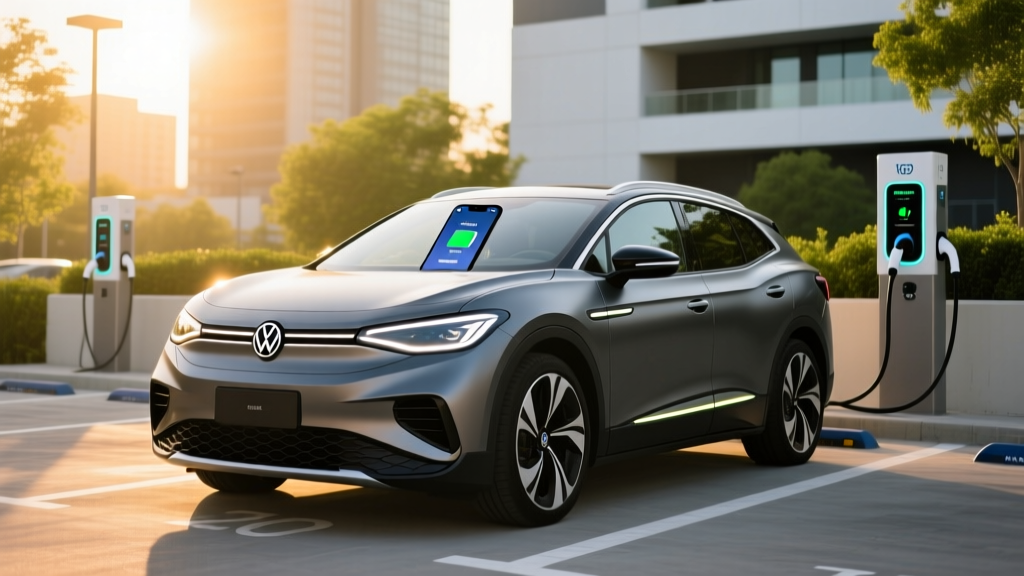
The Volkswagen ID.4 occupies a strange space in the 2026 compact electric SUV segment: it isn't the fastest, the longest-range, or the most technologically daring. But when dealers stack aggressive lease incentives on top of the federal §30D tax credit passed through to lessees, the ID.4 transforms into one of the most financially compelling EVs on the market. If you've been searching for an ID.4 lease deal, this review dissects the exact numbers — range, charging speed, pricing, and tax-credit mechanics — you need before signing anything.
Quick Verdict: Who Should Lease the 2026 ID.4?
The ID.4 is a practical family crossover built for daily commuting, school runs, and weekend trips under 250 miles. With 291 miles of EPA range on Standard Range rear-wheel-drive trims and up to 263 miles on the AWD Pro S, it covers most American driving patterns without drama. Where it shines is in lease economics: VW frequently subsidizes leases through VW Credit, and because leased vehicles allow the leasing company (not the buyer) to claim the $7,500 federal EV tax credit and pass it as a capitalized-cost reduction, lessees can sidestep the income and battery-sourcing restrictions that disqualify many retail buyers.
It's not a performance SUV. The 0-60 time of 7.7 seconds on the RWD model feels adequate, not thrilling. Infotainment remains a sore point. But if you want a spacious, comfortable, quiet electric crossover at a monthly payment that undercuts a gas RAV4, the ID.4 lease math is hard to ignore.
Range, Efficiency & Real-World Expectations
- Standard Range (RWD, 63 kWh): 206 miles EPA
- Pro / Pro S (RWD, 82 kWh usable): 291 miles EPA
- Pro S Plus (AWD, 82 kWh usable): 263 miles EPA
Real-World Caveat: On a 70-mph highway loop in moderate temperatures, expect the RWD Pro to deliver approximately 250–265 miles. In freezing conditions (below 30°F), range drops 20–30%, putting the AWD Pro S near 185–210 miles on a full charge. The ID.4's heat pump (standard on Pro S and above) mitigates some cold-weather loss but doesn't eliminate it.
| Spec | Standard Range RWD | Pro RWD | Pro S AWD |
|---|---|---|---|
| EPA Range | 206 mi | 291 mi | 263 mi |
| Battery (usable) | 63 kWh (NMC) | 82 kWh (NMC) | 82 kWh (NMC) |
| Horsepower | 201 hp | 282 hp | 335 hp |
| 0-60 mph | 9.3 sec | 7.7 sec | 5.4 sec |
| Drivetrain | RWD (single motor) | RWD (single motor) | AWD (dual motor) |
| MPGe (combined) | 104 MPGe | 107 MPGe | 98 MPGe |
| Efficiency | 32 kWh/100mi | 31 kWh/100mi | 34 kWh/100mi |
| Max DC Fast Charge | 135 kW | 170 kW | 170 kW |
| 10–80% DCFC Time | ~28 min | ~28 min | ~28 min |
| Level 2 Charge Rate | 11 kW | 11 kW | 11 kW |
Efficiency is competitive for the class. At roughly 31 kWh per 100 miles (Pro RWD), the ID.4 costs about $4.65 to drive 100 miles at the U.S. average residential electricity rate of $0.15/kWh. A comparable gas crossover at 28 MPG and $3.40/gallon costs $12.14 for the same distance.
Charging Speed: DC Fast, Level 2 & Home Setup
The ID.4's charging performance is mid-pack in 2026. The 82 kWh battery on Pro trims peaks at 170 kW on a DC fast charger — respectable but trailing the Hyundai Ioniq 5's 240 kW and the Tesla Model Y's ~250 kW peak. The critical metric is the 10–80% charge time, which VW rates at approximately 28 minutes under optimal battery preconditioning.
| Charging Level | Power | Miles Added per Hour | Typical Use Case |
|---|---|---|---|
| Level 1 (120V) | ~1.4 kW | ~4 mi/hr | Emergency / overnight trickle |
| Level 2 (240V, 48A) | 11 kW | ~33 mi/hr | Home daily charging (~9 hr for full charge) |
| DC Fast Charge | 170 kW peak | ~186 mi in 28 min (10–80%) | Road trips, public stations |
Charging curve reality: The 170 kW peak only sustains from roughly 10–30% State of Charge. Above 50%, the rate tapers significantly — expect 80–90 kW through the mid-range, and below 40 kW once you pass 80%. If you routinely charge to 100% at a public station, plan for 50+ minutes total. Preconditioning the battery via the navigation system (set a DC charger as your destination) is essential for hitting peak rates in cold weather.
At home on a Level 2 wallbox, the 11 kW onboard charger adds about 33 miles of range per hour. A full 0–100% charge on the 82 kWh battery takes roughly 8.5 hours — fine for overnight charging on a 40-amp or 48-amp circuit. Expect home installation of a Level 2 charger to run $800–$2,000 depending on panel capacity and run length.
Lease Pricing, MSRP & Tax Credit Math
Here's where the ID.4 lease deal gets interesting. Volkswagen prices the 2026 ID.4 starting around $40,790 for the Standard Range S trim and climbing to approximately $51,190 for the Pro S Plus AWD with the Gradient package. These MSRPs are before destination ($1,395) and before any incentives.
| Trim | MSRP | §30D Credit (via lease) | Effective Cap Cost | Est. Monthly Lease* |
|---|---|---|---|---|
| Standard Range S | $40,790 | −$7,500 | ~$33,290 | $299–$349/mo |
| Pro RWD | $44,790 | −$7,500 | ~$37,290 | $349–$399/mo |
| Pro S RWD | $47,990 | −$7,500 | ~$40,490 | $389–$449/mo |
| Pro S Plus AWD | $51,190 | −$7,500 | ~$43,690 | $429–$499/mo |
*Estimates based on 36-month/10,000-mile leases with $0 down, 600+ credit tier. Actual payments vary by dealer, region, and VW Credit incentives. Always confirm the cap-cost reduction is applied.
Federal Tax Credit Eligibility (§30D) — The Lease Loophole
Under IRS §30D rules, the $7,500 federal EV tax credit is subject to buyer income caps ($150K single / $300K joint), vehicle MSRP caps ($80K for SUVs), and battery critical-mineral and component sourcing requirements. The ID.4, assembled in Chattanooga, Tennessee, with a mix of sourced battery materials, has fluctuated in eligibility for retail purchasers.
However, under the commercial clean vehicle credit (§45W) lease pass-through structure, the leasing company (VW Credit) claims the credit and applies it as a capitalized-cost reduction. This means lessees benefit from the full $7,500 reduction regardless of personal income or the vehicle's battery-sourcing status — a significant advantage over retail buyers who must meet all §30D requirements. Always verify with your dealer that the $7,500 is reflected as a cap-cost reduction on the lease paperwork, not merely advertised.
Interior Space, Tech & Daily Livability
The ID.4's cabin is where it quietly excels. Rear legroom measures 37.6 inches, beating the Tesla Model Y's 35.2 inches and rivaling midsize sedans. Cargo volume behind the rear seats is 30.3 cubic feet, expanding to 64.2 cu ft with the 60/40 split seats folded — enough for a week's family luggage or a Costco run.
The 12.9-inch infotainment touchscreen (standard on Pro and above) runs VW's ID. Software 4.0, which has improved substantially over the launch-version ID.3/ID.4 interface. Wireless Apple CarPlay and Android Auto are standard. Response times are acceptable but still a half-step behind Tesla's or Hyundai's systems.
Driver assistance: The ID.4 comes equipped with VW's IQ.DRIVE suite — adaptive cruise control, lane centering, blind-spot monitoring, and automatic emergency braking. This is an SAE Level 2 system, meaning the driver must remain fully engaged with hands on the wheel and eyes on the road. It's competent for highway cruising but is not a "self-driving" feature and does not compete with Tesla's FSD or GM's Super Cruise in hands-free capability.
Notable drawbacks: The capacitive-touch steering wheel controls and lack of physical HVAC buttons remain frustrating. The panoramic glass roof (Pro S and above) has no physical shade, leading to cabin heat buildup in summer. Rear drum brakes (a cost-saving measure) draw criticism, though they perform adequately in daily use and benefit from regenerative braking reducing wear.
Pros, Cons & How It Stacks Up
Pros
- Aggressive lease pricing with $7,500 credit pass-through
- Spacious rear seat and cargo area for the class
- Comfortable, quiet ride quality on highway and rough roads
- AWD available with strong 335 hp / 5.4-sec 0-60
- 8-year/100,000-mile battery warranty
- 3 years of complimentary Electrify America DC charging (30-min sessions)
Cons
- 170 kW peak DC charging lags Ioniq 5, Model Y, and EV6
- Capacitive touch controls and no physical climate buttons
- Real-world cold-weather range drops 20–30%
- Infotainment still less polished than competitors
- Unshaded glass roof causes solar heat gain
- No front trunk (frunk) — charge cable storage only
ID.4 vs. Key Competitors (2026 Lease Landscape)
Against the Hyundai Ioniq 5, the ID.4 trades faster charging (Ioniq 5 peaks at 240 kW) and a more distinctive design for a lower effective lease payment and more rear-seat room. The Tesla Model Y offers a superior Supercharger network and software but typically leases for $100–$150/month more and has a firmer ride. The Kia EV6 is sportier to drive but has less cargo volume. For pure monthly-payment value on a family crossover, the ID.4 lease deal consistently ranks at or near the top.
Battery Warranty & Long-Term Ownership
VW covers the ID.4's NMC lithium-ion battery for 8 years or 100,000 miles (whichever comes first) against defects and capacity loss below 70% of original capacity, per Volkswagen's official warranty terms. The powertrain carries the same 8-year/100,000-mile coverage. The limited vehicle warranty is 4 years/50,000 miles.
For lessees on a 36-month term, battery degradation is largely a non-issue — most ID.4 batteries lose 5–8% capacity in the first three years based on owner-reported data. If you plan to buy out the lease, factor in long-term degradation expectations of roughly 10–15% over 8 years under normal use.
Bottom Line: Is the ID.4 Lease Worth It?
Lease the ID.4 if:
- You want the lowest monthly payment in the compact EV SUV segment
- Your daily driving is under 60 miles and you can charge at home
- You value rear-seat space and ride comfort over sporty handling
- You want to access the $7,500 federal credit without income/sourcing restrictions
Look elsewhere if:
- You frequently take 400+ mile road trips (Ioniq 5 or Model Y charge faster)
- You need hands-free highway driving (consider GM's Super Cruise vehicles)
- You live in extreme cold and need maximum range retention
Frequently Asked Questions
What is the real-world range of the 2026 VW ID.4?
The EPA rates the ID.4 Pro RWD at 291 miles, but expect 250–265 miles in mixed real-world driving at highway speeds. In freezing temperatures, plan for 190–220 miles. The AWD Pro S delivers approximately 230 miles real-world in moderate weather.
How fast does the ID.4 charge at home and on the road?
On a Level 2 home charger (240V, 48A), the ID.4 charges at 11 kW, adding about 33 miles per hour — a full charge takes roughly 8.5 hours overnight. On a DC fast charger, it peaks at 170 kW and charges from 10–80% in about 28 minutes with proper battery preconditioning.
How much does the ID.4 cost after tax credits on a lease?
With the $7,500 federal credit applied as a cap-cost reduction, effective lease pricing starts around $299/month for the Standard Range S and roughly $389/month for the well-equipped Pro S RWD on a 36-month term with no money down. Actual payments depend on dealer pricing, credit tier, and regional VW Credit incentives.
Does the 2026 ID.4 qualify for the federal EV tax credit?
For retail buyers, §30D eligibility depends on battery critical-mineral sourcing and buyer income limits ($150K single / $300K joint), which change periodically. For lessees, the credit is typically passed through the leasing company as a cap-cost reduction regardless of personal income or sourcing status. Confirm with your dealer that the credit appears on the lease agreement.
Is the ID.4 worth it vs. the Tesla Model Y or Hyundai Ioniq 5?
The ID.4 wins on monthly lease cost and rear-seat comfort. The Ioniq 5 wins on charging speed (240 kW vs. 170 kW) and design. The Model Y wins on charging infrastructure and software. If your priority is the lowest payment on a practical family EV, the ID.4 lease deal is the strongest option in 2026.
What's included with the ID.4's complimentary charging?
Volkswagen includes 3 years of complimentary 30-minute DC fast-charging sessions on the Electrify America network. This covers most road-trip charging needs during a typical lease term. After 3 years or if you exceed session limits, standard EA rates apply (typically $0.30–$0.48/kWh depending on region).