Quick Verdict: The Tesla Rear Drive Unit Powers the Most Affordable Model 3
The single-motor, rear-wheel-drive Tesla Model 3 remains the entry point into Tesla ownership and one of the most efficient electric sedans on the market. At the heart of this variant is the Tesla rear drive unit — a permanent-magnet synchronous motor integrated into the rear axle that delivers 271 horsepower and propels the car from 0-60 mph in 5.8 seconds. For 2026, the Model 3 RWD starts at $38,990 (before destination and incentives), pairs that rear drive unit with a ~60 kWh lithium iron phosphate (LFP) battery, and achieves an EPA-estimated 272 miles of range.
This is the Model 3 variant that prioritizes efficiency and value over all-out performance. If you don't need dual-motor all-wheel drive or the 363-mile Long Range model, the RWD is the smart money — and understanding how the Tesla rear drive unit and its LFP battery work together explains why.
Range and Efficiency: EPA Numbers vs. Real-World Reality
Real-World Expectation: 235–260 miles on highway trips at 70+ mph; 200–225 miles in sub-30°F winter conditions. City and moderate-climate driving can meet or slightly exceed the EPA sticker thanks to strong regenerative braking.
The 2026 Model 3 RWD achieves an EPA-rated 132 MPGe combined (roughly 25 kWh per 100 miles), making it one of the most energy-efficient vehicles in its class. The rear drive unit's single-motor layout eliminates the weight and drivetrain losses of a second motor, which directly translates to fewer kilowatt-hours consumed per mile.
According to fueleconomy.gov, the Model 3 RWD's combined efficiency edges out competitors like the Hyundai Ioniq 6 SE (140 MPGe but with a smaller battery and 260-mile range) and the BMW i4 eDrive35 (which sacrifices efficiency for luxury). In our experience, highway driving at sustained 75 mph drops range to roughly 240 miles in mild weather. Cold weather is the bigger equalizer — LFP chemistry loses a larger percentage of usable capacity in freezing temperatures compared to NMC, so plan for 200–225 miles on frigid commutes and precondition the battery before fast charging.
Battery Chemistry: Why LFP Matters in the RWD Model 3
| Spec | Value |
|---|---|
| EPA Range | 272 miles |
| Battery Capacity (usable) | ~60 kWh |
| Battery Chemistry | LFP (Lithium Iron Phosphate) |
| Drivetrain | Rear-Wheel Drive (single motor) |
| Horsepower | 271 hp |
| Torque | 317 lb-ft |
| 0–60 mph | 5.8 seconds |
| Top Speed | 125 mph |
| Max DC Fast Charge Rate | 170 kW |
| 10–80% DC Fast Charge Time | ~25 minutes |
| Level 2 Home Charging Rate | 11.5 kW (~44 mi/hr) |
| Efficiency (combined) | 132 MPGe / 25 kWh/100 mi |
| Cargo Volume | 23 cu ft (trunk + frunk) |
| Rear Legroom | 35.3 inches |
| Base MSRP | $38,990 (+ $1,390 destination) |
| Battery & Drive Unit Warranty | 8 years / 100,000 miles |
Tesla uses CATL-sourced LFP cells in the rear-drive Model 3. LFP offers distinct trade-offs versus the nickel-manganese-cobalt (NMC) chemistry found in Long Range and Performance variants:
- Longevity advantage: LFP cells tolerate repeated 100% charging and exhibit slower long-term degradation. Tesla recommends charging to 100% at least once weekly in LFP models.
- Lower energy density: LFP stores fewer kWh per kilogram, which is why the RWD carries a smaller battery and delivers less range than the NMC Long Range.
- Cold-weather sensitivity: LFP cells experience greater internal resistance in freezing temperatures, reducing both range and fast-charging speed unless the battery is preconditioned.
- Cost advantage: LFP eliminates cobalt and nickel, reducing raw-material cost — savings Tesla passes on through the RWD's lower MSRP.
The Tesla rear drive unit itself is covered under the same 8-year/100,000-mile battery and drive unit warranty, with a minimum 70% capacity retention threshold. If degradation drops below that level within the warranty period, Tesla replaces or refurbishes the pack. Drive unit failures (bearing wear, inverter faults) are uncommon but covered under this same powertrain warranty.
Charging Speed: DC Fast, Level 2, and the Charge Curve Reality
| Charging Level | Power / Rate | Miles Added per Hour | Notes |
|---|---|---|---|
| Level 1 (120V household) | ~1.4 kW | ~5 mi/hr | Emergency / overnight trickle only |
| Level 2 (240V home) | 11.5 kW max | ~44 mi/hr | Full charge in ~6 hours; requires 48A circuit |
| DC Fast (Tesla Supercharger V3/V4) | 170 kW peak | Up to ~175 mi in 15 min | 10–80% in ~25 min; tapers sharply above 80% |
The Model 3 RWD peaks at 170 kW on DC fast chargers — lower than the Long Range's ~250 kW capability, owing to the LFP pack's smaller size and chemistry constraints. Here's what that means practically:
Charge curve reality: The 170 kW peak is achieved only between roughly 10–30% state of charge. From 30–60%, the rate settles to around 120–140 kW. Above 80%, it drops below 50 kW as the battery management system protects cell health. This is why Tesla (and every other automaker) advertises 10–80% times rather than full charges — the final 20% can take as long as the first 70%.
On a Tesla V3 Supercharger (250 kW capable), the RWD will only pull its 170 kW maximum. At a non-Tesla CCS station (with a NACS-to-CCS adapter or at newer open Superchargers), expect the same curve. For home charging, a Tesla Wall Connector on a 60-amp circuit delivers the full 11.5 kW (48 amps), replenishing the ~60 kWh pack in about 5.5–6 hours. Budget $500–$1,500 for professional Level 2 installation depending on your panel capacity and run distance.
Preconditioning matters here: if you navigate to a Supercharger using the car's built-in navigation, the battery thermal management system warms or cools the pack en route, ensuring you hit peak charge rate on arrival. Skip preconditioning on a cold morning and your initial charge rate may be cut in half for the first 5–10 minutes.
Performance and the Rear Drive Unit Architecture
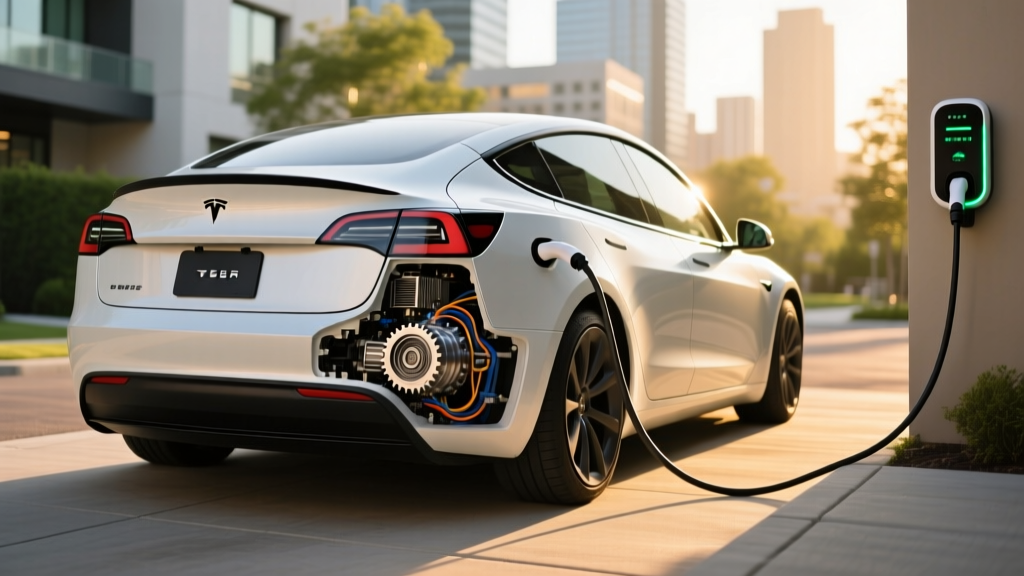
The Tesla rear drive unit in the Model 3 RWD is a permanent-magnet synchronous motor mounted on the rear subframe, driving the rear wheels through a single-speed reduction gear. Output is rated at 271 horsepower and 317 lb-ft of torque. The 0–60 mph time of 5.8 seconds won't embarrass you at a merge ramp — it's quicker than most turbocharged four-cylinder sport sedans — but it's a full 1.7 seconds behind the Long Range AWD.
What the single rear motor gives up in straight-line performance, it makes up in driving dynamics. The RWD Model 3 is the lightest variant in the lineup (approximately 3,862 lbs), and that lower curb weight over the rear axle yields sharper turn-in and more neutral handling. Enthusiasts who prioritize cornering feel over straight-line thrust often prefer the RWD for exactly this reason.
One-pedal driving via regenerative braking is strong in the RWD model. The rear drive unit acts as a generator during deceleration, sending energy back to the LFP pack and allowing most commuters to drive without touching the friction brake pedal in daily traffic.
Interior, Cargo, and Technology
The 2026 Model 3 RWD carries forward the refreshed "Highland" interior introduced in late 2023:
- 15.4-inch center touchscreen handles all infotainment, climate, and vehicle controls (no separate instrument cluster)
- 8-inch rear touchscreen for rear-seat passengers (climate, media)
- Ventilated front seats and premium audio with 17 speakers (standard on all trims post-refresh)
- Ambient lighting and acoustic glass for improved cabin quietness
Cargo space totals 23 cubic feet (trunk plus front trunk/frunk), competitive with the Hyundai Ioniq 6 (11.2 cu ft trunk but no frunk) and slightly behind the BMW i4 (16.6 cu ft trunk). The Model 3's hatchback-style trunk opening and flat-load floor make it practical for larger items.
Rear legroom measures 35.3 inches — adequate for adults on shorter trips but tight for six-footers on long hauls. This is where competitors like the Hyundai Ioniq 5 and Kia EV6, with their longer wheelbases and crossover proportions, offer more rear-seat comfort.
Tesla Autopilot comes standard: adaptive cruise control, lane centering, and automatic emergency braking. Full Self-Driving (Supervised) is a $8,000 add-on or $99/month subscription. To be clear, FSD remains an SAE Level 2 driver-assistance system — you must keep your hands on the wheel and eyes on the road at all times. It is not autonomous driving.
Pricing, Tax Credits, and Total Cost
| Item | Amount |
|---|---|
| Base MSRP | $38,990 |
| Destination Fee | $1,390 |
| MSRP Total (before options) | $40,380 |
| Federal §30D Tax Credit (if eligible) | Up to $7,500 (point-of-sale) |
| Effective Price After Max Credit | ~$32,880 |
The Model 3 RWD's sub-$39,000 MSRP places it well under the $55,000 MSRP cap for sedans under the IRS §30D federal EV tax credit. However, qualifying for the full $7,500 requires meeting several conditions that change annually:
- Buyer income cap: Modified AGI must not exceed $150,000 (single) or $300,000 (joint filing). Check current-year thresholds at irs.gov.
- Battery component sourcing: A percentage of battery components must be manufactured or assembled in North America. The Model 3 RWD's LFP cells have historically been CATL-sourced (China), which may reduce or eliminate the $3,750 battery-component half of the credit. The $3,750 critical-minerals half may still apply depending on supply-chain sourcing for the model year.
- Point-of-sale transfer: As of 2024, buyers can transfer the credit to the dealer at purchase, reducing the purchase price upfront rather than waiting for a tax refund.
- FEOC restriction: Vehicles with battery components from a Foreign Entity of Concern (which can include certain Chinese-sourced materials) may face credit reductions. Verify current eligibility on Tesla's website and the IRS clean vehicle credit page before purchasing.
Because LFP battery sourcing is the key variable, we recommend confirming the exact credit amount with Tesla at the time of order and consulting a tax professional for your specific situation. The credit is not guaranteed at $7,500 for every buyer.
Pros, Cons, and Who Should Buy the RWD Model 3
Pros
- Lowest MSRP in the Tesla lineup — under $39K before credits
- 132 MPGe combined — among the most efficient EVs sold
- LFP battery tolerates daily 100% charging with minimal degradation concern
- Access to the Tesla Supercharger network (17,000+ stalls in North America)
- Sharp handling from lighter RWD layout
- OTA updates continuously add features post-purchase
Cons
- 272-mile range is tight for long road trips vs. 363-mi Long Range
- 170 kW DC peak is slower than Long Range (250 kW) and competitors like Ioniq 5 (240 kW)
- LFP cold-weather range loss is more pronounced than NMC
- Rear seat legroom is snug for taller adults
- Touchscreen-only controls (no physical buttons for climate, mirrors, glovebox)
- Tax credit may be reduced due to LFP battery sourcing
Choose the Model 3 Long Range AWD instead if: You regularly drive 300+ miles between charges, need all-wheel drive for snow, want the 250 kW fast-charging speed for road trips, or live in a cold climate where NMC's winter advantage matters.
Look at the Hyundai Ioniq 6 or Kia EV6 if: You prefer physical controls, want more rear-seat space, or need 800V ultra-fast charging architecture (10–80% in ~18 minutes).
Tesla Rear Drive Unit FAQ
What is the real-world range of the Tesla Model 3 RWD?
The EPA rates it at 272 miles. In real-world highway driving at 70–75 mph in mild temperatures, expect 235–260 miles. In freezing conditions, plan for 200–225 miles. City driving with regenerative braking can meet or exceed the EPA estimate.
How fast does the Model 3 RWD charge?
On DC fast chargers, it peaks at 170 kW and charges from 10–80% in approximately 25 minutes. At home on a Level 2 (240V, 48A) charger, it adds about 44 miles of range per hour, fully recharging in 5.5–6 hours.
How much does the Model 3 RWD cost after tax credits?
The base MSRP is $38,990 plus $1,390 destination. If you qualify for the full $7,500 federal credit (subject to income, sourcing, and MSRP rules), the effective price drops to approximately $32,880. However, LFP battery sourcing may reduce the credit — verify at purchase.
Is the Model 3 RWD worth buying vs. competitors?
For efficiency-focused commuters, it's one of the best values in the segment. The Supercharger network access, LFP longevity, and OTA updates are strong differentiators. If you need more range, faster charging, or a roomier rear seat, the Long Range model, Hyundai Ioniq 6, or Kia EV6 are worth cross-shopping.
Does the Tesla rear drive unit require maintenance?
The rear drive unit is sealed and requires no routine maintenance — no fluid changes, no belts, no spark plugs. The single-speed reduction gear is designed to last the life of the vehicle. It's covered under Tesla's 8-year/100,000-mile battery and drive unit warranty.
Does the Model 3 RWD qualify for the federal EV tax credit?
It meets the MSRP cap ($55,000 for sedans) and is eligible for §30D credit, but the exact amount depends on battery-component and critical-mineral sourcing requirements that change yearly. LFP cells sourced from CATL (China) may trigger FEOC restrictions. Check the IRS clean vehicle credit page and Tesla's configurator for current-year eligibility before ordering.
Can I charge a Tesla Model 3 RWD at non-Tesla chargers?
Yes. The 2026 Model 3 comes with the NACS (North American Charging Standard) connector natively. Tesla Superchargers work without adapters. For CCS-equipped public chargers (Electrify America, EVgo, etc.), Tesla provides or sells a NACS-to-CCS adapter. CHAdeMO stations are increasingly rare and not supported.