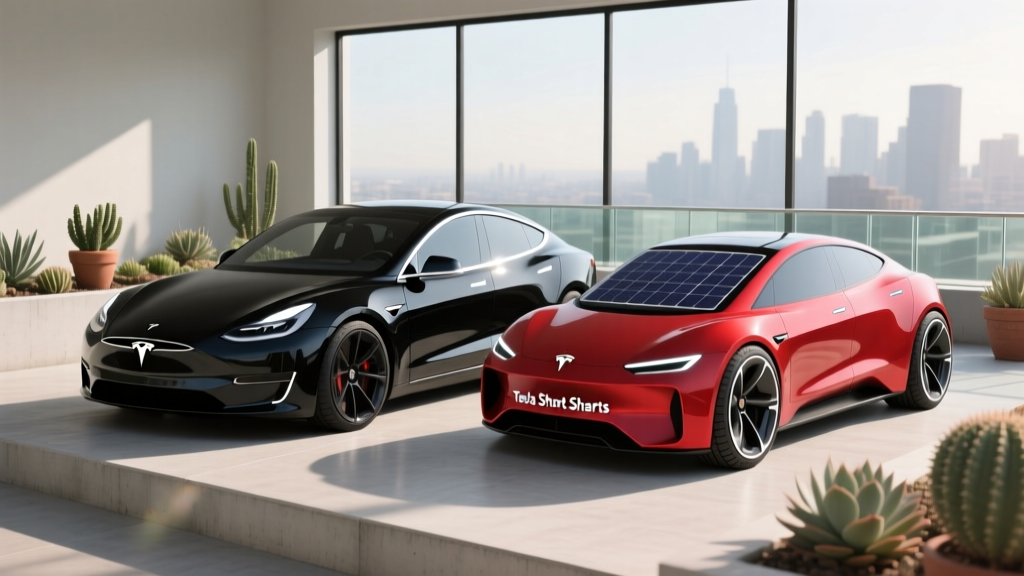
If you've spent any time in Tesla's orbit—whether browsing the online shop or scrolling EV forums—you've likely encountered the phrase Tesla short shorts. Elon Musk famously donned a pair of crimson Tesla-branded satin shorts to ring the NASDAQ bell, and they've since become a tongue-in-cheek symbol of Tesla's irreverent culture. But while the short shorts are a novelty item in Tesla's merchandise store, the vehicle most associated with that same bold, unapologetic energy is the 2026 Tesla Model S Plaid. This review gives you the full ownership picture: real range, charging reality, tax-credit math, and whether it's still worth the premium in an increasingly crowded luxury EV field.
Quick Verdict: The Model S Plaid in 2026
The 2026 Model S Plaid remains the benchmark for combining four-door practicality with hypercar-rivaling acceleration. At 1,020 horsepower and a 1.99-second 0-60 mph claim, it's absurdly fast. But the Plaid's real daily value lies in its 396-mile EPA range estimate (Long Range AWD variant), access to the most reliable DC fast-charging network in North America, and a continually improving software stack. The tradeoffs? A starting price near $89,990, limited rear-seat headroom, and a minimalist interior that polarizes buyers accustomed to traditional luxury sedans.
2026 Tesla Model S Core Specifications
| Spec | Model S Long Range AWD | Model S Plaid |
|---|---|---|
| EPA Est. Range | 402 miles | 396 miles |
| Battery Capacity (usable) | ~95 kWh (NMC) | ~95 kWh (NMC) |
| Drivetrain | Dual-Motor AWD | Tri-Motor AWD |
| Horsepower | 670 hp | 1,020 hp |
| 0-60 mph | 3.1 sec | 1.99 sec |
| Top Speed | 155 mph | 200 mph |
| Peak DC Fast Charge | 250 kW | 250 kW |
| 10-80% DCFC Time | ~30 min | ~30 min |
| Level 2 Home Charge (48A) | ~34 mi/hr (11.5 kW) | ~34 mi/hr (11.5 kW) |
| EPA Efficiency | 124 MPGe (27 kWh/100mi) | 116 MPGe (29 kWh/100mi) |
| Cargo (rear + frunk) | 28 cu ft + 3.1 cu ft | 28 cu ft + 3.1 cu ft |
| Rear Legroom | 35.4 in | 35.4 in |
| Base MSRP | $74,990 | $89,990 |
| Battery Warranty | 8 yr / 150,000 mi | 8 yr / 150,000 mi |
Real-World Range: Beyond the EPA Sticker
Real-World Highway (70-80 mph, mild weather): ~310-340 miles
Cold Weather (below 32°F, mixed driving): ~250-285 miles
Expectation: Plan road trips around ~280-300 usable miles per charge to preserve a comfort buffer and avoid the steep charge-curve taper above 80% SoC.
According to fueleconomy.gov, the Model S Plaid achieves 396 miles of EPA-estimated range. In practice, highway driving at sustained speeds above 75 mph drops efficiency to roughly 300-330 Wh/mi, yielding about 310-340 miles before the battery buffer kicks in. Winter conditions—especially below freezing—can reduce range by 20-30% due to cabin heating demands and reduced battery chemistry efficiency, even with Tesla's heat pump and battery preconditioning.
The tri-motor Plaid's carbon-sleeve rotors and high-performance tune prioritize output over efficiency. The Long Range dual-motor variant squeezes out a few more miles thanks to lower parasitic drivetrain losses. For owners who commute in moderate climates and charge at home nightly, either variant delivers more than enough range. Cross-country road trippers should use Tesla's built-in navigation, which factors elevation, wind, and temperature into its arrival SoC predictions with impressive accuracy.
Charging Speed: DC Fast Charging and Home Setup
| Level | Power | Miles Added per Hour | Notes |
|---|---|---|---|
| Level 1 (120V) | ~1.4 kW | ~4 mi/hr | Emergency/trickle only |
| Level 2 (240V, 48A) | 11.5 kW | ~34 mi/hr | Home Wall Connector; full charge ~10 hrs |
| DC Fast (Supercharger V2) | 150 kW peak | ~200+ mi in 15 min | Older stalls; taper begins ~60% SoC |
| DC Fast (Supercharger V3/V4) | 250 kW peak | ~200 mi in 15 min | 10-80% in ~30 min; steep taper above 80% |
The Model S charges via the NACS (North American Charging Standard) connector natively, granting seamless access to Tesla's Supercharger network—over 25,000 stalls in North America. At a V3 or V4 Supercharger, the Plaid peaks at 250 kW and adds roughly 200 miles in 15 minutes under ideal conditions (preconditioned battery, low starting SoC). However, like all lithium-ion packs, the charge curve tapers significantly: expect 10-80% in approximately 30 minutes, but 80-100% can take nearly as long. On road trips, Tesla's trip planner intelligently routes you to charge only as much as needed, which keeps you in the fast-charging portion of the curve.
At home, the Tesla Wall Connector (48 amps, 240V) delivers 11.5 kW, translating to about 34 miles of range per hour of charging. A full 0-100% charge takes roughly 10 hours—perfect for overnight replenishment. Installation costs typically range from $500 to $2,000 depending on whether your electrical panel needs a service upgrade (200A panel recommended). Always consult a licensed electrician for final specs.
Performance: Tri-Motor Fury
The Model S Plaid's tri-motor all-wheel-drive system—one motor up front, two in the rear—produces a combined 1,020 horsepower and achieves a manufacturer-claimed 1.99-second 0-60 mph time (with rollout subtracted). Independent testing by outlets like Motor Trend and Car and Driver has validated sub-2.1-second runs. This places the Plaid in hypercar territory at a fraction of the cost of a Rimac or Bugatti.
Beyond straight-line speed, the Plaid features torque vectoring across the rear axle, a carbon-ceramic brake option (requires the track package), and an adaptive air suspension that adjusts ride height and damping in real time. The yoke steering wheel, standard on the Plaid, takes adjustment—some drivers love the unobstructed display view; others find low-speed maneuvers awkward without a full rim to grip.
Pricing, Trims, and Federal Tax Credit Eligibility
| Trim | Base MSRP | Federal §30D Credit | Effective Price (if eligible) |
|---|---|---|---|
| Model S Long Range AWD | $74,990 | Not eligible (exceeds $55K sedan cap) | $74,990 |
| Model S Plaid | $89,990 | Not eligible (exceeds $55K sedan cap) | $89,990 |
Under current IRS §30D rules, new clean vehicle tax credits are capped at $55,000 MSRP for sedans (and $80,000 for SUVs/trucks/vans). The Model S, classified as a sedan, exceeds this threshold on every trim. As a result, no new Model S qualifies for the $7,500 federal tax credit, regardless of buyer income or battery sourcing.
Buyer income caps also apply: $300,000 MAGI for joint filers, $225,000 for heads of household, $150,000 for single filers. Even if the MSRP cap were met, high-earning buyers would be excluded. Tesla does not currently offer a lower-priced sedan trim to meet the threshold. State-level incentives (such as those in California, Colorado, or Massachusetts) may still apply—check your state's energy office for current programs.
Interior, Cargo, and Technology
The Model S cabin centers on a 17-inch landscape touchscreen running Tesla's proprietary infotainment OS, supplemented by a 12.3-inch driver instrument cluster and a rear 8-inch screen for passengers. The yoke or conventional round steering wheel (your choice at order) controls most vehicle functions, while physical buttons are nearly nonexistent—climate, mirrors, and glovebox are all screen-driven.
Cargo space is generous for a sedan: 28 cubic feet behind the rear seats (hatchback design) plus a 3.1 cu ft front trunk (frunk). With the rear seats folded (60/40 split), cargo capacity expands to approximately 79 cubic feet, rivaling many midsize SUVs. Rear legroom measures 35.4 inches—adequate for adults but tighter than a Mercedes EQS or BMW i7.
Standout tech:
- Autopilot (standard): Adaptive cruise, lane centering, auto emergency braking — SAE Level 2 driver-assist, requires active supervision
- Full Self-Driving (Supervised) ($8,000 option or subscription): Navigate on Autopilot, auto lane change, Smart Summon, traffic light/stop sign recognition — still Level 2
- 22-speaker premium audio with active noise cancellation
- Over-the-air (OTA) software updates that add features post-purchase
- Gaming-capable hardware (up to 10 teraflops) for in-car entertainment while parked or charging
Pros, Cons, and Competitor Comparison
- Sub-2-second 0-60 mph (Plaid); hypercar performance at sedan pricing
- 396-402 mile EPA range; best-in-class efficiency for the performance segment
- Unmatched Supercharger network access with NACS native connector
- OTA updates keep software and features current
- Hatchback cargo versatility with frunk adds practicality
- 8-year/150,000-mile battery & drive unit warranty
- No federal tax credit eligibility (sedan MSRP cap exceeded)
- Minimalist interior lacks the material luxury of Mercedes EQS, BMW i7
- Rear headroom and legroom tighter than German rivals
- Yoke steering controversial; takes adaptation for low-speed turns
- Insurance premiums run 20-40% higher than comparable luxury sedans
- Service center availability can mean longer wait times in some markets
Vs. the competition: The Lucid Air Grand Touring offers 516 miles of EPA range and a more opulent interior but starts above $109,000. The Porsche Taycan Turbo S delivers sharper handling dynamics and 800V charging architecture but sacrifices range (~283 miles EPA). The Mercedes EQS 580 provides a whisper-quiet luxury experience with ~371 miles of range but can't match the Plaid's acceleration. For pure performance-per-dollar, the Model S Plaid remains unmatched.
Frequently Asked Questions
What are Tesla short shorts, and can I still buy them?
"Tesla Short Shorts" are a satirical merchandise item—red satin shorts with the Tesla logo—originally sold in limited runs through the Tesla Shop. They sold out quickly and are now mostly found on resale markets. The term has become shorthand in EV communities for Tesla's playful brand identity, which extends to the Model S Plaid's over-the-top performance ethos.
Does the Model S qualify for the federal EV tax credit in 2026?
No. Under IRS §30D rules, sedans must have an MSRP at or below $55,000 to qualify. The Model S starts at $74,990 (Long Range) and $89,990 (Plaid), making it ineligible regardless of buyer income or battery sourcing. State incentives may still apply.
What is the real-world range of the Model S Plaid?
EPA-estimated at 396 miles. In real-world highway driving at 70-80 mph, expect 310-340 miles. In cold weather (below 32°F), plan for 250-285 miles. The onboard trip planner accounts for conditions when routing Supercharger stops.
How fast does the Model S charge at home and on the road?
At home on a Level 2 Tesla Wall Connector (48A/240V), you'll add ~34 miles per hour, with a full charge in ~10 hours. On a V3/V4 Supercharger, the Model S peaks at 250 kW and charges 10-80% in roughly 30 minutes.
Is the Model S Plaid worth buying over a Lucid Air or Porsche Taycan?
If straight-line acceleration, Supercharger access, and range-per-dollar are your priorities, the Plaid wins. If you value traditional luxury materials and rear-seat space, the Lucid Air or EQS may serve you better. If driving dynamics and handling precision matter most, the Taycan Turbo S is the driver's choice—though it sacrifices ~100+ miles of range.
What battery chemistry does the Model S use?
The Model S uses an NMC (nickel manganese cobalt) lithium-ion pack (~95 kWh usable). NMC offers high energy density suited to performance and long-range applications. Tesla recommends charging to 80-90% for daily use and 100% only before long trips to optimize long-term battery health.