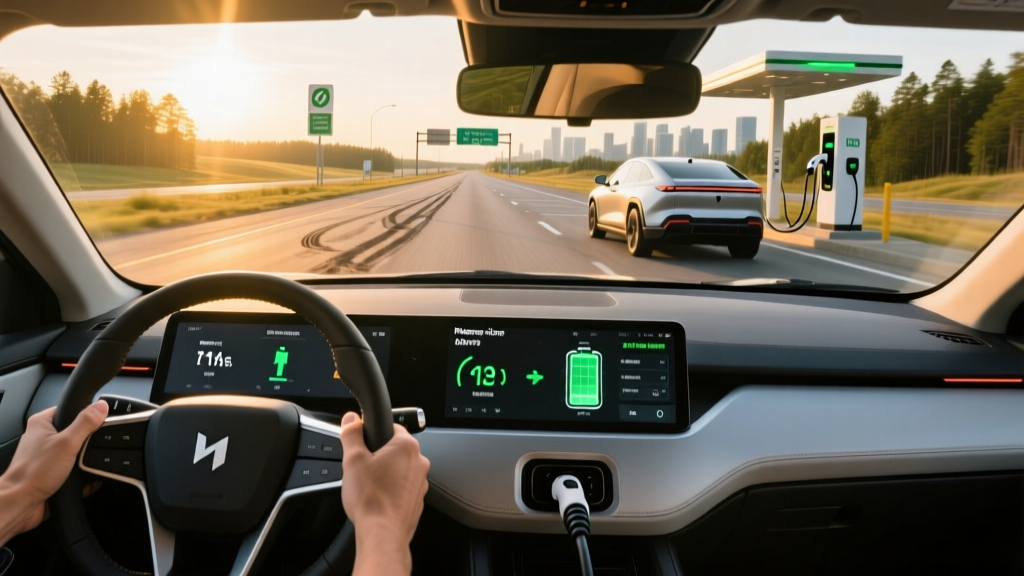
Rivian's Enhanced Highway Assist (EHA) is the automaker's Level 2 hands-free driving system, bundled into the R1T pickup and R1S SUV through the Driver+ software package. But for buyers researching this feature, the real questions extend far beyond the steering wheel: What is the actual highway range when EHA is engaged for hours at a time? How fast do these trucks charge on a road trip? And does the math still work after federal tax credits?
This profile breaks down the 2026 Rivian R1T and R1S — the two vehicles that carry Enhanced Highway Assist — with exact EPA figures, real-world range observations, charging curves, and ownership economics.
What Is Rivian Enhanced Highway Assist?
Enhanced Highway Assist is Rivian's hands-on-wheel, eyes-on-road driver-assistance system that combines adaptive cruise control with lane-centering on divided highways. It operates as a SAE Level 2 system, meaning the driver must remain fully engaged and ready to take over at any moment. It is not autonomous driving.
EHA is part of Rivian's Driver+ package, which also includes features like automatic lane changes (when the driver confirms with a turn signal), adaptive cruise with stop-and-go, and lane-keeping assist. The system works on mapped divided highways and uses a combination of cameras, radar, and ultrasonic sensors. As of 2026, EHA coverage has expanded significantly across the U.S. interstate system following multiple over-the-air updates.
Rivian R1T and R1S: Range, Battery, and Efficiency
Both the R1T (pickup) and R1S (three-row SUV) share the same skateboard platform and battery options. For 2026, Rivian offers the Dual-Motor and Quad-Motor configurations, with battery packs in Standard, Large, and Max capacities.
| Spec | R1T Dual-Motor (Large Pack) | R1T Quad-Motor (Max Pack) | R1S Dual-Motor (Large Pack) |
|---|---|---|---|
| EPA Range | 352 mi | 415 mi | 352 mi |
| Battery (usable) | ~106 kWh (NMC) | ~141 kWh (NMC) | ~106 kWh (NMC) |
| Efficiency | 73 MPGe / 46 kWh/100mi | 70 MPGe / 48 kWh/100mi | 73 MPGe / 46 kWh/100mi |
| 0-60 mph | 4.5 sec | 3.0 sec | 4.6 sec |
| Horsepower | 533 hp | 835 hp | 533 hp |
| Drivetrain | AWD (Dual-Motor) | AWD (Quad-Motor) | AWD (Dual-Motor) |
| Towing Capacity | 11,000 lbs | 11,000 lbs | 7,700 lbs |
| Battery Warranty | 8 yr / 175,000 mi | 8 yr / 175,000 mi | 8 yr / 175,000 mi |
Rivian uses NMC (nickel manganese cobalt) chemistry across its battery lineup. NMC offers higher energy density than LFP, which is critical for fitting large capacities into the skateboard platform. The trade-off is that NMC batteries are more sensitive to sustained 100% states of charge — Rivian recommends daily charging to 85-90% and reserving 100% for road trips.
According to fueleconomy.gov, the R1T Dual-Motor Large Pack achieves 73 MPGe combined, translating to roughly 46 kWh consumed per 100 miles driven. That's competitive with the Ford F-150 Lightning Extended Range (70 MPGe) but trails lighter, more aerodynamic EVs by a significant margin. The boxy truck shape and 6,000+ lb curb weight are the primary efficiency penalties.
Charging Speed: DC Fast Charging and Home Level 2
Charging speed is where Rivian has made meaningful gains with its Gen 2 platform. The R1T and R1S now support faster DC charging and come standard with the NACS (North American Charging Standard) port, granting native access to the Tesla Supercharger network without an adapter.
| Charging Level | Power / Rate | Speed (mi/hr) | Notes |
|---|---|---|---|
| Level 1 (120V) | 1.4 kW | ~3-4 mi/hr | Emergency/trickle only |
| Level 2 (240V, 48A) | 11.5 kW | ~25-28 mi/hr | Home overnight: 106 kWh in ~10 hrs |
| Level 2 (240V, 60A) | 14.4 kW (vehicle max) | ~32-35 mi/hr | Requires 60A+ circuit |
| DC Fast (Peak) | 200+ kW (Max Pack) | ~500+ mi/hr (peak) | 10-80% in ~30 min (Max Pack) |
| DC Fast (Large Pack) | ~190 kW (peak) | ~450+ mi/hr (peak) | 10-80% in ~28 min |
A few critical notes on the charging curve: the 200 kW peak rate on the Max Pack is not sustained. Like all EVs, the Rivian charge curve tapers significantly above 80% SoC. The 10-80% window is where the truck absorbs energy most aggressively. Plan road-trip stops around the 15-80% window for the best time efficiency — charging from 80-100% can add 20+ minutes for relatively few miles gained.
The native NACS port is a major practical advantage as of 2026. The Tesla Supercharger network remains the most reliable and widely deployed DC fast-charging infrastructure in the U.S., and Rivian owners can access it without the CCS-to-NACS adapter that earlier delivery vehicles required. This matters enormously for road-trip planning and charging-desert avoidance.
For home charging, the R1T and R1S accept up to 14.4 kW on Level 2 (with a 60-amp circuit). Most buyers install a 48-amp hardwired Level 2 charger on a 60-amp breaker, yielding 11.5 kW — enough to fully replenish the Large Pack overnight in about 10 hours. A licensed electrician should evaluate your panel capacity before installation, as these trucks draw substantial current.
Pricing, Trim Levels, and Federal Tax Credit Eligibility
Rivian positions the R1T and R1S in the premium electric truck and SUV segment. Pricing varies considerably by configuration, and federal tax credit eligibility adds complexity.
| Configuration | Base MSRP | §30D Credit Eligible? | Est. After Credit |
|---|---|---|---|
| R1T Dual-Motor (Standard Pack) | $69,900 | Yes (if under $80K MSRP cap) | ~$62,400 |
| R1T Dual-Motor (Large Pack) | $75,900 | Yes (under $80K cap) | ~$68,400 |
| R1T Quad-Motor (Max Pack) | $99,000+ | No — exceeds $80K truck cap | $99,000+ |
| R1S Dual-Motor (Large Pack) | $79,900 | Borderline — check trim/options | ~$72,400 (if eligible) |
| R1S Quad-Motor (Max Pack) | $105,000+ | No — exceeds $80K SUV cap | $105,000+ |
The Driver+ package (which includes Enhanced Highway Assist) is typically a $2,500-$4,000 add-on depending on the model year and subscription structure. Rivian has shifted some advanced driver-assist features to a subscription model, so buyers should confirm whether EHA is included in the purchase price or requires an ongoing monthly fee at the time of ordering.
Cargo, Passenger Space, and Practical Utility
The R1T's defining feature is its gear tunnel — a pass-through storage compartment between the cab and bed that holds roughly 11 cubic feet of gear. Combined with the 4.5-foot bed (extendable with the tailgate down), the R1T offers versatility that traditional trucks can't match in an electric package.
- R1T bed length: ~4.5 ft (5.5 ft with tailgate down)
- R1T gear tunnel: ~11 cu ft
- R1T frunk (front trunk): ~11 cu ft
- R1S cargo (behind 3rd row): ~10.6 cu ft
- R1S cargo (2nd row folded): ~46.7 cu ft
- R1S cargo (all rows folded): ~83.5 cu ft
- R1S 2nd-row legroom: ~39.5 inches
- R1S 3rd-row legroom: ~32.3 inches (tight for adults on long trips)
The R1S's third row is best suited for children or occasional use. For families that regularly carry six or seven adults, a larger SUV like the Rivian's own upcoming longer-wheelbase variant or a competitor like the Cadillac Escalade IQ may be more appropriate. But for most two-row or occasional-three-row use cases, the R1S is remarkably practical with its flat load floor and front trunk.
Enhanced Highway Assist: Real-World Performance and Limitations
On divided interstates with clear lane markings, Enhanced Highway Assist performs competently. The lane-centering is smooth, the adaptive cruise handles cut-ins predictably, and the system's confidence in gentle curves is reassuring. The driver-monitoring camera effectively tracks eye gaze, issuing warnings if attention drifts.
- It does not navigate exits, interchanges, or construction zones autonomously.
- It does not handle city streets, stoplights, or stop signs.
- It does not function reliably in heavy rain, snow, or when lane markings are faded or absent.
- It does not replace the driver. You are legally and operationally responsible for the vehicle at all times.
- Automatic lane changes require driver confirmation via turn signal — the system will not change lanes on its own.
Compared to GM's Super Cruise and Ford's BlueCruise, Rivian's EHA is competitive in core functionality but trails in total mapped highway coverage and hands-free duration in some scenarios. Where Rivian excels is the integration with its broader software ecosystem — OTA updates have materially improved the system since launch, and the company's development cadence suggests continued improvement. Still, buyers who prioritize the most mature hands-free highway driving should cross-shop Super Cruise on the Cadillac Lyriq or GMC Hummer EV.
Pros and Cons
Pros
- Native NACS port — full Tesla Supercharger access without adapters
- Class-leading performance: Quad-Motor 0-60 in 3.0 seconds
- Max Pack delivers 415 mi EPA (R1T) — best in electric truck segment
- 8-year/175,000-mile battery warranty exceeds industry standard
- Gear tunnel and frunk provide unique storage versatility (R1T)
- Regular OTA updates improve EHA and vehicle features over time
- 11,000-lb towing capacity (R1T) is competitive with full-size gas trucks
Cons
- Highway range drops significantly at 75+ mph and in cold weather
- Quad-Motor and Max Pack trims exceed $80K — no federal tax credit
- Efficiency (46-48 kWh/100mi) means higher electricity costs vs. lighter EVs
- Driver+ package may require subscription — confirm at purchase
- EHA coverage still expanding; not all divided highways are mapped
- R1S third row is cramped for adults on longer trips
- Insurance premiums run 15-25% higher than comparable gas trucks
Who Should Buy a Rivian with Enhanced Highway Assist?
The Rivian R1T with EHA is best suited for adventure-oriented truck buyers who want daily-driver refinement, weekend towing capability, and the latest in driver-assistance tech — and who have reliable home charging. The R1S fits families of four to five who want three rows, serious cargo space, and a premium cabin without defaulting to a minivan.
If your primary use case is long-distance highway commuting (200+ miles daily) in cold climates, the real-world range limitations of the Large Pack may push you toward the Max Pack — which in turn pushes you above the tax credit MSRP cap. Run the numbers carefully.
For buyers who want a premium electric truck but prioritize the most mature hands-free driving system above all else, cross-shop the Ford F-150 Lightning with BlueCruise and the GMC Sierra EV / Hummer EV with Super Cruise. Both offer comparable utility with different trade-offs in range, charging, and software maturity.
Frequently Asked Questions
What is the real-world range of the Rivian R1T on the highway?
With the Large Pack (106 kWh), expect roughly 280-310 miles at 75 mph in mild weather. The Max Pack (141 kWh) extends this to approximately 340-360 miles. Cold weather (below 30°F) can reduce these figures by 15-25%. Always plan charging stops conservatively — arriving at a charger with a 10% buffer is safer than running the battery to 5%.
How fast does the Rivian R1T charge on a road trip?
The Max Pack peaks above 200 kW on DC fast chargers, achieving a 10-80% charge in roughly 30 minutes. The Large Pack peaks around 190 kW with a similar 10-80% time of approximately 28 minutes. Remember that charging slows dramatically above 80% — for road trips, charge to 80% and move on rather than waiting for a full battery.
Does the Rivian R1T qualify for the $7,500 federal EV tax credit?
It depends on the trim. R1T Dual-Motor configurations with an MSRP at or below $80,000 can qualify, provided the buyer meets income limits ($300K joint / $150K single) and the vehicle meets battery sourcing requirements. Quad-Motor and Max Pack configurations typically exceed the $80K MSRP cap for trucks and do not qualify. Verify current rules at irs.gov before purchasing.
Is Enhanced Highway Assist included in the purchase price?
Rivian has moved some Driver+ features to a subscription model. At the time of ordering, confirm whether Enhanced Highway Assist is bundled with the vehicle or requires a monthly/annual subscription. This has changed across model years, so check your specific build configuration.
How does EHA compare to Tesla Autopilot or GM Super Cruise?
EHA is competitive with Tesla's basic Autopilot in lane-centering smoothness and adaptive cruise behavior. GM's Super Cruise offers a broader network of pre-mapped hands-free highways and a more permissive hands-off experience (with eye monitoring). Tesla's FSD (Supervised) attempts city-street capability but requires more active supervision. All three are SAE Level 2 — none is self-driving.
What is the Rivian battery warranty?
Rivian covers the battery pack and electric drivetrain for 8 years or 175,000 miles, whichever comes first. This is more generous than the industry-standard 8-year/100,000-mile warranty offered by most competitors. The warranty covers defects and excessive capacity degradation (typically below 70% state of health, though confirm the exact threshold with Rivian at purchase).
Can the Rivian R1T tow with Enhanced Highway Assist active?
EHA can function while towing, but the added weight and aerodynamic drag of a trailer will significantly reduce range — often by 30-50% depending on trailer size and speed. Plan charging stops much more frequently when towing. The system's lane-centering may also be less confident with a trailer due to altered vehicle dynamics.
Sources: EPA fuel economy data via fueleconomy.gov, Rivian official specifications, IRS Clean Vehicle Credits (irs.gov). All specs reflect 2026 model year at time of publication. Verify pricing and credit eligibility before purchase.