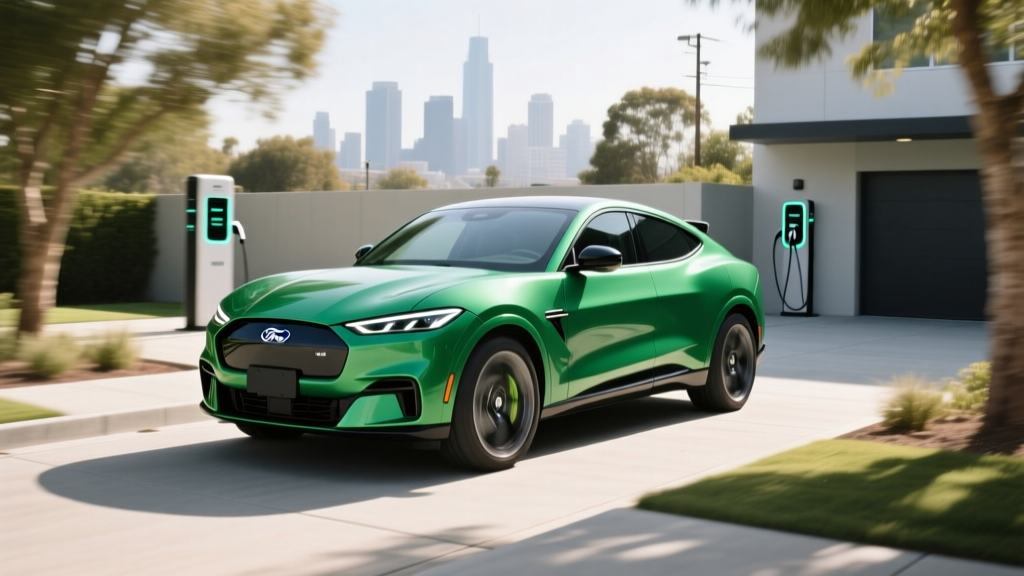
Ford's Mustang Mach-E has been a cornerstone of the mainstream electric crossover segment since its launch, and for 2026 it continues to offer one of the most balanced packages in its class. But beyond the performance specs and BlueCruise tech, a surprisingly common search among shoppers is the Mustang Mach-E green — buyers wanting to know whether Ford offers a green exterior paint option, how the eco-credentials stack up, and whether this electric SUV delivers on its environmental promises in real-world driving. This review covers everything: paint availability, real-world range, charging speeds, tax credit eligibility, and whether the Mach-E is the right electrified vehicle for your garage.
Mustang Mach-E Green Paint and Exterior Options for 2026
For the 2026 model year, Ford offers the Mach-E in a curated palette that shifts slightly from prior years. The closest to a true green in recent lineups has been colors like Eruption Green Metallic (available on select trims in 2024–2025) and Vineyard Green on earlier models. For 2026, Ford's exterior color availability varies by trim (Select, Premium, California Route 1, GT), and green hues have historically been limited-run or trim-specific offerings.
If a green Mustang Mach-E is a priority, your best strategies are:
- Check Ford's build-and-price tool for the current 2026 color matrix — paint availability changes mid-year.
- Search dealer inventory for remaining 2024–2025 Eruption Green Metallic units, which may still be on lots.
- Consider a vinyl wrap (~$2,500–$4,000) if your preferred trim doesn't offer green from the factory.
Beyond paint, the "green" story of the Mach-E is really about its lifecycle environmental impact: zero tailpipe emissions, a battery supply chain Ford has been actively working to localize under §30D critical-mineral sourcing rules, and an interior that uses recycled materials including a vegan-friendly upholstery option on select trims.
Real-World Range and Efficiency: What the EPA Number Doesn't Tell You
The 2026 Mustang Mach-E lineup offers multiple range tiers depending on battery pack and drivetrain:
| Trim/Config | Battery (Usable kWh) | Chemistry | EPA Range | MPGe (Combined) | kWh/100 mi |
|---|---|---|---|---|---|
| Select RWD (Standard Range) | 72 kWh | NMC | ~250 mi | 101 MPGe | 33 |
| Premium RWD (Extended Range) | 91 kWh | NMC | ~320 mi | 101 MPGe | 33 |
| Premium AWD (Extended Range) | 91 kWh | NMC | ~290 mi | 94 MPGe | 36 |
| GT AWD | 91 kWh | NMC | ~280 mi | 86 MPGe | 39 |
What this means on the road: The 320-mile EPA figure for the Extended Range RWD is achievable in moderate city/suburban driving at 45–55 mph with mild climate-control usage. On a 75-mph interstate run in 70°F weather, expect roughly 260–290 miles before you're hunting for a charger. In sub-30°F winter conditions, lithium-ion batteries lose efficiency and cabin heating draws significant power — plan for 220–250 miles of usable range. The Mach-E's heat pump (standard on Extended Range trims) helps mitigate this compared to resistive-heating EVs, but cold-weather range loss of 20–30% is physics, not a flaw.
According to fueleconomy.gov, the Mach-E Extended Range RWD posts 101 MPGe combined — competitive with the Hyundai Ioniq 5 (110 MPGe) and slightly behind the Tesla Model Y Long Range (122 MPGe) in pure efficiency.
Charging Speed: DC Fast Charging and Home Level 2
Charging speed is often the make-or-break factor for EV buyers, and the Mach-E delivers competent but not class-leading DC fast-charging performance.
| Charging Level | Power (kW) | Speed | Notes |
|---|---|---|---|
| Level 1 (120V household) | ~1.4 kW | ~3–4 mi/hr | Emergency/trickle only |
| Level 2 (240V home, 32A) | ~7.7 kW | ~22 mi/hr | Ford Mobile Charger included |
| Level 2 (240V, 48A wallbox) | ~11.5 kW | ~33 mi/hr | Recommended for daily use |
| DC Fast Charge (peak) | ~150 kW | 10–80% in ~38 min | CCS connector (NACS adapter available) |
Charging curve reality check: The Mach-E's peak 150 kW rate is not sustained across the entire session. You'll see peak rates between roughly 15–50% State of Charge (SoC), after which the curve tapers significantly. A 10–80% session takes approximately 38 minutes at a 150+ kW CCS station, but if you arrive at a charger with a cold battery (below ~60°F), preconditioning is essential — the Mach-E's battery thermal management will limit charge rates until the pack warms up. Always use the navigation-based preconditioning feature by entering your charging stop as a destination.
For 2026, Ford provides a NACS (Tesla Supercharger) adapter, giving Mach-E owners access to Tesla's 17,000+ Supercharger stalls — a major advantage for road-trip charging reliability. At home, a 48-amp Level 2 wallbox on a 60-amp circuit will fully replenish the Extended Range pack in roughly 8–9 hours, making overnight charging effortless.
Performance and Drivetrain: From Commuter to GT
The Mach-E's performance spectrum is wide. The base Select RWD makes 266 horsepower and hits 0–60 mph in roughly 6.3 seconds — brisk for daily commuting. Step up to the dual-motor AWD Extended Range and you get 346 hp with a 0–60 time around 5.1 seconds. The GT variant cranks output to 480 hp (with the Performance Upgrade) and drops 0–60 to approximately 3.5 seconds, putting it in genuine sports-car territory.
| Configuration | Horsepower | Torque (lb-ft) | 0–60 mph | Drivetrain |
|---|---|---|---|---|
| Select RWD | 266 hp | 387 | ~6.3 sec | Rear-Wheel Drive |
| Premium AWD (ER) | 346 hp | 428 | ~5.1 sec | Dual-Motor AWD |
| GT | 480 hp | 634 | ~3.5 sec | Dual-Motor AWD |
The Mach-E uses Ford's BlueCruise driver-assistance system, which is a SAE Level 2 hands-free highway driving feature on pre-mapped divided highways. BlueCruise allows hands-off operation with continuous eye monitoring, but the driver must remain attentive and ready to take over at any moment. This is not autonomous driving — it's an advanced cruise-and-lane-centering system that reduces fatigue on long trips. Coverage has expanded to over 130,000 miles of compatible highways across the US and Canada.
Pricing, Trims, and Federal Tax Credit Eligibility
The 2026 Mustang Mach-E starts at approximately $37,995 for the Select trim (before destination) and climbs through Premium (~$43,995), California Route 1 (~$46,000), and GT (~$53,995). Here's how federal incentives interact with pricing:
| Trim | Base MSRP | §30D Credit Eligibility | Effective Price (if eligible) |
|---|---|---|---|
| Select RWD | ~$37,995 | Up to $7,500 (subject to sourcing/income rules) | ~$30,495 |
| Premium RWD (ER) | ~$43,995 | Up to $7,500 | ~$36,495 |
| Premium AWD (ER) | ~$46,995 | Up to $7,500 | ~$39,495 |
| GT AWD | ~$53,995 | Up to $7,500 | ~$46,495 |
Critical §30D eligibility caveats (2026 tax year): The federal EV tax credit under IRS §30D is not automatic. Per IRS guidelines, you must meet all of the following:
- MSRP cap: SUVs/crossovers must have an MSRP at or below $80,000 (all Mach-E trims qualify).
- Income cap: Modified AGI must not exceed $150,000 (single), $225,000 (head of household), or $300,000 (joint).
- Battery sourcing: A percentage of critical minerals and battery components must be sourced from the US or free-trade-agreement countries. These thresholds increase annually — verify current-year compliance on the IRS qualified vehicles list before purchasing.
- Point-of-sale transfer: Since 2024, you can transfer the credit to the dealer at purchase, reducing your out-of-pocket cost immediately rather than waiting to claim it on your tax return.
The credit amount itself is split: $3,750 for meeting critical-mineral requirements and $3,750 for battery-component requirements. Depending on the Mach-E's supply-chain compliance in 2026, you may qualify for the full $7,500, a partial $3,750, or potentially $0 if sourcing thresholds are not met. Always confirm the specific VIN's eligibility on the DOE's qualified vehicle list before signing paperwork.
Cargo, Interior Space, and Daily Livability
The Mach-E is a midsize crossover, and its interior dimensions reflect that:
- Cargo volume (behind rear seats): 29.7 cu ft
- Cargo volume (rear seats folded): 59.7 cu ft
- Front trunk (frunk): 4.7 cu ft — useful for charging cables or a small bag
- Front legroom: 43.3 inches
- Rear legroom: 38.9 inches
The 15.5-inch vertical touchscreen running SYNC 4A dominates the dashboard and handles navigation, media, climate, and vehicle settings. Wireless Apple CarPlay and Android Auto are standard. The Mach-E also features a phone-as-a-key system (FordPass), over-the-air software updates, and a panoramic fixed glass roof that adds to the airy cabin feel. Build quality is solid, with soft-touch materials on upper surfaces, though some lower door panels use harder plastics typical of this price segment.
Notable drawback: Rear visibility is compromised by the coupe-like roofline and thick C-pillars. The 360-degree camera system helps, but it's a consideration for parking-heavy urban drivers.
Pros, Cons, and Who the Mach-E Suits Best
Pros
- Strong real-world range (Extended Range RWD: ~290 mi highway)
- Tesla Supercharger access via NACS adapter
- BlueCruise hands-free highway driving (130,000+ miles mapped)
- GT variant delivers genuine sports-car acceleration (3.5 sec 0–60)
- Competitive pricing after potential $7,500 tax credit
- Spacious cargo area with useful frunk
- Over-the-air updates continuously improve the vehicle
Cons
- DC fast charging peaks at ~150 kW — slower than Ioniq 5 (240 kW) or Model Y (250 kW)
- Green exterior paint options are limited or unavailable depending on trim/year
- Rear visibility hindered by styling
- No LFP battery option — NMC chemistry requires charge-management discipline
- Road-trip charging stops take ~38 min (10–80%), longer than some rivals
- Insurance premiums tend to run higher than equivalent gas crossovers
Who Should Buy the Mustang Mach-E?
Choose the Mach-E if: You want a mainstream electric crossover with strong brand recognition, Tesla Supercharger access, hands-free highway driving, and enough range for 250+ mile road-trip legs. The Premium Extended Range RWD is the sweet spot for commuters who want maximum range without the GT's energy thirst.
Look elsewhere if: You prioritize the fastest possible DC charging (Ioniq 5 or EV6 with 800V architecture), need three rows of seating (Kia EV9), or want an LFP battery for worry-free 100% daily charging (base Tesla Model Y RWD).
Battery Warranty and Long-Term Ownership
Ford covers the Mach-E's high-voltage battery with an 8-year/100,000-mile warranty (whichever comes first), guaranteeing that the battery will retain at least 70% of its original capacity during that period. The electric powertrain components are covered under the same 8-year/100,000-mile term. The basic bumper-to-bumper warranty is 3 years/36,000 miles.
The Mach-E uses NMC (nickel manganese cobalt) lithium-ion chemistry, which offers higher energy density than LFP but is more sensitive to prolonged high-state-of-charge storage. Best practices for NMC longevity:
- Set daily charge limit to 80–90% for routine use.
- Charge to 100% only when you need maximum range for a trip.
- Avoid leaving the vehicle at very low SoC (below 10%) for extended periods.
- Use DC fast charging sparingly — frequent 150 kW sessions accelerate degradation modestly.
Real-world data from Mach-E owners at 60,000–100,000 miles suggests degradation in the 5–10% range, which is consistent with industry averages for liquid-cooled NMC packs.
Frequently Asked Questions
What is the real-world range of the Mustang Mach-E?
The EPA rates the Extended Range RWD at 320 miles, but real-world highway driving at 70–75 mph yields approximately 260–290 miles. In cold weather (below 30°F), expect 220–250 miles. The Standard Range RWD delivers roughly 200–220 miles on the highway.
How fast does the Mach-E charge at home and on the road?
At home on a 48-amp Level 2 charger, the Mach-E adds about 33 miles of range per hour, fully charging overnight. On DC fast chargers, it peaks at approximately 150 kW, reaching 10–80% in about 38 minutes. The NACS adapter enables Tesla Supercharger access for road trips.
Does the 2026 Mustang Mach-E qualify for the federal EV tax credit?
The Mach-E is eligible for up to $7,500 under IRS §30D, but actual credit depends on your income (capped at $150K single / $300K joint), the vehicle's battery-sourcing compliance for the 2026 tax year, and MSRP (all trims are under the $80K SUV cap). The credit can be transferred to the dealer at point of sale. Always verify the specific VIN on the DOE qualified vehicles list.
Is the Mustang Mach-E worth buying vs. the Tesla Model Y or Ioniq 5?
The Mach-E competes well on range, interior quality, and Supercharger access (via adapter). The Tesla Model Y offers better efficiency and faster charging. The Hyundai Ioniq 5 charges faster (240 kW peak) and has more distinctive styling. The Mach-E wins on BlueCruise availability and Ford dealer service network breadth. Test-drive all three before deciding.
Can I get the Mustang Mach-E in green?
Green exterior paint availability varies by model year and trim. Eruption Green Metallic was offered on select 2024–2025 models. For 2026, check Ford's build-and-price configurator or search dealer inventory for remaining green units. A professional vinyl wrap is an alternative if factory green isn't available on your preferred trim.
Is BlueCruise self-driving?
No. BlueCruise is an SAE Level 2 driver-assistance system. It allows hands-free driving on pre-mapped divided highways, but the driver must remain attentive, keep eyes on the road (monitored by an infrared camera), and be ready to take over immediately. It does not handle construction zones, unmapped roads, or complex urban environments autonomously.