Why 'Tesla Server Down' Matters for EV Buyers in 2026
Searches for Tesla server down spike every few months — usually when a regional AWS outage or Tesla backend maintenance knocks the app, navigation routing, and Supercharger authentication offline simultaneously. For prospective Model 3 buyers in 2026, these outages raise a legitimate ownership question: how dependent is this car on a constant internet connection, and what actually stops working when the Tesla server is down?
This review covers the 2026 Tesla Model 3 (Highland refresh) with exact specs — EPA range, battery chemistry, DC fast-charge curves, real-world efficiency, and pricing after federal tax credits — while addressing the connectivity-dependency question that conventional EV reviews often skip. If you're cross-shopping the Model 3 against the Hyundai Ioniq 6, BMW i4, or Polestar 2, the server-dependency issue is a genuine differentiator.
2026 Tesla Model 3: Core Specifications at a Glance
| Spec | Model 3 RWD | Model 3 Long Range AWD | Model 3 Performance |
|---|---|---|---|
| EPA Range | 272 mi | 341 mi | 315 mi |
| Battery (usable) | ~57.5 kWh (LFP) | ~75 kWh (NMC) | ~75 kWh (NMC) |
| Drivetrain | RWD, single motor | AWD, dual motor | AWD, dual motor |
| Horsepower | 271 hp | 346 hp | 510 hp |
| 0-60 mph | 5.8 sec | 4.2 sec | 2.9 sec |
| Peak DC Charge Rate | 170 kW | 250 kW | 250 kW |
| 10-80% DCFC Time | ~25 min | ~18 min | ~18 min |
| Level 2 Home Charge | 11.5 kW (~44 mi/hr) | 11.5 kW (~44 mi/hr) | 11.5 kW (~44 mi/hr) |
| MPGe (combined) | 132 MPGe | 125 MPGe | 115 MPGe |
| kWh/100 mi | 25 kWh | 27 kWh | 30 kWh |
| Base MSRP | $38,990 | $45,990 | $52,990 |
| Battery Warranty | 8 yr / 100,000 mi | 8 yr / 120,000 mi | 8 yr / 120,000 mi |
Source: fueleconomy.gov and Tesla's 2026 spec sheets. Prices reflect current MSRP before destination fees or incentives.
Real-World Range: What the EPA Sticker Doesn't Tell You
EPA sticker: 341 miles. Expect ~280-300 miles on sustained highway driving at 70-75 mph. In freezing temperatures (below 32°F), plan for ~230-260 miles of usable range due to cabin heating demands and increased battery internal resistance. City driving with regenerative braking recovers closer to the EPA figure, often hitting 310-330 miles in mild conditions.
The Model 3 Long Range's 75 kWh NMC pack delivers strong efficiency — 27 kWh per 100 miles is competitive with the Ioniq 6's 25 kWh/100 mi, especially given the Tesla's superior Supercharger network access. The RWD model's LFP (lithium iron phosphate) battery sacrifices about 70 miles of range versus Long Range but gains cycle-life longevity: LFP cells tolerate repeated 100% charges without meaningful degradation, meaning daily commuters can charge to full without the 80% ceiling that NMC owners observe.
The Highland refresh improved the Model 3's drag coefficient to approximately 0.219 Cd, and Tesla added a heat pump as standard across all trims — a meaningful cold-weather upgrade over the pre-2024 resistive heater setup that could consume 3-5 kW of battery power in winter.
Charging Speed: DC Fast Charge and Home Level 2 Breakdown
| Charging Level | Power | Miles Added per Hour | Notes |
|---|---|---|---|
| Level 1 (120V household) | ~1.4 kW | ~5 mi/hr | Emergency/trickle only |
| Level 2 (240V, 48A) | 11.5 kW | ~44 mi/hr | Full overnight charge in 7-8 hours |
| DC Fast Charge (RWD) | Peak 170 kW | ~650 mi/hr (peak) | 10-80% in ~25 min; tapers sharply above 80% |
| DC Fast Charge (LR/Perf) | Peak 250 kW | ~950 mi/hr (peak) | 10-80% in ~18 min; sustains 200+ kW to ~50% SoC |
Tesla's charge curve on the Long Range and Performance trims is among the best in the segment. The 250 kW peak isn't just a marketing number — the Model 3 sustains above 200 kW from roughly 10% to 50% state of charge before tapering. By comparison, the BMW i4 eDrive40 peaks at 205 kW but drops off more aggressively after 40% SoC.
When the Tesla server is down, Supercharger authentication can fail. The car's RFID-based fallback (tapping your Tesla key card at the stall) doesn't work at all Supercharger generations — V3 and V4 stalls rely on the vehicle's cellular handshake with Tesla's backend. In practice, most outages last 15-45 minutes, but during a prolonged outage, you may need to rely on third-party CCS networks (Electrify America, EVgo) using the Model 3's NACS-to-CCS adapter, which Tesla now includes with new vehicles.
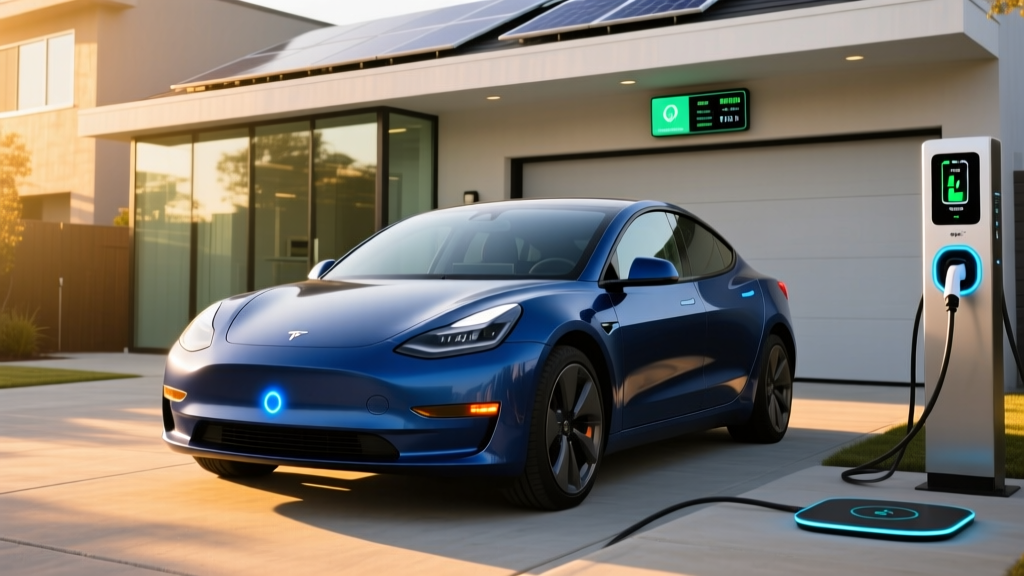
Home Level 2 charging requires a Tesla Wall Connector ($420) or any J1772 station with a NACS adapter. A 60A circuit delivering 48A continuous provides the full 11.5 kW — expect roughly $500-$1,500 for professional installation depending on panel proximity, according to typical licensed electrician rates. If your home has a 100A panel, you may need a $1,500-$3,000 panel upgrade to support a 60A dedicated circuit.
What Actually Breaks When the Tesla Server Is Down
The Model 3's reliance on Tesla's cloud backend is deeper than most EVs. Here's what works and what doesn't during an outage:
- Still works: Driving, acceleration, regenerative braking, climate control, Bluetooth audio, locally cached navigation maps, key card/phone-key unlock (via BLE), Sentry Mode recording to USB drive
- Partially degraded: Navigation loses live traffic and Supercharger stall-availability data; route energy predictions may be less accurate without real-time elevation/weather API calls
- Stops working: Tesla mobile app (remote lock/unlock, climate pre-conditioning, location tracking), Supercharger plug-and-charge authentication at some stalls, FSD map updates, over-the-air software updates, streaming media (Spotify, Tidal via car's connection), Tesla Profile loading at non-home locations
For daily driving, the impact is modest — the car is a functional vehicle without its server connection. For road trips relying on real-time Supercharger routing, an outage is a genuine inconvenience. Keep a CCS adapter in the trunk and have the Electrify America or EVgo app on your phone as a backup.
Pricing, Tax Credits, and Total Cost
| Trim | Base MSRP | Destination | Est. §30D Credit | Effective Price |
|---|---|---|---|---|
| Model 3 RWD | $38,990 | $1,390 | Up to $7,500* | ~$32,880 |
| Model 3 Long Range AWD | $45,990 | $1,390 | Up to $7,500* | ~$39,880 |
| Model 3 Performance | $52,990 | $1,390 | Up to $7,500* | ~$46,880 |
*Federal §30D tax credit eligibility requires meeting ALL of the following, per IRS rules:
- MSRP cap: Vehicle must be under $55,000 (sedans) — the Performance trim at $52,990 base qualifies, but options can push it over
- Buyer income cap: AGI ≤ $150,000 (single), $225,000 (head of household), $300,000 (joint)
- Battery sourcing: Critical minerals and battery components must meet phased-in domestic/free-trade-ally sourcing percentages (2026 thresholds are stricter than 2024)
- Point-of-sale transfer: You can apply the credit as a dealer discount at purchase rather than waiting for tax filing
Tesla's battery sourcing has historically met the critical-minerals threshold, but component-sourcing rules tighten annually. Verify current eligibility on fueleconomy.gov's credit lookup tool before purchasing — don't assume the full $7,500 without confirming the specific VIN qualifies.
Interior, Cargo, and Daily Livability
The Highland refresh added ventilated front seats, ambient lighting, rear-seat ventilation, and a rear touchscreen — addressing the two biggest complaints about the pre-2024 Model 3's spartan interior. Build quality has improved noticeably: panel gaps are tighter, and the cabin is substantially quieter thanks to acoustic glass and additional sound deadening.
- Cargo volume: 23 cu ft (trunk) + 3.1 cu ft (frunk) = 26.1 cu ft total
- Rear legroom: 35.3 inches — adequate for adults under 6'0", tight for taller passengers on long trips
- Front headroom: 40.3 inches
- Curb weight: ~3,862 lbs (RWD) to ~4,034 lbs (Performance)
Compared to the Hyundai Ioniq 6 (which offers similar range but less cargo space at ~12.3 cu ft trunk), the Model 3 is the more practical family sedan. Compared to the BMW i4 Gran Coupe, the Tesla offers comparable rear space but a more usable frunk.
Driver Assistance: Autopilot, FSD, and SAE Level 2 Reality
Tesla's Autopilot and Full Self-Driving (Supervised) are SAE Level 2 systems. The driver must remain engaged, hands on or near the wheel, and eyes on the road at all times. These are NOT self-driving systems. Tesla's camera-only "Tesla Vision" approach uses 8 cameras and a neural network for lane centering, adaptive cruise, and traffic-light recognition — but it does not replace driver attention.
Autopilot (included) handles highway lane centering and adaptive cruise competently. FSD Supervised ($8,000 one-time or $99/month in 2026) adds city-street navigation, stop-sign/light recognition, and automatic turns. Real-world FSD performance varies significantly by geography — it's more confident in well-marked Sun Belt suburbs than in construction-heavy Northeast cities. During a Tesla server outage, FSD's map-dependent routing features may degrade, though basic Autopilot lane-keeping and cruise control operate from onboard sensors and remain functional.
Pros, Cons, and the Verdict
- Supercharger network: 6,000+ U.S. stalls with reliable plug-and-charge (when server is up)
- Class-leading DC fast-charge curve on Long Range/Performance (250 kW sustained)
- LFP battery on RWD allows daily 100% charging without degradation concern
- OTA updates continuously add features — the car improves post-purchase
- Strong resale value relative to non-Tesla EVs
- Heat pump standard on all trims for cold-weather efficiency
- Server dependency: app, Supercharger auth, and live nav all fail during outages
- No Apple CarPlay or Android Auto — Tesla's native UI is the only option
- Rear-seat space is tighter than competitors like the Ioniq 6 or Polestar 2
- FSD at $8,000 remains a Level 2 system, not autonomous driving
- Insurance premiums run 15-30% higher than comparable gas sedans
- No physical buttons for climate/mirrors — all touchscreen-controlled
Who Should Buy the 2026 Tesla Model 3?
Choose the Model 3 if: You have home Level 2 charging, prioritize access to the Supercharger network for road trips, want the strongest OTA update pipeline, and value the LFP battery option for worry-free daily charging.
Look elsewhere if: You need Apple CarPlay, want physical climate controls, frequently drive in areas with poor cellular coverage (amplifying server-dependency issues), or need maximum rear-seat space for tall passengers.
Consider the Ioniq 6 if: You want comparable range (361 mi EPA on SEL), slightly better efficiency, and a more traditional dealership/service experience — but accept a less reliable public charging network.
Frequently Asked Questions
Can I still drive and charge my Tesla when the server is down?
Yes. Driving, climate control, and local navigation all function offline. Home Level 2 charging works without any server connection. Supercharger charging may require the CCS adapter and a third-party network app during prolonged outages, as some V3/V4 stalls require Tesla backend authentication.
What is the real-world range of the 2026 Model 3?
The Long Range AWD delivers approximately 280-300 miles on highway trips at 70-75 mph in mild weather, and 230-260 miles in sub-freezing conditions. The RWD model with LFP battery typically yields 220-240 miles highway. City driving with regen braking recovers closer to the EPA sticker figures.
Does the 2026 Model 3 qualify for the $7,500 federal EV tax credit?
The RWD and Long Range trims generally qualify, and the Performance trim qualifies if its as-equipped MSRP stays under the $55,000 sedan cap. Buyer income limits apply ($150K single / $300K joint AGI), and battery-sourcing requirements must be met for the specific VIN. Verify on fueleconomy.gov and consult a tax professional.
How fast does the Model 3 charge at home and on DC fast chargers?
On a 48A Level 2 home charger, the Model 3 adds about 44 miles of range per hour — a full charge takes 7-8 hours. On DC fast chargers, the Long Range and Performance trims peak at 250 kW, reaching 10-80% in approximately 18 minutes. The RWD model peaks at 170 kW with a 10-80% time of about 25 minutes.
Is the Model 3 worth buying over the Hyundai Ioniq 6 or BMW i4?
The Model 3 wins on charging network access, software updates, and LFP battery longevity. The Ioniq 6 offers slightly more EPA range and lower pricing. The BMW i4 offers a more traditional luxury interior and Apple CarPlay. If Supercharger reliability matters for your road trips, the Model 3 remains the pragmatic choice despite its server dependency.
What's the battery warranty on the 2026 Model 3?
Tesla covers the battery and drive unit for 8 years or 100,000 miles on the RWD trim, and 8 years or 120,000 miles on Long Range and Performance trims. The warranty guarantees at least 70% capacity retention over the warranty period. Tesla's official warranty page details exclusions including track use and flood damage.