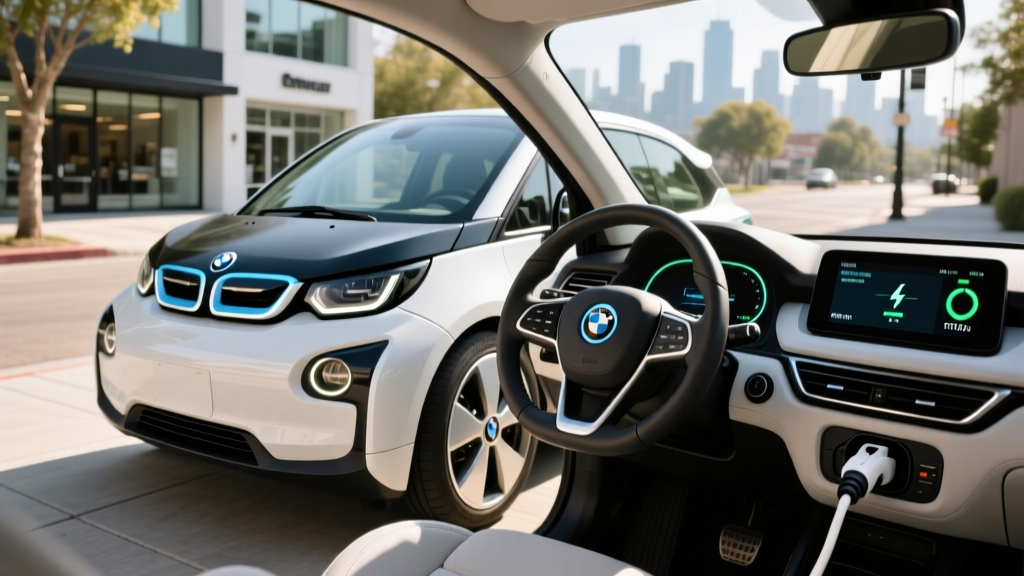
The 2016 BMW i3 was an engineering moonshot when it debuted — a carbon-fiber-reinforced plastic (CFRP) passenger cell, rear-wheel-drive electric motor, and a quirky, futuristic interior built from recycled and renewable materials. A decade later, it sits on the used EV market at bargain prices, often between $8,000 and $16,000 depending on mileage and condition. But can an 81-mile EPA-range city car still serve as a practical daily driver in 2026? This review breaks down every spec that matters to a used-EV buyer: real-world range, battery degradation, charging speeds, and ownership economics.
2016 BMW i3 At a Glance: Full Spec Sheet
| Specification | 2016 BMW i3 BEV | 2016 BMW i3 REx (Range Extender) |
|---|---|---|
| EPA Range (Electric) | 81 miles | 72 miles (electric) + ~72 miles (gas) |
| Total Range (REx) | — | ~150 miles combined |
| Battery Capacity (Gross / Usable) | 22 kWh / 18.8 kWh | 22 kWh / 18.8 kWh |
| Battery Chemistry | Samsung SDI NMC (Nickel Manganese Cobalt) | Samsung SDI NMC |
| Motor Output | 170 hp / 184 lb-ft torque | 170 hp / 184 lb-ft torque |
| Drivetrain | Rear-wheel drive (single-speed) | Rear-wheel drive (single-speed) |
| 0–60 mph | 7.0 seconds | 7.8 seconds |
| Top Speed | 93 mph (electronically limited) | 93 mph |
| DC Fast Charge (Peak) | 50 kW (CCS Combo 2 option) | 50 kW (CCS option) |
| Level 2 Charge Rate | 7.4 kW | 7.4 kW |
| EPA Efficiency | 124 MPGe (27 kWh/100mi) | 117 MPGe (combined EV+gas) |
| Cargo Volume | 15.1 cu ft (rear seats folded) | 15.1 cu ft |
| Curb Weight | 2,799 lbs | 3,098 lbs |
| Original Base MSRP | $43,395 (incl. destination) | $47,245 |
| Used Price Range (2026) | $8,000–$14,000 | $10,000–$16,000 |
| Battery Warranty (Original) | 8 years / 80,000 miles | 8 years / 80,000 miles |
Real-World Range: What 81 EPA Miles Actually Means
Real-World Expectation: 65–75 miles in mixed city/highway driving; 50–60 miles at sustained 70+ mph highway speeds or in temperatures below 35°F.
The 2016 BMW i3's 22 kWh battery (18.8 kWh usable) was modest even for its era. The EPA rated it at 81 miles for the pure-electric BEV variant and 72 electric miles for the REx (Range Extender) model, which adds a 647cc two-cylinder gasoline generator.
In practice, the i3's tall, narrow 155/70R19 tires and lightweight CFRP body deliver exceptional city efficiency — often achieving 3.5 to 4.0 miles per kWh in stop-and-go traffic thanks to aggressive regenerative braking. However, highway driving is where this car struggles. At 70 mph, aerodynamic drag and the lack of a multi-speed transmission push consumption to 4.5+ miles per kWh, cutting effective range to roughly 60 miles on a warm day.
Cold weather compounds the problem. The i3's battery thermal management system is passive (air-cooled with an optional cabin heat pump), and the NMC chemistry loses roughly 25–35% of its capacity in sub-freezing temperatures. Expect 50–55 miles of real range in a 25°F winter commute. If you're considering this car, your daily round-trip commute should ideally stay under 45 miles to maintain a comfortable buffer.
Charging Speed: DC Fast, Level 2, and Level 1
| Charging Level | Power / Rate | Time (0–100% or 10–80%) | Miles Added per Hour |
|---|---|---|---|
| Level 1 (120V household) | ~1.4 kW | ~14 hours (full charge) | ~5 miles/hr |
| Level 2 (240V / 32A) | 7.4 kW | ~3 hours (full charge) | ~25 miles/hr |
| DC Fast Charge (CCS) | 50 kW peak | ~28 min (10–80%) | ~100 miles/hr (at peak) |
A critical detail for used buyers: not every 2016 i3 has DC fast charging. BMW offered the CCS (Combined Charging System) DC fast-charge port as a $750 option. Many base models were delivered with only a Level 2 J1772 port, meaning they max out at 7.4 kW AC charging. Always verify the presence of the CCS port (a larger, two-pin lower section below the standard J1772 connector) before purchasing.
For vehicles equipped with CCS, the 50 kW peak rate sounds modest by 2026 standards, but the i3's small 18.8 kWh usable battery means it charges quickly in absolute terms. A 10–80% session takes roughly 28 minutes at a functional 50 kW station. The charge curve holds relatively well until about 70% State of Charge (SoC), then tapers significantly — a common trait of early NMC cells without sophisticated thermal preconditioning.
Level 2 home charging is the i3's sweet spot. A standard 240V/32A home charger replenishes the pack in about 3 hours, which is perfectly adequate for overnight top-ups. The onboard charger accepts up to 7.4 kW, so you won't benefit from installing a 48A or 11.5 kW wallbox — the car is the bottleneck.
Performance and Driving Dynamics
BMW's "eDrive" powertrain produces 170 horsepower and 184 lb-ft of instant torque, routed through a single-speed reduction gear to the rear wheels. The 0–60 mph sprint takes 7.0 seconds in the BEV and 7.8 seconds in the heavier REx variant. Those numbers were genuinely quick for a subcompact in 2016 and still feel peppy in city driving.
The i3's driving character is dominated by two factors: its ultra-lightweight construction (under 2,800 lbs for the BEV) and its aggressive one-pedal regenerative braking. Lift off the accelerator and the car decelerates sharply — most owners rarely touch the brake pedal in city traffic. The narrow tires prioritize efficiency over grip, so the i3 is a confident commuter rather than a corner carver, despite its near 50/50 weight distribution and rear-drive layout.
Ride quality is firm. The short wheelbase (101.2 inches) and stiff suspension tuning transmit road imperfections directly into the cabin. This is a car engineered for European cobblestones and tight city streets, not American highway expansion joints.
Interior Space, Tech, and Build Quality
The i3's interior remains one of the most distinctive in the EV world. BMW used eucalyptus wood trim, recycled PET plastic textiles, and kenaf (natural fiber) door panels to create a lounge-like cabin that feels more Scandinavian than Bavarian. The "coach doors" (rear-hinged back doors) provide decent rear-seat access, though the rear seats are best suited for children or short trips.
Key interior dimensions:
- Front headroom: 39.6 inches
- Front legroom: 40.5 inches
- Rear headroom: 37.2 inches
- Rear legroom: 31.9 inches (tight for adults over 5'10")
- Cargo (behind rear seats): 15.1 cu ft with seats folded; ~7.5 cu ft with seats up
The infotainment system runs BMW's iDrive with a 6.5-inch display (10.25-inch with the optional Technology/Navigation package). It supports Bluetooth audio and USB input but lacks Apple CarPlay and Android Auto — a significant omission by 2026 standards. The available Driving Assistant Plus package adds forward collision warning, pedestrian detection, and adaptive cruise control, but there is no lane-keeping assist or blind-spot monitoring. This is an SAE Level 0–1 vehicle in terms of driver assistance — no hands-off or eyes-off capability.
Used Pricing and Federal Tax Credit Eligibility
The 2016 BMW i3 originally started at $43,395 (BEV) and $47,245 (REx) before incentives. In the 2026 used market, expect to pay:
| Variant | Used Price Range | Federal Used EV Credit (§25E) | Effective Cost After Credit |
|---|---|---|---|
| i3 BEV (Mega World base) | $8,000–$11,000 | Up to $4,000 (30% of sale price) | $5,000–$8,000 |
| i3 BEV (Giga/Tera World) | $10,000–$14,000 | Up to $4,000 | $7,000–$11,000 |
| i3 REx (Range Extender) | $10,000–$16,000 | Up to $4,000 | $7,000–$13,000 |
Important tax credit details: The 2016 i3 is no longer eligible for the new-vehicle §30D credit (that program applies to new purchases only). However, it can qualify for the §25E Used Clean Vehicle Credit, which provides up to $4,000 or 30% of the sale price (whichever is lower). Key eligibility requirements:
- The vehicle must be purchased from a licensed dealer (private-party sales do not qualify)
- Sale price must be $25,000 or less (easily met for the i3)
- Buyer's adjusted gross income must not exceed $75,000 (single) / $150,000 (joint)
- The credit can be applied at the point of sale as an immediate discount
- The vehicle must have a battery capacity of at least 7 kWh (the i3's 22 kWh pack qualifies)
Always verify eligibility with a tax professional and the dealer before finalizing the purchase, as IRS rules and dealer participation can vary.
Battery Degradation and Longevity
The 2016 i3 uses Samsung SDI NMC (Nickel Manganese Cobalt) cells arranged in 8 modules of 12 cells each. BMW's original battery warranty guaranteed the pack would retain at least 70% of its original capacity for 8 years or 80,000 miles. Since all 2016 models are now past the 8-year mark, that factory battery warranty has expired for every vehicle in this model year.
Real-world degradation data from owner communities and fleet studies shows the i3's 22 kWh pack typically retains 80–90% of its original capacity at 60,000–80,000 miles when the car has been garage-kept and not repeatedly DC fast-charged. Units in hot climates (Arizona, Southern California) or those frequently charged to 100% and DC fast-charged may show 70–78% State of Health (SoH). Before buying, request a battery diagnostic from a BMW dealer or use an OBD-II dongle with an app like BimmerLink to read the actual SoH percentage.
Battery replacement cost is the elephant in the room. A refurbished 22 kWh pack from BMW runs approximately $8,000–$12,000 installed as of 2026 — a significant expense relative to the car's value. Some independent EV shops offer cell-level repairs for $3,000–$5,000, replacing only degraded modules. Third-party upgraded 33 kWh or 42 kWh packs (pulled from later i3 model years) are occasionally available through specialist shops, though compatibility and warranty support vary.
Pros and Cons: Honest Assessment
Pros
- Exceptional city efficiency (124 MPGe; 3.5–4.0 mi/kWh)
- Ultra-lightweight CFRP construction — unique in its class
- Tight 25.1-foot turning circle — ideal for urban parking
- Strong regenerative braking enables true one-pedal driving
- Distinctive, sustainable interior materials
- Low used purchase price; eligible for up to $4,000 used-EV credit
- Premium BMW build quality and dealer service network
Cons
- Very limited range (81 mi EPA; ~60 mi highway)
- DC fast charging was optional — many units lack CCS
- Expired 8-year battery warranty; replacement cost exceeds car value
- No Apple CarPlay or Android Auto
- Cramped rear seats; limited cargo space
- Expensive, low-profile tires ($200–$300 each)
- Firm ride quality on rough roads
- No advanced driver-assist features (lane-keep, blind-spot)
2016 BMW i3 vs. Key Used-EV Competitors
In the $8,000–$16,000 used EV market, the i3 competes against several alternatives worth cross-shopping:
- 2016–2017 Nissan Leaf (30 kWh): 107-mile EPA range, more cargo space, lower maintenance costs, but no active thermal management (passive air-cooled battery degrades faster in hot climates). CHAdeMO DC charging is standard. Less engaging to drive.
- 2017 Volkswagen e-Golf: 125-mile EPA range (with 35.8 kWh pack), more conventional and practical hatchback layout, CCS standard, better highway comfort. Slightly higher used prices ($12,000–$18,000).
- 2017 Chevrolet Bolt EV: 238-mile EPA range — in a completely different league for range. More affordable to own long-term. Higher used prices ($14,000–$20,000) but dramatically more practical for mixed use.
Choose a competitor if: You need more than 80 miles of range, you take regular highway trips, you need rear-seat space for adults, or you're concerned about out-of-warranty battery replacement costs. The Bolt EV or e-Golf are more versatile daily drivers.
Frequently Asked Questions
Does the 2016 BMW i3 qualify for any federal tax credit?
Not the new-vehicle §30D credit — that only applies to new purchases. However, it can qualify for the §25E Used Clean Vehicle Credit of up to $4,000 if purchased from a licensed dealer for $25,000 or less, and your income is within IRS limits ($75K single / $150K joint filer). Confirm eligibility with your dealer and tax professional.
What is the real-world range of a 2016 BMW i3 in 2026?
With typical battery degradation (80–90% SoH at this age), expect 65–75 miles in mixed city driving and 50–60 miles at highway speeds. In freezing weather, subtract another 20–30%. The REx model adds approximately 72 miles of gasoline-generated range for a total of roughly 140–150 miles.
Is the 2016 i3's battery warranty still active?
No. BMW's original 8-year/80,000-mile battery warranty has expired for all 2016 model-year vehicles as of 2024. Any battery failure or significant degradation is now the owner's financial responsibility.
Can I upgrade the 2016 i3's battery to a larger pack?
BMW offered a factory 33 kWh battery upgrade for early i3 models in some markets, but availability in the US is limited and expensive ($10,000+). Some independent EV specialists retrofit later 42 kWh packs, but this is a niche service. Budget for a potential battery replacement rather than counting on an upgrade.
Does the 2016 i3 support Apple CarPlay or Android Auto?
No. BMW did not add CarPlay to the i3 until the 2018 model year, and Android Auto was never offered. Aftermarket solutions like third-party iDrive interface boxes exist but add cost and complexity.
How reliable is the 2016 BMW i3?
The electric drivetrain is generally robust — the motor and power electronics have proven durable well past 100,000 miles. The main reliability concerns are the 12V auxiliary battery (common failure point in all EVs), the REx engine's fuel system if not exercised regularly, and the specialty tires. BMW's i3-specific parts remain available through the dealer network, though some cosmetic and interior trim pieces are becoming harder to source.
Is the Range Extender (REx) worth the premium?
If your commute occasionally exceeds 60 miles or you lack reliable public charging on your routes, the REx provides meaningful peace of mind with its additional ~72 miles of gasoline range. However, the two-cylinder engine is noisy, adds weight (reducing electric range to 72 miles), and requires standard ICE maintenance (oil changes, fuel system). For strict city commuters with home charging, the pure BEV is simpler and lighter.
Bottom Line: Who Should Buy a 2016 BMW i3?
The 2016 BMW i3 is a compelling used-EV bargain for a very specific buyer: someone with a short, predictable commute, reliable home charging, and an appreciation for the i3's engineering ambition and design. At $8,000–$14,000 (potentially $5,000–$10,000 after the §25E used-EV credit), it's one of the most affordable ways into a premium-brand EV.
But honesty demands acknowledging its limitations. The 81-mile EPA range is restrictive, the battery warranty has expired, and a replacement battery could total the car financially. If your needs extend beyond city commuting — regular highway driving, longer trips, or family hauling — the 2017+ Chevy Bolt EV or VW e-Golf are more practical choices at similar prices. The i3 is a brilliant city runabout that pioneered carbon-fiber EV construction. Just be clear-eyed about what it is, and what it isn't.