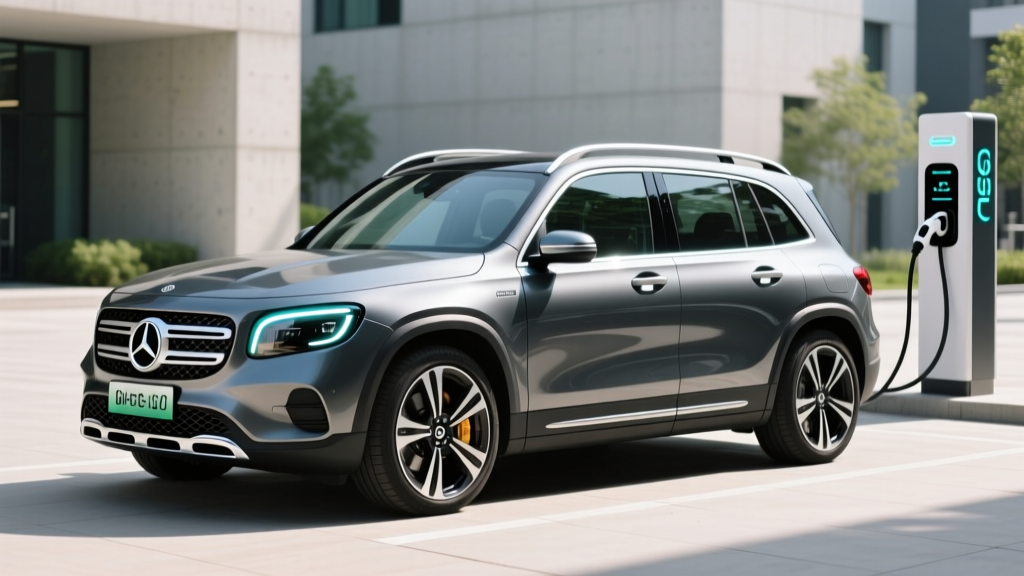
If you're searching for a Mercedes GLB EV, you are looking at the Mercedes-Benz EQB, the all-electric sibling of the popular GLB compact SUV. For the 2026 model year, the EQB 300 4MATIC delivers an EPA-estimated 245 miles of range from its 66.5 kWh (usable) battery, starts at roughly $54,200 before destination, and peaks at 100 kW on DC fast chargers (10–80% in about 32 minutes). It qualifies for a partial or full federal tax credit under current IRS §30D rules depending on your income, the vehicle's MSRP cap status, and battery-mineral sourcing — always verify with your tax professional before purchasing.
Quick Verdict: The Mercedes GLB EV (EQB) at a Glance
Best for: Urban and suburban families who want a premium compact electric SUV with optional third-row seating, home Level 2 charging access, and daily commutes under 150 miles round-trip.
Think twice if: You regularly road-trip 300+ miles, live in a charging desert without home charging, or need class-leading DC fast-charge speeds. The 245-mile EPA range and 100 kW peak charge rate are adequate, not exceptional, for the price point.
Range, Battery, and Charging: The Numbers That Matter
The 2026 EQB 300 4MATIC uses a 66.5 kWh usable lithium-ion (NMC chemistry) battery pack powering dual electric motors for all-wheel drive. Here is what the official and real-world data looks like:
| Specification | 2026 Mercedes-Benz EQB 300 4MATIC |
|---|---|
| EPA Range | 245 miles |
| Real-World Highway (~70 mph) | ~210–225 miles |
| Real-World Cold Weather (below 30°F) | ~180–200 miles |
| Battery Capacity (usable) | 66.5 kWh (NMC) |
| Efficiency | 87 MPGe combined (per fueleconomy.gov) |
| DC Fast Charge Peak | 100 kW |
| 10–80% DC Fast Charge Time | ~32 minutes |
| Level 2 (240V, 48A) Charge Time | ~7.5 hours (0–100%) |
| Onboard Charger | 11 kW AC |
| Connector | CCS1 (J1772 + DC pins) |
| 0–60 mph | 6.0 seconds |
| Horsepower | 225 hp |
| Torque | 288 lb-ft |
Real-World Range vs. EPA Sticker
The 245-mile EPA estimate assumes a mix of city and highway driving at moderate temperatures. On a pure highway road trip at 75 mph in summer, expect roughly 210–225 miles before needing a charge. In winter conditions (below 30°F), battery chemistry and cabin heating demands can reduce range to 180–200 miles. The EQB's heat pump (standard on 2026 models) helps mitigate cold-weather losses compared to resistive heating, but the reduction is still meaningful. Plan road trips with a 20% buffer below EPA range.
On the charging side, the 100 kW peak DC rate means you will not see the blistering 15–18 minute 10–80% fills that 800V architectures (like Hyundai's E-GMP platform) deliver. The charge curve tapers noticeably above 60% SoC, so charging from 80–100% at a DC fast charger is slow and generally not worth the wait — top off the last 20% at home on Level 2.
Mercedes GLB EV vs. Gas GLB: Cost and Efficiency Compared
How does the electric EQB stack up against the gasoline GLB 250 4MATIC? The comparison reveals the classic EV trade-off: higher upfront cost, lower running costs.
| Metric | 2026 EQB 300 4MATIC (EV) | 2026 GLB 250 4MATIC (Gas) |
|---|---|---|
| Base MSRP | $54,200 | $42,350 |
| Fed. Tax Credit (§30D) | Up to $7,500 (see eligibility below) | $0 |
| Effective Starting Price | ~$46,700 (if full credit applies) | $42,350 |
| EPA Fuel Economy | 87 MPGe combined | 26 MPG combined |
| Energy Cost per Mile | ~$0.045 (home L2, $0.13/kWh avg) | ~$0.13 (gas at $3.40/gal) |
| Annual Fuel/Energy (12,000 mi) | ~$540 | ~$1,560 |
| Annual Maintenance Est. | ~$350 | ~$650 |
| 5-Year Energy + Maint. | ~$4,450 | ~$11,050 |
Over five years and 60,000 miles, the EQB can save roughly $6,600 in combined fuel and maintenance costs compared to the gas GLB, according to our estimates based on national average electricity rates from the EIA and AAA maintenance cost data. The break-even point on the purchase price premium — even after the tax credit — typically arrives around year 4–5 for drivers covering 12,000+ miles annually.
Total Ownership Cost Breakdown: 5-Year Projection
| Cost Category | EQB 300 4MATIC (EV) | GLB 250 4MATIC (Gas) |
|---|---|---|
| Purchase Price (after credit) | $46,700 | $42,350 |
| Home Charger Install (Level 2) | $1,200–$2,500 | $0 |
| 5-Year Insurance (est. avg) | $10,800 | $9,000 |
| 5-Year Energy/Fuel | $2,700 | $7,800 |
| 5-Year Maintenance | $1,750 | $3,250 |
| Estimated Depreciation (5-yr) | $22,000 | $18,500 |
| 5-Year Total Cost of Ownership | ~$85,150–$86,450 | ~$80,900 |
Key takeaways from this breakdown:
- Insurance runs 15–20% higher on the EQB vs. the gas GLB, consistent with industry-wide EV insurance premiums due to higher repair costs and battery replacement exposure.
- Depreciation on EVs remains less predictable than ICE vehicles. The EQB's luxury badge helps, but EV resale values have been volatile since 2023 price wars.
- Home charger installation is a one-time $1,200–$2,500 cost if your electrical panel has capacity. A 200-amp panel upgrade can add $1,500–$3,000 — get a quote from a licensed electrician before committing.
- Public DC fast charging costs more than home charging — typically $0.30–$0.48/kWh at networks like Electrify America or EVgo, pushing per-mile costs closer to $0.10–$0.14. Heavy reliance on public charging erodes the EV cost advantage significantly.
Federal Tax Credit Eligibility: What Actually Applies
Under current IRS §30D rules for 2026, the EQB may qualify for up to $7,500 in federal tax credits, but eligibility is not automatic. Here is the checklist:
- MSRP Cap: SUVs must be under $80,000 MSRP. The EQB's base price of $54,200 qualifies; fully loaded trims may approach the cap — verify the specific VIN's MSRP.
- Buyer Income Limits: Adjusted gross income must not exceed $150,000 (single), $225,000 (head of household), or $300,000 (joint filers).
- Battery Component Sourcing: A percentage of battery components must be manufactured or assembled in North America, and critical minerals must meet sourcing thresholds. These percentages increase annually. Check the latest IRS guidance and the manufacturer's certification for the specific model year.
- Point-of-Sale Transfer: As of 2024, you can transfer the credit to the dealer at purchase, reducing your out-of-pocket cost at the dealership rather than waiting for a tax refund.
- Final Assembly: The vehicle must undergo final assembly in North America. Verify the VIN on the DOE's qualifying vehicle list.
Critical note: Battery sourcing rules have tightened each year since 2023. A model that qualified for the full $7,500 in a prior year may qualify for $3,750 or $0 in 2026 depending on supply-chain shifts. Always confirm with your dealer and a tax professional before relying on the credit in your purchase budget.
Common Misconceptions About the Mercedes GLB EV
| Myth | Fact |
|---|---|
| "The EQB has the same range as the gas GLB's driving range." | The gas GLB 250 can travel ~370 miles on a tank. The EQB's 245 EPA miles (real-world ~210 highway) is substantially less. You will plan charging stops on road trips over 200 miles. |
| "It charges as fast as a Tesla." | The EQB peaks at 100 kW DC. A Tesla Model Y on a V3 Supercharger peaks at 250 kW (10–80% in ~20 min). The EQB takes ~32 min for the same fill — a meaningful difference on road trips. |
| "I don't need a home charger." | Public DC charging costs 3–5x more per kWh than home Level 2. Without home charging, the EQB's cost-per-mile advantage over gas largely disappears, and you'll spend 2–4 hours per week at public chargers. |
| "The third row is practical for adults." | The optional third row fits children or very short trips. Legroom is extremely tight for anyone over 5'4". Think of it as a 5+2, not a true 7-seater. |
| "EV batteries need replacement within a few years." | Mercedes-Benz warranties the EQB's high-voltage battery for 8 years/100,000 miles against degradation below 70% capacity. Industry data shows most NMC packs retain 85–92% capacity at 100,000 miles under normal use. |
Who Should Buy the Mercedes GLB EV — And Who Shouldn't
Decision Framework: Is the EQB Right for You?
Choose the Mercedes EQB (GLB EV) if:
- You have access to home Level 2 charging (garage or driveway with a 240V outlet).
- Your daily driving is under 100 miles round-trip, with occasional 200-mile trips.
- You want a premium-brand compact SUV with available third-row flexibility for small children.
- You qualify for the §30D tax credit, bringing the effective price closer to $47,000.
- You value a quiet, smooth electric drivetrain and Mercedes' MBUX infotainment system.
Look elsewhere if:
- You regularly drive 300+ miles between charging opportunities — consider the Tesla Model Y (330 mi EPA) or Hyundai Ioniq 5 (310 mi EPA) for range, or a PHEV like the Volvo XC60 Recharge for mixed use.
- You lack home charging and your area has sparse public DC infrastructure.
- You need fast road-trip charging — the 100 kW peak rate means longer stops than competitors on 800V platforms.
- You need a genuinely usable third row for adults — look at the Kia EV9 or Rivian R1S.
- Your budget is firm at $40,000 — the gas GLB 250 or a mainstream EV like the Hyundai Ioniq 5 may serve better.
What First-Time EV Buyers Should Know Before Purchasing
If the EQB is your first EV, here are the ownership realities no brochure will emphasize:
1. Home charging is the foundation. Over 80% of EV charging happens at home. Budget $1,200–$2,500 for a quality Level 2 station (like a ChargePoint Home Flex or Emporia Vue) plus professional installation by a licensed electrician. If your home has a 100-amp electrical panel, you may need a panel upgrade ($1,500–$3,000) to support a 48-amp charger on a dedicated 60-amp circuit.
2. Learn the kW vs. kWh distinction. Your battery holds 66.5 kWh of energy (like a gas tank's gallons). A charger delivers power in kW (like a pump's flow rate). A 100 kW charger can theoretically add 100 kWh in one hour — but your 66.5 kWh battery limits the session, and charge speed tapers as the battery fills.
3. Preconditioning matters. Use the EQB's scheduled departure feature to warm or cool the battery and cabin while plugged in. This preserves range and enables faster DC charging by bringing the battery to optimal temperature before you arrive at a fast charger.
4. Regenerative braking changes how you drive. The EQB offers adjustable regen levels via paddle shifters. At maximum regen, you can approximate one-pedal driving in city traffic, recovering energy on deceleration and reducing brake wear. Expect brake pads to last well beyond 80,000 miles.
5. Cold weather is real, but manageable. A 15–25% range reduction in sub-freezing temperatures is physics, not a defect. Precondition while plugged in, use seat heaters (more efficient than cabin air), and plan for shorter effective range in winter.
FAQ: Mercedes GLB EV (EQB) Ownership Questions
Is the Mercedes GLB EV the same as the EQB?
Yes. The "Mercedes GLB EV" is commonly used to refer to the Mercedes-Benz EQB, which is the all-electric version of the GLB compact SUV platform. Mercedes consolidated some naming conventions, but the EQB badge remains on the vehicle.
What is the real-world range of the 2026 EQB?
The EPA rates it at 245 miles combined. In real-world highway driving at 70–75 mph, expect 210–225 miles. In cold weather (below 30°F), plan for 180–200 miles. These figures assume no extreme terrain or heavy cargo loads.
Does the EQB qualify for the $7,500 federal tax credit?
It may, depending on your income (must be under IRS thresholds), the vehicle's MSRP (must be under $80,000 for SUVs), battery component sourcing requirements, and final assembly location. These rules change annually. Check the IRS clean vehicle credit page and confirm with a tax professional before purchase.
How long does it take to charge the EQB at home?
On a Level 2 home charger (240V, 48 amps / 11.5 kW), a full 0–100% charge takes approximately 7.5 hours. Most owners plug in overnight and wake to a full battery every morning. On a standard 120V household outlet (Level 1), expect roughly 3–4 miles of range per hour of charging — adequate only for very low daily mileage or emergency trickle charging.
What connector does the Mercedes EQB use?
The 2026 EQB uses a CCS1 connector (J1772 for AC charging, with two additional DC pins below for fast charging). It is compatible with Electrify America, EVgo, ChargePoint DC stations, and most non-Tesla public chargers. An adapter may be needed for Tesla Supercharger network access as Mercedes expands NACS compatibility in future model years.
How does the EQB compare to the Tesla Model Y?
The Model Y Long Range offers 330 miles EPA range, 250 kW peak DC charging, and a starting price around $48,000. The EQB counters with a more traditional luxury interior, optional third-row seating, and Mercedes build quality. On pure range and charging speed metrics, the Model Y leads. On interior refinement and brand prestige, the EQB holds its own. The right choice depends on your priorities.
What is the battery warranty on the EQB?
Mercedes-Benz covers the high-voltage battery for 8 years or 100,000 miles (whichever comes first), warranting it against degradation below 70% of original capacity. The general vehicle limited warranty covers 4 years/50,000 miles.