The 2026 Tesla Semi: What Changed and Why It Matters
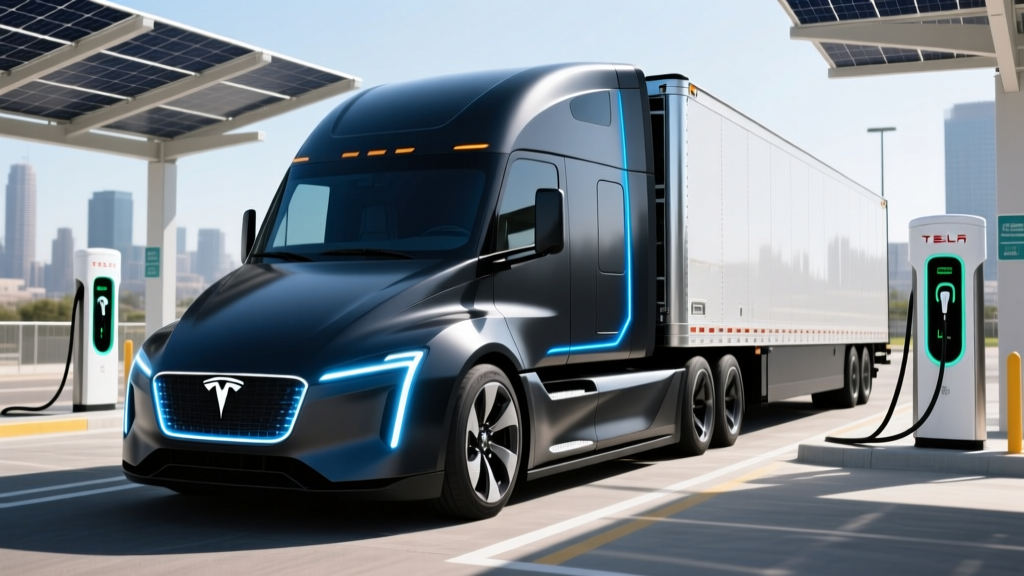
The Tesla Semi has been in limited production since late 2022, but the 2026 Tesla Semi design update marks the first significant refresh since PepsiCo received its first units. The changes are less about sheet metal and more about thermal management, aerodynamic refinement, and the rollout of Tesla's Megacharger network — the 1.2 MW DC infrastructure required to make a ~900 kWh battery practical for regional and long-haul trucking.
As of early 2026, the Semi remains available only to fleet operators and commercial buyers — not individual consumers. Production is still scaling at the Nevada Gigafactory, and order backlogs stretch into 2027. Here is everything we know from Tesla's latest filings, fleet operator reports, and Tesla's official Semi page.
Spec Table: 2026 Tesla Semi at a Glance
| Specification | 300-Mile Variant | 500-Mile Variant |
|---|---|---|
| EPA Estimated Range | 300 mi (loaded) | 500 mi (loaded) |
| Battery Capacity (usable, est.) | ~560 kWh | ~900 kWh |
| Battery Chemistry | NMC (nickel manganese cobalt) | NMC |
| Max DC Fast Charge | 1.2 MW (Megacharger) | 1.2 MW (Megacharger) |
| 10–80% Charge Time (est.) | ~35 min | ~40 min |
| Drivetrain | Tri-motor AWD | Tri-motor AWD |
| Horsepower (peak combined) | ~1,000+ hp | ~1,000+ hp |
| 0–60 mph (loaded, 80k lb GCW) | ~20 sec | ~20 sec |
| 0–60 mph (unloaded) | ~5 sec | ~5 sec |
| Energy Consumption (loaded) | <2 kWh/mi | <2 kWh/mi |
| Base MSRP | $150,000 | $180,000 |
| Reservation Fee | $25,000 (refundable) | |
| Warranty (battery/drivetrain) | Confirmed details TBD; fleet contracts vary | |
Note: Tesla has not published official EPA range certificates for the Semi as of this writing. The figures above reflect Tesla's claimed range at 82,000 lb GCW. Fleet operator data from PepsiCo and others suggests real-world results are close to these claims under favorable conditions.
Design and Aerodynamic Updates for 2026
The 2026 Tesla Semi design update introduces several visible and under-skin changes aimed at improving highway efficiency and serviceability:
- Revised front fascia: A slightly reshaped bumper and chin spoiler reduce drag coefficient, which Tesla claims improves highway range by approximately 2–3% at 65 mph.
- Updated side skirts and rear fender fairings: Tighter panel gaps and new composite side skirts channel airflow around the drive wheels, addressing a known turbulence zone on Class 8 tractors.
- Thermal management revision: The 2026 Semi adopts a heat pump system derived from the Cybertruck's architecture, improving cabin heating efficiency in cold weather and reducing the range penalty of winter operation.
- Megacharging port relocation: The CCS-compatible Megacharger port has been repositioned to the driver's side for better alignment with new Tesla Megacharger pull-through stalls designed for 53-foot trailers.
- Interior updates: The dual touchscreen layout remains, but the 2026 model adds a revised steering column, improved seat bolstering for long-haul comfort, and updated software with fleet telematics integration.
The Semi's centrally mounted driving position — a signature design choice — remains unchanged. This gives the driver a panoramic forward view and eliminates the traditional hood-side blind spot, though it does require adaptation for drivers accustomed to left-hand-drive Class 8 conventionals.
Range, Efficiency, and Real-World Expectations
EPA Claimed Range (500-mi variant): 500 miles at 82,000 lb GCW
Real-World Highway (65–70 mph, flat terrain, 60°F): ~430–470 miles
Cold Weather (below 30°F, loaded): ~350–400 miles
Mountainous/High-Grade Routes: Expect 20–30% range reduction on sustained climbs; regenerative braking recovers significant energy on descents.
Tesla's claim of under 2 kWh per mile is the efficiency benchmark for Class 8 electric trucks. For context, the Freightliner eCascadia achieves roughly 2.0–2.2 kWh/mi in fleet testing, while diesel equivalents consume the energy equivalent of ~6–7 kWh/mi.
The 2026 heat pump addition is the most impactful real-world update. Early fleet operators reported 25–35% range loss in sub-freezing temperatures on 2023–2024 Semis, primarily due to resistive cabin heating. The heat pump should reduce that penalty to 15–20%, bringing cold-weather range closer to 400 miles for the 500-mile variant.
One factor fleet planners must account for: battery degradation. Tesla has not published an official degradation curve for the Semi, but NMC chemistry in high-cycle commercial use typically retains 85–90% capacity after 3,000 charge cycles. At 500 miles per cycle, that translates to roughly 1.5 million miles before hitting 80% state of health — aligning with Tesla's claim that the Semi drivetrain is designed for a million-mile service life.
Charging: Megacharger Network and Depot Charging
Charging a ~900 kWh battery is fundamentally different from charging a passenger EV. The 2026 Tesla Semi design update coincides with Tesla's expansion of its Megacharger network — purpose-built stations delivering up to 1.2 MW of DC power per stall.
| Charging Method | Power Level | Estimated Time (10–80%) | Notes |
|---|---|---|---|
| Tesla Megacharger (DC) | Up to 1,200 kW (1.2 MW) | ~35–40 min (500-mi variant) | Requires Megacharger-equipped route; pull-through stalls for trailers |
| CCS2 DC Fast Charge | Up to 350 kW (adapter) | ~2.5–3 hours | Compatible with Electrify America and third-party networks; slow for this battery size |
| Depot Level 2 (AC) | ~40–80 kW per vehicle | 8–12 hours (overnight) | Requires dedicated depot infrastructure; typical for daily return-to-base fleets |
The 1.2 MW charge rate is the Semi's defining advantage. At peak power, the truck adds roughly 10–12 miles of range per minute of charging. However, as with all EVs, the charge curve tapers significantly above 80% state of charge. Fleet operators optimizing for turnaround time typically charge from 10–80% and dispatch, rather than topping off to 100%.
Depot charging remains the backbone of most Semi operations. A fleet depot with 10 Semis charging overnight at 80 kW each requires approximately 800 kW of dedicated electrical capacity — roughly equivalent to a small neighborhood's peak load. Utilities typically require 6–12 months of lead time for transformer upgrades and service connections at this scale.
Performance and Drivetrain
The Semi's tri-motor all-wheel-drive layout — one motor on the steer axle and two on the drive axle — delivers over 1,000 peak horsepower. The 2026 update carries over this powertrain without major changes, as the original design already outperformed every diesel Class 8 tractor on the market in acceleration and grade-holding ability.
With a full 80,000-pound gross combination weight, the Semi hits 60 mph in approximately 20 seconds — compared to 45–60 seconds for a comparably loaded diesel truck. Unloaded, the Semi rockets to 60 in about 5 seconds, which is sports-car territory for a vehicle with a curb weight exceeding 20,000 pounds.
The three independent motors also provide redundancy: if one motor fails, the remaining two can still move the truck at highway speeds, reducing the risk of a roadside breakdown. Tesla's regenerative braking system is aggressive enough to enable near-one-pedal driving in stop-and-go distribution routes, significantly reducing brake wear — a major operating cost for diesel fleets.
Pricing, Tax Credits, and Ownership Economics
The Tesla Semi is priced at two tiers based on range:
| Variant | Base MSRP | Federal §30D / 45W Credit | Estimated Net Cost |
|---|---|---|---|
| 300-Mile Range | $150,000 | Up to $40,000 (§45W commercial clean vehicle credit) | ~$110,000 |
| 500-Mile Range | $180,000 | Up to $40,000 (§45W commercial clean vehicle credit) | ~$140,000 |
Tax credit clarification: The Semi does not qualify for the consumer §30D credit (which caps at $7,500 and applies to vehicles under 14,000 lb GVWR). Instead, commercial fleets access the IRS §45W Commercial Clean Vehicle Credit, which provides up to $40,000 for qualifying vehicles over 14,000 lb GVWR. Eligibility depends on battery sourcing requirements, MSRP thresholds, and the purchasing entity's tax status. Consult a tax professional — these rules are subject to change and vary by fleet structure.
Beyond the sticker price, the Semi's total cost of ownership (TCO) advantage comes from fuel and maintenance savings. At $0.12/kWh (commercial depot rate) and 2 kWh/mi, electricity costs roughly $0.24/mile. A comparable diesel at 6.5 mpg and $4.00/gallon costs ~$0.62/mile. Over 100,000 miles annually, that is approximately $38,000 in annual fuel savings per truck. Brake maintenance savings add another $3,000–5,000 per year due to regenerative braking.
Tech, Safety, and Driver Assistance
The 2026 Semi carries Tesla's latest commercial software stack, which includes:
- Enhanced Autopilot (standard): Adaptive cruise control, lane centering, automatic emergency braking, and blind-spot monitoring. This is an SAE Level 2 driver-assistance system — the driver must remain fully engaged and responsible at all times.
- Fleet telematics dashboard: Real-time vehicle tracking, energy consumption analytics, driver behavior scoring, and remote diagnostics accessible via Tesla's fleet management portal.
- Dual 15-inch touchscreens: Left screen handles navigation, media, and vehicle settings; right screen displays fleet management tools, cargo manifests, and camera feeds.
- 360-degree camera system: Eight exterior cameras provide surround-view and recording capability, replacing traditional mirrors with camera-based displays (where permitted by FMCSA regulations).
- Over-the-air updates: Tesla continues to push firmware updates that improve efficiency, add features, and refine thermal management — a capability no legacy Class 8 OEM currently matches at this frequency.
Tesla's Autopilot and any future "FSD for Commercial" feature on the Semi remain SAE Level 2 systems. They do not make the Semi autonomous. The driver must keep hands on the wheel, eyes on the road, and assume full liability. No Level 4 driverless trucking is available or approved for the Semi as of 2026.
How It Compares to Class 8 Electric Competitors
| Spec | Tesla Semi (500 mi) | Freightliner eCascadia | Volvo VNR Electric |
|---|---|---|---|
| Range (loaded) | 500 mi | 230 mi | 275 mi |
| Battery (usable) | ~900 kWh | ~438 kWh | ~565 kWh |
| Max DC Charge | 1,200 kW | ~250 kW | ~250 kW |
| 10–80% Time | ~40 min | ~90 min | ~90 min |
| Horsepower | ~1,000+ | ~470 | ~455 |
| Base Price (est.) | $180,000 | ~$260,000 | ~$250,000 |
The Semi's range and charging speed advantage is substantial, but availability remains the limiting factor. Freightliner and Volvo have established dealer and service networks across North America; Tesla's commercial service infrastructure is still building out. Fleet operators in regions without Megacharger coverage or Tesla service centers may find the eCascadia or VNR Electric more practical today, despite the range gap.
Pros and Cons
- 500-mile range leads Class 8 electric trucks by a wide margin
- 1.2 MW Megacharging enables 10–80% in ~40 minutes
- Tri-motor AWD with 1,000+ hp and 20-second loaded 0–60
- Significantly lower per-mile energy cost vs diesel (~$0.24 vs $0.62)
- OTA updates and fleet telematics integration
- Central driving position with panoramic visibility
- Regenerative braking drastically reduces brake wear
- Production volume still limited; order backlog extends into 2027
- Megacharger network coverage is sparse outside key freight corridors
- Tesla's commercial service network is not yet nationwide
- ~900 kWh battery adds significant weight, reducing payload capacity
- Central driving position requires driver retraining
- No published battery warranty details for commercial use
- Depot charging requires major electrical infrastructure investment
Who Should Buy the 2026 Tesla Semi?
- Regional fleet operators running 300–500-mile daily loops with depot return (e.g., distribution, drayage, dedicated lane freight)
- Fleets with access to Megacharger corridors or the ability to install depot-level charging infrastructure
- Operators prioritizing per-mile cost reduction over upfront price — the TCO math strongly favors the Semi for high-mileage routes
- Companies with sustainability mandates seeking to decarbonize heavy freight operations
- Long-haul irregular-route carriers without predictable charging access
- Small owner-operators who lack depot infrastructure and fleet-scale electricity procurement
- Fleets in regions with no Tesla commercial service presence
Frequently Asked Questions
What is the real-world range of the Tesla Semi?
Tesla claims 500 miles at 82,000 lb GCW for the long-range variant. Fleet operators report real-world highway range of approximately 430–470 miles under favorable conditions (60–70°F, flat terrain, 65 mph cruise). Cold weather below 30°F reduces this to roughly 350–400 miles, though the 2026 heat pump update should narrow that gap.
How fast does the Tesla Semi charge?
On a Tesla Megacharger at 1.2 MW, the 500-mile variant charges from 10–80% in approximately 40 minutes. On a standard 350 kW CCS2 charger, expect 2.5–3 hours. Depot AC charging at 40–80 kW takes 8–12 hours overnight.
Does the Tesla Semi qualify for a federal tax credit?
Not the consumer §30D credit. The Semi qualifies for the IRS §45W Commercial Clean Vehicle Credit, which provides up to $40,000 for vehicles over 14,000 lb GVWR. Eligibility depends on battery component sourcing, the purchasing entity's tax situation, and current IRS guidance. Always consult a tax professional before relying on credit projections.
Is the Tesla Semi worth buying vs the Freightliner eCascadia?
On paper, the Semi dominates in range (500 vs 230 mi), charging speed (1.2 MW vs 250 kW), and performance. However, Freightliner's established dealer and service network makes the eCascadia a more practical choice for fleets without Tesla Megacharger access or those in regions where Tesla commercial service is unavailable. If your routes align with Tesla's charging infrastructure, the Semi's TCO advantage is compelling.
What battery chemistry does the Tesla Semi use?
Tesla has not officially confirmed the Semi's cell chemistry, but industry analysis and supply chain reporting indicate NMC (nickel manganese cobalt) cells, likely sourced from Panasonic's Nevada Gigafactory lines. NMC offers the energy density required for a 500-mile range in a Class 8 package, though it is more expensive and has a lower cycle life than LFP chemistry.
Can an individual buy a Tesla Semi?
As of 2026, Tesla prioritizes fleet and commercial orders. Individual purchases are theoretically possible but not the production priority. The Semi requires commercial insurance, CDL licensing, and depot-scale charging infrastructure — making it impractical for non-commercial buyers.