Quick Answer: Which Electric BMW Should You Buy?
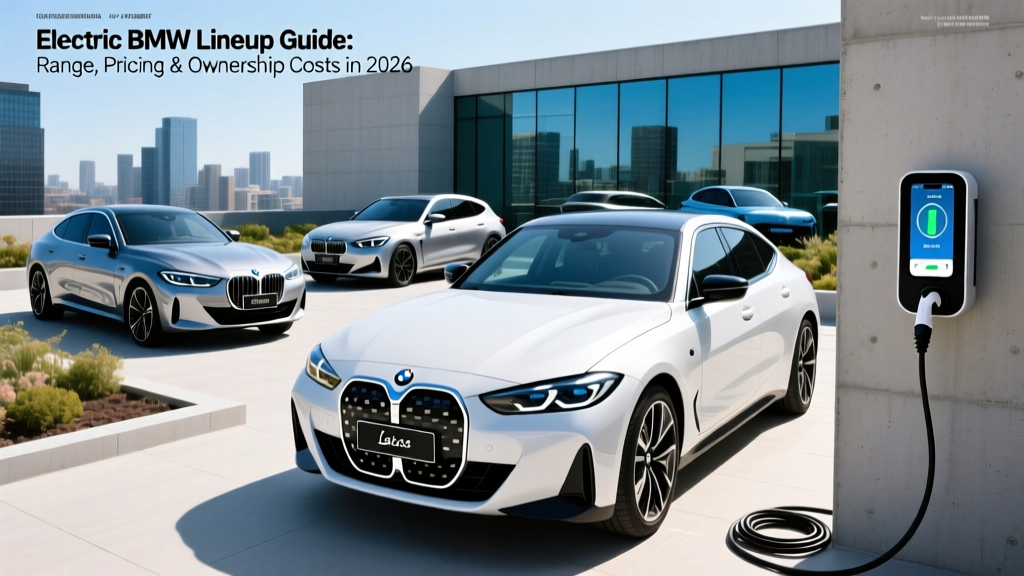
If you're shopping for an electric BMW in 2026, the lineup spans four core models from $52,000 to over $120,000. The BMW i4 eDrive40 (~$52,600, EPA 307 mi) is the best entry point and the most likely to qualify for partial federal tax credits. The i5 eDrive40 (~$67,100, EPA 295 mi) suits executive-sedan buyers. The iX xDrive50 (~$87,250, EPA 324 mi) is the family SUV flagship. None of BMW's current EVs reliably qualify for the full $7,500 §30D federal credit due to battery-sourcing and MSRP-cap rules — always verify eligibility on the IRS Clean Vehicle Credit page before purchasing.
The 2026 Electric BMW Lineup at a Glance
BMW's EV strategy centers on flexible CLAR-platform vehicles that share architecture with their gas counterparts. That means an i4 drives like a 4 Series Gran Coupe, an i5 mirrors the 5 Series, and the iX is a dedicated electric SUV. Here's how the core models stack up on paper and in practice.
| Model | Drivetrain | Battery (usable kWh) | EPA Range | Peak DC Charge | 10–80% DCFC | 0–60 mph | HP | Base MSRP |
|---|---|---|---|---|---|---|---|---|
| i4 eDrive40 | RWD | 81.5 kWh (NMC) | 307 mi | 205 kW | ~31 min | 5.5 s | 335 | $52,600 |
| i4 M50 | AWD | 81.5 kWh (NMC) | 271 mi | 205 kW | ~31 min | 3.7 s | 536 | $67,300 |
| i5 eDrive40 | RWD | 81.2 kWh (NMC) | 295 mi | 205 kW | ~31 min | 5.7 s | 335 | $67,100 |
| i5 M60 | AWD | 81.2 kWh (NMC) | 256 mi | 205 kW | ~31 min | 3.7 s | 593 | $84,100 |
| iX xDrive50 | AWD | 111.5 kWh (NMC) | 324 mi | 200 kW | ~35 min | 4.4 s | 516 | $87,250 |
| i7 eDrive50 | RWD | 101.7 kWh (NMC) | 318 mi | 195 kW | ~34 min | 4.5 s | 449 | $105,700 |
Real-World Range Reality: EPA estimates assume mixed driving at moderate temperatures. Expect highway-only range to drop 10–15% below sticker (e.g., an i4 eDrive40 at 75 mph delivers ~260–275 miles). In sub-30°F winter conditions, plan for 20–30% range loss unless you precondition the battery and use a heat pump (standard on iX and i7, optional on i4/i5). BMW's NMC chemistry delivers strong energy density but is more cold-sensitive than LFP alternatives used by some competitors.
Electric BMW vs. Gas BMW: Real Cost Comparison
The purchase price of an electric BMW is higher than its gas equivalent, but operating costs tell a different story. Below is a 5-year comparison of the i4 eDrive40 versus a comparably equipped 430i Gran Coupe, assuming 12,000 miles/year, $0.16/kWh home charging, $3.60/gallon premium, and 70% home / 30% public DC charging.
| Cost Factor (5 Years) | BMW i4 eDrive40 | BMW 430i Gran Coupe | Difference |
|---|---|---|---|
| Purchase Price (MSRP) | $52,600 | $49,700 | +$2,900 EV |
| Estimated Federal Tax Credit | $0–$3,750* | $0 | –$3,750 EV |
| Fuel/Energy Cost | $4,610 | $9,720 | –$5,110 EV |
| Maintenance (5 yr est.) | $2,100 | $4,800 | –$2,700 EV |
| Insurance (5 yr est.) | $11,400 | $9,900 | +$1,500 EV |
| Depreciation (est.) | $23,100 | $19,400 | +$3,700 EV |
| Net 5-Year Cost | $70,860 | $74,120 | –$3,260 EV |
*Tax credit eligibility for BMW EVs varies by model year, battery-sourcing compliance, and buyer income. The i4 eDrive40 falls under the $55,000 sedan MSRP cap for §30D; the i5, iX, and i7 exceed MSRP caps for sedans ($55K) and SUVs ($80K) in most trims. Always verify at IRS.gov Clean Vehicle Credits.
The i4 wins on fuel and maintenance savings — no oil changes, fewer brake replacements thanks to regenerative braking, and roughly $0.05/mile energy cost versus $0.15/mile on premium gasoline. However, EV insurance premiums run 10–20% higher on average, and depreciation on luxury EVs remains steeper than gas equivalents, though the gap has narrowed since 2024.
Charging an Electric BMW: Home and Public
Every current electric BMW uses the CCS1 connector for DC fast charging and J1772 for Level 2 AC. BMW has announced NACS adoption for future models, but 2026 models ship with CCS. Tesla Supercharger access requires a CCS-to-NACS adapter (BMW does not include one standard; third-party adapters cost $150–$250).
| Charging Level | Power | Miles Added per Hour | Typical Use Case | Cost |
|---|---|---|---|---|
| Level 1 (120V) | 1.4 kW | ~4–5 mi/hr | Overnight trickle / emergency | $0.03–0.05/mi |
| Level 2 (240V, 48A) | 11.5 kW | ~35–40 mi/hr | Home daily charging | $0.04–0.06/mi |
| DC Fast Charge | Up to 205 kW | ~180 mi in 10 min (peak) | Road trips | $0.10–0.18/mi |
Home charging setup: A Level 2 home charger (BMW Wallbox or third-party like ChargePoint Home Flex) costs $500–$700 for equipment. Professional installation by a licensed electrician runs $600–$2,000 depending on panel capacity and run length. If your home has a 200-amp panel with spare capacity, expect the lower end. A panel upgrade to 200A adds $1,500–$3,000.
Charging curve reality: BMW's peak 205 kW rate holds from roughly 10–35% State of Charge, then tapers progressively. From 35–60%, expect ~150 kW; from 60–80%, ~90 kW. The published 10–80% time of ~31 minutes reflects this taper. If you're road-tripping, plan stops at 15–20% SoC to maximize time in the peak-charging window rather than charging past 80%.
Tax Credits, Incentives, and the MSRP Cap Problem
This is where many BMW EV buyers face disappointment. The federal §30D Clean Vehicle Credit offers up to $7,500, but eligibility hinges on three filters that eliminate most of BMW's electric lineup:
- MSRP Cap: Sedans must be under $55,000; SUVs/pickups/vans under $80,000. Only the i4 eDrive40 base trim qualifies on price.
- Buyer Income Cap: Modified AGI must not exceed $150K (single), $225K (head of household), or $300K (joint).
- Battery Sourcing: Critical minerals and battery components must meet escalating annual thresholds for North American or FTA-partner sourcing. BMW's supply chain has improved but partial compliance may yield $3,750 instead of $7,500.
- Point-of-Sale Transfer: Eligible buyers can apply the credit as a down-payment reduction at the dealer, lowering out-of-pocket cost immediately.
State incentives vary widely. California's CVRP, Colorado's innovative motor vehicle credit, and New York's Drive Clean rebate can add $1,000–$5,000 depending on income and model. Check your state energy office for current programs — these change frequently and often have their own income or price caps.
Decision Framework: Which Electric BMW Fits Your Life?
Choose the BMW i4 eDrive40 if:
- You want the most affordable entry into an electric BMW (under $55K MSRP)
- Your daily commute is under 60 miles round-trip and you can charge at home
- You want the best chance at partial federal tax credit eligibility
- You prefer a sporty liftback with decent cargo flexibility (16.6 cu ft hatchback)
Choose the BMW i5 eDrive40 if:
- You need a true executive sedan with rear-seat comfort and premium features
- Budget is $65K–$75K and you accept no federal tax credit
- You value Highway Assistant (hands-off, eyes-on Level 2 driving up to 85 mph) on compatible highways
Choose the BMW iX xDrive50 if:
- You need an SUV with family cargo space (35.5 cu ft rear, 77.9 cu ft folded)
- You tow occasionally (3,500 lb capacity)
- You want the longest real-world range in the lineup and standard heat pump for cold climates
- Budget exceeds $85K and you'll rely on state incentives rather than federal credits
Skip the electric BMW lineup if:
- You lack reliable home or workplace charging and your area has sparse DC fast-charging infrastructure
- You regularly drive 300+ miles in sub-freezing weather between charge stops
- You want a vehicle that qualifies for the full $7,500 federal credit — consider a Tesla Model Y, Ford F-150 Lightning, or Chevrolet Equinox EV instead
Common Misconceptions About Electric BMWs
| Myth | Fact |
|---|---|
| "BMW EVs are just compliance cars with no soul" | The i4 M50 delivers 536 hp and a 3.7-second 0–60 with torque-vectoring AWD. BMW tuned these for driving dynamics, not just efficiency. Regenerative braking is adjustable, and adaptive M suspension is available. |
| "The battery will need replacing in 5 years" | BMW warranties the high-voltage battery for 8 years/100,000 miles against degradation below 70% of original capacity. Real-world data from 2022–2024 i4 and iX owners shows ~5–7% degradation at 60,000 miles — well within warranty tolerance. Replacement cost, if ever needed out of warranty, runs $15,000–$22,000 depending on model. |
| "I can charge at any Tesla Supercharger" | Not without an adapter. BMW's 2026 EVs use CCS1. Tesla's Supercharger network is opening to non-Tesla vehicles via the NACS standard, but you'll need a CCS-to-NACS adapter and must use stations equipped with the Magic Dock or designated non-Tesla chargers. |
| "Electric BMWs qualify for the $7,500 tax credit" | Most don't. The MSRP cap eliminates the i5, iX, and i7 entirely. The i4 eDrive40 may qualify for $3,750 or $7,500 depending on battery-sourcing compliance for the specific model year. Always check the fueleconomy.gov tax credit lookup for the exact VIN configuration. |
Ownership Realities: What First-Time EV Buyers Should Know
If you're transitioning from a gas BMW to an electric BMW, plan for these practical adjustments:
Home charging is essential. Public-only charging is viable but costs 2–3× more per mile and adds 20–40 minutes per session to your week. If you can't install a Level 2 charger at home or access one at work, an electric BMW may not fit your lifestyle yet. Confirm your parking situation (garage, driveway, or street) before committing.
Preconditioning matters. Use the BMW app to precondition the battery while plugged in before a DC fast-charge stop. This warms the NMC cells to optimal temperature and can shave 5–8 minutes off your charge session. In winter, preconditioning the cabin while plugged in preserves 15–20 miles of range that would otherwise go to resistive heating.
Tire costs are higher. EVs are heavier (the iX xDrive50 weighs 5,660 lbs) and deliver instant torque. Expect tire replacement every 25,000–35,000 miles rather than 40,000–50,000 on a gas equivalent. Budget $1,200–$1,800 for a set of EV-rated tires (look for low rolling resistance with high load index).
Maintenance is simpler but not zero. You'll skip oil changes, spark plugs, and transmission fluid. You'll still need cabin air filters ($100–$150/yr), brake fluid flushes (every 2 years), windshield washer fluid, and wiper blades. Brake pads last 80,000+ miles thanks to regen, but rotors may need attention if they corrode from lack of friction-brake use.
Frequently Asked Questions
Does BMW make a fully electric SUV under $80,000?
The BMW iX xDrive50 starts at $87,250, which exceeds the $80,000 federal tax credit MSRP cap for SUVs. BMW does not currently offer a compact electric SUV (an iX1 is sold in Europe but not the US). If you need an electric luxury SUV under $80K with tax-credit eligibility, look at the Tesla Model Y or the Cadillac Lyriq.
How long does it take to charge a BMW i4 at home overnight?
From 10% to 100% on a Level 2 home charger (11.5 kW), the i4's 81.5 kWh battery takes approximately 7.5–8 hours. Most owners plug in at 30–40% remaining and wake up fully charged in 4–5 hours. A standard 120V outlet (Level 1) adds only ~25 miles overnight — not enough for high-mileage drivers.
Is BMW's Highway Assistant truly hands-free driving?
No. BMW's Highway Assistant is a SAE Level 2 driver-assistance system. It allows hands-off driving on divided highways at speeds up to 85 mph, but the driver must keep their eyes on the road (monitored by a driver-facing camera). It is not autonomous driving. You remain legally responsible for the vehicle at all times. Only Level 4 systems like Waymo operate without driver supervision, and those are limited to specific geofenced areas.
What happens if the battery degrades significantly?
BMW's high-voltage battery warranty covers capacity loss below 70% of original for 8 years or 100,000 miles. If your battery falls below that threshold, BMW will repair or replace modules to bring capacity above 70%. Full pack replacement outside warranty costs $15,000–$22,000, but industry data shows most NMC packs retain 85–90% capacity at 100,000 miles with normal use.
Can I road-trip an electric BMW cross-country?
Yes, but plan carefully. The iX xDrive50 (324 mi EPA) can handle 200–220 mile highway legs between DC fast-charge stops. Electrify America and EVgo networks cover major interstates, but reliability varies — expect 10–15% of chargers to be offline or slow. Use A Better Routeplanner (ABRP) or the BMW navigation's built-in route planner to pre-map stops, and never plan to arrive at a charger below 10% SoC in remote areas.